iGeo 2014, Писмен тест — F. Section F · Globalisation and Transnational Corporations (TNCs)
11th International Geography Olympiad · Written Response Test · 12 август 2014 г. · 15 т.
Внимание: Бележка към темата
The original resource PDF omits the D2 boat-school photograph and explicitly withholds the E3 malaria map from public display; the official key supplies no E3 answer. Literal native table, wording, examiner/report label and exemplar/key disagreements are retained in their attributed source scopes.
Instructions for the Students
Instructions for the Students
Fill in your name, team and iGeo student number on the front page of this Question and Answer Booklet.
Fill in your iGeo student number in the boxes on top of the pages in this Booklet.
This test consists of 6 Sections.
The maximum total mark is 90. The mark for each question is given in the margin at the beginning of the question. There are a maximum of 15 marks for each Section.
Answer all questions in the spaces provided in this Booklet.
Check the backs of pages as questions are printed on both sides of a page.
Give only the required number of answers (reasons, examples, etc.). For instance, if the question asks for 2 reasons and you give more than 2, only the first 2 reasons will be marked.
The Resource Booklet contains Sources referred to in this Booklet.
You may use a calculator during the test.
Time: 180 minutes for students not educated in English,
150 minutes for students educated in English.
- Students not educated in English are allowed to use bilingual dictionaries during the test.
Good luck!
Instructions for the Markers
Instructions for the Markers
Check if the iGeo Student Numbers are on each sheet before dividing up the paper.
This test consists of 6 Sections.
One whole Section per marker and double-checker.
Check whether the answer continues outside the designated area. No credits will be given to answers in the Resource Booklet.
The maximum total mark is 90. The mark for each question is given at the beginning of the question. There are a maximum of 15 marks for each Section.
Get the hang of the full range of answers by reading through a few papers with your co-marker before you start your marking.
These answers are not exhaustive. Credit any relevant answer.
Mark only the required number of answers (reasons, examples, etc.). For instance, if the question asks for 2 reasons and there is more than 2, only the first 2 reasons should be marked.
Put your mark next to the question number in the column on the left – it eases the work of the person who has to put the numbers into MS Excel. Total the marks by the title of the Section.
The Moderators (Sue and Anu) will sample the marking of all teams.
Условие
Section F: Globalisation and Transnational Corporations (TNCs). Maximum 15 marks.
Question 1 (1 т.)
1 What is globalisation? [1 т.]
Question 2 (3 т.)
2 Give 3 factors that have influenced the process of globalisation.
Factor 1: ______
Factor 2: ______
Factor 3: ______ [3 т.]
Question 3 (4 т.)
3 Study Table F1 below: Examples of adaptations by Transnational Corporations (TNCs).
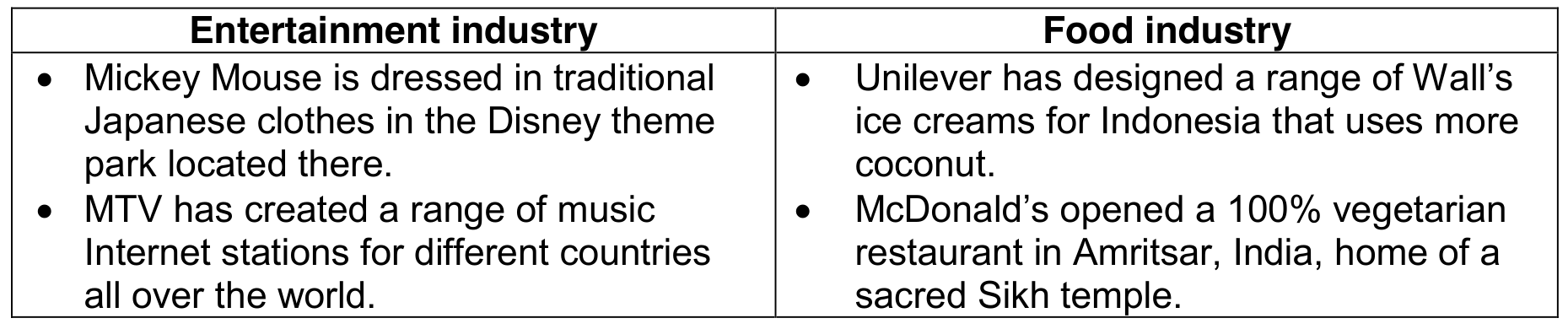
| Entertainment industry | Food industry |
|---|---|
| Mickey Mouse is dressed in traditional Japanese clothes in the Disney theme park located there. | Unilever has designed a range of Wall’s ice creams for Indonesia that uses more coconut. |
| MTV has created a range of music Internet stations for different countries all over the world. | McDonald’s opened a 100% vegetarian restaurant in Amritsar, India, home of a sacred Sikh temple. |
Explain, giving 2 reasons why transnational corporations (TNCs) adapt their products for different markets.
Reason 1: ______
Reason 2: ______ [4 т.]
Question 4 (3 т.)
4 Study Resource Booklet Figure F1: Distribution of the McDonald’s Restaurants, 1940–2007. Describe and suggest reasons for the global spread of McDonald’s Restaurants since 1940.
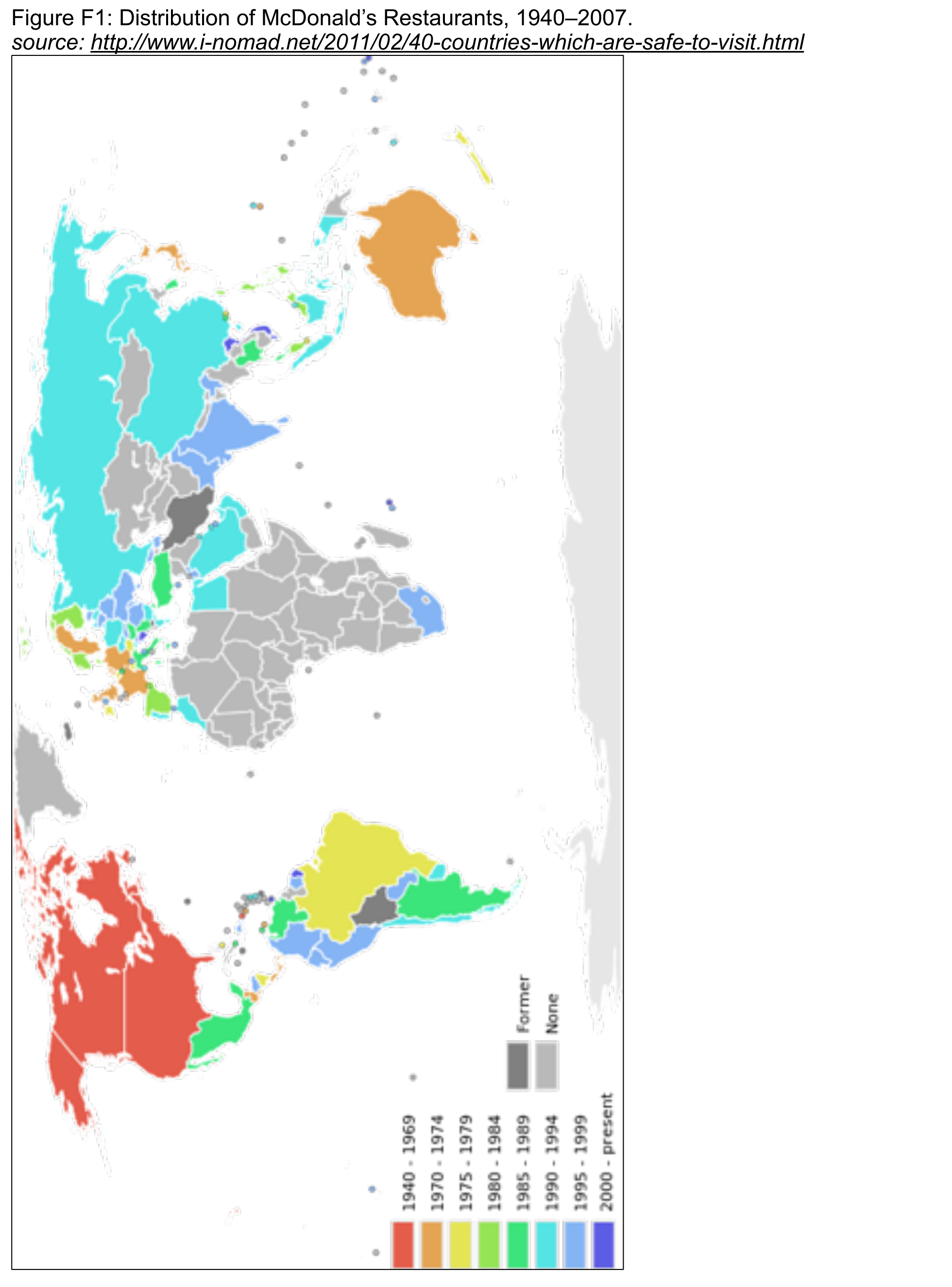
[3 т.]
Question 5 (4 т.)
5 Describe and explain why some groups of people gain from the growth of TNCs in the host countries while others lose out. [4 т.]
The native booklet prints “end ■”.
Решение
Official Marking Scheme · Section F.
Question 1 (1 т.)
Answer: 1m 1m – The process by which the world is becoming more interconnected (as a result of increased trade and communications).
Question 2 (3 т.)
Answer: 3m
■ Improved transport (air travel, etc.).
■ Improved communications (Internet and mobile technology)
■ Labour availability and skills (e.g. cheap labour in India).
■ Freedom of trade which removes barriers between countries.
■ increase in tourism and migration
Question 3 (4 т.)
Answer: 4m 1 mark for each different explanation and 1 mark for each extension that supports that explanation. Answers should focus on explanations of TNC product adaptation:
■ Profitability – these are sales strategies;
■ Culture – some items not wanted/liked/to taste;
■ Religious objections;
■ Youthful product no yet mass marketed, trials;
■ Affluence – not all can afford all products of TNCs;
■ Local availability of parts/ingredients may affect product.
Question 4 (3 т.)
Answer: 3m Clear description of distribution over time
■ 1970-1974 McDonalds spreads to high income countries with the highest HDI (G7 in Europe, Japan, Australia) – English language in communication and trade, high income, working hours and need for fast food restaurants (take out); McDonalds opened restaurants in several countries in Central America who were economically connected to/dependent on USA; they adopted „American“ way of living (in everyday life)
■ 1975-1979 Brasil, Ireland, New Zealand, Switzerland, Austria... new industrial economies, life style as in other high income countries...
■ 1980-1984 Scandinavian countries, Spain – McDonalds spreads to mainly higher income countries, neighbouring those where the restaurants were already present
■ 1984-1989 globalisation processes affect (demographically large) countries such as Argentina, Turkey, Venezuela and Mexico oil reserves (important to USA)
■ 1990-1994 fall of Berlin Wall and “Iron curtain“; transition from socialist to market economies + globalisation process (“American lifestyle“) enters/ spreads to several Eastern European countries, Russia (former USSR) and China (opening to the west) also as demographically large countries; Morocco (tradition/historical reason: Morocco first recognized USA in 1776) and Egypt in Africa (tourist from USA and European countries where McDonalds is already present), Chile (fast growing economy – “Pacific puma“); Arabian Peninsula (oil reserves)
■ 1995-1999 lower income Eastern European countries, India (their participation on world market, english speaking), South Africa (after Apartheid includes in global economy, foreign companies enter on South Africa's market); Peru, Equador and Colombia, Paraguay (involved in APEC – USA interest in economies of these countries; Peru and Colombia are also known as “Pacific pumas“ – alongside Chile and Mexico)
■ from 2000: Vietnam (opens to western economies - in 2001 had one of the highest economic growth rates (7.1 percent) in the world; in October 2001, the U.S. Congress approved the bilateral trade bill with Vietnam – that provided an important new opening for Vietnam to export to the large U.S. market and eventually to join the WTO), Bosnia and Herzegovina (after the war) Level Marking:
• indication of global ie. more than one region plus;
• 1 - something related to a place if just explanation
• 2. either well described or some description with good explanation
• 3 well developed answer with some detail - global spread
Question 5 (4 т.)
Answer: 4m Answer might include some examples which can be credited. Does not need to be in table format.
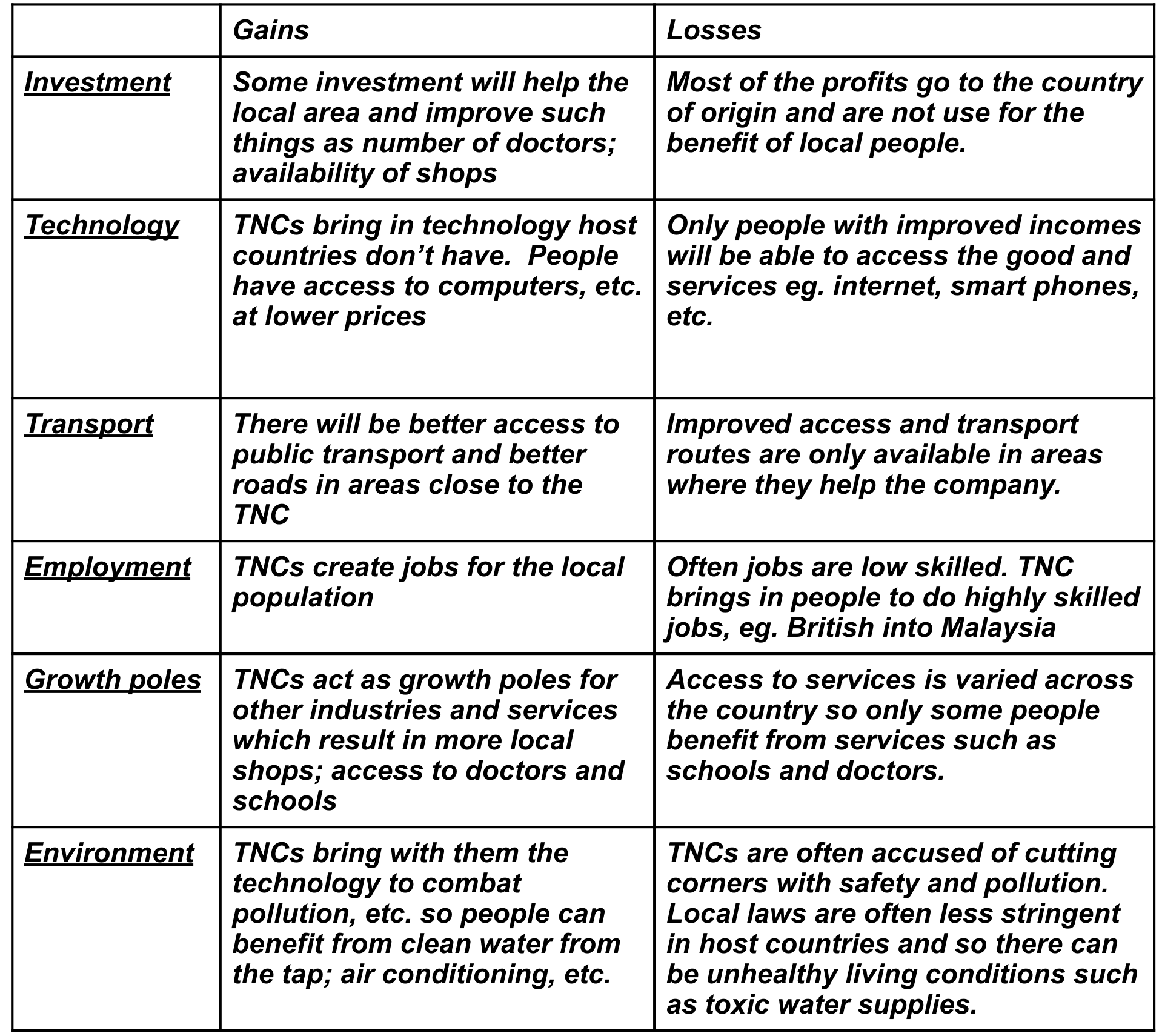
| Gains | Losses | |
|---|---|---|
| Investment | Some investment will help the local area and improve such things as number of doctors; availability of shops | Most of the profits go to the country of origin and are not use for the benefit of local people. |
| Technology | TNCs bring in technology host countries don’t have. People have access to computers, etc. at lower prices | Only people with improved incomes will be able to access the good and services eg. internet, smart phones, etc. |
| Transport | There will be better access to public transport and better roads in areas close to the TNC | Improved access and transport routes are only available in areas where they help the company. |
| Employment | TNCs create jobs for the local population | Often jobs are low skilled. TNC brings in people to do highly skilled jobs, eg. British into Malaysia |
| Growth poles | TNCs act as growth poles for other industries and services which result in more local shops; access to doctors and schools | Access to services is varied across the country so only some people benefit from services such as schools and doctors. |
| Environment | TNCs bring with them the technology to combat pollution, etc. so people can benefit from clean water from the tap; air conditioning, etc. | TNCs are often accused of cutting corners with safety and pollution. Local laws are often less stringent in host countries and so there can be unhealthy living conditions such as toxic water supplies. |
Level marking:
1 - lacks detail, one idea explained 2 - gains or losses but more than one idea (explanation) 3 - gains and losses - one in depth or detail 4 - both gains and losses with more detail and depth
Committee Report · Appendix 1
Committee Report, October 2014 — Appendix 1. This section contains some examples of good answers with comments from the marking teams in speech bubbles. All the exemplar answers are taken from scripts of students who are not educated in English. These source-attributed exemplars retain their native wording, numbering, marks and disagreements with the Marking Scheme.
Committee Report exemplar · F1, scored1/1; complete answer and whole examiner bubble.
Source-attributed student answer and marking-team comment:
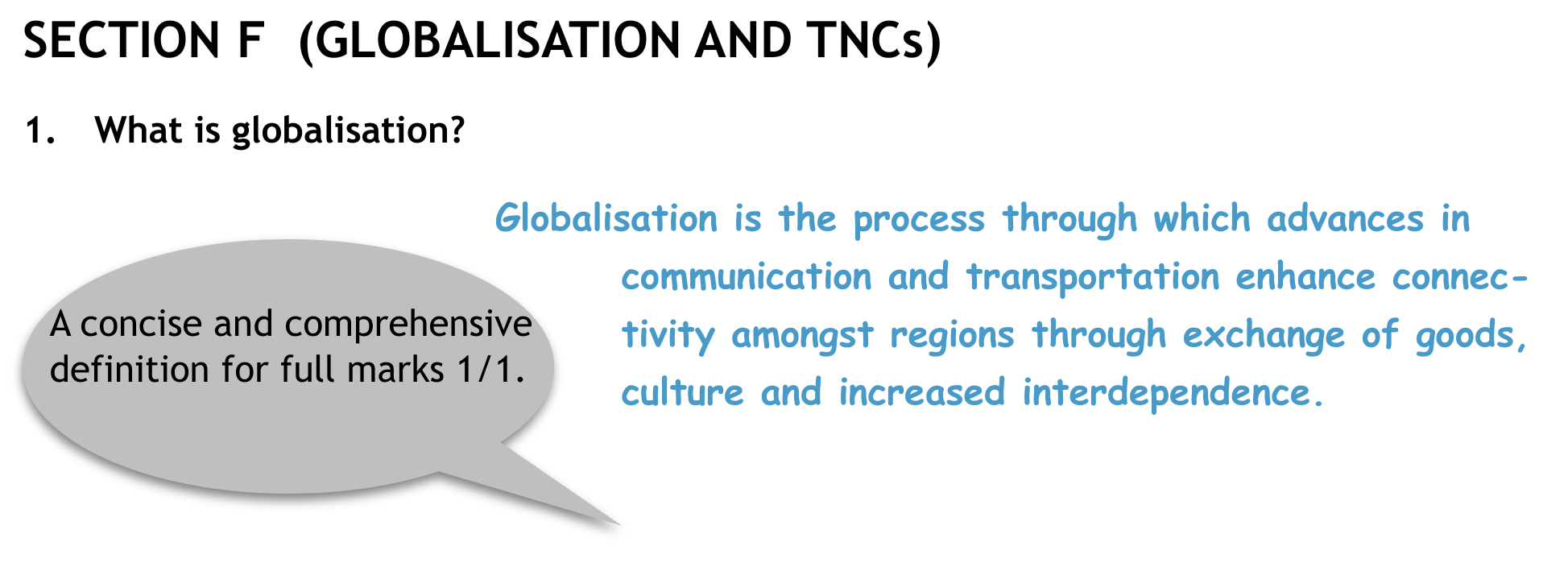
- What is globalisation? Globalisation is the process through which advances in communication and transportation enhance connectivity amongst regions through exchange of goods, culture and increased interdependence.
A concise and comprehensive definition for full marks 1/1.
Committee Report exemplar · TNC adaptation, printed2 in report but3 in booklet/key, scored4/4; both reasons and examiner bubble.
Source-attributed student answer and marking-team comment:
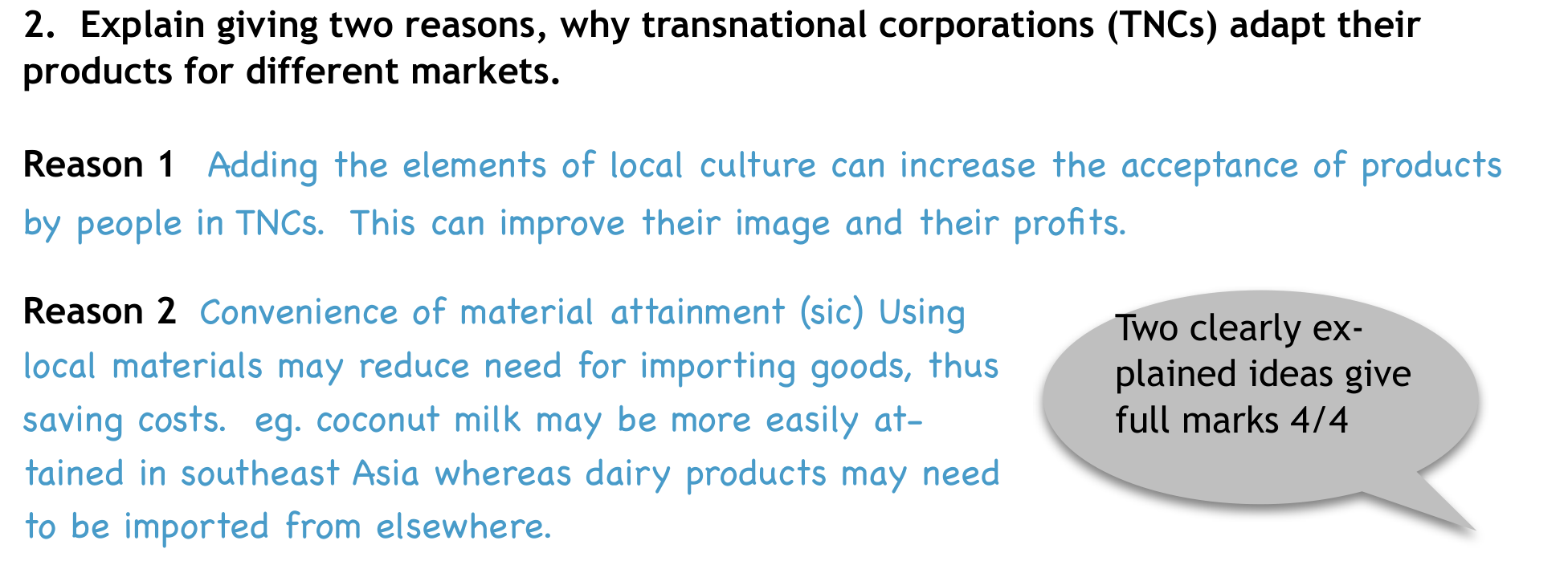
- Explain giving two reasons, why transnational corporations (TNCs) adapt their products for different markets. Reason 1 Adding the elements of local culture can increase the acceptance of products by people in TNCs. This can improve their image and their profits.
Reason 2 Convenience of material attainment (sic) Using local materials may reduce need for importing goods, thus saving costs. eg. coconut milk may be more easily attained in southeast Asia whereas dairy products may need to be imported from elsewhere.
Two clearly explained ideas give full marks 4/4
Committee Report exemplar · F5, scored4/4; whole student answer and complete examiner bubble.
Source-attributed student answer and marking-team comment:
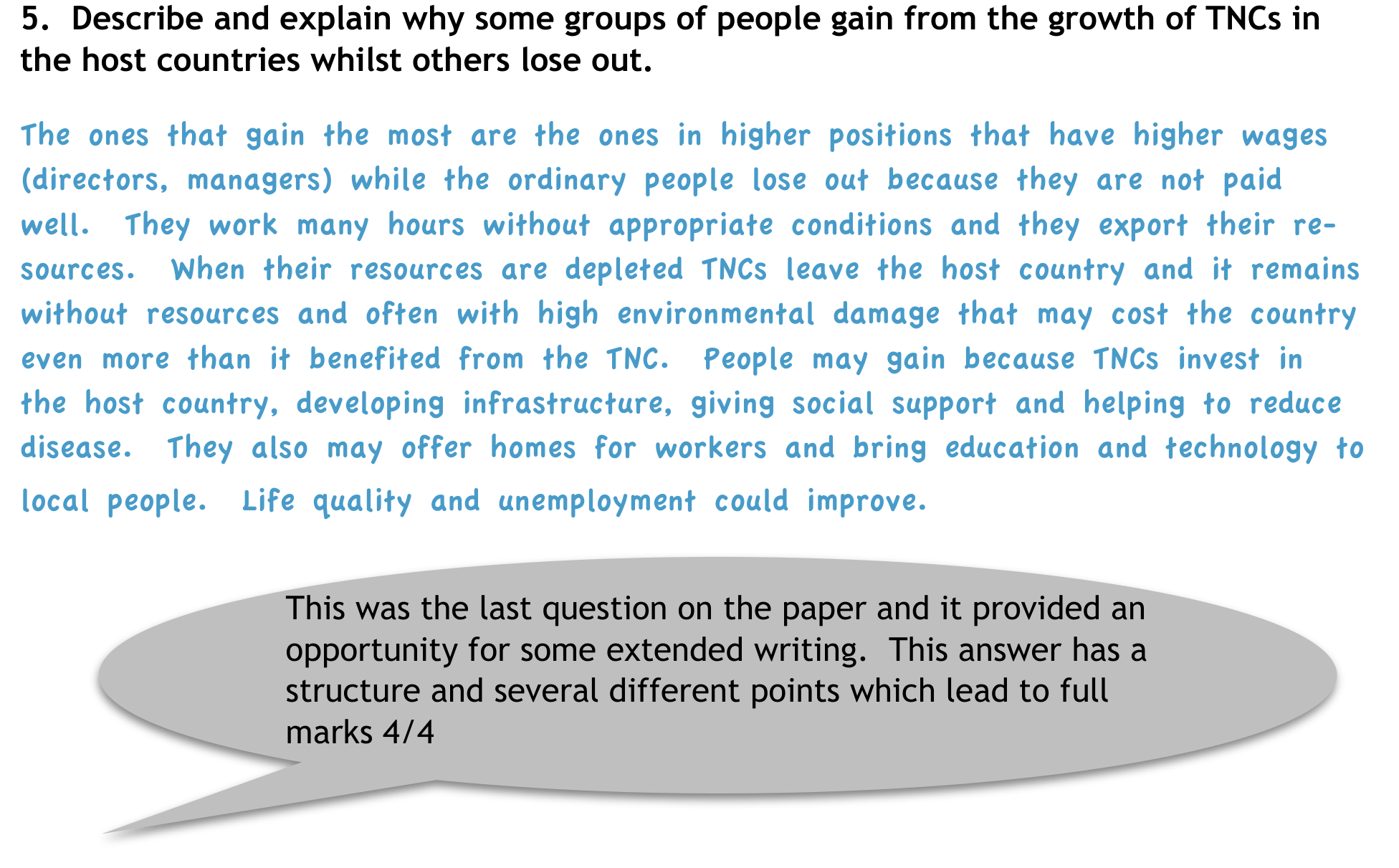
- Describe and explain why some groups of people gain from the growth of TNCs in the host countries whilst others lose out. The ones that gain the most are the ones in higher positions that have higher wages (directors, managers) while the ordinary people lose out because they are not paid well. They work many hours without appropriate conditions and they export their resources. When their resources are depleted TNCs leave the host country and it remains without resources and often with high environmental damage that may cost the country even more than it benefited from the TNC. People may gain because TNCs invest in the host country, developing infrastructure, giving social support and helping to reduce disease. They also may offer homes for workers and bring education and technology to local people. Life quality and unemployment could improve.
This was the last question on the paper and it provided an opportunity for some extended writing. This answer has a structure and several different points which lead to full marks 4/4
Committee Report · October 2014 · General report
Geography Olympiad 2014 - Krakow
Written Response Test Report
Student Performance
•
Overall the paper was accessible by all students. The total marks were out of 90
with the lowest score being 14 marks (compared to 9 marks in 2013) and the highest score reaching 70 marks (75.5 marks in 2013). The median mark was 47 out of
90 (43 in 2013). Overall this was a higher scoring paper than last year’s WRT.
•
The highest scoring section overall was Section F (Globalisation and Transnational
Corporations) where the median mark was 11 out of 15.
•
Section A (Geology and Coastal Landforms) was the only section where a student
achieved full marks (15)
•
The lowest scoring section was Section C ( Global Ecological Footprint) where the
median mark was 8 out of 15.
•
Section A had several students who did not score at all and Section C and E each
had 2 students who didn’t score at all. However, Section A was also where the
highest mark was achieved.
General Comments
•
The writing committee has continued to make a conscious effort to ask more
‘open’ questions which we hoped would encourage students to write in more extended prose.
•
Questions were structured so that generally, the easier more closed questions came
at the beginning of each section using command words such as identify, outline,
describe, name, and what?
•
The more open, challenging questions came towards the end using command words
such as explain, suggest, comment on and justify.
•
As in previous years, the team also tried to produce sections that integrated physical and human geography topics.
•
We always try to provide a variety of data representation/visualisation (eg. maps,
graphs, tables, etc.) to reflect the range of sources that geographers work with.
•
We also tried to introduce some more modern topics e.g. geography of health; the
solar powered boat schools and the recent expansion of globalisation.
•
Some questions were very poorly answered by students:
o
In question C7 students were asked to comment on the differences between
the data shown in the table for Africa and Oceania. 87 students did not
score on this part.
o
QuestionA4 asked students to draw a series of diagrams to show the formation of a delta. 58 students did not score on this part.62 students were unable to give a reasonable definition of globalisation in question F1.
• However, other questions were more competently answered:
o
Question B2 asked about afforestation and only 8 students were unable to
gain a mark here.
o
Section F2 asked students to give factors influencing the process of globalisation and only 21 students did not score on this section.
o
It was pleasing to see that more than half the students could explain the
impacts of El Nino in Section D2.
Command words
•
There seemed to be fewer instances where students misinterpreted the command
words. This may have been because again time was given for students who are not
educated in English to read and digest the command words before the test starts.
•
The writing committee does not see this should be a particular problem for non-
English speakers.
Marking
Again, I am grateful to everyone who marked the WRT this year and especially to Anu
Printsmann and Dubravka Spevec whose academic backgrounds and meticulous approach contributed to a robust marking process.
Consistency and quality assurance is achieved by teams of two markers marking all the
scripts of the students for one section. The provisional mark scheme was prepared by
the writing team before the test took place. This was adjusted if necessary, by the
paid of geography specialist markers and the moderators (Anu and Sue) after a sample
of 30 papers had been marked. Each pair double marked papers where there was an
issue or marked together and then the moderators sample marked papers from every
team and marked each moderated question with a coloured dot. We moderated approximately 10% of all scripts and at least one question was moderated from a student
from each participating country.
I am confident that this system is effective and robust.
Again, the writing team were pleased with the way in which students attempted all questions in the test. No topic seemed to be inaccessible to students, although certain parts
appeared to pose a problem. This is still a small issue about command words we think for
some countries where students are not educated in English. The writing team recognise
that there is always room for improvement and will always strive to construct a fair and
equitable test.
Additional points:
• We try hard to ensure that there is no cascading disadvantage, ie that students who get
one question wrong are not penalised in subsequent questions.
• Correct exemplification is always considered for extra marks if the mark scheme allows.
• We want to credit what the students know, understand and can do in geography and so
we use positive marking, unless the question requires a specific answer which can be
right or wrong.
• For some of the more ‘open’ questions you will see from the mark scheme that we have
used level marking rather than point marking. This arises from the increased opportunity for students to write extended answers. All the marking team were happy with this
approach.
I would like to express my thanks to all the writing team:
Josef Tan, Anu Printsmann and Dubravka Spevec and to Kath Berg for the hours of work
that went into producing the Written Response Test for the 2014 Geography Olympiad.
In order to support participating countries further, a selection of high scoring answers is
appended below (Appendix 1). This is intended to be accessible from the iGeo website.
Sue Lomas
Chair, Written Response Test Committee
Assessment Coordinator
sue-lomas@talktalk.net
October 2014
Оригинал в Архива: 2014WRT-KrakowQuestionBooklet.pdf · официални решения: 2014WRT-MarkingScheme.pdf · допълнителни данни: 2014WRT-KrakowFinalReport.pdf · допълнителни данни: 2014WRT-Resources.pdf