iGeo 2018, Писмен тест — Задача 2. Section A: Population — Question 2
15th International Geography Olympiad — Québec City, Canada — 31 July – 6 August, 2018 — Written Response Test — Question and Answer Booklet · 31 юли 2018 г. · 6 т.
Внимание: Бележка към темата
The Resource Booklet (Figures A1, B1–B3, C1–C4, E1–E4, F1–F3 and Table A1) referred to in the questions is not part of this archive file.
Корица
Name: … Team: …
Student number: 1 5 _ _ _ _
Do NOT open the Booklet before instructed to do so by a supervisor.
Instructions for Students
Fill in your name, team and iGeo student number on the front page of this Question and Answer Booklet.
Fill in your iGeo student number in the boxes on top of the pages in this Booklet.
This test consists of 6 Sections.
The maximum total mark is 90. The mark for each question is given in the margin at the beginning of the question.
There is a maximum of 15 marks for each Section.Answer all questions in the spaces provided in this Booklet in English. Keep the left margin free for markers.
Please write clearly.
Please use blue (or black) pen, not pencil.Check the backs of pages as questions are printed on both sides of a page.
There are blank pages which you can use as additional space for your notes. Please cross through any notes so that we know they are not part of your answers.
If you use these pages for answers, please label them clearly with your Student Number, the Section and question number (e.g. A1). Mark by the question to search for follow-up.Where appropriate, please write sentences or phrases not single words.
Give only the required number of answers (reasons, examples, etc.). For instance, if the question asks for 2 reasons and you give more than 2, only the first 2 reasons will be marked.
The Resource Booklet contains Figures referred to in this Booklet. Do not write any of your answers in Resource Booklet.
You may use a calculator during the test.
Time: 180 minutes for students not educated in English (+10 minutes reading time),
150 minutes for students educated in English (+10 minutes reading time).Students not educated in English are allowed to use bilingual dictionaries during the test.
Good luck!
Written Response Test
Contributions from: Australia, New Zealand, Poland and Thailand
Committee Convenor: Margaret McIvor (Australia)
Deputy: Dubravka Spevec (Croatia)
Editors: Birgit Sandermann Justesen (Denmark), Ivan Sulc (Croatia), Li Ling Tan (Singapore)
Reviewers: Mark Higginbottom (UK) and Anu Printsmann (Estonia)
Director of Tests: Su-Min Shen (Taiwan/China-Taipei)
Marking Scheme — cover
15th International Geography Olympiad
Québec City, Canada
31 July – 6 August, 2018
Written Response Test
Marking Scheme
Instructions for Markers
Check if the iGeo student numbers are on each sheet (on odd pages) before dividing up the Test.
This test consists of 6 Sections.
The maximum total mark is 90. The mark for each question is given in the margin at the beginning of the question.
There is a maximum of 15 marks for each Section.One whole Section per pair of markers.
Get the hang of the full range of answers by reading through a few papers with your co-marker before you start your marking. You can mark together (especially for level marking), or after establishing a consensus on how to mark for thoroughness and consistency, act as each other’s double-checkers by marking half of the test and then swapping the pile.
We strongly recommend whenever in doubt, consult your marking partner and, if appropriate, one of the designated Moderators – Dubravka or Mark.Please develop your own marking/correcting notation system (using +/-, x/0, √ marks), underlining, comments etc. to ease double-checking and sample marking.
These answers here are not exhaustive. Credit any relevant answer.
Check whether the answer continues outside the designated area, in the margins or as clearly marked on blank pages. No credits will be given to answers in the Resource Booklet.
The Test uses two marking systems: point and level marking.
Half marks can only be given where indicated as the total of 90 marks will yield only 40% of the total Olympiad result.
Mark only the required number of answers (reasons, examples etc.). For instance, if the question asks for 2 reasons and there is more than 2, only the first 2 reasons should be marked.
Put your final mark next to the question number in the column on the left – it eases the work of the person who has to put the numbers into MS Excel. Please write your numbers clearly.
Please write down any inconsistencies of the Marking Scheme, revisions and additional answers or answers not accepted on the Notes page at the end of the Booklet (e-mail is preferred) and hand them in after marking to improve the final Marking Scheme that will be uploaded to show the actual marking.
The Moderators (Dubravka and Mark) will sample the marking of all teams.
Command Terms for use in Written Response Test
| Terms | Meaning |
|---|---|
| Compare | identify the points of similarity and difference between two or more things (two sets of descriptions are not a comparison) |
| Contrast | identify clearly the points of difference |
| Define | State precisely/accurately what a word means |
| Describe | give a factual statement of the distinctive features of something, e.g. for a landform, its shape, dimensions, composition, location (do not explain) |
| Discuss | give a thorough account from different points of view |
| Draw | make a clearly defined diagram, flowchart or map, and include labels |
| Evaluate | consider several arguments or options and come to a conclusion about their importance or success |
| Explain | give a reason, a cause, an effect, a consequence for why or how something happens |
| Identify | name, select, point out something |
| Name | state or specify, using a word or words by which something is known |
| Outline | give the main points or general principles of something, omitting minor details, and usually emphasizing structure and relationships |
In level marking in order to credit higher marks the response has to cover a multi-perspective view with a range of factors/impacts from different spatial and temporal scales forming a thorough and well-elaborated account.
Written Response Test
Contributions from: Australia, New Zealand, Poland and Thailand
Committee Convenor: Margaret McIvor (Australia)
Deputy: Dubravka Spevec (Croatia)
Editors: Birgit Sandermann Justesen (Denmark), Ivan Sulc (Croatia), Li Ling Tan (Singapore)
Reviewers: Mark Higginbottom (UK) and Anu Printsmann (Estonia)
Director of Tests: Su-Min Shen (Taiwan/China-Taipei)
Условие
Study Resource Booklet Table A1: Population data – selected years.
(a) Draw a graph which shows the Age Dependency Ratio for Countries A, C, D and F. [4 т.]
(b) Describe the trends shown in the graph. [2 т.]
Решение
(a) Answer (point marking):
0.5 marks each for correct title, correct labelling of the horizontal axis, correct labelling of the vertical axis (with appropriate scale), a key. (2 marks) (Note - the horizontal axis will need to show a five-year interval for the period 2010 to 2015)
0.5 marks for each line drawn correctly. (2 marks)
(Note – a line graph is the most suitable graph to the information required. If you think that an alternative graph is appropriate, mark it accordingly. Otherwise, only give marks to aspects that are correct.)
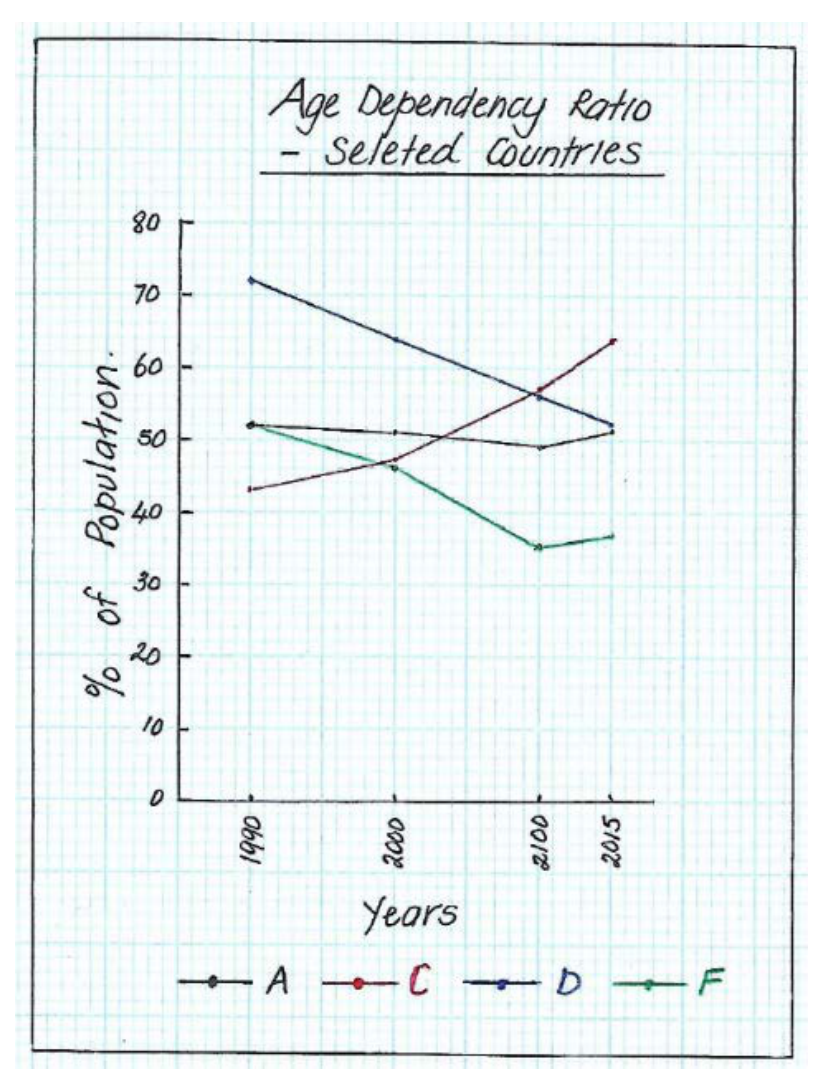
(b) Answer (point marking – 0.5 marks for each correct way):
Countries D and F demonstrate a similar trend (0.5 marks) as both have experienced a significant decreasing age dependency ratio (0.5 marks)
(Note – instead of the point above, students may say
- Country D’s age dependency ratio had a steady decrease from 72% in 1990 to 52% in 2015.
- Country F’s age dependency ratio decreased from 52% in 1990 to 35% in 2010 but then it increased between 2010 and 2015 to 37% (.0.5 marks)
The age dependency ratio for Country A has remained relatively constant averaging 50% - with only slight fluctuations (0.5 marks)
Country C has experienced a significant increase in the age dependency ratio from 43% in 1990 to 64% in 2015.
Blank pages
This page is intentionally blank (you can use it for your notes (please cross them through afterwards) or for answers, which are clearly labelled with the Section and question number).
Оригинал в Архива: WRT_QUESTION_2018iGeo.pdf · официални решения: Marking_Scheme WRT_2018iGeo_final_version.pdf