IMChO 2003, Експеримент — Задача 1. Synthesis of benzimidazole
Synthesis of benzimidazole
Условие
The 37th Mendeleev Olympiad (2003)
(authors – Beklemishev M.K., Druzhinin S.V., Nenajdenko V.G.)
The task consists of two parts. First, you will have to determine titrimetrically the formic acid, followed by the benzimidazole synthesis.
Reagents, labware and equipment
| Item | Quantity | Label |
|---|---|---|
| For each participant | ||
| 10 mL graduated pipette | 1 pc. | |
| Pipette filler | 1 pc. | |
| Laboratory stand with burette clamp | 1 pc. | |
| 25 mL burette | 1 pc. | |
| 50 mL beaker, to be used under the burette | 1 pc. | |
| 150 mL conical flask for titration | 4 pcs. | |
| Flask without the mark, for the analyzed solution 1 | 1 pc. | Solution 1 |
| 100 mL volumetric flask with the stopper, for the diluted solution 2 | 1 pc. | Solution 2 |
| Funnel for filling the burette | 1 pc. | |
| Formic acid, 30–45 % solution (the precise concentration to be determined) | 20 mL | HCOOH |
| NaOH, 0.1 M standard solution | 100 mL | NaOH |
| Phenolphthalein, ~0.1 % solution | 2 mL | Phenolphthalein |
| , ~1 M solution (the oxidation medium) | 100 mL | |
| , solution ~1:4 (the titration medium) | 100 mL | |
| , ~0.1 M solution (for formate oxidation) | 25 mL | ~0.1 M |
| , 0.01 M standard solution (the titrant) | 100 mL | , 0.01 M |
| Mohr’s salt, 0.2 M standard solution (the reducer) | 100 mL | Mohr’s salt |
| Waste container | 1 pc. | |
| 100 mL round-bottom flask | 1 pc. | |
| Reflux condenser with hoses to water supply and drain | 1 pc. | |
| Hotplate | 1 pc. | |
| 20 mL vial with tetrahydrofuran | 1 pc. | THF |
| 20 mL vials with eluents (A, B, and C) | 3 pcs. | A, B, and C |
| Boiling chips | A few pcs. | |
| 100 mL beaker | 1 pc. | |
| pH-indicator strips | 5 pcs. | |
| 250 mL glass beaker for TLC, covered with a Petri dish | 3 pcs. | |
| Distilled water in wash bottle | 0.5 L | |
| TLC capillary | 5 pcs. | |
| TLC plate | 4 pcs. | |
| Glass rod | 1 pc. | |
| Spatula | 1 pc. | |
| Tweezers | 1 pc. | |
| Ruler | 1 pc. | |
| Pencil | 1 pc. | |
| -Phenylenediamine | To be determined | Sample |
| Formic acid, 42 % solution | 100 mL | HCOOH, 42 % |
| Fritted glass filter | 1 pc. | |
| Bunsen flask | 1 pc. | |
| Water-jet pump with a hose | 1 pc. | |
| Weighing bottle for the product | 1 pc. | Product |
| Capillary for melting point determination | 3 pcs. | |
| For each 4 participants | ||
| 0.5 L bottle for the alkali | 1 pc. | NaOH |
| 0.5 L bottle for the Mohr’s salt | 1 pc. | Mohr’s salt |
| 0.5 L bottle for soda | 1 pc. | |
| 0.5 L bottle for the permanganate solution for oxidation | 1 pc. | , ~0.1 M |
| 0.5 L bottle for the permanganate solution for titration | 1 pc. | , 0.01 M |
| 0.5 L bottle for sulfuric acid | 1 pc. | |
| 10 mL measuring cylinder | 2 pcs. | |
| Vial with dropper for adding the indicator | 1 pc. | |
| At the table of common use | ||
| Analytical balance | 1 pc. | |
| Iodine chamber | 1 pc. | |
| Apparatus for melting point determination | 1 pc. | |
| Glass tube for filling the capillaries | 1 pc. | |
| Latex gloves (M, S, L) | 3 packs |
Part 1. Titrimetric determination of the formic acid concentration in solution
In this task you have to determine the formic acid concentration in its solution by titrimetry. The analytical part includes two determinations. First you have to carry out an acid-base titration of a sample of the formic acid solution with the standard alkali solution using phenolphthalein as the indicator. This is followed by the redox permanganatometric titration of the formate ion. Oxidation of formate is a non-stoichiometric reaction, thus you need to carry out the oxidation with the permanganate excess in an alkaline medium.
Permanganate can be reduced to both manganese dioxide and manganese as a result of formate oxidation in an aqueous soda solution. Besides, an incomplete formate oxidation leading to the oxalate ion is also possible:
The formate oxidation affords the anion-radical as an intermediate. The latter can either lose another electron giving or form a dimer of the oxalate ion. Too high pH values favor the oxalate formation, thus oxidation is carried out in mildly alkaline medium (soda rather than alkali solution). The oxidation proceeds slowly, so the mixture is incubated for 20–60 min at room temperature, and then the excess of the oxidant is determined by ferrometry. However, it is impossible to titrate permanganate with Mohr’s salt directly because of the uncertainty of the endpoint fixation (the suspension of reacts very slowly with , if the latter is present in low concentration). Therefore, the medium is adjusted to acidic, and Mohr’s salt is added in an excess. Finally, the excess is titrated with permanganate.
The described above method is referred to as double back titration.
Procedure
You are given the formic acid solution of an unknown concentration (lying in the range of 30–45 % by mass) in the mark-free flask labeled Solution 1.
a) Perform the acid-base titration (fig. 1/2003). Fill the burette with the standard alkali solution ( M). Introduce a 5.0 mL aliquot of the starting formic acid solution (Solution 1) into the 100 mL volumetric flask and bring up to the mark, thus obtaining a ~0.3-0.5 M solution (Solution 2). Using the pipette, transfer a 10.00 mL aliquot () of Solution 2 into a titration flask. Add 2–3 drops of phenolphthalein and titrate until the pink color is stable for at least 30 s. Add the titrant slowly and uniformly, which will permit to reduce the dispensing error.
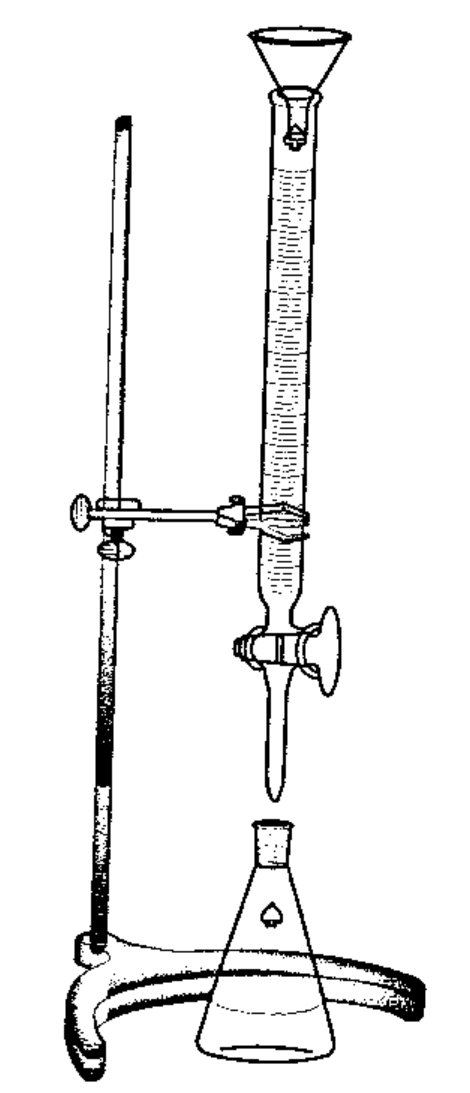
b) Repeat the titration as necessary. Write down the titration results and the accepted titrant volume, mL.
Note. It is recommended to perform a draft titration adding the titrant in ~1 mL portions prior to the precise titrations.
Questions and assignments
1. Write down equation of formic acid reaction with alkali.
2. Derive the formula for calculation of the formic acid concentration in mol/L. Calculate (with 3-digit precision) the concentration of formic acid in the analyzed solution. Use the precise concentrations of the standard solutions given on the bottle labels.
c) Perform the redox titration. Place 2.0 mL () of the undiluted solution of formic acid (Solution 1) using the pipette, 10 mL of 1 M soda solution using the measuring cylinder, and 5.0 mL () of the standard permanganate solution for the formate oxidation ( M) into a titration flask. Mix the flask contents well and incubate the mixture for not less than 20 and not longer than 60 min.
Then using the measuring cylinder introduce 10 mL of (1:4) and 12.00 mL of the standard Mohr’s salt solution ( M) into the flask.
Attention! Add the sulphuric acid solution carefully to avoid foaming.
Note. It is recommended to prepare the mixture as described in item c) in several flasks simultaneously if you feel like doing more than one titration.
d) Fill the burette with the permanganate solution for titration ( M) and titrate the excess of iron(II).
e) Repeat the titration as necessary. Write down the titration results and the accepted titrant volume, mL.
Note. It is recommended to perform a draft titration adding the titrant in ~1 mL portions prior to the precise titrations.
Questions and assignments
3. Write down equations of the main reactions which may occur upon formate oxidation by permanganate in the soda solution.
4. Write down equations of the reactions occurring upon interaction of Mohr’s salt with the acidified solution obtained as a result of formate oxidation by permanganate.
5. Write down equation of the reaction occurring upon titration of the Mohr’s salt excess with potassium permanganate.
6. Derive the final formula for calculation of the formic acid concentration in mol/L. Calculate (with 3-digit precision) the concentration of formic acid in the analyzed solution. Use the precise concentrations of the standard solutions given on the bottle labels.
7. Can the following side processes affect the accuracy of the formic acid determination based on its oxidation with permanganate in alkaline solution?
Part 2. Synthesis of benzimidazole
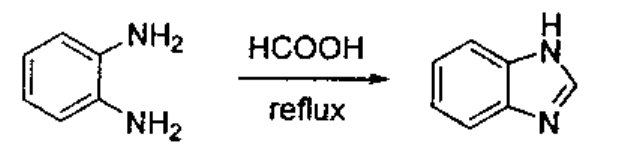
You have to synthesize a heterocyclic compound benzimidazole and determine the retention coefficient () of the starting compound, intermediates and product by thin-layer chromatography (TLC), as well as to study some other characteristics of the synthesized compound. To prepare benzimidazole, you have to carry out the reaction of -phenylenediamine with the formic acid solution with the concentration determined in Part 1.
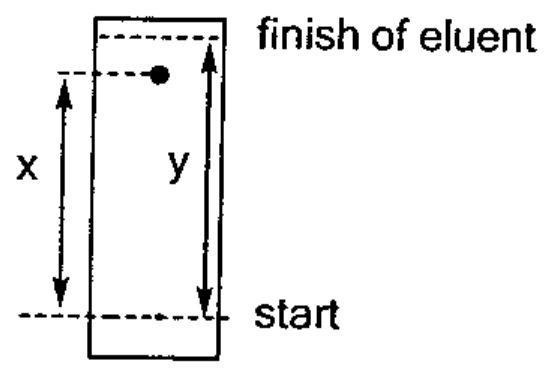
Thin-layer chromatography (TLC) is widely used in organic chemistry for identification of compounds and their purity check. Each individual compound in a mixture is characterized by its retention factor (), which is defined as the ratio of the distance the spot moved above the origin to that the eluent front moved above the origin (fig. 2/2003):
Procedure
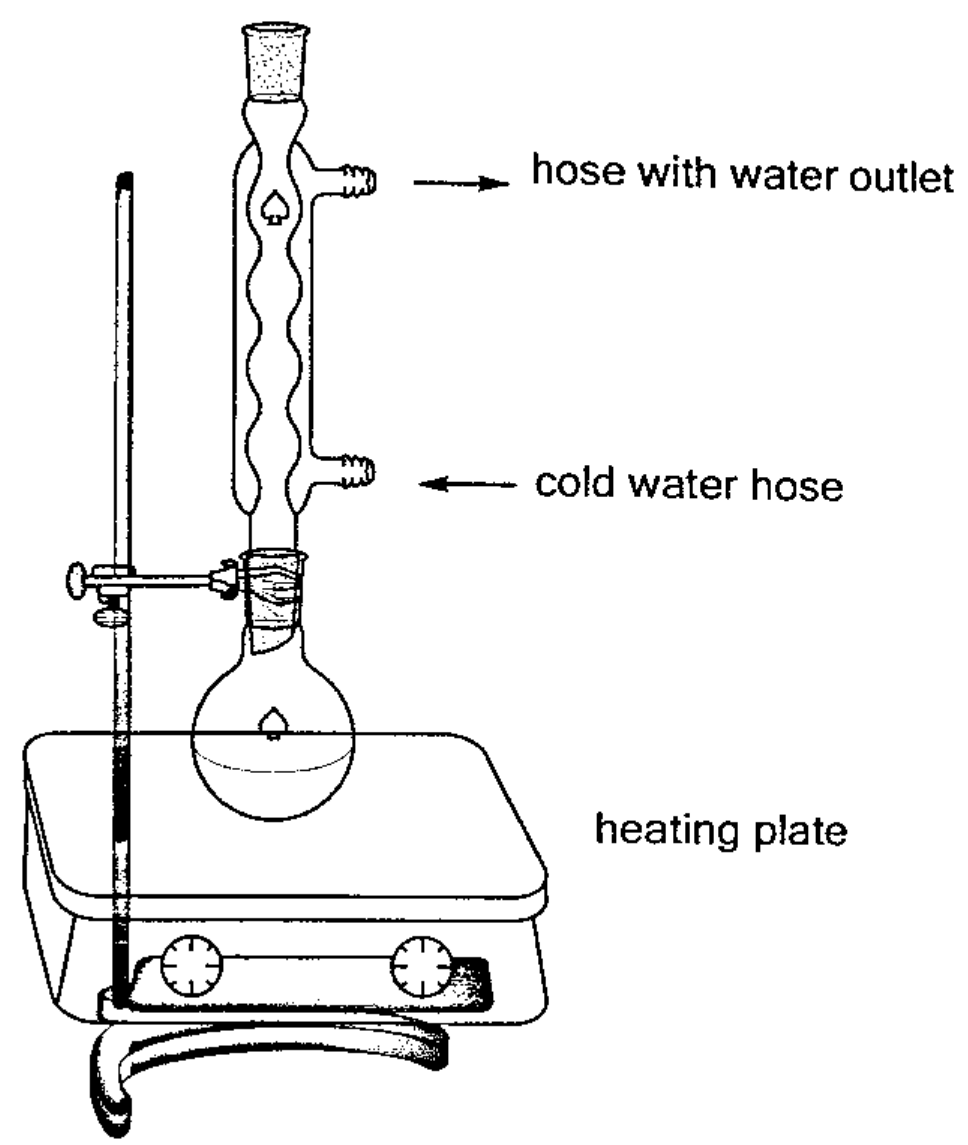
a) Assemble the setup consisting of the round-bottom flask equipped with the reflux condenser connected to the water supply and drain.
b) Weigh the -phenylenediamine sample on the analytical balance and transfer the substance into the flask.
c) Calculate the volume of the 42 % aqueous solution of formic acid required to complete the reaction (note that a ten-fold excess of the formic acid solution is needed to attain the complete reaction). Place the calculated volume of formic acid into the flask and add the boiling chips. Attach the reflux condenser to the flask and place the setup over the hotplate. Boil the mixture under reflux for about 1 h fig. 3/2003).
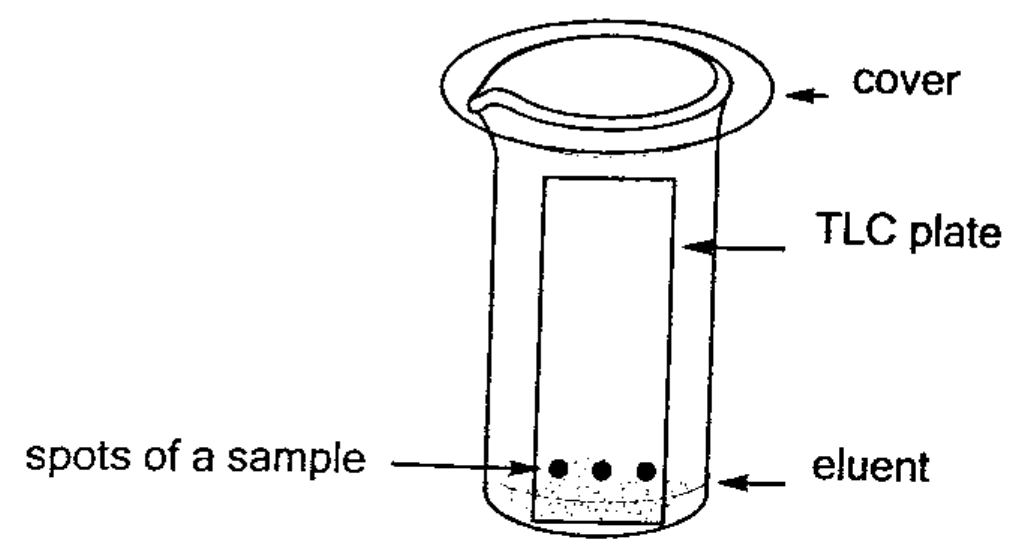
d) Use TLC to estimate the reaction completeness. To do so, use a capillary to take a sample of the reaction mixture in about 30 min since it started boiling and apply it to each of the three TLC plates (A, B, and C) at the dot labeled “1”. Use a clean capillary to apply the reference -phenylenediamine solution to each of the three TLC plates at the dot labeled “2”. Place Plate A into the chamber with eluent A (hexane), Plate B into the chamber with eluent B (hexane – ethyl acetate, 1/1), and Plate C into the chamber with eluent C (ethyl acetate) (fig. 4/2003).
Retrieve the plates once the eluent front nearly reaches the top side of each plate. Dry the plates in air for 3 to 5 min, then develop in the iodine chamber.
Questions and assignments
8. Take a sketch of the TLC plates A, B, and C.
9. Determine the value of benzimidazole when the reaction is not complete and that of -phenylenediamine.
10. Which of the chromatography systems (A, B, or C) is more suitable for the reaction mixture analysis? Give proofs.
e) Use TLC to estimate the reaction completeness in about 1 h since the reaction mixture started boiling. Stop boiling, let it cool down slightly, and then continue cooling down to room temperature in a beaker with cold water. Use a capillary to take a sample of the reaction mixture and apply it to Plate E at the dot labeled “1”. Use a clean capillary to apply the reference -phenylenediamine solution at the dot labeled “2”. Place the plate into the chamber with the eluent you decided optimal for the reaction mixture (of those studied in the item d). Retrieve the plate once the eluent front nearly reaches the top side of the plate. Dry the plate at air for 3 to 5 min, then develop in the iodine chamber.
f) Transfer the flask contents in a dry clean beaker. Add dropwise the aqueous sodium hydroxide solution to the reaction mixture with an intense mixing with the glass rod till the pH 9.5–10 (check with the pH-indicator strips). Observe how precipitation starts. Scratch the beaker walls with the glass rod and put it aside for 5 min till the precipitation is complete.
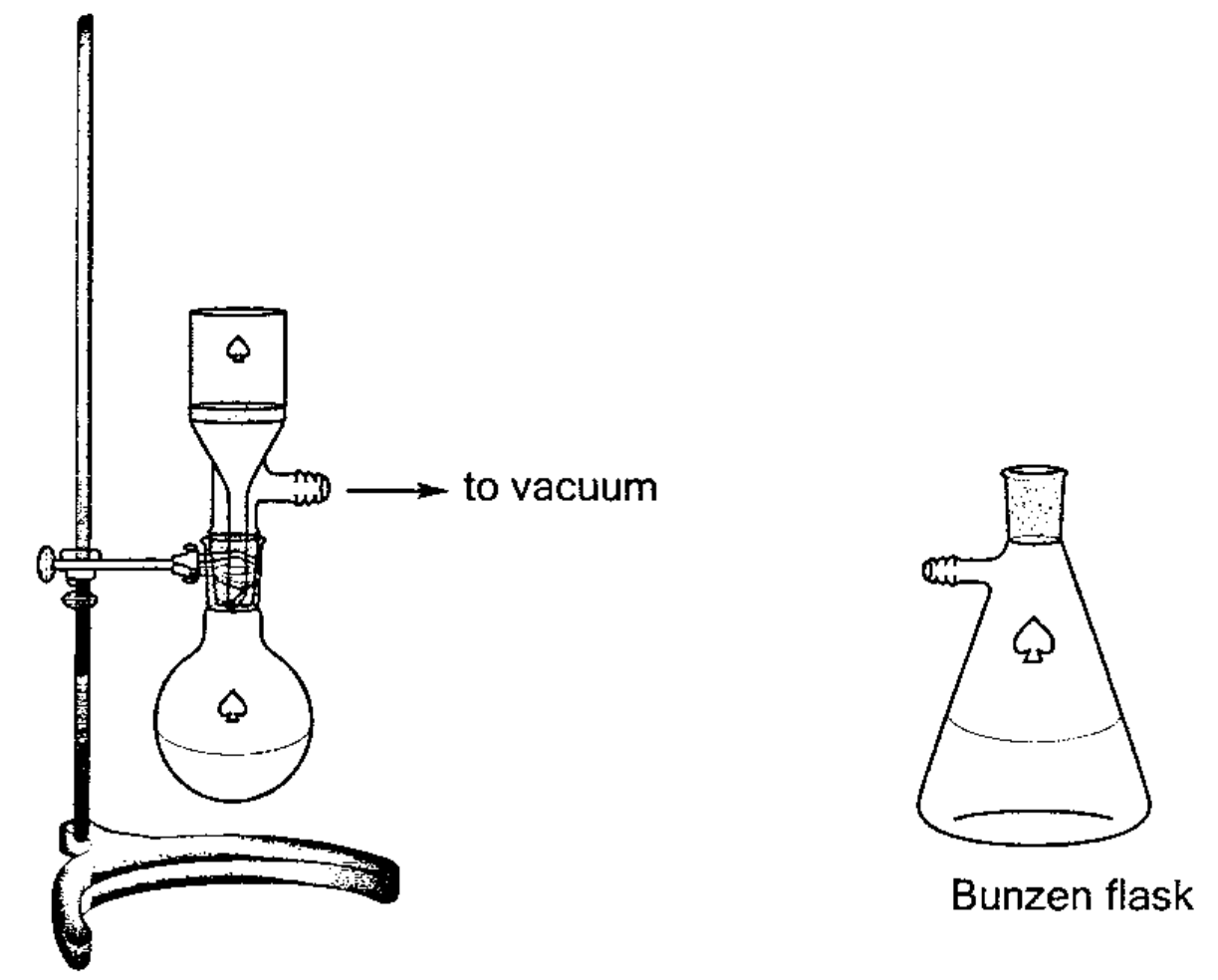
g) Assemble a setup for vacuum filtration using the water-jet pump. Use the spatula to stir the precipitate in the beaker and transfer it to the fritted glass filter. Switch on the water-jet pump, connect the flask to the hose leading to vacuum line and filter the precipitate under vacuum. Once you can see no more drops of the mother waters coming, disconnect the vacuum hose. Pour a few milliliters of tetrahydrofuran to the precipitate on the filter and carefully stir with the spatula (note that the product is significantly soluble in tetrahydrofuran!). Attach the vacuum hose and filtrate the precipitate again. To dry the substance, leave it on the filter for 10 min with the water-jet pump switched on (fig. 5/2003).
Attention! The water-jet pump valve can be closed only when the vacuum hose is disconnected from the setup.
h) Weigh the obtained product in the weighing bottle.
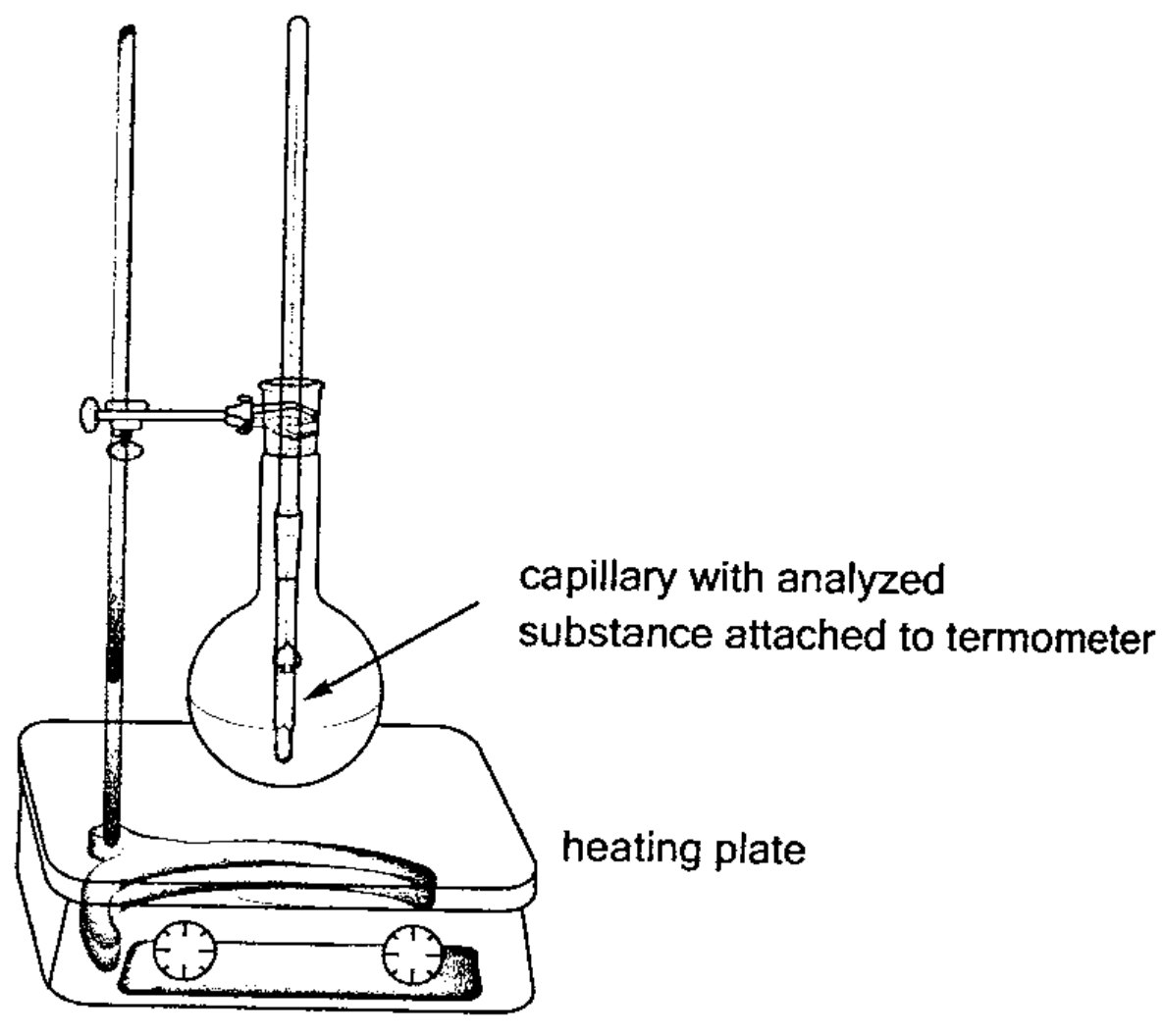
i) Determine the melting point of the obtained compound.
The melting point is determined by using a special apparatus and a capillary packed with a substance to be analyzed. Fill the open end of the capillary with the substance and bring it to the bottom throwing the capillary several times through a glass tube placed on a solid surface. Repeat as needed to pack the capillary tightly. Place the ready capillary into the apparatus for melting point determination (fig. 6/2003).
Questions and assignments
11. Take a sketch of TLC plate E.
12. Estimate the reaction completeness by TLC.
13. Write down the product mass and calculate the yield. Describe the product appearance (the structure and color of the crystals).
14. Write down the recorded melting point.
Решение
Внимание: Непълно решение
The supplied 2003 answer key prints answers numbered 1–8 and 14 only; answers 9–13 and participant-dependent observations or numerical experimental results are not supplied. The printed answer 8 is retained under that number.
Answers — 2003
1.
2. The concentration of formic acid (, mol/L) is calculated as: .
3. As it is mentioned in the task, permanganate can be reduced to both manganese dioxide and manganese as a result of formate oxidation in soda solution:
4. Both excessive and formed as a result of formate oxidation are reduced when Mohr’s salt interacts with the acidified solution obtained after formate oxidation:
5. Mohr’s salt titration with permanganate proceeds stoichiometrically:
6. Finally, the formic acid concentration in the analyzed solution can be calculated as:
7. Of the reactions given, only incomplete formate oxidation leading to the oxalate ion (see the introduction to the task) can affect the accuracy of the formic acid determination:
Permanganate reduction to manganese dioxide (instead of ) has no effect, since both and are reduced after acidification and addition (see above). Other reactions (1, 3–5) are impossible under the titration conditions.
8. The value is about 0.5 in the optimal system.
14. The literature melting point is 172 – 173 °C.
Теми и трудност
Трудност: неоценена.
Аналитична химия · Физикохимия · Органична химия · Титруване · Киселини, основи и pH · Окисление и редукция · Органичен синтез
Предпоставки: Гимназиална подготовка, Разширена олимпиадна подготовка
Оригинал в Архива: 37_MMO_exp.pdf · официални решения: 37_MMO_exp_sol.pdf