IMChO 2005, Експеримент — Задача 1. Synthesis of an inorganic substance
The 39th Mendeleev Olympiad (2005)
Внимание: Бележка към темата
The source scan erases part of the equipment table label column and clips two solution labels between9 and15. The supplied official solution gives no separate answers for10,13 or14.
Условие
(author – Zhirov A.I.)
In this task, you have to synthesize a substance X using iodine, potassium chloride, and potassium carbonate as the initial reagents. Next, you will titrimetrically analyze the synthesized product and draw a conclusion about its composition.
Latimer diagrams
Latimer diagrams are used as a simple form of delivering information about redox properties of compounds of a particular chemical element in an aqueous medium (see the examples below). The diagrams are composed in a way that stable particles containing the element of interest are arranged left-to-right in the decreasing order of the element oxidation state. The standard potential in Volts is shown for every redox transition between neighboring particles over the arrow. Thus, Latimer diagrams give dual information: about an element forms possible in aqueous solution and thermodynamic characteristics of redox reactions involving the element forms. Let us consider some properties of Latimer diagrams.
- Stability of a given particle towards disproportionation using the diagram as an example.
Y would be stable towards disproportionation, if the free energy of X and Z mixture in the ratio corresponding to the «average» oxidation state equal to that of the electroactive element in Y is higher than Y.
Let us imagine a line connecting X and Z in coordinates – «oxidation state» of the electroactive element in the particles under consideration. Stability of Y can be interpreted in term of the corresponding dot position regarding the XZ line. Y is unstable if its dot is above the line, and is stable if below. Using one can calculate and , the slope in these parts unambiguously pointing at the position of Y regarding the line:
| Y dot lies on the XZ line | |
| Y dot lies above the XZ line; Y is unstable | |
| Y dot lies below the XZ line; Y is stable. |
Thus, we have formulated the criterion of a particle stability towards disproportionation. It is worth mentioning that the intermediate oxidation states can be unstable towards disproportionation into particles with extreme oxidation states. Thus, one needs to compare more that the transition potentials between the nearest neighboring particles to make a solid conclusion about a particle stability.
- Calculation of standard potentials for an arbitrary transition between oxidation states of a given element. There could be totally redox transitions between oxidation states of an element. Using the potentials given on the diagram one can calculate all the rest values, which clearly demonstrates how convenient the way of representing thermodynamic information is. Only the number of electrons involved in the redox transition between every successive pair of particles is needed to calculate any potential. The general representation of the formula for a potential calculation is:
where and are the number of electrons and potentials of all the intermediate transition steps from the initial (oxidized) form towards the final (reduced) one, respectively.
- The potential correction to non-standard conditions (the conditional potential). According to the Nernst equation, the standard potential is referred to the conditions when all the half-reaction participants have the activity of unity. In real system, it is rarely suitable to use the activities of the participants of redox reactions, thus these are usually substituted by the concentrations of the corresponding reagents. Concentration dependences of the potentials in different systems very convenient for draft calculations are a product of this simplification. Beside the concentrations of electroactive particles, the potential is dependent on pH, complexing agent, etc. for many redox reactions in aqueous solutions. The potential corrected with respect to the process conditions is referred to as conditional. It can be easily seen that chlorine diagrams given below as if contain excessive data about the medium pH, still such information also points at the major type of ions involved as a particle either accepting or returning the oxygen atoms from/to the central atom. If the equations of corresponding half-reactions with oxygen-containing acids are written down, one will see that the pH value (according to the Nernst equation) very significantly influence the potential, which suggests introducing corrections to the diagrams depending on pH. Actually, the potentials of the chlorine involving processes on the diagram at pH 0 and 14 dramatically differ even for those particles (anions) that are not subjected to protolysis in acidic medium. is the only constant potential, since the medium molecules and ions are not involved in the electrode equilibrium.
For example, we can recalculate the potential found at pH 0 to the value corresponding to pH 14, because the possible forms of the particles in these oxidation states in both acidic and alkaline medium are the same. The reaction equations and corresponding values are:
| a) pH 0: | ; | |
| b) pH 14: | ; | |
| c) | . |
According to the Hess’ law, , thus,
And after substitution:
which only by 0.01 V differs from the value for pH 14 given at the diagram.
If the oxidation states change when passing over from one pH value to another, the potential must be corrected with an account for the corresponding equilibrium constants.
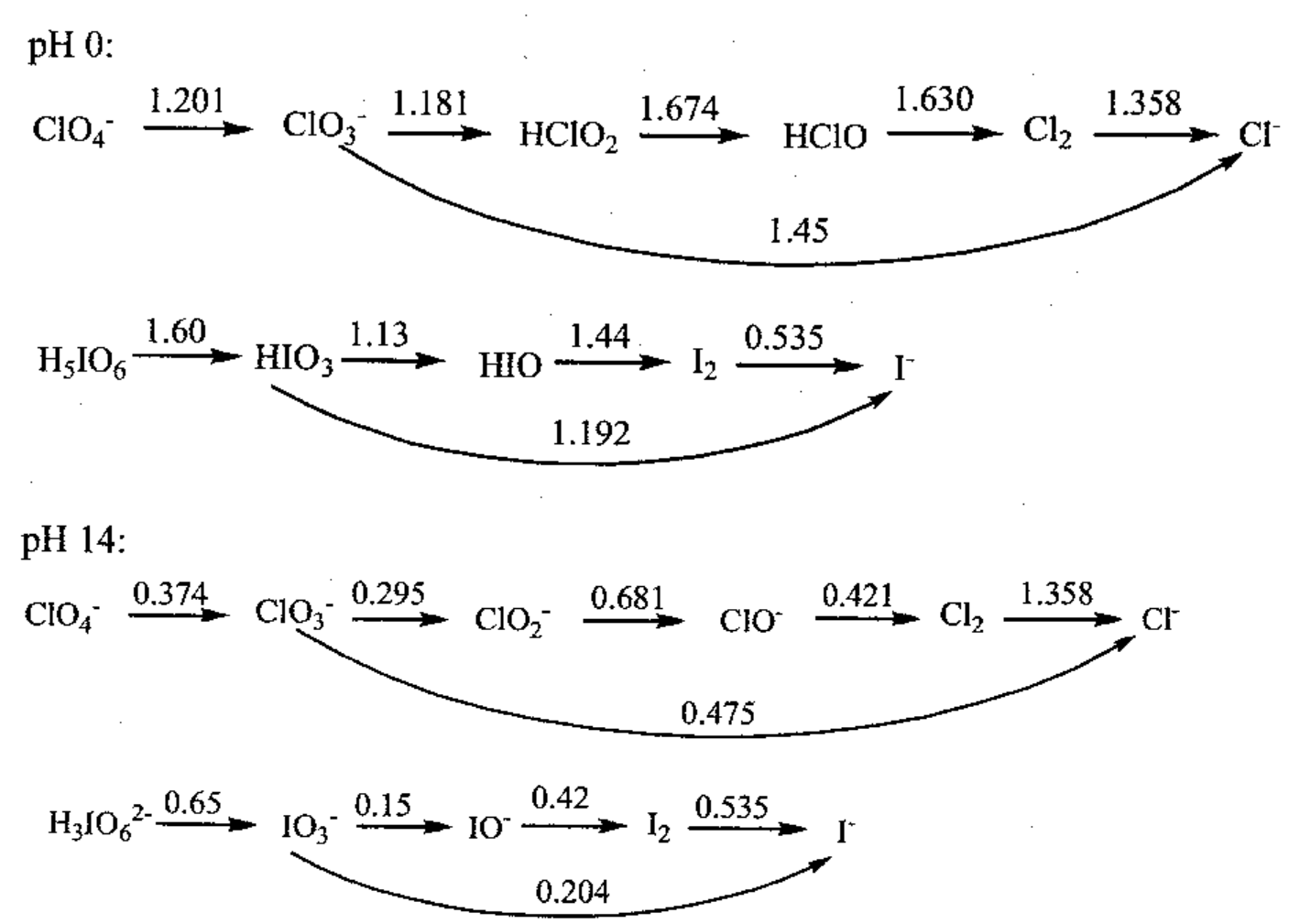
For example:
at pH 0, the potential of the half-reaction equals 1.201 V;
at pH 14, the potential of the half-reaction equals 0.374 V.
Answer the theoretical questions based on the Latimer diagrams:
1. Suggest the probable formula of the substance X to be synthesized.
2. What medium (acidic, neutral, or alkaline) is needed to carry out the first reaction step?
3. What substance (iodine or potassium chlorate) acts as the oxidizer at the first reaction step?
4. What side processes can occur during the first reaction step? Write down the reaction equations.
Reagents, labware and equipment
| Item | Quantity | Label |
|---|---|---|
| For each participant | ||
| Weighing bottle (for iodine) | 1 pc. | |
| Hotplate | 1 pc. | |
| 100 mL conical flask | 1 pc. | |
| 100 mL volumetric flask | 3 pcs. | |
| Mohr pipette | 3 pcs. | |
| Pipette filler | 1 pc. | |
| Finger tips to handle hot things | 1 pair | |
| Distilled water in wash bottle | 0.5 L | |
| Spatula | 1 pc. | |
| Glass rod | 1 pc. | |
| Crystallizing dish | 1 pc. | |
| Watch glass | 1 pc. | |
| Fritted glass filter | 1 pc. | |
| Bunsen flask | 1 pc. | |
| Water-jet pump with vacuum hose | 1 pc. | |
| 100 mL beaker | 2 pcs. | |
| Weighing bottle for the product | 1 pc. | Product |
| Laboratory stand with burette clamp | 1 pc. | |
| Burette | 2 pcs. | |
| 50 mL glass, to be used under the burette | 2 pcs. | |
| Funnel for filling the burette | 2 pcs. | |
| 150 mL titration flasks | 3 pcs. | |
| 20 mL measuring cylinder | 1 pc. | |
| Potassium chlorate (Berthollet’s salt) | 7.5 g | |
| Hydrochloric acid, concentrated | 2 mL | HCl conc. |
| Acetone | 30 mL | Acetone |
| Phenolphthalein, in a drop-bottle | 5 mL | Phenolphthalein |
| Starch, 1 % solution (in a drop-bottle) | 5 mL | Starch |
| At the table of common use | ||
| Analytical balance | 1 pc. | |
| Iodine | 100 g | |
| Sodium hydroxide, standard solution (see the precise concentration on the label) | 1 L | NaOH (___M) |
| Potassium iodide | 1 L | KI |
| Sodium thiosulfate, ~0.5 M standard solution (see the precise concentration on the label) | 1 L | (__M) |
| Hydrochloric acid | 100 mL | HCl 2 M |
Procedure
a) Weigh approximately 7 g of iodine powder in a weighing bottle. Turn on the hotplate.
Attention! Use rubber finger tips when handling hot things! Be careful while manipulating with the concentrated hydrochloric acid!
b) Place 20 mL of water into the 100 mL conical flask, bring it to boiling on the hotplate, then add 5 g of and stir with the spatula until complete dissolution of the substance. Add 0.5 mL of the concentrated hydrochloric acid (36 %). Cover the flask with the watch glass. Keep adding iodine portion-wise (about 0.2-0.5 g in each portion) from the weighing bottle. Mix the flask contents by swirling (do not remove the watch glass). Keep heating the flask until the vapors of iodine can be distinctly seen over the solution.
Attention! Be careful! Avoid losses of iodine due to sublimation. This can significantly worsen your result!
Add every new portion of iodine only when the previous one has completely reacted. Once the process is finished (there are some pieces of iodine left, while the solution becomes yellow), clarify the solution by adding a small amount (0.1-0.2 g) of potassium perchlorate, keeping the solution hot. Then add 20 mL of water and potassium carbonate in the quantity calculated as follows:
Be careful! Add potassium carbonate only in small portions, so that the reaction mixture does not slop out of the flask! Do not heat up the flask on the hotplate while adding carbonate!
5. Write down equation of the reaction behind the performed inorganic synthesis. Pay attention to the consumed amounts of iodine and potassium chlorate.
6. What is the role (either catalyst or reagent) of the concentrated hydrochloric acid?
7. How would the increase in the added acid volume influence the reaction rate and the product yield? Rationalize your answer.
c) Weigh the weighing bottle with the iodine left and calculate its consumption.
d) Cool down the solution in the crystallizing dish containing chilled water with constant mixing. Filter the precipitated crystals on the fritted glass filter of medium porosity, getting rid of the mother water as complete as possible (fig. 1/2005). Disconnect the vacuum line and add a double-fold (with respect to the substance) volume of acetone (about 20 mL). Mix well and dry at vacuum of the water-jet pump for 10–15 min.
Attention! You may close the valve of the water-jet pump only provided the vacuum hose is disconnected from the setup.
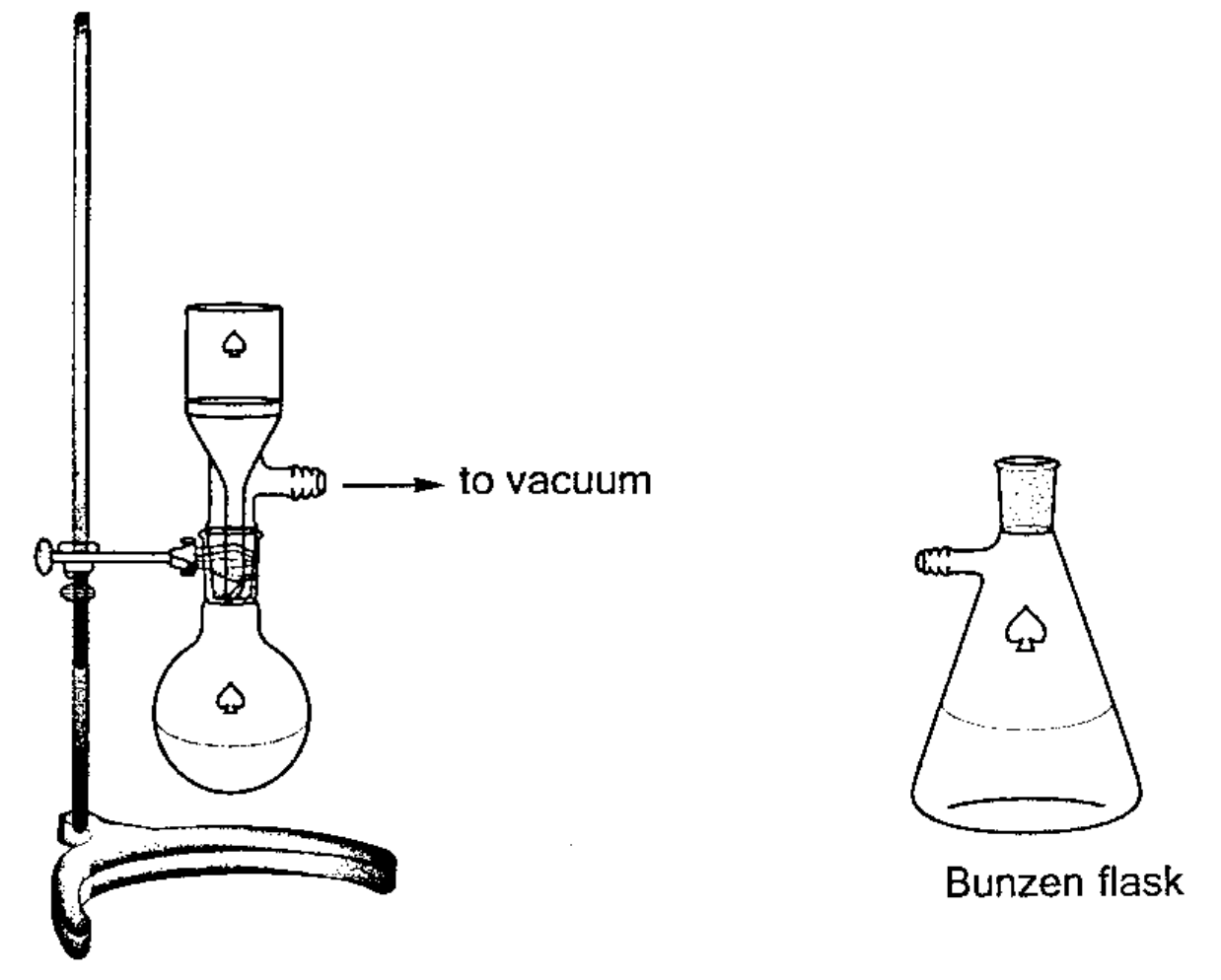
e) Collect the obtained dry substance and weigh it. Take exactly 1.00 g of the substance and dissolve in water in a 100 mL volumetric flask, bring up to the mark with water and keep aside for subsequent work (Solution 1).
f) To recrystallize X, place 25 mL of water in the beaker, bring to boiling and dissolve there while mixing the rest of the dry product. If you still have few undissolved chips, get rid of those by decanting the solution into a clean beaker. Filter the precipitated crystals using the fritted glass filter of medium porosity, getting rid of the mother water as much as possible. Collect the mother waters in a separate beaker. Transfer 20 mL of the mother waters into a 100 mL volumetric flask and bring up to the mark with distilled water. Keep the prepared Solution 2 for subsequent work.
g) Disconnect the vacuum line and wash the precipitate with small amount of acetone. Dry the precipitate under vacuum for 10–15 min. Transfer the dry recrystallized product into the weighing bottle and weigh it. Write down the dry product mass. Take exactly 1.00 g of the purified substance and dissolve it in water in a 100 mL volumetric flask, bring up to the mark with water and keep aside for subsequent work (Solution 3).
h) Analyze X (prior and after recrystallization) as well as the mother waters by titrimetry. You will determine the acidic component of X by acid-base titration, and the oxidizer content by iodometric titration. Finally, you will have to draw a conclusion about the product composition based on the titration results.
Perform two consecutive titrations of each of the previously prepared Solutions 1,2, and 3 (do all the titrations of a particular solution in the same flask).
Acid-base titration. To each of the three titration flasks, add 10.00 mL of the analyzed solutions and 3–5 drops of the phenolphthalein solution. Fill the burette with the standard sodium hydroxide solution (see the precise concentration on the label) and titrate until appearance of a stable pink color.
Repeat titrations as necessary. Write down the titration results and the accepted titrant volumes, mL, for each of the studied solutions.
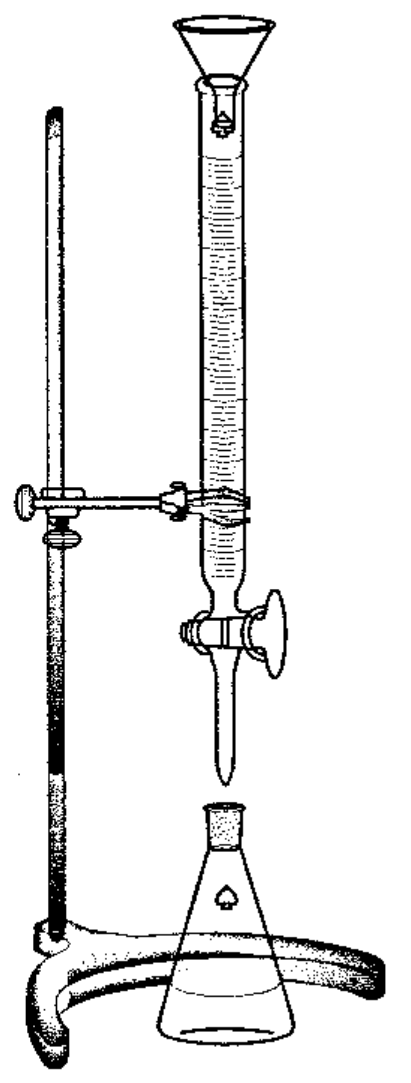
Iodometric titration. Using the measuring cylinder, add 10 mL of 10% potassium iodide solution and 2 mL of 2 M hydrochloric acid solution to each of the flasks left over after the first titration. Mix the flask contents well, cover with the watch glass and put aside for a few minutes. Titrate the prepared solutions with sodium thiosulfate solution (~0.5 M) until pale-yellow coloration. Then add 3–5 drops of 1% starch solution and continue the titration with constant swirling of the mixture until stable (for at least 0.5 min) disappearance of the blue coloration (fig. 2/2005).
Repeat titrations as necessary. Write down the titration results and the accepted titrant volumes, mL, for each of the studied solutions.
Questions and assignments
8. Write down the equation (in the ionic form) of the reaction occurring upon addition of potassium iodide and hydrochloric acid to the analyzed solution.
9. Write down the equation of the reaction occurring during titration with thiosulfate.
10. Calculate the molar ratio of to the oxidizer of substance X in all the studied solutions:
11. Based on the titrations done, determine the molar ratio /oxidizer in the molecule of the synthesized compound X.
12. Draw the formula of the synthesized substance X.
13. Was the product recrystallization really needed? Rationalize your answer.
14. Based on the results of the mother waters (Solution 2) titration, estimate the product solubility at the experiment temperature.
15. Is the obtained substance neutral, acid, or basic salt?
16. Salt of what acid is the obtained substance?
17. What substance (potassium chlorate or iodine) was a limiting one during the synthesis?
18. Give possible reasons for the incomplete yield of the product.
19. What substances was it possible to get rid of due to initial crystallization? Choose from the list: , , , , , .
20. What substances was it possible to get rid of due to the recrystallization? Choose from the same list as in i. 19.
21. Estimate the strength of iodic acid using Pauling’s rule: whether the acid is very strong, strong, moderate, weak, or very weak? Give an estimated value.
22. Using the standard redox potentials (see the Latimer diagrams), calculate the value of the iodic acid.
23. Give an example of a monobasic acid, which is also capable of forming acid salts.
Отговори
- KH(IO₃)₂
- Answer the theoretical questions based on the Latimer diagrams:, 1. KH(IO₃)₂
- Answer the theoretical questions based on the Latimer diagrams:, 2. Acidic medium.
- Answer the theoretical questions based on the Latimer diagrams:, 3. Potassium chlorate.
- Procedure, 6. Catalyst.
- Questions and assignments, 12. KH(IO₃)₂
- Questions and assignments, 15. Acid salt.
- Questions and assignments, 16. Iodic acid HIO₃.
- Questions and assignments, 17. Iodine.
- Questions and assignments, 23. HF; KHF₂.
Решение
Внимание: Непълно решение
The supplied solution has clipped labels between9 and15 and no separate answers for10,13 or14. The visible ratio and formula answers are preserved without reconstructing their clipped numbers.
is the product to be synthesized. Taking into account the Latimer diagrams and chemical properties of iodine with stable oxidation states of +7, +5, and −1, one can expect that the oxidation product will be iodate, whereas the amount of added to the solution containing the product of iodine oxidation suggests that the iodine : potassium ratio equals 2 : 1.
The first step must be conducted in an acidic medium. Since the difference of and potentials is maximal in acidic medium, using pH 0 at the first step of the synthesis would contribute to a higher yield. Protonation of anions of oxygen-containing acids contributes to higher reactivity due to the fact that an electron transfer onto a neutral particle happens easier than than onto an anion. Thus, the process rate will be higher in an acidic medium.
Comparison of potentials at the Latimer diagram suggests that chlorate is the oxidizer.
The side processes accompanying the first synthesis step are: iodine evaporation, evolution of and :
- Equations of the reaction of the target product synthesis:
Concentrated HCl is a catalyst, since it adjusts the required pH value (see above), not being consumed in the reaction.
As it is seen from item 2, the reaction rate should increase at higher hydrochloric acid concentrations. Most probably this will be accompanied by a lowered yield due to enhanced formation of by-products ( и ), whereas the neutralization of acid with potassium carbonate will lead to a great amount of KCl in the precipitate.
Equation of the reaction between KI and in the hydrochloric acid-containing medium is:
- Equation of the reaction between and :
[label clipped in source] The ratio of to oxidizer in X must be equal to 1 : 12.
[label clipped in source] .
is an acid salt.
The product is a salt of iodic acid .
Iodine was the limiting reagent. It was necessary to constantly add new portions of iodine, as it was being consumed by an excess of potassium chlorate during the first synthetic step.
The reasons for a lower product yield:
- losses of iodine due to sublimation;
- chlorine evolution in the course of the reaction;
- mechanical losses.
The initial crystallization allows purification of the product from all the listed substances: HCl, KCl, , , , but not the product itself.
Substances with poor solubility in water and those present in an excess in the mother waters (KCl, , ) are removed by recrystallization.
According to Pauling’s rule, iodic acid is strong, since there are two oxo (=O) and only one hydroxyl (–OH) groups. Thus, iodic acid should be close to nitric and perchloric acids by strength.
The estimated value for acids equals ; in the case under consideration, thus . According to the literature data, .
- Let us write down equations of the processes and calculate the corresponding values:
| (1) | |
| (2) | |
| (3) | |
| (4) |
Thus,
and:
After the expression conversion:
- For instance, hydrofluoric acid HF forms an acid salt ().
Теми и трудност
Трудност: неоценена.
Физикохимия · Аналитична химия · Окисление и редукция · Титруване · Електрохимия
Предпоставки: Разширена олимпиадна подготовка
Оригинал в Архива: 39_MMO_exp.pdf · официални решения: 39_MMO_exp_sol.pdf