IMChO 2007, Експеримент — Задача 1. Kinetics of iodination of acetone in acidic medium
The 41st Mendeleev Olympiad (2007)
Внимание: Бележка към темата
The supplied official solution contains only answers 8–14; answers 1–7 are absent.
Условие
(authors Khvalyuk V.N., Beklemishev M.K., Golovko Yu.S.)
The irreversible reaction between dimethyl ketone and iodine in aqueous solution is catalyzed by protons:
[Acetone iodination reaction with proton catalyst.]
The corresponding kinetic equation can be written as:
The initial rate is measured in order to determine the rate constant and the reaction orders , , and with respect to every reacting substance. The initial rate can be determined by following the decrease of iodine concentration in the reaction mixture during a definite period of time (15 min in the present experiment) after the reaction start. The curvature of the kinetic curve can be neglected, when the conversion degree of reagents is low. Thus, it is possible to treat the average rate during a short period as the initial reaction rate :
where , , and are the initial concentrations of dimethyl ketone, iodine and hydrogen ions, respectively.
Sodium acetate is added to the reaction mixture in order to stop the reaction at the required time point. Acetate reacts instantly with resulting in formation of acetic acid and decreasing the concentration of the ions to the values, when the reaction takes place at a negligibly low rate. Since the reaction of iodination is not completely stopped (it is just slowed down), the reaction mixture must be titrated as fast as possible, once sodium acetate is added.
The excess of unreacted iodine in the reaction mixture is determined by titration with sodium thiosulfate using starch as an indicator. Calculate the initial molar concentrations of iodine, dimethyl ketone and HCl in flasks A–D, hypothetically taking the dimethyl ketone concentration in the 100 mL flask as 1 M.

Reagents, labware and equipment
| Item | Quantity | Label |
|---|---|---|
| For each participant | ||
| 250 mL volumetric flask | 1 pc. | |
| 100 mL conical flask with stopper | 4 pcs. | A, B, C, D |
| 5.00 mL graduated pipette | 1 pc. | |
| 10.00 mL graduated pipette | 1 pc. | |
| Pipette filler | 1 pc. | |
| Stopwatch | 1 pc. | |
| Distilled water in wash bottle | 0.5 L | |
| Spatula | 1 pc. | |
| Glass rod | 1 pc. | |
| 100 mL beaker | 1 pc. | |
| Laboratory stand with burette clamp | 1 pc. | |
| Burette | 2 pcs. | |
| 50 mL beaker (to be used under the burette) | 2 pcs. | |
| Funnel for filling the burette | 2 pcs. | |
| 150 mL titration flask | 2 pcs. | |
| 20 mL measuring cylinder | 1 pc. | |
| 100 mL measuring cylinder | 1 pc. | |
| Hydroxylamine hydrochloride, 0.2 M solution | 50 mL | |
| Dimethyl ketone, in 100 mL volumetric flask (concentration to be determined) | - | Acetone |
| On the table of common use | ||
| Analytical balance | 1 pc. | |
| Iodine, aqueous solution (concentration to be determined) | 1 L | |
| Sodium acetate | 250 g | |
| Sodium hydroxide, aqueous solution (concentration to be determined) | 1 L | NaOH |
| Sodium thiosulfate, standard solution (see the exact concentration on the label) | 1 L | (___M) |
| Hydrochloric acid, 0.1000 M aqueous solution | 1 L | HCl |
| Starch, 1 % solution (in the dropper) | 25 mL | Starch |
| Methyl Orange, alcohol solution (in the dropper) | 25 mL | Methyl Orange |
Part 1. Standardization of iodine solution
a) Using the pipette, transfer a 5.00 mL aliquot of the iodine aqueous solution into the 100 mL conical flask labeled A. Using the measuring cylinder, add 10 mL of distilled water.
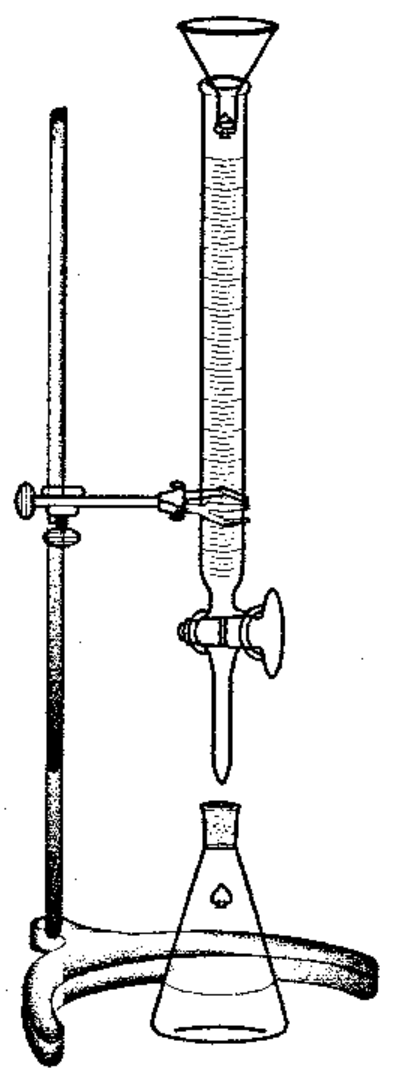
b) Titrate the obtained iodine solution with the standard sodium thiosulfate solution to the pale-yellow coloration. Then add 3 drops of the starch solution and continue titrating until the blue coloration disappears (fig. 1/2007).
c) Repeat the titration as needed. Write down the titration results and the accepted titrant volume, mL.
d) Wash the flask A.
Questions and assignments
1. Calculate the iodine concentration in the given solution.
Part 2. Study of dimethyl ketone iodination kinetics in acidic medium
e) Bring up the dimethyl ketone solution to the mark in the 100 mL volumetric flask with distilled water and mix well. Caution: the solution warms up upon mixing. Hold the stopper tightly, periodically taking it out to release the pressure inside the flask.
f) Pour a portion of dimethyl ketone solution into the beaker. Add the hereunder given volumes of distilled water, 0.1000 M hydrochloric acid and dimethyl ketone solution to the conical flasks labeled A, B, C, and D (stopper the flasks after adding the solutions).
Volume, mL
| Flask | Water | HCl | Dimethyl ketone solution | Iodine solution |
|---|---|---|---|---|
| A | 5.00 | 5.00 | 5.00 | 5.00 |
| B | 0 | 5.00 | 5.00 | 10.00 |
| C | 0 | 5.00 | 10.00 | 5.00 |
| D | 0 | 10.00 | 5.00 | 5.00 |
g) Using the pipette, transfer a 5.00 mL aliquot of the iodine solution into the flask A. Switch on the stopwatch exactly when you start adding the iodine solution. Stopper the flask tightly, mix the flask contents well and incubate for 15 min.
h) Meanwhile, prepare the sodium acetate solution. Weigh ~5.0 g of sodium acetate in the 50 mL beaker. Using the measuring cylinder, add 80 mL of water and stir the mixture to completely dissolve the salt.
i) In 15 min, add 10 mL of the sodium acetate solution to the reaction mixture using the cylinder and stir.
j) Titrate the iodine excess in the reaction mixture with the standard thiosulfate solution. Write down the titration results.
k) Repeat i. f), g), i), and j) for the flasks B, C, and D, adding the solutions in the amounts shown in the above table.
Questions and assignments
2. Calculate the initial rate of iodine consumption (in ).
3. Using the initial reaction rates and initial concentrations, calculate the reaction orders , , and .
4. Write down the kinetic reaction.
Part 3. Standardization of the alkali
l) Fill the second burette with the alkali solution. Titrate a 10.00 mL aliquot of 0.1000 M HCl solution in the presence of Methyl orange with the alkali solution. The titration endpoint is determined by the color transition of the indicator from pink to yellow.
m) Repeat the titration as needed. Write down the titration results and the accepted titrant volume, mL.
Questions and assignments
5. Calculate the concentration of the alkali solution.
Determination of the dimethyl ketone concentration
n) Transfer a 4.00 mL aliquot of the dimethyl ketone solution into the 250 mL volumetric flask and bring up to the mark with water.
o) Transfer a 10.00 mL aliquot of the obtained dimethyl ketone solution from the 250 mL flask into a 100 mL conical flask. Add 10 mL of 0.2 M hydroxylamine hydrochloride solution, stopper the flask, stir the obtained mixture and store it for 5 min.
p) Titrate the mixture with the alkali solution in the presence of Methyl orange until the indicator color changes from pink to yellow.
q) Repeat the titration as needed. Write down the titration results and the accepted titrant volume, mL.
Questions and assignments
6. Calculate the dimethyl ketone concentration in the initial solution.
7. Knowing molar concentrations of all the reagents, calculate the rate constant for the flasks A – D using the kinetic equation you have derived earlier.
8. The catalytic iodination of dimethyl ketone you have studied includes the following steps:
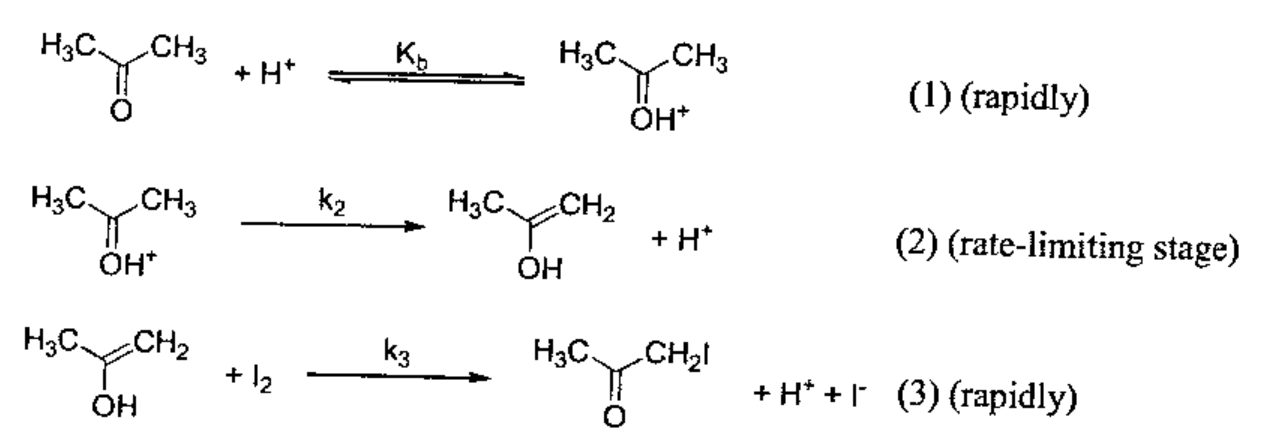
The rate of the entire process is determined by that of enol formation (2).
Use the above scheme to derive the theoretical kinetic equation of dimethyl ketone iodination (show dimethyl ketone as A).
9. Write down the condition when the derived equation coincides with the experimental kinetic equation that you had to obtain doing when the experimental parts.
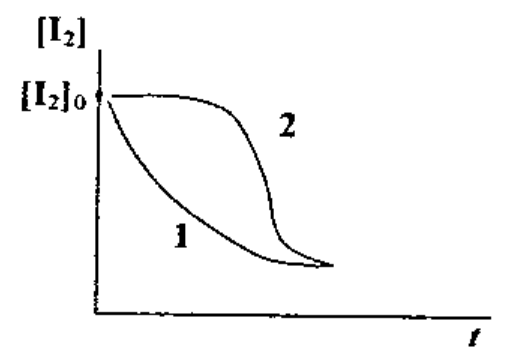
10. Iodination of dimethyl ketone can be also carried out in an acid-free medium, the initial rate being considerably lower in this case than in an acidic medium. Draw the kinetic curves in the acid-containing and acid-free media.
11. Compare the rate constants of bromination and iodination of dimethyl ketone with and under the conditions of your experiment (encircle one of the following):
a) ; b) ; c) ; d)
12. Messinger’s method is another procedure for dimethyl ketone determination. The method involves addition of an excess of iodine to the alkaline aqueous solution of dimethyl ketone with subsequent titrimetric determination of the unreacted iodine after acidification of the mixture. Write down the equation of the reaction occurring upon iodine addition to dimethyl ketone.
13. Is the Messinger’s method selective towards dimethyl ketone? Write down the reaction supporting your answer.
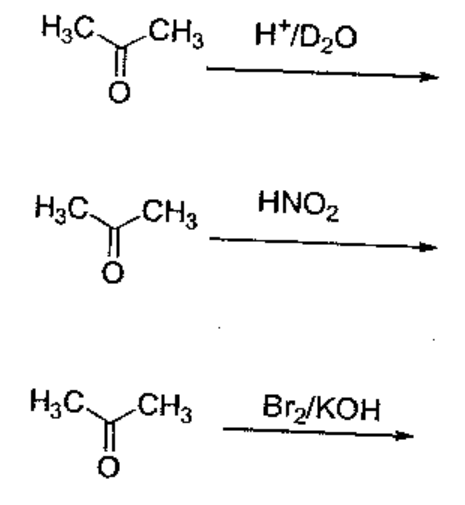
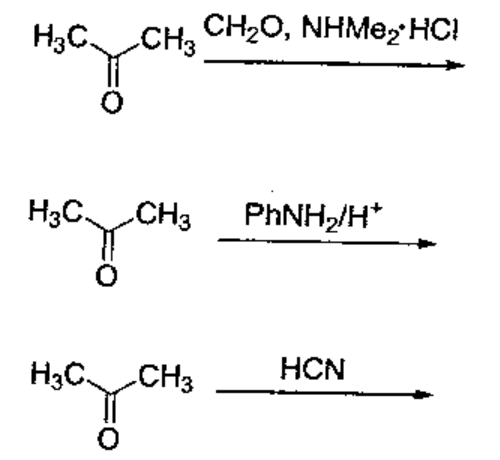
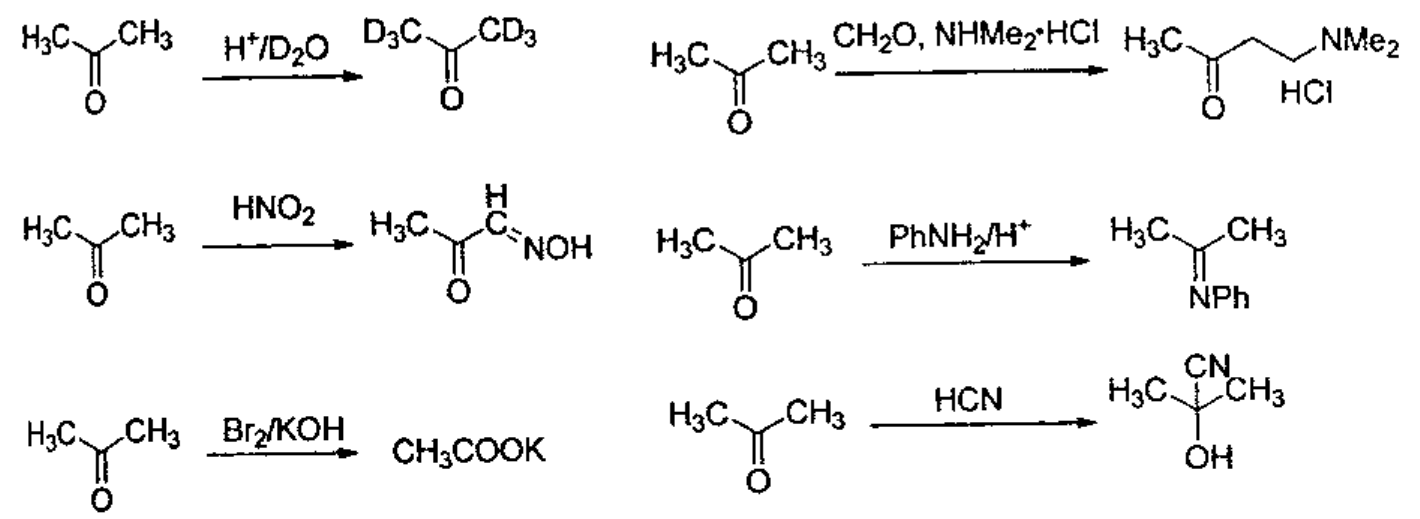
14. Write down the structures of the products of the following reactions.
Решение
Внимание: Непълно решение
The supplied official solution begins at question 8 and contains only answers 8–14; answers 1–7 are not present.
- Since the enol (E) formation is the stage limiting the entire process, we can suppose that . Then, we can apply the quasi-stationary approach towards enol as an intermediate (A is acetone):
whereas , and the reaction rate , thus, taking into account the quasi-stationary state of the enol:
Since , the effective constant is .
[Iodine concentration versus time, showing curves 1 and 2 for acidic and acid-free media.]
Shape of the kinetic curves of acetone iodination in an acidic medium (1) and acid-free solution (2) (the self-acceleration of the reaction must be shown for curve (2)).
The constants of carbonyl compound halogenation rate with chlorine, bromine, and iodine are the same, though the compounds differ in their reaction capacity.
The iodine reaction with acetone in an alkaline medium (iodoform formation):
The method is not selective, since different substances including all methyl ketones and ethanol would react with iodine in an alkaline medium. So the reaction must be similar to that shown in item 12. Ethanol forms aldehyde first, which is further halogenated.
[Six acetone reaction schemes with the printed products.]
Теми и трудност
Трудност: неоценена.
Физикохимия · Аналитична химия · Органична химия · Химична кинетика · Титруване · Карбонилни съединения
Предпоставки: Разширена олимпиадна подготовка
Оригинал в Архива: 41_MMO_exp.pdf · официални решения: 41_MMO_exp_sol.pdf