IMChO 2008, Експеримент — Задача 1. Identification of organic compounds
The 42nd Mendeleev Olympiad (2008)
Внимание: Бележка към темата
The supplied problems excerpt ends at printed p.71: the announced Part 2 and questions 3–6 are absent. The caption of Fig. 1/2008 is printed, but the figure area is blank. The supplied solutions contain the identification table and answers 1, 2, 5 and 6 only.
Условие
(author Beklemishev M.K.)
The task consist of two parts: identification of organic compounds, some of which are common medicines, and quantitation of analgin in tablets.
Reagents, labware and equipment
| Item | Quantity | Label |
|---|---|---|
| For each student | ||
| Laboratory stand with clamp and ring | 1 pc. | |
| 250 mL Erlenmeier flask, for titration | 3 pcs. | |
| 100 mL volumetric flask, for the sample | 1 pc. | |
| 25 mL burette | 1 pc. | |
| 10 mL pipette | 3 pcs. | |
| Pipette filler | 1 pc. | |
| 100 mL beaker | 1 pc. | |
| 50 mL measuring cylinder | 1 pc. | |
| Spatula | 3 pcs. | |
| Glass rod | 3 pcs. | |
| Eyedropper | 6 шт. | |
| Paper towels | 1 pack | |
| Distilled water in wash bottle | 0.5 L | |
| p-Nitrophenol (for analysis, in a vial) | 1 g | One of A-G |
| Benzoic acid (for analysis, in a vial) | 1 g | One of A-G |
| Salicylic acid (for analysis, in a vial) | 1 g | One of A-G |
| Acetylsalicylic acid (for analysis, in a vial) | 1 g | One of A-G |
| Paracetamol (for analysis, in a vial) | 1 g | One of A-G |
| Streptocide White (for analysis, in a vial) | 1 g | One of A-G |
| Analgin (for analysis, in a vial) | 1 g | One of A-G |
| Analgin (for determination, in a beaker) | weighed amount | H |
| Potassium permanganate, 0.04 M aqueous solution | 15 mL | |
| Iron(III) chloride, 0.01 M aqueous solution | 15 mL | |
| Sodium nitrite, 0.1 M aqueous solution | 15 mL | |
| Hydrochloric acid, 1 M aqueous solution | 15 mL | HCl |
| Sodium hydroxide, 3 M aqueous solution | 15 mL | NaOH |
| p-Dimethylaminobenzaldehyde, 0.06 M solution in 50 % ethanol containing 1.4 M HCl | 15 mL | p-DMABA |
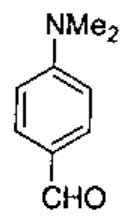
p-DMABA
Part 1. Identification of organic compounds
Each participant is supplied with containers labeled A – G, each containing an individual compound from 7 listed below: p-nitrophenol, benzoic acid, salicylic acid, acetylsalicylic acid, paracetamol, streptocide, and analgin:
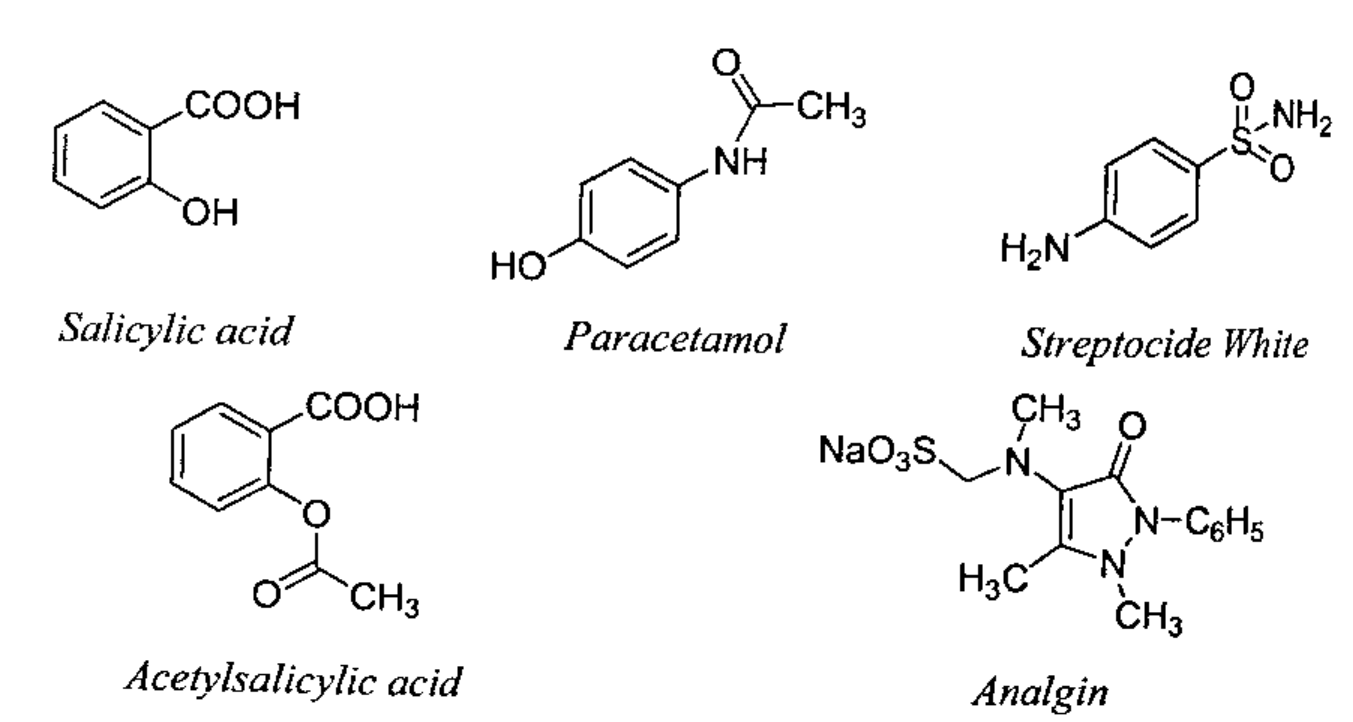
Identify the compounds using the reagents provided (decipher the compound in each vial). Identification is based on the ability of compounds to give more or less intensely colored products as a result of interaction with the corresponding reagents.
Tips:
- Perform qualitative reactions in the 96-well plate (fig. 1/2008).
- The unknown compounds can be subjected to analysis in the solid form. Transfer small amounts of compounds into the wells on spatula. Carefully wipe the spatula with paper towels.
- Do not remove the vial stoppers; only pull out the pipettes from the stoppers. Do not pour high amount of the solutions into the wells (1-2 drops of a reagent are sufficient).
- Follow both intensity of a product color as well as the time of its appearance.
- Oxidation of the compounds by permanganate should be tested in neutral and alkaline media.
Fig. 1/2008. 96-well plate for qualitative reactions.
[Source image absent: the figure area above this caption is blank in the scan.]
- One of the unknown compounds (that with aromatic ring most enriched with electrons) promptly reacts with nitrous acid at room temperature yielding a yellow nitro-derivative.
- p-DMABA reacts with amines under acidic conditions affording Schiff bases. Most intensely colored products are formed with the compounds containing a primary amino group:
- Many phenols interact with iron(III) ions, the coloration being most intense in the case of chelate formation.
- The sample of acetylsalicylic acid may contain salicylic acid as an impurity.
Procedure
a) Identification of the unknown compounds
Place a small amount of the substance from vial A into each of the six wells of the 96-well plate. Add the alkali solution to the first well, neutral solution to the second well, and alkali solutions to the third well, solution to the forth well, and hydrochloric acid solutions to the fifth well, and p-DMABA solution to the sixth well. Repeat the same for the substances from vials B – G. Write down the observations in Table 1/2008.
Table 1/2008. A sample protocol for recording the observations.
| Vial Code | The reagents added | |||||
|---|---|---|---|---|---|---|
Based on the study, identify the compounds in vials A – G (fill in the Table):
| Compound | n-Nitrophenol | Benzoic acid | Salicylic acid | Acetylsalicylic acid | Paracetamol | Streptocide White | Analgin |
|---|---|---|---|---|---|---|---|
| Vial Code |
b) Confirmation of the identification results
Aromatic amines react with sodium nitrite in acidic medium affording diazonium salts (diazotization reaction), which, in turn, interact with electron enriched aromatic compounds with formation of intensely colored products (azo coupling reaction). The reaction takes place in weakly acidic or weakly alkaline medium; the deprotonated forms of the products usually possess the strongest coloration.
Questions and assignments
1. Write down the equation of a diazotization reaction, denoting the aromatic moiety as Ar.
2. Write down the equation of an azo coupling reaction, denoting the aromatic moiety as Ar'.
To confirm the identification you have accomplished, study the possibility of diazotization of one of the compounds A – G followed by azo coupling with another compound from the same list (A – G). Remember that an intensely colored product is formed. Complete the Table (only one colored product is scored).
| Compound selected for diazotization (vial code) | Compound used for azo coupling (vial code) | Color of the product |
|---|---|---|
Решение
Внимание: Непълно решение
The supplied problems excerpt ends after questions 1–2 of Part 1. The announced Part 2 and questions 3–6 are missing. The solutions excerpt contains the identification table and answers 1, 2, 5 and 6 only; no reconstruction of missing questions or answers is supplied.
Reactions recommended for the identification of compounds
Phenomena resulting from the interaction with the reagents
| Compound | NaOH | KMnO₄ (neutral) | KMnO₄ (alkaline) | FeCl₃ | NaNO₂ + HCl | p-DMABA + HCl |
|---|---|---|---|---|---|---|
| Analgin | No changes | Instantaneous reduction | Reduction | Vanishing blue color | Blue color changing into pale-yellow | Yellow |
| Streptocide | No changes | No reaction | Reduction | No changes | Very slowly turning yellow | Brick-red |
| Paracetamol | No changes | Instantaneous reduction | Reduction | Practically no changes | Yellow color | Yellow |
| Acetylsalicylic acid | No changes | Very slow | Reduction | Very weak color | No changes | No changes |
| Salicylic acid | No changes | Rapid reduction | Reduction | Bright-purple color | No changes | No changes |
| Benzoic acid | No changes | No reaction | No reaction | No changes | No changes | No changes |
| p-Nitrophenol | Yellow color | Slow reduction | Reduction | Purple color | No changes | No changes |
Comments to the Table above.
- p-Nitrophenol is identified by the yellow color of phenolate ion
- Benzoic acid is identified by non-reduction of the alkaline permanganate (one will only need to distinguish it from streptocide, if neutral permanganate is used).
- Streptocide is identified by intense color of the reaction product with p-DMABA (analgin and paracetamol give weaker coloration).
- Salicylic acid is identified by coloration with iron(III) (the color is most intense in the case of chelate formation, which is possible only for salicylate).
- Aspirin (acetylsalicylic acid) gives the same reaction, still with much weaker coloration (the latter is due to salicylic acid admixture or slow hydrolysis of aspirin affording salicylic acid). By contrast to paracetamol, aspirin is not nitrated by nitrite.
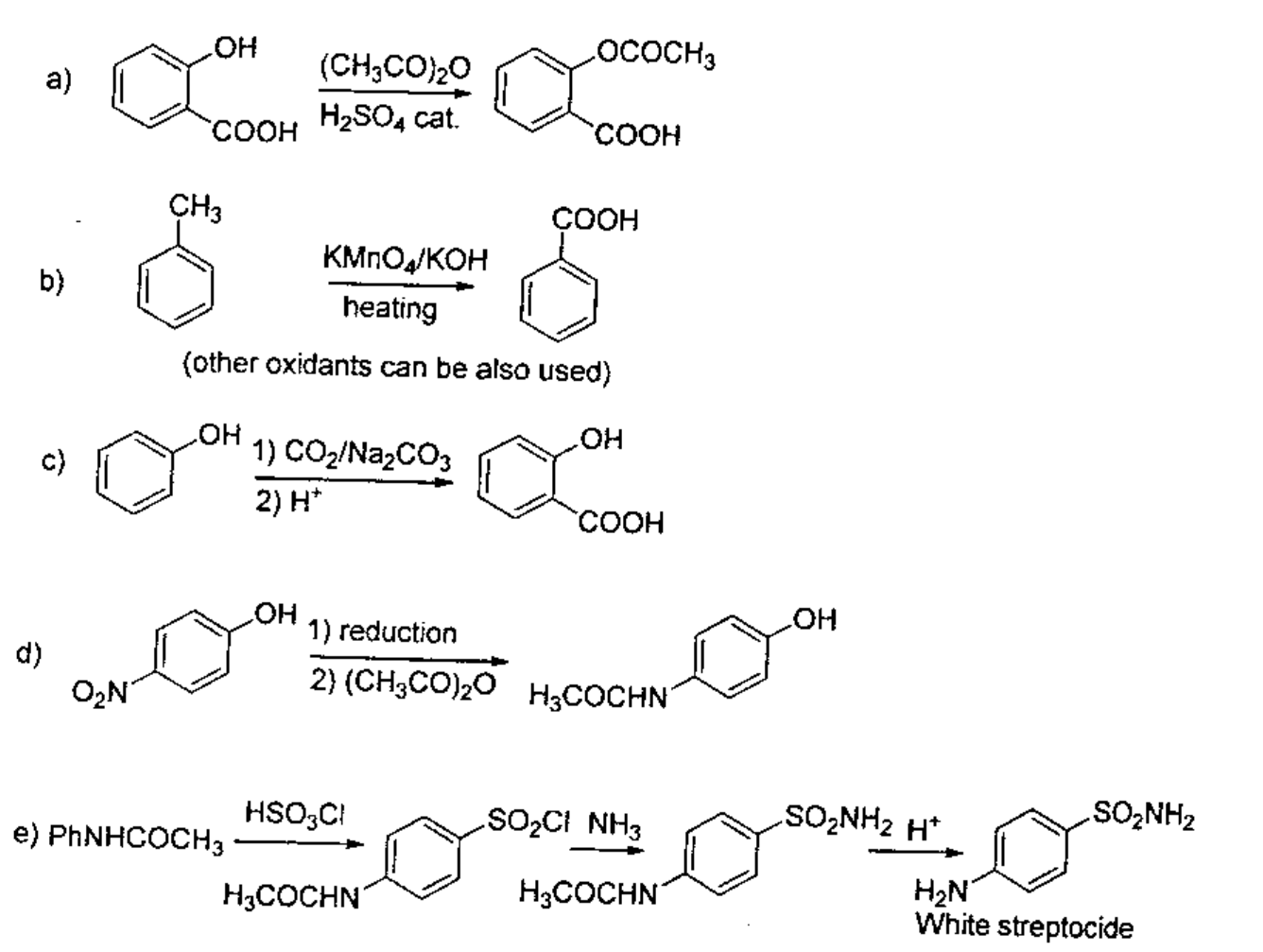
- Paracetamol is identified by the formation of a yellow nitro-derivative (in acidic media, nitrite introduces a nitro group (earlier believed to be a nitrozo group) in the 2ⁿᵈ position of phenol). The coloration develops most promptly in the case of paracetamol rather than streptocide, which needs to be identified with p-DMABA.
- Analgin forms an intensely colored blue radical with all the oxidizers. The radical undergoes fast decomposition. By contrast to paracetamol, aspirin and salicylic acid, analgin does not form any stable products with iron(III) or nitrite. Analgin reduces neutral permanganate, which differs it from streptocide and correlates with the existence of a double bond in its structure.
- Diazotization reaction:
- Formation of colored azo compounds (azo coupling reaction with phenols):
Distillation with water vapor can be used for separation because o-nitrophenol forms intramolecular hydrogen bond.
Теми и трудност
Трудност: неоценена.
Органична химия · Аналитична химия · Карбонилни съединения · Определяне на структура · Органичен синтез
Предпоставки: Разширена олимпиадна подготовка
Оригинал в Архива: 42_MMO_exp.pdf · официални решения: 42_MMO_exp_sol.pdf