IMChO 2013, Експеримент — Задача 1. Decomposition of hydrogen peroxide
The 47th Mendeleev Olympiad (2013)
Внимание: Бележка към темата
The source scan partly erases the equipment table label column on printed p.107 and clips the labels of questions 5.3 and 6 on p.110. No missing labels have been reconstructed.
Условие
(author – Chulkin P.V.)
Hydrogen peroxide is used as an oxidizing or weak reducing agent in organic and analytical chemistry as well as a disinfectant in medicine. When stored, hydrogen peroxide spontaneously decomposes, the process being significantly accelerated in the presence of various ions such as iodide. In this task, you will study the kinetics of catalytic decomposition of hydrogen peroxide.
The general plan
- Standardization of solution.
- Determination of the decomposition reaction order in : investigation of the dependence of peroxide concentration on time by titrimetry and determination of the reaction order from the obtained plot.
- Calculation of the rate constant of decomposition: plotting the concentration dependence on time in appropriate coordinates.
- Calculation of the reaction order with respect to iodide ion and derivation of the kinetic equation in the differential form.
- Determination of KI concentration in an unknown solution by the kinetic method: investigation of the concentration dependence on time (based on the results of 8 titrations) followed by the calculation of the rate constant from the dependence revealed above and the kinetic equation derived above.
Reagents, glassware and equipment
| Item | Quantity | Label |
|---|---|---|
| For each participant | ||
| Laboratory stand | 1 pc. | |
| Clamp | 2 pcs. | |
| Volumetric flask | 1 pc. | |
| Burette (for and ) | 2 pcs. | |
| 5 mL pipette (for ) | 1 pc. | |
| 10 mL graduated pipette (for KI) | 1 pc. | |
| 25–50 mL beaker (for preparation of solutions and filling the burettes with titrants) | 3 pcs. | |
| 300 mL bottle | 5 pcs. | , , KI, , |
| Funnel (for the burettes) | 2 pcs. | |
| Conical flask for titration | 2 pcs. | |
| 10 mL measuring cylinder (for ) | 1 pc. | |
| Wash bottle with distilled water | 1 pc. | |
| Rubber bulb | 1 pc. | |
| Spatula | 1 pc. | |
| Scaled paper (A4) | 1 pc. | |
| 0.050 M | 200 mL | |
| 0.10 M | 200 mL | |
| (~10 %) | 200 mL | |
| (0.10 M) | 300 mL | |
| KI (0.10 M) | 100 mL | KI |
| The solution of X ( M KI + 0.10 M ) | 100 mL | X |
| as “Hydroperite” tablet (complex of urea and ) | 2 tablets, 1.5 g each |
Procedure
a) Fill in the burettes with and solutions. Transfer a 5.00 aliquot of solution into the titration flask. Add 5 mL of using the cylinder. Titrate with solution until the mixture stops decolorizing (fig. 1/2013).
1. Write down the equation of reaction proceeding upon standardization. Calculate the precise concentration of .
b) Preparation of the working solution. Hydrogen peroxide oxidizes iodide in an acidic medium, thus the experiment should be conducted in an alkaline solution. Dissolve one ”Hydroperite” tablet in buffer solution (one tablet contains about 0.6 g of ). Transfer the solution in the 100 mL volumetric flask. Add KI solution in a quantity providing for its concentration in the final solution of 0.001, 0.003, 0.005, 0.007, or 0.009 M (choose any of these values). Bring up to the mark with solution. Write down the KI concentration in the resultant solution.
Record the time when the working solution was ready with an accuracy of 1 min (use your own watch or laboratory clock).
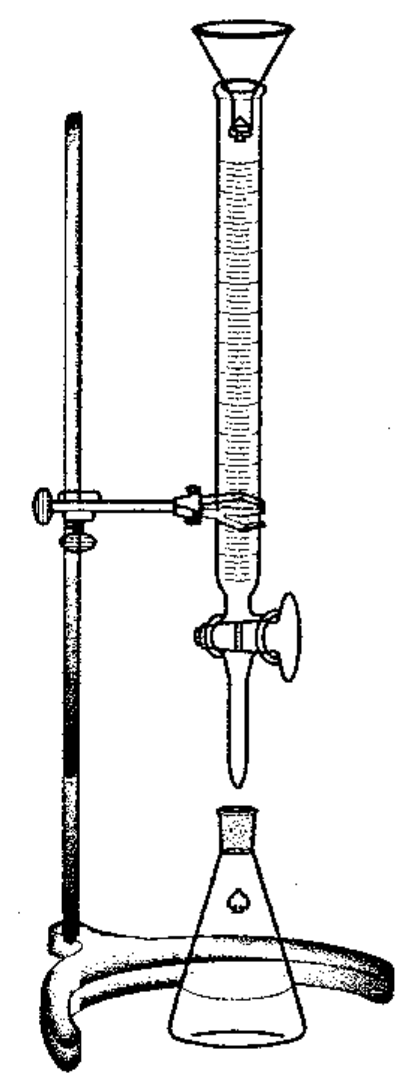
c) The kinetic experiment is based on back titration of the reaction mixture aliquots removed after definite periods of time. First, an excess of the acidified permanganate solution is added to the titration flask. The unreacted permanganate is further titrated with the iron sulfate solution.
2. Write down the equations of all the reactions occurring upon addition of to the aliquot. Calculate the amount of needed for complete oxidation of in a 5.00 mL aliquot. Write down the corresponding solution volume as .
Using the pipette, place solution into the beaker ( and extra 0.50 mL) and add 10 mL of 10 % . Using the pipette, remove a 5.00 mL aliquot of solution and put it into the titration flask. Rapidly add the solution from the beaker to the titration flask. Record the time with an accuracy of 10 s. Mix the flask contents and wait until the gas evolution is over.
Note. Gas evolution accompanies the aliquot removal. Thus, decomposes faster, the phenomenon making only marginal effect on the obtained results, which can be neglected.
Titrate the excess of with the solution. Write down the titrant volume consumed.
3. Calculate the concentration in the aliquot used.
Repeat the procedure with at least 8 aliquots of solution withdrawn after different periods of time. Always record the time with an accuracy of 10 s. Write down the results.
Note. Time intervals between the titrations of consecutively withdrawn aliquots should be within the range of 4 to 10 min.
4. Determine the reaction order of hydrogen peroxide decomposition on . If needed, plot the dependence of concentration on time. Propose coordinates affording linear dependence of concentration on time. Draw the plot in these coordinates on the graph-paper (Plot #1). Draw the straight line fitting the experimental points in the best possible way. You can skip the points looking as outliers (it is your decision!). Use the plot to evaluate the rate constant of decomposition following the kinetic equation .
d) At concentration M, the rate constant in the equation equals . The dependence of the rate constant on concentration is linear. Parameters of the complete kinetic equation of decomposition can be determined if two values of the rate constant corresponding to two concentrations are known. Write down the kinetic equation in the differential form with all the parameters as numeric values.
e) Wash the volumetric flask when finished with the above experiment. Dissolve the other tablet in solution and transfer the obtained solution to the volumetric flask. Transfer the KI solution of the unknown concentration quantitatively into the same flask and bring it up to the mark with solution. Titrate as described in item b and the plot of the results in coordinates providing for linear dependence of on time (Plot #2). Using the complete kinetic equation and Plot #2, calculate the amount of KI in the analyzed solution.
Answer the questions
5. The reaction of catalytic decomposition of peroxide is carried out in weakly alkaline medium. When analyzing , the reagents ( and ) are added in an excess, simultaneously and rapidly. What side reactions can occur if:
5.1. an aliquot of is directly titrated with the acidified solution?
5.2. solution is added first, which is followed by ?
.3. is not added to the initial solution?
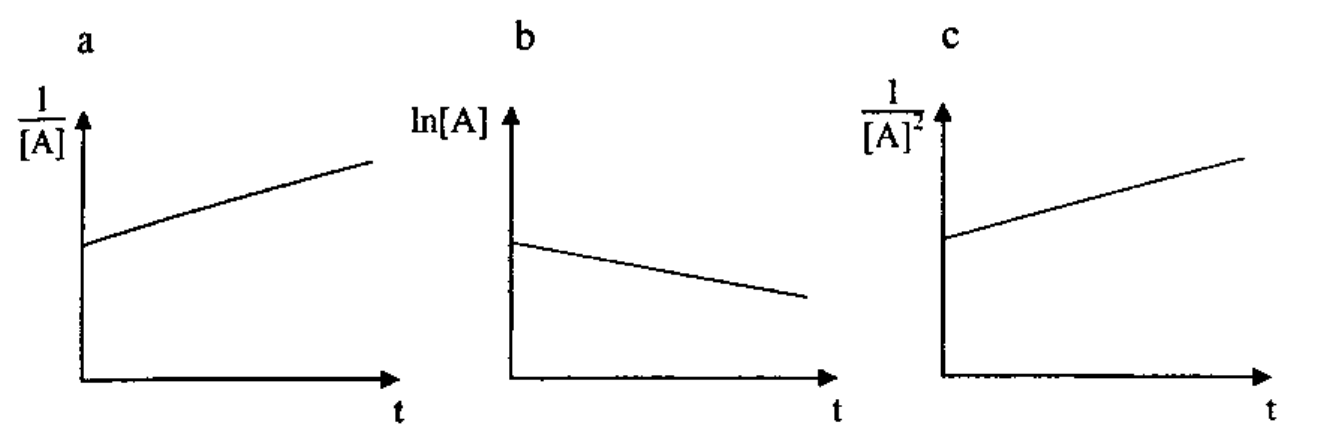
. Determine the reaction order on the substance A for each of the plots (a, b, c):
7. On the following graph, label each line (E vs. pH) with one of the following numbers:
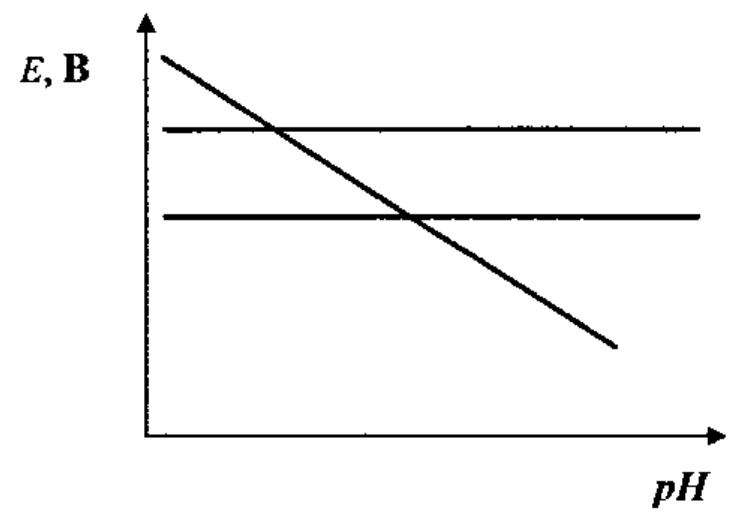
Is it possible to selectively oxidize with in the presence of ? If so, encircle the corresponding pH range.
Решение
.
Equations of the reactions proceeding when is added to the aliquot:
Calculation of the amount needed for complete oxidation (for initial concentration of 0.176 M):
Sample titration results:
| Absolute time, h.min.s. | Relative time (time of the experiment minus the initial time), s | V (KMnO₄) total, mL | V (FeSO₄), mL | c (H₂O₂), mol/L | Note showing outlier results |
|---|---|---|---|---|---|
| 10.00.10 | 370 | 8.0 | 3.8 | 0.159 | |
| 10.04.50 | 650 | 6.1 | 0.5 | 0.144 | |
| 10.08.20 | 860 | 7.0 | 2.3 | 0.149 | – |
| 10.13.20 | 1160 | 6.1 | 2.5 | 0.124 | |
| 10.15.40 | 1300 | 6.1 | 3.0 | 0.119 | |
| 10.22.00 | 1680 | 5.6 | 3.0 | 0.107 | |
| 10.28.00 | 2040 | 5.1 | 3.0 | 0.094 | |
| 10.33.15 | 2355 | 4.6 | 2.6 | 0.086 | |
| 10.37.00 | 2580 | 3.6 | 1.5 | 0.072 | – |
| 10.45.00 | 3060 | 3.6 | 1.8 | 0.069 |
- Peroxide concentration:
- Calculation of the reaction order: linear dependence is found in coordinates – time. The slope of the line () equals . The reaction order on equals unity.
Sample Plot #1:
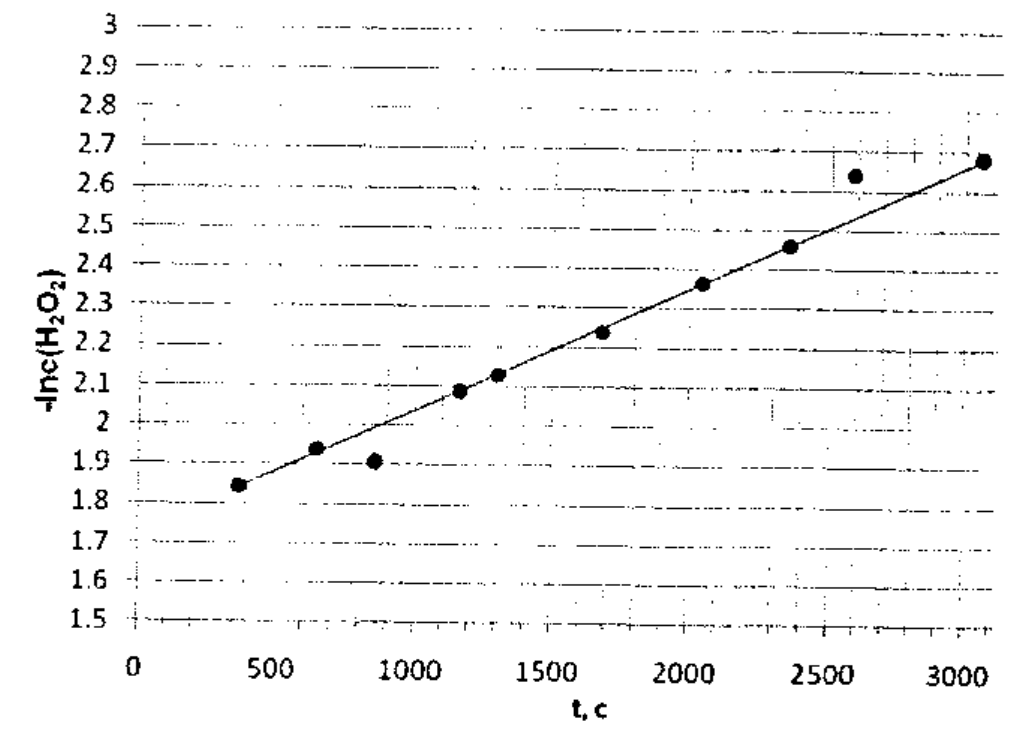
The slope of the above plot equals . The reaction rate of decomposition found from the graph: .
When marking, the Jury calculates the value and corresponding error using the least square procedure (the outliers are not counted).
where , time in seconds (from the Table), . The error:
where is the number of measurements; , accounts the experiment quality. Besides,
is calculated. This value indicates whether was calculated from the experimental data adequately. The values reported by the participants are not recalculated. Besides,
value is also calculated. The latter characterizes the quality of the aliquot removal and the solution preparation.
The criteria for giving points:
- : 12 points (maximum); : 0 points; : linear dependence of the number of points on .
- : 7 points (maximum); : 0 points; : linear dependence of the number of points on .
- : 6 points (maximum); : 0 points; : linear dependence of the number of points on .
5.1. (catalysis by manganese dioxide)
5.2.
5.3.
- The reaction order corresponding to the plots:
| a | b | c |
|---|---|---|
- The inclined line refers to , the lower horizontal one to , and the upper horizontal line to . Iodide oxidation by in the presence of chloride is possible in the pH range between the intercepts of the lines.
Теми и трудност
Трудност: неоценена.
Физикохимия · Аналитична химия · Химична кинетика · Титруване · Окисление и редукция
Предпоставки: Разширена олимпиадна подготовка
Оригинал в Архива: 47_MMO_exp.pdf · официални решения: 47_MMO_exp_sol.pdf