INPhO 2019, Теория — Задача 2. Particle in a one dimensional box
Indian National Physics Olympiad – 2019 · 3 февруари 2019 г. · 11 т.
Внимание: Бележка към темата
The complete retained question booklet includes summary answer boxes, eighteen blank detailed-answer pages and three blank graph sheets. All matching archived HBCSE key content is retained, including both full handwritten graph sheets and accepted alternatives/ranges. Printed exponent, sign, factor, notation and unit inconsistencies remain literal with labelled source notes.
Native cover and instructions
Indian National Physics Olympiad – 2019
Date: 03 February 2019. Time: 09:00–12:00 (3 hours). Maximum Marks: 75.
Roll Number: . Extra sheets attached: [blank box]. Centre (e.g. Kota): [blank line].
(Do not write below this line)
- This booklet consists of 29 pages (excluding this page) and total of 7 questions.
- This booklet is divided in two parts: Questions with Summary Answer Sheet and Detailed Answer Sheet. Write roll number at the top wherever asked.
- The final answer to each sub-question should be neatly written in the box provided below each sub-question in the Questions & Summary Answer Sheet.
- You are also required to show your detailed work for each question in a reasonably neat and coherent way in the Detailed Answer Sheet. You must write the relevant Question Number(s) on each of these pages.
- Marks will be awarded on the basis of what you write on both the Summary Answer Sheet and the Detailed Answer Sheet. Simple short answers and plots may be directly entered in the Summary Answer Sheet. Marks may be deducted for absence of detailed work in questions involving longer calculations. Strike out any rough work that you do not want to be considered for evaluation.
- Adequate space has been provided in the answersheet for you to write/calculate your answers. In case you need extra space to write, you may request additional blank sheets from the invigilator. Write your roll number on the extra sheets and get them attached to your answersheet and indicate number of extra sheets attached at the top of this page.
- Non-programmable scientific calculators are allowed. Mobile phones cannot be used as calculators.
- Use blue or black pen to write answers. Pencil may be used for diagrams/graphs/sketches.
- This entire booklet must be returned at the end of the examination.
Table of Constants
| Constant | Symbol | Value |
|---|---|---|
| Speed of light in vacuum | ||
| Planck’s constant | ||
| Universal constant of Gravitation | ||
| Magnitude of electron charge | ||
| Rest mass of electron | ||
| Value of | ||
| Avogadro’s number | ||
| Acceleration due to gravity | ||
| Universal Gas Constant | ||
| Permeability constant |
| Question | Marks | Score |
|---|---|---|
| 1 | 9 | |
| 2 | 11 | |
| 3 | 12 | |
| 4 | 7 | |
| 5 | 9 | |
| 6 | 14 | |
| 7 | 13 | |
| Total | 75 |
HOMI BHABHA CENTRE FOR SCIENCE EDUCATION
Tata Institute of Fundamental Research
V. N. Purav Marg, Mankhurd, Mumbai, 400 088
Native key cover
Solutions of Indian National Physics Olympiad – 2019
The native key cover repeats the nine instructions, twelve constant rows, seven-question score table totalling 75 marks, roll-number form and HBCSE address from the question cover. It prints “20 pages (excluding this page)”; the retained key contains twenty-one PDF pages, including two appended handwritten graph sheets.
Условие
Consider a particle of mass confined to a one dimensional box of length . The particle moves in the box with momentum colliding elastically with the walls. We consider the quantum mechanics of this system. As far as possible, express your answers in terms of .
a) At each energy state, the particle may be represented by a standing wave given by the de Broglie hypothesis. Express its wavelengths in terms of in the th energy state.
Summary answer box: [blank]. [1 т.]
b) Write the energy of the th energy state, .
Summary answer box: [blank]. [1 т.]
c) Let there be (mass ) electrons in this box where is an even number. Obtain the expression for the lowest possible total energy of the system (e.g., the ground state energy of this -particle system). Neglect coulombic interaction between the electrons.
Summary answer box: [blank]. [2 т.]
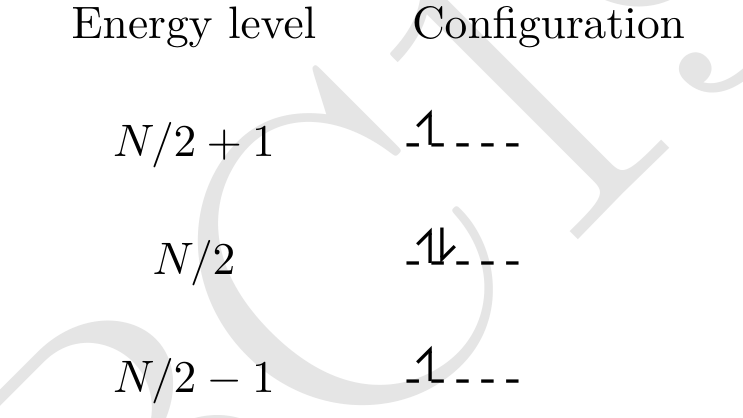
d) Express the total energy in terms of and relevant quantities when the system is in the first excited state. Also express the total energy in terms of and relevant quantities when the system is in the second excited state.
Summary answer boxes: [blank]; [blank]. [3,5 т.]
e) When the system is in the ground state, let the length of the box change slowly from to . Obtain the magnitude of the force on each wall in terms of , when .
Summary answer box: [blank]. [1 т.]
f) Assuming is large () obtain the ratio of to the energy level of the highest occupied ground state.
Summary answer box: [blank]. [1 т.]
g) We assume once again that is large. Consider the possibility of the electrons forming a uniform continuum of length with constant linear density. Using dimensional analysis, calculate the gravitational energy of this system assuming that it depends on its total mass, universal gravitational constant and . Equate this (attractive) energy to the (repulsive) energy . Obtain in terms of and related quantities.
Summary answer boxes: [blank]; [blank].
Detailed answers can be found on page numbers: [blank]. [1,5 т.]
Решение
(a)
(b)
where we have used .
(c)
Highest occupied level is and each level is occupied by the two electrons.
Source note: The first sum in printed Eq. (2.2) has no factor2 even though the adjacent text gives two electrons per level and the following sum has . The complete printed equality is retained.
(d)
1st excited state configuration is
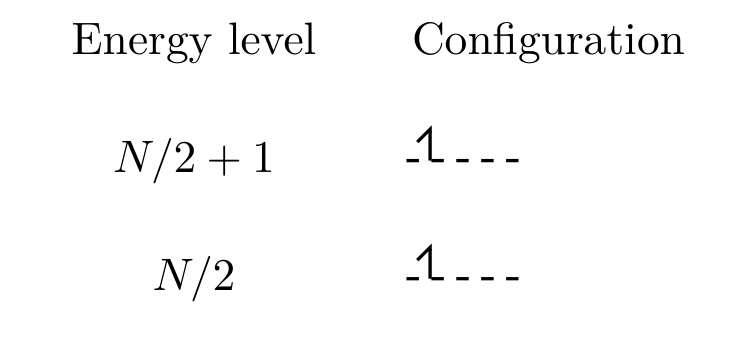
2nd excited state configuration is
(e)
From the work-energy theorem,
(f)
Highest occupied ground state corresponds to , for which the energy level is . Thus
(g)
For large , .
Оригинал в Архива: INPhO2019-Question.pdf · решение от архива: INPhO2019-Solution-20190219.pdf