INPhO 2023, Теория — Задача 1. Dancing on the floor
Indian National Physics Olympiad (INPhO)-2023 — Question Paper · 29 януари 2023 г. · 6 т.
Указания
Date: 29 January 2023
Time: 09:00-12:00 (3 hours) Maximum Marks: 60
Instructions Roll No.:
- This booklet consists of 6 pages and total of 5 questions. Write roll number at the top wherever asked.
- Booklet to write the answers is provided separately. Instructions to write the answers are on the Answer Booklet.
- Non-programmable scientific calculators are allowed. Mobile phones cannot be used as calculators.
- Please submit the Answer Sheet at the end of the examination. You may retain the Question Paper.
Table of Constants
| Speed of light in vacuum | ||
| Planck’s constant | ||
| Universal constant of Gravitation | ||
| Magnitude of electron charge | ||
| Rest mass of electron | ||
| Value of | ||
| Avogadro’s number | ||
| Acceleration due to gravity | ||
| Universal Gas Constant | ||
| Boltzmann constant | ||
| Permeability constant | ||
| 1 Angstrom unit | 1Å | |
| 1 micro unit | units | |
| 1 electron volt | 1 eV |
| Q No | 1 | 2 | 3 | 4 | 5 | Total |
|---|---|---|---|---|---|---|
| Maximum Marks | 6 | 6 | 16 | 16 | 16 | 60 |
Указания
Date: 29 January 2023
Time: 09:00-12:00 (3 hours) Maximum Marks: 60
Instructions Roll No.:
- This booklet consists of 19 pages and total of 5 questions. Write roll number at the top wherever asked.
- Booklet to write the answers is provided separately. Instructions to write the answers are on the Answer Booklet.
- Non-programmable scientific calculators are allowed. Mobile phones cannot be used as calculators.
- Please submit the Answer Sheet at the end of the examination. You may retain the Question Paper.
Table of Constants
| Speed of light in vacuum | ||
| Planck’s constant | ||
| Universal constant of Gravitation | ||
| Magnitude of electron charge | ||
| Rest mass of electron | ||
| Value of | ||
| Avogadro’s number | ||
| Acceleration due to gravity | ||
| Universal Gas Constant | ||
| Boltzmann constant | ||
| Permeability constant | ||
| 1 Angstrom unit | 1Å | |
| 1 micro unit | units | |
| 1 electron volt | 1 eV |
| Q No | 1 | 2 | 3 | 4 | 5 | Total |
|---|---|---|---|---|---|---|
| Maximum Marks | 6 | 6 | 16 | 16 | 16 | 60 |
Please note that alternate/equivalent methods and different way of expressing final solutions may exist. A correct method will be suitably awarded.
Условие
There are various apps that record the intensity of an audio signal. An app (WaveEditor here) displays the audio signal as a wave, whose amplitude is proportional to the audio signal’s loudness. A smartphone with this app recording the sound signal is kept on a uniformly built flat floor of a classroom.
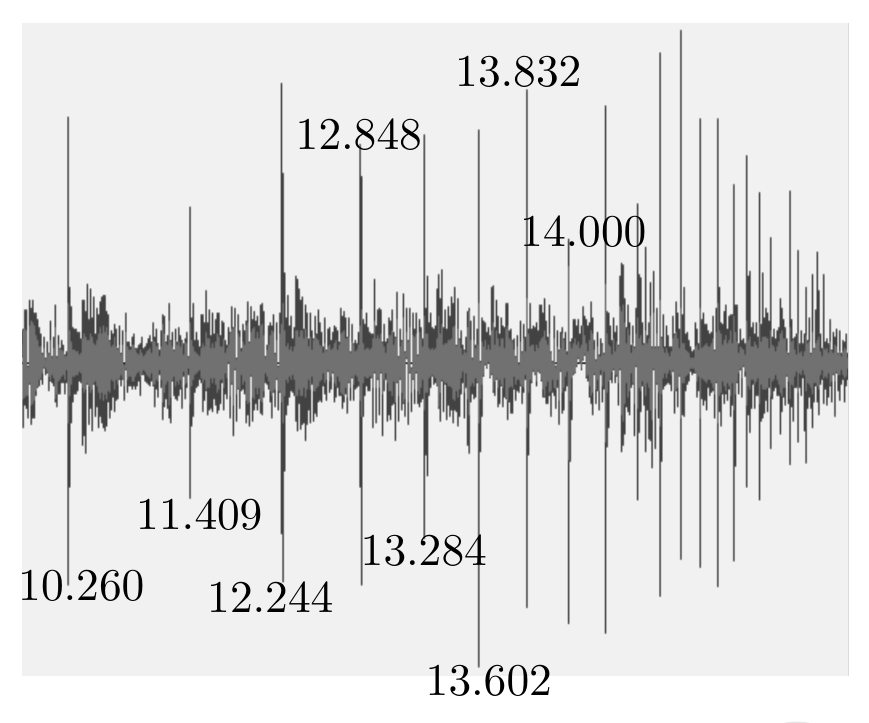
A perfectly small spherical steel ball is thrown up such that it almost touches the ceiling and comes back without hitting. The ball hits the floor and thereafter it keeps bouncing. The app records the sound signal produced when the ball hits the floor on every bounce. A screenshot of the recording is shown. The timestamps (in seconds) of the first eight consecutive bounces are also shown next to the peak. For example, the app records a peak at 10.260 s when the first time the ball hits the floor.
Make reasonable assumptions, when the ball hits the floor and calculate the height of the classroom from the given data. State your assumptions clearly.
Отговори
3.06 m
Official solution: h0 = 3.06 m; the accepted range of h0 is 2.80 m – 3.12 m.
Решение
Solution: The initial height of the peaks seems to be random. This might happen when the ball hits the floor near the phone and some time away from the phone. The time interval between the peaks is reducing, indicating that the ball is colliding inelastically with the floor.
It is also not given when the app started recording the sound. If we take the timestamp of first peak (10.26 s) to be the true time taken for the first bounce, that will give the height of the room to be 131 m which is a nonphysical number for a classroom’s height.
Since the ball and the floor both are uniformly shaped objects, we can consider that in each bounce, the ball loses the same amount of energy. Let the height of the room be . The ball attains the height , and after the first and the second bounce respectively.
Let the time interval between the first and the second bounce be and the time interval between second and the third bounce be and . This yields
where
Substituting Eqs. (1.4) and (1.5) in Eq.(1.3), we get
Alternate ways of solving exist. The accepted range of is .
Оригинал в Архива: INPhO2023-Question.pdf · официални решения: INPhO2023-Solution-20230215.pdf