INPhO 2024, Теория — Задача 3. Chandrayaan-3
Indian National Physics Olympiad (INPhO)-2024 — Question Paper · 4 февруари 2024 г. · 14 т.
Внимание: Бележка към темата
The original question booklet and the complete available matching key are retained. The separately mentioned Answer Booklet is not included in this retained archive source set. Printed formula, graph-label and prose discrepancies in the key are preserved, rather than silently corrected. In key2(d), only the four vertices of face C′F′E′B′ are explicitly listed, although the question asks for all vertices of the second prism.
Original cover and instructions
Indian National Physics Olympiad (INPhO)-2024
HOMI BHABHA CENTRE FOR SCIENCE EDUCATION
Tata Institute of Fundamental Research
V. N. Purav Marg, Mankhurd, Mumbai, 400 088
Question Paper
Date: 04 February 2024
Time: 09:00-12:00 (3 hours)
Maximum Marks: 80
Instructions — Roll No.:
- This booklet consists of 9 pages and total of 6 questions. Write roll number at the top wherever asked.
- Booklet to write the answers is provided separately. Instructions to write the answers are on the Answer Booklet.
- Non-programmable scientific calculators are allowed. Mobile phones cannot be used as calculators.
- Please submit the Answer Sheet at the end of the examination. You may retain the Question Paper.
| Question Number | 1 | 2 | 3 | 4 | 5 | 6 | Total |
|---|---|---|---|---|---|---|---|
| Maximum Marks | 8 | 18 | 14 | 11 | 18 | 11 | 80 |
Table of Constants
| Universal constant of Gravitation | ||
| Value of | ||
| Avogadro’s number | ||
| Acceleration due to gravity | ||
| Universal Gas Constant | ||
| Molar mass of Helium | ||
| Boltzmann constant | ||
| Earth’s radius | ||
| Earth’s mass | ||
| Moon’s mass | ||
| Moon’s radius |
Native key notice
The matching key cover repeats the cover and instructions with “23 pages”.
Please note that alternate/equivalent methods and different way of expressing final solutions may exist. A correct method will be suitably awarded.
Условие
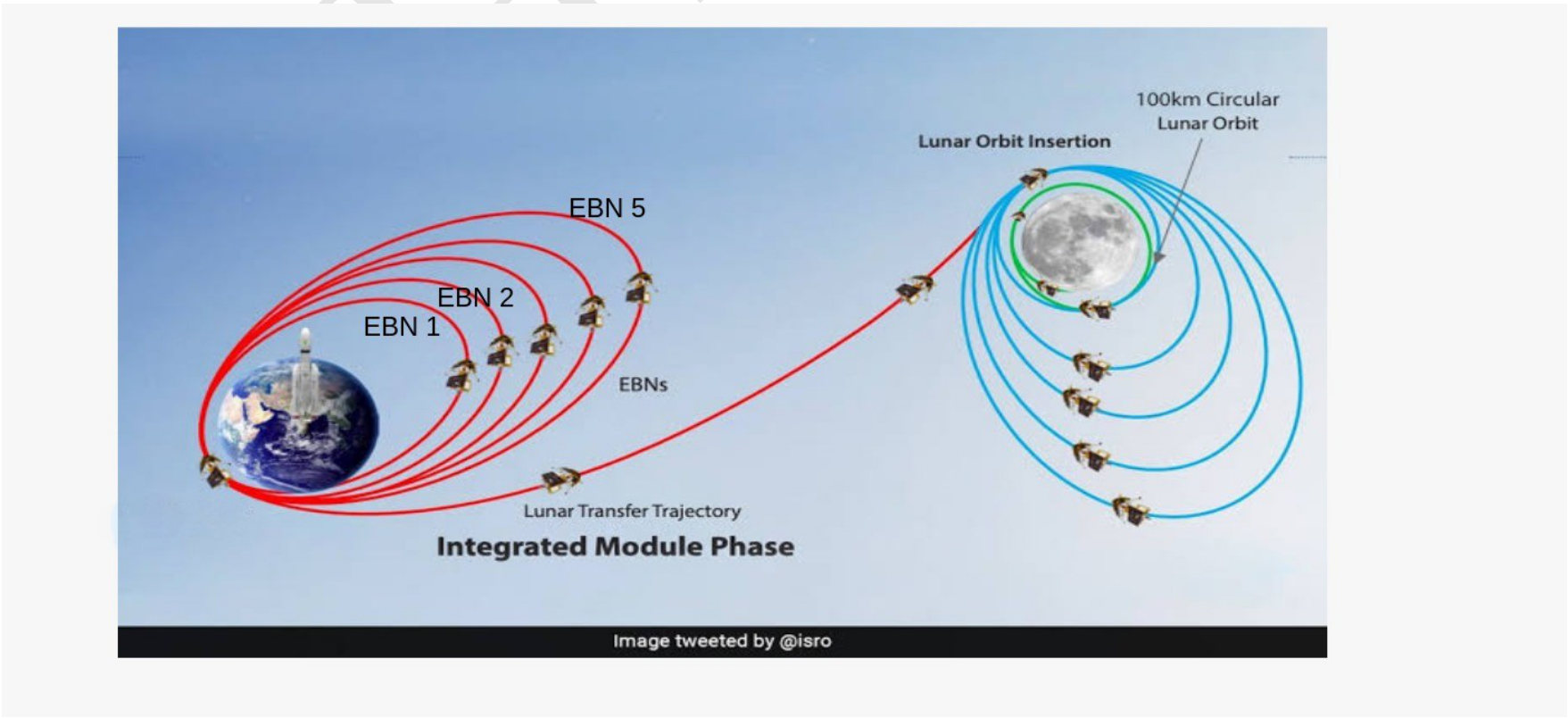
On July 14, 2023, India’s lunar mission satellite, Chandrayaan-3, was successfully launched by the Indian Space Research Organization (ISRO). Chandrayaan-3 (mass ) was taken to the Moon through a series of Earth Bound Manoeuvres (elliptical) orbits (EBNs) as depicted in the figure below. In this problem, we will explore the physics governing some part of its journey, employing a simplified model. For all parts of this problem except part (f), we consider Chandrayaan-3 to be moving only under the influence of Earth’s gravity (a central force).
a) Upon launch, Chandrayaan-3 entered an elliptical orbit around Earth, with Earth at one of the foci (E) as shown below. The points P and A are the perigee (nearest point from the Earth) and apogee (farthest point from the Earth), respectively. We introduce the polar coordinate system , where is the vector from the centre of the Earth (origin) to the satellite, and is the angle that makes with the major axis (PA = ). The directions of unit vectors and are shown in the figure.
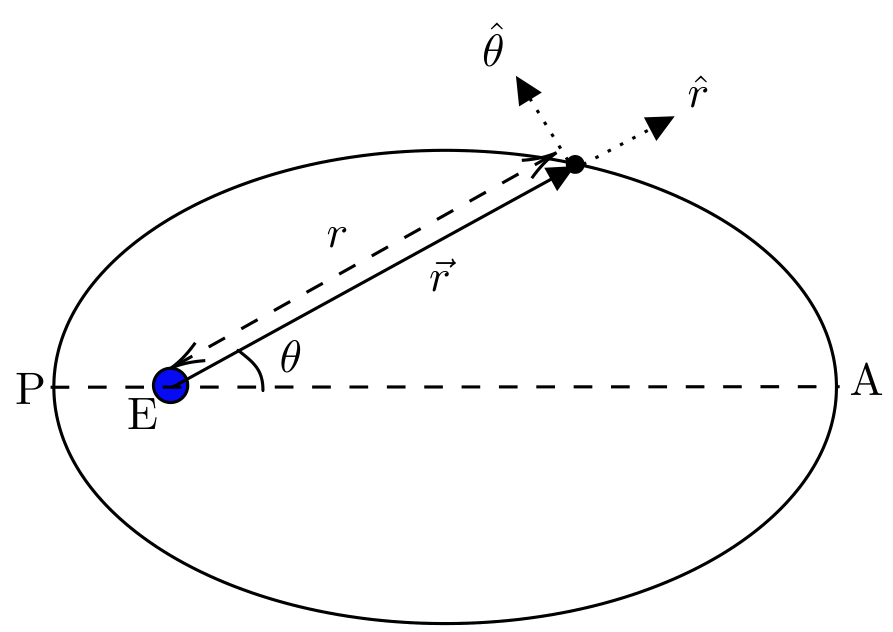
The equation of the ellipse can be written in polar coordinates as
where is eccentricity of the orbit and is called the latus rectum. The velocity of the satellite in polar coordinates can be written as
where is the “radial” speed and is the “tangential” speed.
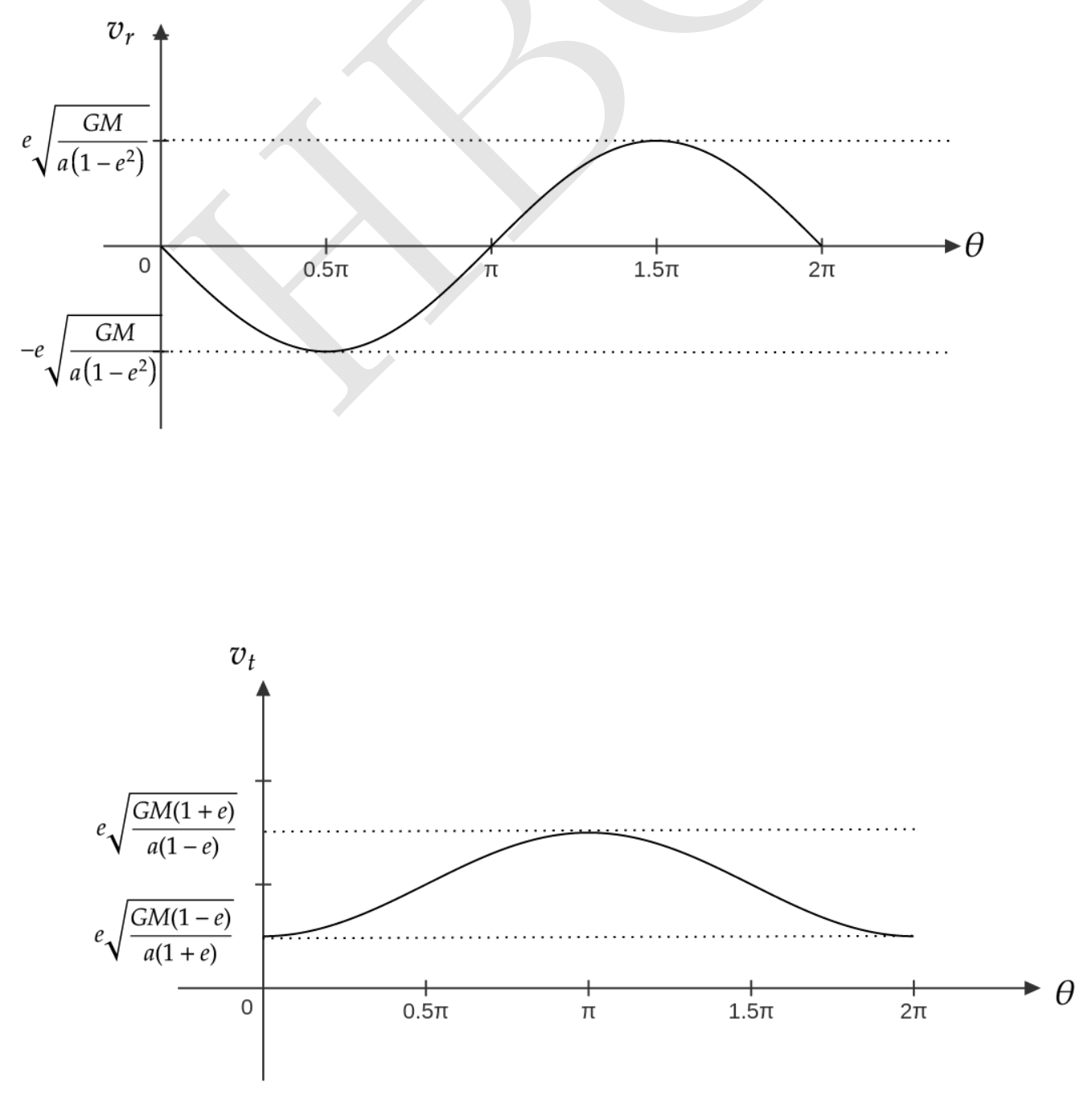
Make schematic plots of the speeds and as functions of over one full orbit. Mark any significant points in the plots in terms of , and other variables. [6 т.]
b) Obtain an expression for the total energy of the orbiting satellite in terms of and other constants. [1,5 т.]
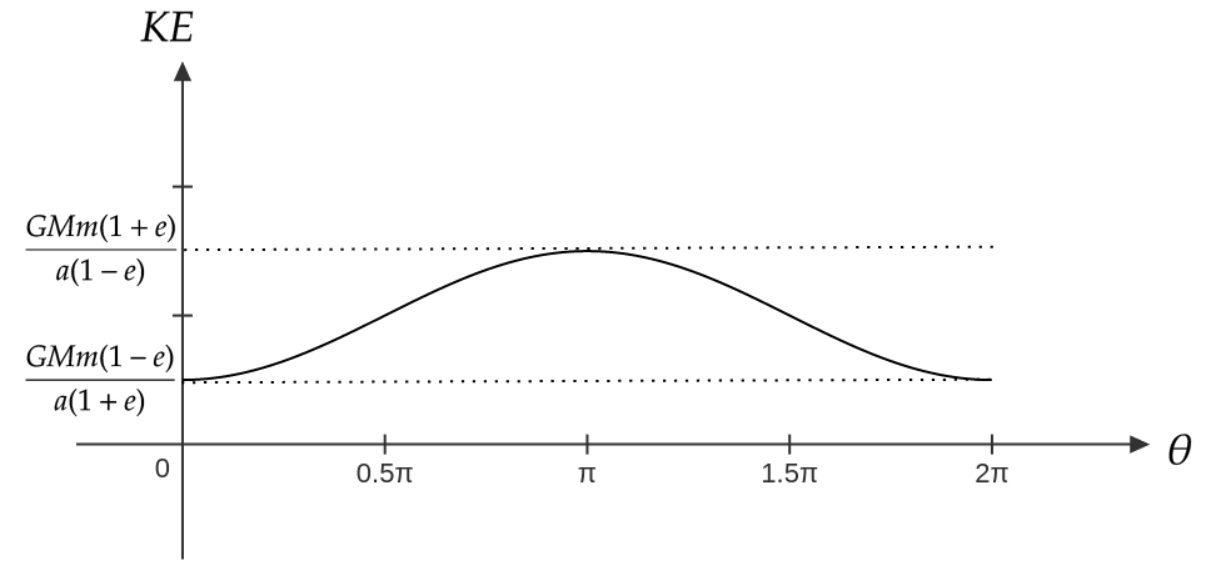
c) Plot the kinetic energy (KE) of the satellite as a function of over one full orbit. Mark any significant points in terms of , and other variables. [1 т.]
d) The perigee and apogee of the elliptical orbit in part (a) are 200 km and 36500 km, respectively. It is generally described as a (200×36500) km orbit. Here the distances are defined from the surface of the Earth. Calculate the period of rotation (in hr) of Chandrayaan-3 in this orbit. [1,5 т.]
e) To move Chandrayaan-3 from the first orbit (in part (d)) to another elliptical orbit EBN-1, an instantaneous boost was applied at perigee by changing the velocity by , without altering the direction. This changed the apogee to 41800 km above Earth’s surface while keeping the perigee unchanged. Calculate . [2,5 т.]
f) After a series of manoeuvres, Chandrayaan-3 was placed in an elliptical orbit of (100 × 1437) km around the Moon. Here, the distances are calculated from the surface of the Moon. Calculate the change in velocity , applied at the perigee, that is required to bring Chandrayaan-3 from this elliptical orbit to a circular orbit at a distance of 100 km from the surface of the Moon. For this part, assume that Chandrayaan-3 is only under the influence of the Moon’s gravitational field. [1,5 т.]
Решение
(a) Solution: It is given that
Since the force is central, angular momentum is conserved. The conserved angular momentum is given by
Substituting above equation and expression of in , after simplifying, we get
We know that
Substituting the value of , we get
From above equation, the value of is maximum, when is minimum. i.e. . The maximum value of
From Eq. (3.7), is minimum, when is maximum. i.e . The minimum value of
Since the velocities at P and A are purely tangential, and P is closer to earth as compared to A, hence the tangential speed is maximum at P. Let the velocity of the satellite in the given orbit at P be and velocity at A be . Conservation of energy gives:
Conservation of angular momentum gives
Substituting the above equation into the energy conservation equation, we get
Similarly
Hence the conserved angular momentum can be written as
On simplification, we get
and can also be written as
Similarly , , and can also be written as
(b) Solution: Let
Putting Eq. (3.23) in Eq. (3.10), we get
solving above equation, we get
Again using Eq. (3.23) and value of from above equation in LHS of the Eq. (3.24), we get
Solving above equation, and substituting , we get
(c) Solution:
where . Substituting the value of and in the above equation, we get
For , , and for .
(d) Solution: The period of the orbit is given by
where , where is perigee distance given by and is apogee distance given by and i.e. .
(e) Solution: since the velocities at P and A are purely tangential, and P is closer to earth as compared to A, hence the tangential speed is maximum at P. Let the velocity of the satellite in the given orbit at P be and velocity at A be . Conservation of energy gives:
Conservation of angular momentum gives
Substituting the above equation into the energy conservation equation, we get
Similarly
From Eq. (3.36)
In the new orbit, the perigee distance is kept the same, and the apogee distance changed to 41800 km, hence and remains as it is. Hence, the new velocity at the perigee distance is Using the expression Eq. (3.36), the can be written as
Now the boost required at this position would be
(f) Solution: Let the apogee distance be and perigee distance be The velocity of the satellite at perigee, when it is in the elliptic orbit, is and the velocity when it is in the circular orbit is we know that
Similarly here apogee distance be and perigee distance be . Let
(3.52)
The boost required
Source notes: The literal key is retained, including the duplicated in (3.15), in (3.16), the extra eccentricity factor in the tangential-speed graph labels, in (3.26), and the missing factor in the printed (3.29) and kinetic-energy graph labels. The key’s prose in (d) prints apogee 18350 km, whereas the question and subsequent calculation use 36500 km; it uses Earth mass kg whereas the constants table prints kg. Equation (3.44) prints unprimed in its numerator; (3.50) prints instead of . The original (3.52) is an empty equation-number line.
Rough-work pages
Space for rough work — will NOT be submitted for evaluation
The original question and matching key end with blank rough-work pages (question page9 and key page23).
Оригинал в Архива: INPHO2024-Question.pdf · официални решения: INPHO2024-Solution-20240206.pdf