INPhO 2026, Теория — Задача 1. Find the flaw
Indian National Physics Olympiad (INPhO)-2026 · Question Paper · 1 февруари 2026 г. · 12 т.
Внимание: Бележка към темата
Matching original question and official key booklets are retained in full. The separate blank Answer Booklet, Summary Answersheet copies and blank graph paper referred to in the questions are absent from the archive; the supplied completed Kepler/glass answer-sheet illustrations remain in the key. Native question pages7 and9 are blank. Question6 says photographs on the next page although its photos occur on native p10 after blank p9. Printed source errors/conventions are preserved and attributed locally: P2 negative dM followed by positive boxed dUm and changing absolute-work notation; P3 Qa=-W followed by positive released heat, dropped-mass wording and P0/V0 notation; P4 derivative/height signs, c/cs and time-delay description; P5 intermediate phiP versus final phiC, log log and r/logarithm numerical scales. The graph/grid pixels and printed fitted results are source data, not newly calculated measurements.
Question booklet · Instructions and Table of Constants
Indian National Physics Olympiad (INPhO)-2026
HOMI BHABHA CENTRE FOR SCIENCE EDUCATION · Tata Institute of Fundamental Research · V. N. Purav Marg, Mankhurd, Mumbai, 400 088
Question Paper
Date: 01 February 2026 · Time: 09:00–12:00 (3 hours) · Maximum Marks: 75
Roll Number: □□□□ – □□□□ – □□□□
Instructions
- This booklet consists of 10 pages and total of 6 questions. Write roll number at the top wherever asked.
- Booklet to write the answers is provided separately. Instructions to write the answers are on the Answer Booklet.
- Non-programmable scientific calculators are allowed. Mobile phones cannot be used as calculators.
- Take as many data points as possible for the analysis.
- Please submit the Answer Sheet at the end of the examination. You may retain the Question Paper.
- Except for writing your roll number, no rough work or scribbling is allowed on the question paper.
Table of Constants
| Quantity | Symbol | Value |
|---|---|---|
| Speed of light in vacuum | ||
| Magnitude of electron charge | ||
| Avogadro’s number | ||
| Acceleration due to gravity | ||
| Universal Gas Constant | ||
| Boltzmann constant | ||
| Permeability constant | ||
| One Atmospheric pressure | atm |
| Question Number | 1 | 2 | 3 | 4 | 5 | 6 | Total |
|---|---|---|---|---|---|---|---|
| Maximum Marks | 12 | 12 | 11 | 10 | 18 | 12 | 75 |
Solution booklet · Instructions, constants and alternate-method note
Indian National Physics Olympiad (INPhO)-2026
HOMI BHABHA CENTRE FOR SCIENCE EDUCATION · Tata Institute of Fundamental Research · V. N. Purav Marg, Mankhurd, Mumbai, 400 088
Question Paper
Date: 01 February 2026 · Time: 09:00–12:00 (3 hours) · Maximum Marks: 75
Roll Number: □□□□ – □□□□ – □□□□
Instructions
- This booklet consists of 21 pages and total of 6 questions. Write roll number at the top wherever asked.
- Booklet to write the answers is provided separately. Instructions to write the answers are on the Answer Booklet.
- Non-programmable scientific calculators are allowed. Mobile phones cannot be used as calculators.
- Take as many data points as possible for the analysis.
- Please submit the Answer Sheet at the end of the examination. You may retain the Question Paper.
- Except for writing your roll number, no rough work or scribbling is allowed on the question paper.
Table of Constants
| Quantity | Symbol | Value |
|---|---|---|
| Speed of light in vacuum | ||
| Magnitude of electron charge | ||
| Avogadro’s number | ||
| Acceleration due to gravity | ||
| Universal Gas Constant | ||
| Boltzmann constant | ||
| Permeability constant | ||
| One Atmospheric pressure | atm |
| Question Number | 1 | 2 | 3 | 4 | 5 | 6 | Total |
|---|---|---|---|---|---|---|---|
| Maximum Marks | 12 | 12 | 11 | 10 | 18 | 12 | 75 |
Please note that alternate/equivalent methods and different ways of expressing final solutions may exist. A correct method will be suitably awarded.
Условие
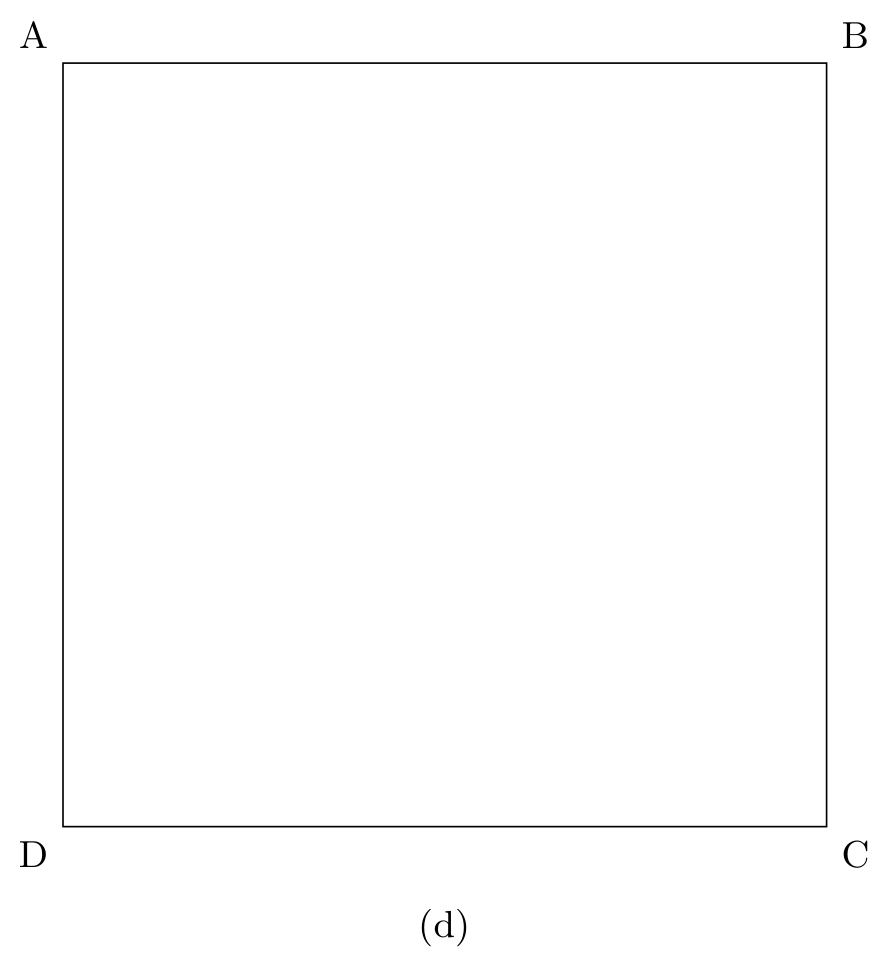
Consider a non-conducting, charged, thin cubical shell with a uniform surface charge density. Consider the plane ABCD, which vertically and symmetrically divides the cubical shell (see figure).
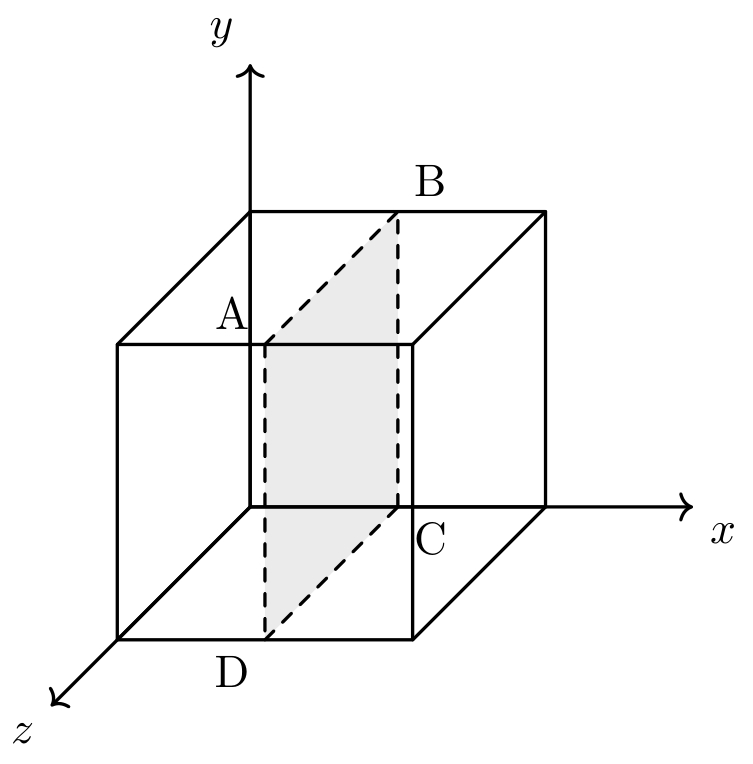
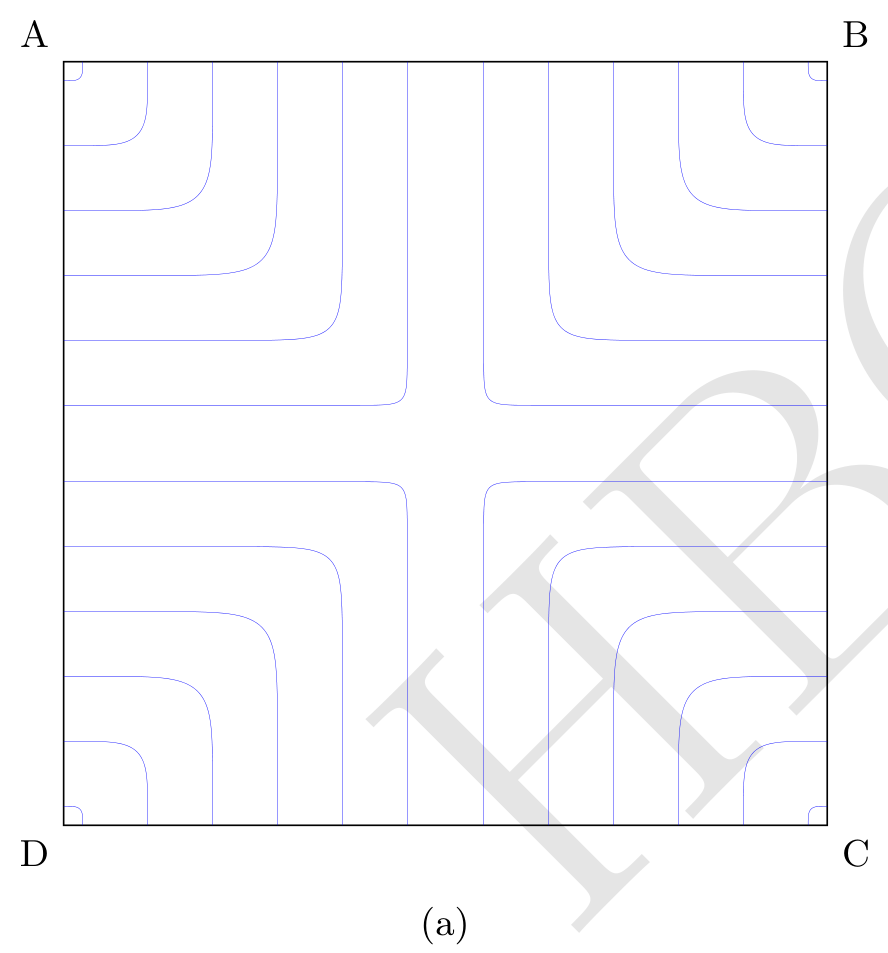
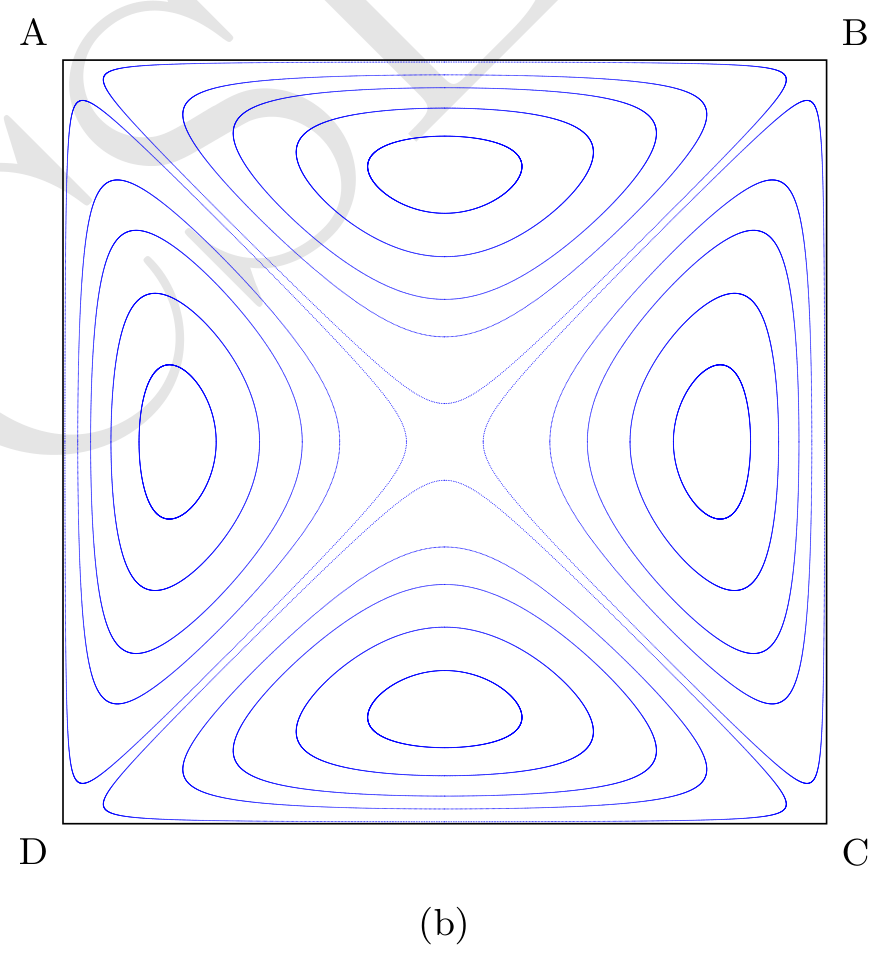
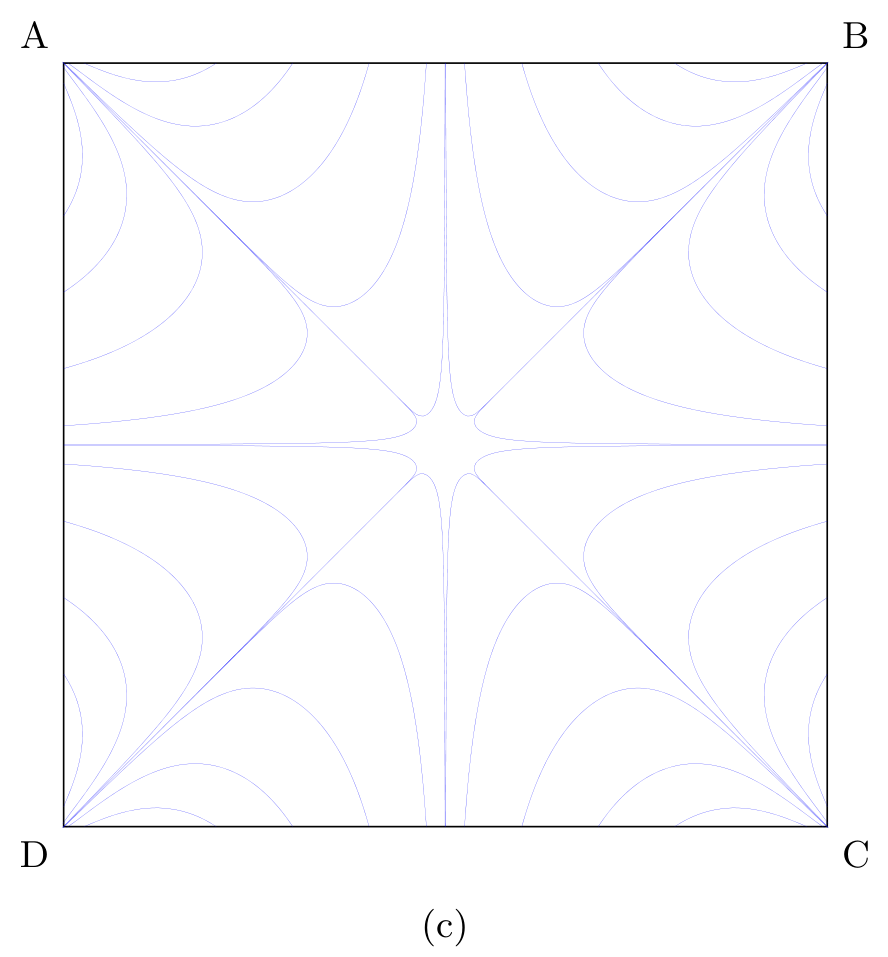
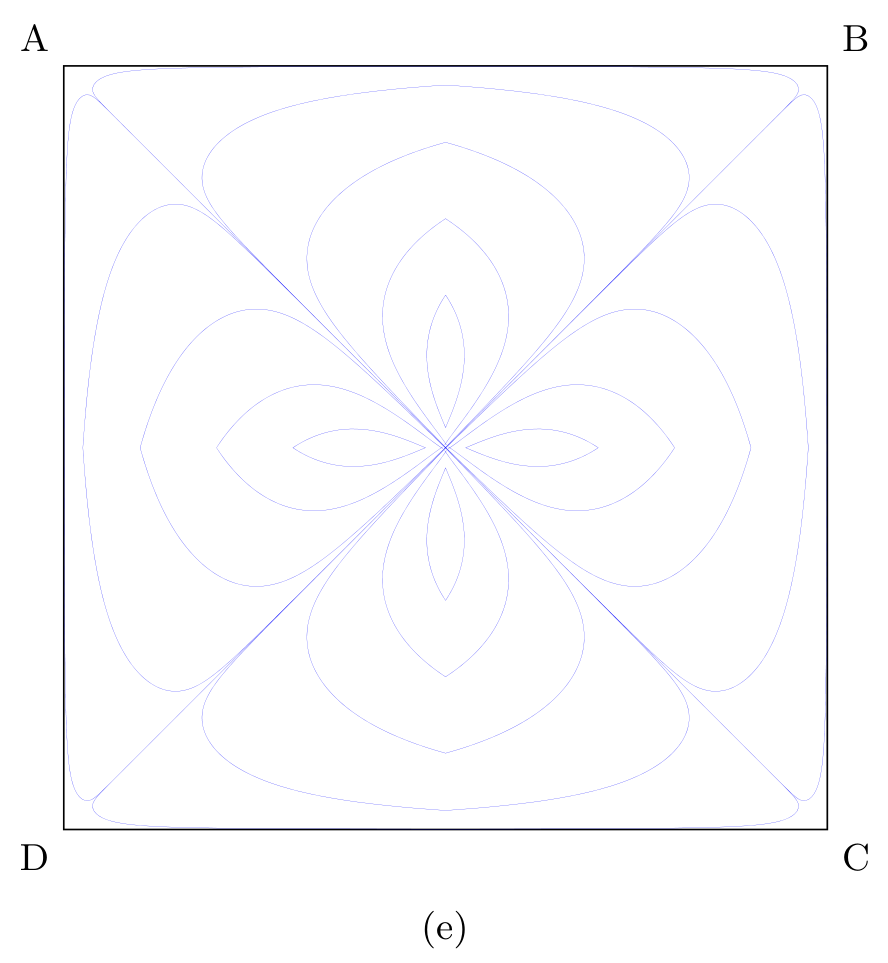
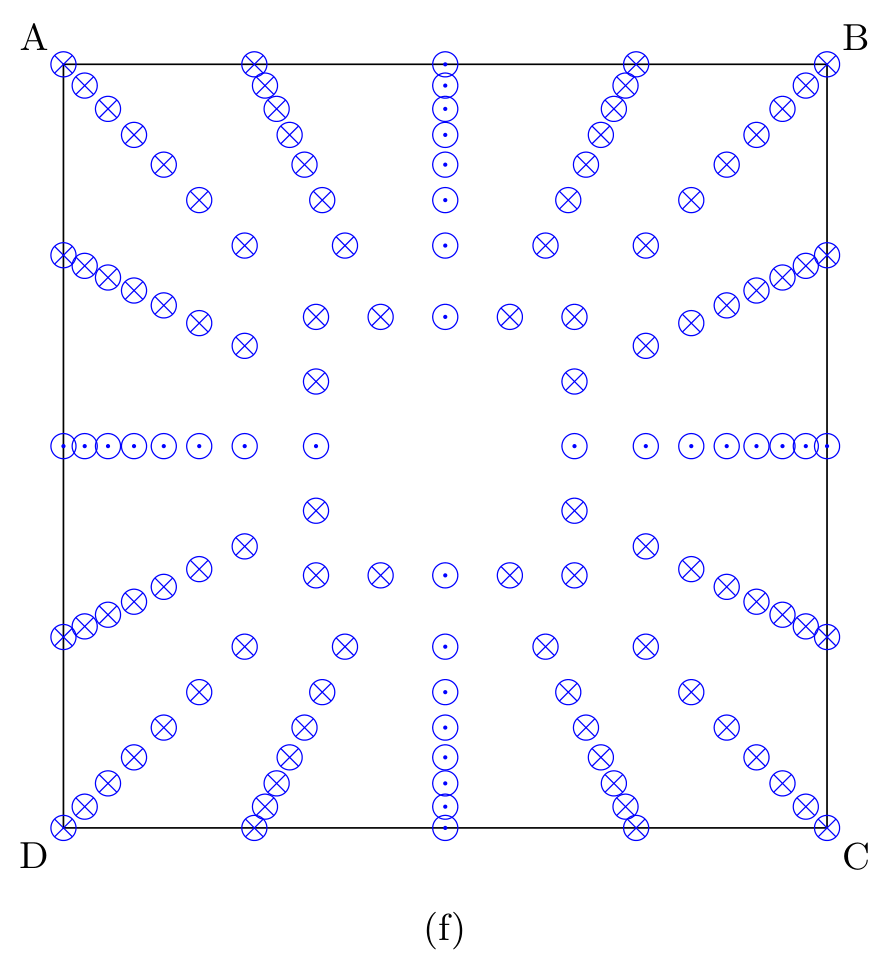
Six students independently solved for the electric field on the plane ABCD and presented six different answers, shown below in Figs. (a) to (f), each approximately depicting the electric field lines in the ABCD plane (the field line arrows are not shown). Consider each of the six answers, and for each, give
- at least one reason (based on a physics argument), explaining why it is incorrect
OR
- at least two reasons why it could be correct.
Note that you are not required to obtain the correct depiction of the electric field or to provide a detailed derivation in this question.
In none of the figures, adjacent field lines touch or intersect each other, although they may appear to do so in Fig. (c) and Fig. (e), where they are very close. In Fig. (d), the diagram indicates that no field is present. In Fig. (f), denotes a field directed along the axis, and denotes a field directed along axis.
Отговори
(a), (b), (d), (e), (f): Incorrect; (c): May be correct.
Native reasons and qualifications retained; the question does not ask for an exact field derivation.
Решение
A key thing to take into account in the given problem is that all the charge is uniformly distributed over the surface of the cube, and there are no other charges inside (or outside the cube).
Some arguments for why each option is clearly incorrect or may be correct are given below. Most of these are based on symmetry arguments (all faces of the cube are identical, and therefore, reflections of the cube surfaces about planes passing through its centre and either parallel to its faces, or passing through diagonally opposite vertices must not alter the electric field at all).
Other valid arguments may be possible and will be evaluated according to their merit.
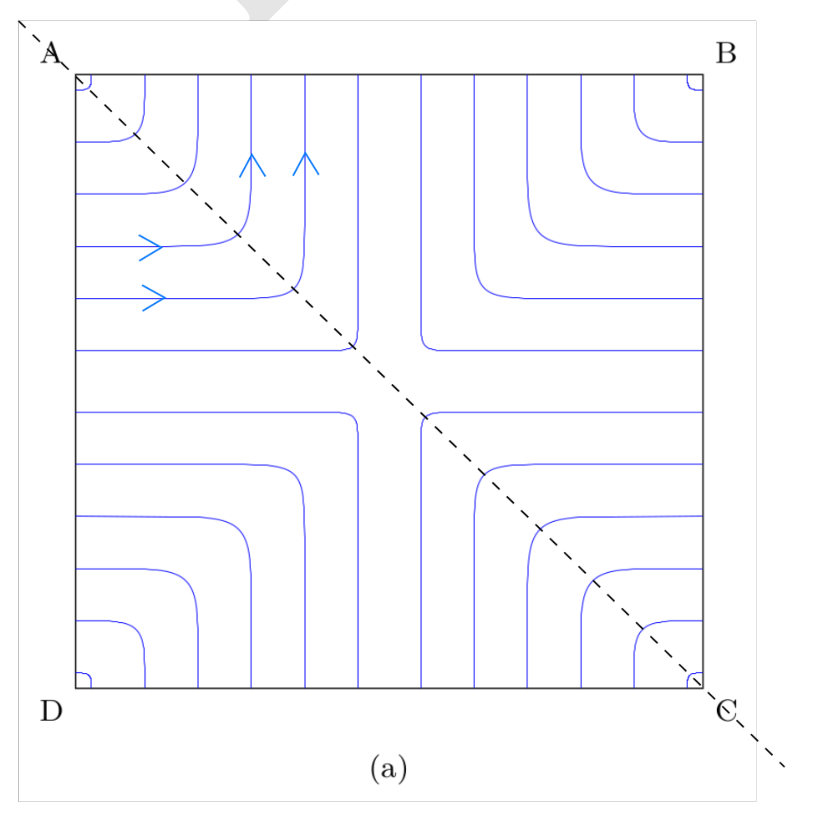
(a) Incorrect
The electric field pattern does not remain unchanged under reflection about a diagonal mirror line in the plane. This can be seen by assigning a direction to the field lines as drawn (see figure). Under reflection along the dashed line, the direction of the electric field reverses, whereas symmetry requires the field to be invariant. Choosing the opposite direction for the field lines leads to the same contradiction. Hence, this option is incorrect.
(b) Incorrect
(a) Electric field lines cannot form closed loops. Since the curves shown form closed loops, this diagram cannot represent an electrostatic field.
(b) Very near the centre of a face, the electric field is dominated by the nearby uniformly charged face. A uniformly charged finite flat surface produces an electric field normal to the surface in the middle region. In this diagram, the electric field is shown to be parallel to the edges near the face centre, which is physically incorrect. Hence, this option is incorrect.
(c) May be correct
This pattern may be correct, based on the following two arguments, and in the absence of an obviously incorrect feature.
(a) This pattern respects all mirror symmetries of the cube (irrespective of the direction of arrows placed on each line), and the electric field lies entirely within the symmetry plane. Also, by symmetry, the electric field at the centre of the cube must vanish, which is correctly depicted.
(b) Near the centres of the faces, the electric field is dominated by the nearby uniformly charged face and is therefore approximately normal to the face. Away from the face centres, the relative contributions from different faces change, leading to a smooth bending of the field lines.
(d) Incorrect.
Unlike a conducting shell, there is no mechanism that can make the electric field vanish everywhere inside. A uniformly charged non-conducting cubical shell does not allow charge rearrangement on the surface. In particular, near an edge of the cube there is positive surface charge in its immediate neighbourhood, which must produce a nonzero electric field in the interior. Hence the claim everywhere inside is incorrect.
(e) Incorrect
(a) Several field lines converge at the centre, implying the presence of a charge there. Since the interior contains no charge, this pattern is impossible.
(b) The field lines seem to form closed loops, which is not possible with static charges.
(c) Near the edges of the cube the electric field should be dominated by the nearby positive surface charge and hence be approximately normal to the surface. In this figure, the field lines are shown parallel to the edges, which is physically incorrect.
(f) Incorrect
If, on the plane, the electric field points inwards or outwards, the symmetry is lost. Hence, this option is incorrect as well.
Теми и трудност
Оценена трудност: 3/5.
Електричество · Електростатика · Електрично поле
Предпоставки: Гимназиална подготовка, Разширена олимпиадна подготовка
Оригинал в Архива: INPhO2026-Question.pdf · официални решения: INPhO2026-Solution.pdf