INPhO 2026, Теория — Задача 3. Slow, smooth, and sudden
Indian National Physics Olympiad (INPhO)-2026 · Question Paper · 1 февруари 2026 г. · 11 т.
Внимание: Бележка към темата
Matching original question and official key booklets are retained in full. The separate blank Answer Booklet, Summary Answersheet copies and blank graph paper referred to in the questions are absent from the archive; the supplied completed Kepler/glass answer-sheet illustrations remain in the key. Native question pages7 and9 are blank. Question6 says photographs on the next page although its photos occur on native p10 after blank p9. Printed source errors/conventions are preserved and attributed locally: P2 negative dM followed by positive boxed dUm and changing absolute-work notation; P3 Qa=-W followed by positive released heat, dropped-mass wording and P0/V0 notation; P4 derivative/height signs, c/cs and time-delay description; P5 intermediate phiP versus final phiC, log log and r/logarithm numerical scales. The graph/grid pixels and printed fitted results are source data, not newly calculated measurements.
Question booklet · Instructions and Table of Constants
Indian National Physics Olympiad (INPhO)-2026
HOMI BHABHA CENTRE FOR SCIENCE EDUCATION · Tata Institute of Fundamental Research · V. N. Purav Marg, Mankhurd, Mumbai, 400 088
Question Paper
Date: 01 February 2026 · Time: 09:00–12:00 (3 hours) · Maximum Marks: 75
Roll Number: □□□□ – □□□□ – □□□□
Instructions
- This booklet consists of 10 pages and total of 6 questions. Write roll number at the top wherever asked.
- Booklet to write the answers is provided separately. Instructions to write the answers are on the Answer Booklet.
- Non-programmable scientific calculators are allowed. Mobile phones cannot be used as calculators.
- Take as many data points as possible for the analysis.
- Please submit the Answer Sheet at the end of the examination. You may retain the Question Paper.
- Except for writing your roll number, no rough work or scribbling is allowed on the question paper.
Table of Constants
| Quantity | Symbol | Value |
|---|---|---|
| Speed of light in vacuum | ||
| Magnitude of electron charge | ||
| Avogadro’s number | ||
| Acceleration due to gravity | ||
| Universal Gas Constant | ||
| Boltzmann constant | ||
| Permeability constant | ||
| One Atmospheric pressure | atm |
| Question Number | 1 | 2 | 3 | 4 | 5 | 6 | Total |
|---|---|---|---|---|---|---|---|
| Maximum Marks | 12 | 12 | 11 | 10 | 18 | 12 | 75 |
Solution booklet · Instructions, constants and alternate-method note
Indian National Physics Olympiad (INPhO)-2026
HOMI BHABHA CENTRE FOR SCIENCE EDUCATION · Tata Institute of Fundamental Research · V. N. Purav Marg, Mankhurd, Mumbai, 400 088
Question Paper
Date: 01 February 2026 · Time: 09:00–12:00 (3 hours) · Maximum Marks: 75
Roll Number: □□□□ – □□□□ – □□□□
Instructions
- This booklet consists of 21 pages and total of 6 questions. Write roll number at the top wherever asked.
- Booklet to write the answers is provided separately. Instructions to write the answers are on the Answer Booklet.
- Non-programmable scientific calculators are allowed. Mobile phones cannot be used as calculators.
- Take as many data points as possible for the analysis.
- Please submit the Answer Sheet at the end of the examination. You may retain the Question Paper.
- Except for writing your roll number, no rough work or scribbling is allowed on the question paper.
Table of Constants
| Quantity | Symbol | Value |
|---|---|---|
| Speed of light in vacuum | ||
| Magnitude of electron charge | ||
| Avogadro’s number | ||
| Acceleration due to gravity | ||
| Universal Gas Constant | ||
| Boltzmann constant | ||
| Permeability constant | ||
| One Atmospheric pressure | atm |
| Question Number | 1 | 2 | 3 | 4 | 5 | 6 | Total |
|---|---|---|---|---|---|---|---|
| Maximum Marks | 12 | 12 | 11 | 10 | 18 | 12 | 75 |
Please note that alternate/equivalent methods and different ways of expressing final solutions may exist. A correct method will be suitably awarded.
Условие
A vertical insulated cylinder fitted with a frictionless, movable, thermally conducting massless piston contains air at pressure , volume , and temperature . Assume the gas is ideal with a ratio of specific heats . The system is initially in equilibrium with its surroundings at temperature and pressure . The piston is then moved so that the gas is compressed to a final volume .
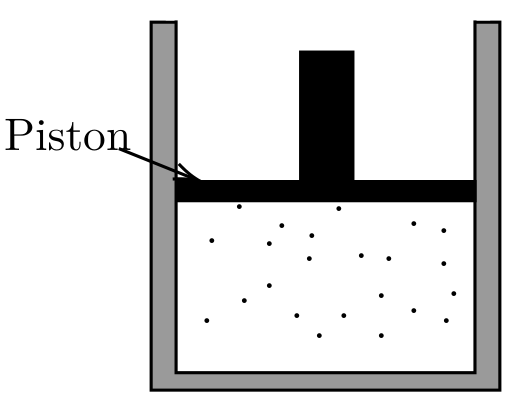
This compression is performed in three different ways:
(a) The piston is moved slowly, so that the compression remains quasistatic and the gas stays in thermal equilibrium with the surroundings throughout (isothermal process). Calculate the total heat exchanged in the process. [3 т.]
(b) The piston is moved quickly but smoothly, so that during compression heat exchange with the surroundings is negligible (adiabatic and reversible). After compression, the gas is allowed to exchange heat with the surroundings without any change in volume, and it returns to the equilibrium temperature . Calculate the total heat exchanged in the process. [3 т.]
(c) The piston is moved suddenly, producing a rapid, irreversible adiabatic compression. After compression, the gas reached a temperature . The gas is now left to exchange heat with the surroundings without further change in the volume, and eventually returns to its equilibrium temperature . Calculate and the total heat exchanged in the process. [5 т.]
Отговори
Qa=1.23×10²J; Qb=1.34×10²J; Tc=375K; Qc=1.89×10²J.
Native positive heat released to surroundings; its Qa=-W line is also preserved.
Решение
(a)
For a quasistatic isothermal (reversible) compression of an ideal gas,
where is the work done on the gas.
Using we get
Given: , , , .
(b)
For a reversible adiabatic compression of an ideal gas,
When the gas later cools back to , the heat released equals the drop in internal energy:
Given: , , , .
(c)
When the mass is dropped suddenly, the compression is adiabatic and irreversible. Let the pressure be when the temperature is . During the fast motion, no heat is exchanged (). The work done on the gas is . The increase in internal energy equals this work:
Also,
Substituting ,
After the compression, the gas cools back to , releasing
Source note: the key first writes , then reports positive heat transferred to the surroundings. Its (c) solution refers to a dropped mass and prints , and as above; these are native conventions and notation, not additions to the question.
Теми и трудност
Оценена трудност: 3/5.
Топлинни явления · Идеални газове · Първи принцип на термодинамиката · Топлообмен
Предпоставки: Гимназиална подготовка, Разширена олимпиадна подготовка
Оригинал в Архива: INPhO2026-Question.pdf · официални решения: INPhO2026-Solution.pdf