INPhO 2026, Теория — Задача 6. Perspective matters
Indian National Physics Olympiad (INPhO)-2026 · Question Paper · 1 февруари 2026 г. · 12 т.
Внимание: Бележка към темата
Matching original question and official key booklets are retained in full. The separate blank Answer Booklet, Summary Answersheet copies and blank graph paper referred to in the questions are absent from the archive; the supplied completed Kepler/glass answer-sheet illustrations remain in the key. Native question pages7 and9 are blank. Question6 says photographs on the next page although its photos occur on native p10 after blank p9. Printed source errors/conventions are preserved and attributed locally: P2 negative dM followed by positive boxed dUm and changing absolute-work notation; P3 Qa=-W followed by positive released heat, dropped-mass wording and P0/V0 notation; P4 derivative/height signs, c/cs and time-delay description; P5 intermediate phiP versus final phiC, log log and r/logarithm numerical scales. The graph/grid pixels and printed fitted results are source data, not newly calculated measurements.
Question booklet · Instructions and Table of Constants
Indian National Physics Olympiad (INPhO)-2026
HOMI BHABHA CENTRE FOR SCIENCE EDUCATION · Tata Institute of Fundamental Research · V. N. Purav Marg, Mankhurd, Mumbai, 400 088
Question Paper
Date: 01 February 2026 · Time: 09:00–12:00 (3 hours) · Maximum Marks: 75
Roll Number: □□□□ – □□□□ – □□□□
Instructions
- This booklet consists of 10 pages and total of 6 questions. Write roll number at the top wherever asked.
- Booklet to write the answers is provided separately. Instructions to write the answers are on the Answer Booklet.
- Non-programmable scientific calculators are allowed. Mobile phones cannot be used as calculators.
- Take as many data points as possible for the analysis.
- Please submit the Answer Sheet at the end of the examination. You may retain the Question Paper.
- Except for writing your roll number, no rough work or scribbling is allowed on the question paper.
Table of Constants
| Quantity | Symbol | Value |
|---|---|---|
| Speed of light in vacuum | ||
| Magnitude of electron charge | ||
| Avogadro’s number | ||
| Acceleration due to gravity | ||
| Universal Gas Constant | ||
| Boltzmann constant | ||
| Permeability constant | ||
| One Atmospheric pressure | atm |
| Question Number | 1 | 2 | 3 | 4 | 5 | 6 | Total |
|---|---|---|---|---|---|---|---|
| Maximum Marks | 12 | 12 | 11 | 10 | 18 | 12 | 75 |
Solution booklet · Instructions, constants and alternate-method note
Indian National Physics Olympiad (INPhO)-2026
HOMI BHABHA CENTRE FOR SCIENCE EDUCATION · Tata Institute of Fundamental Research · V. N. Purav Marg, Mankhurd, Mumbai, 400 088
Question Paper
Date: 01 February 2026 · Time: 09:00–12:00 (3 hours) · Maximum Marks: 75
Roll Number: □□□□ – □□□□ – □□□□
Instructions
- This booklet consists of 21 pages and total of 6 questions. Write roll number at the top wherever asked.
- Booklet to write the answers is provided separately. Instructions to write the answers are on the Answer Booklet.
- Non-programmable scientific calculators are allowed. Mobile phones cannot be used as calculators.
- Take as many data points as possible for the analysis.
- Please submit the Answer Sheet at the end of the examination. You may retain the Question Paper.
- Except for writing your roll number, no rough work or scribbling is allowed on the question paper.
Table of Constants
| Quantity | Symbol | Value |
|---|---|---|
| Speed of light in vacuum | ||
| Magnitude of electron charge | ||
| Avogadro’s number | ||
| Acceleration due to gravity | ||
| Universal Gas Constant | ||
| Boltzmann constant | ||
| Permeability constant | ||
| One Atmospheric pressure | atm |
| Question Number | 1 | 2 | 3 | 4 | 5 | 6 | Total |
|---|---|---|---|---|---|---|---|
| Maximum Marks | 12 | 12 | 11 | 10 | 18 | 12 | 75 |
Please note that alternate/equivalent methods and different ways of expressing final solutions may exist. A correct method will be suitably awarded.
Условие
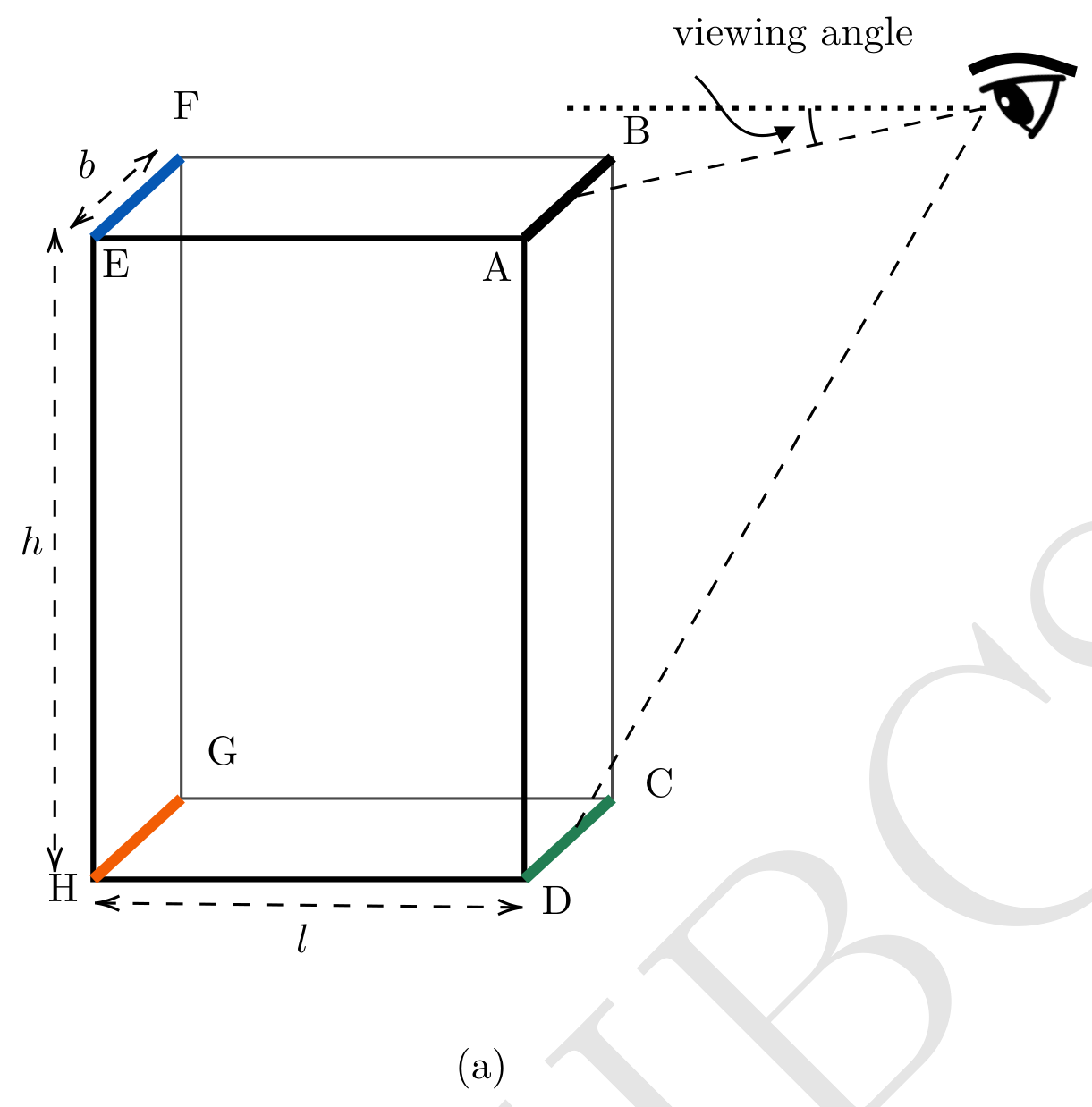
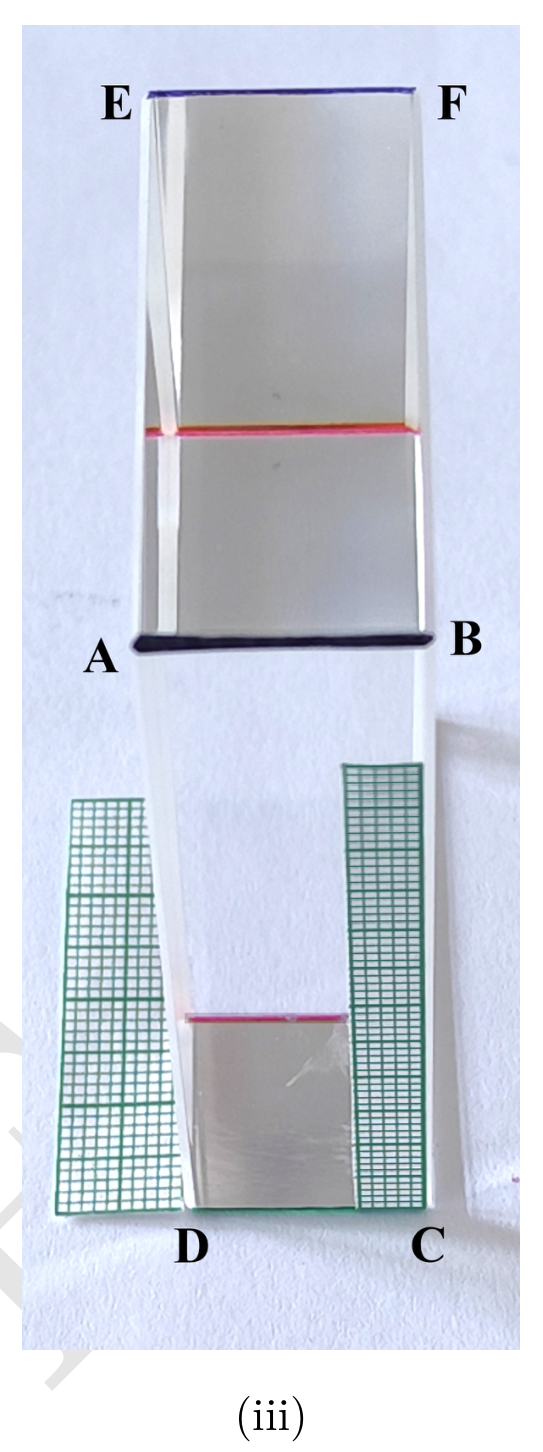
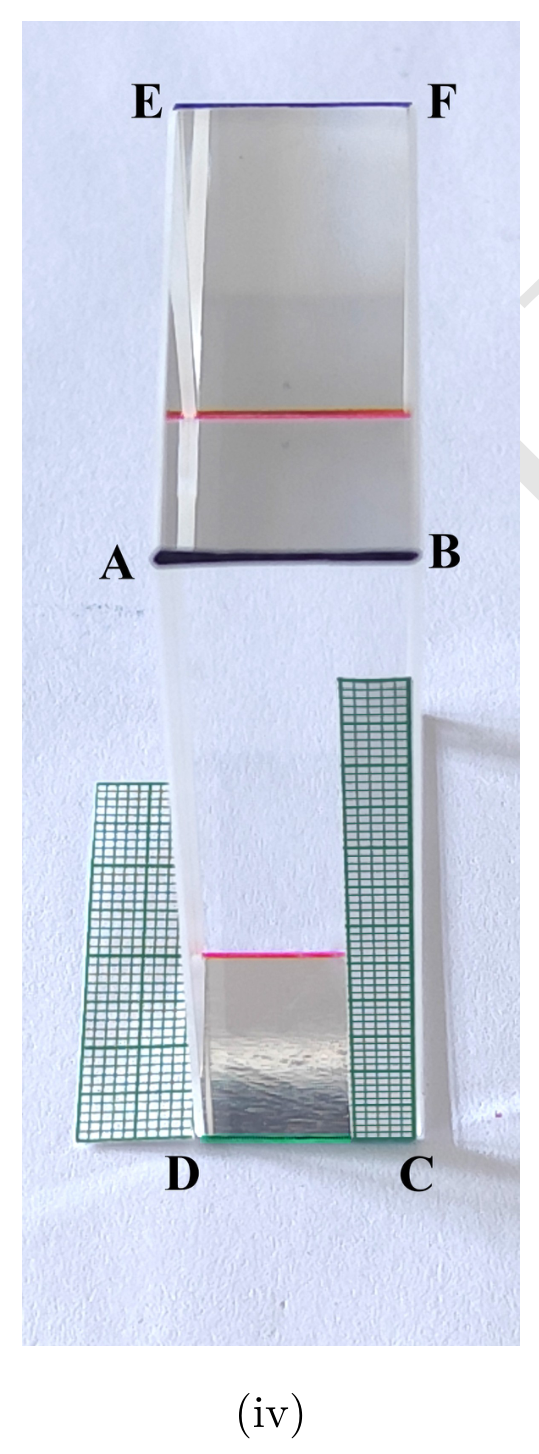
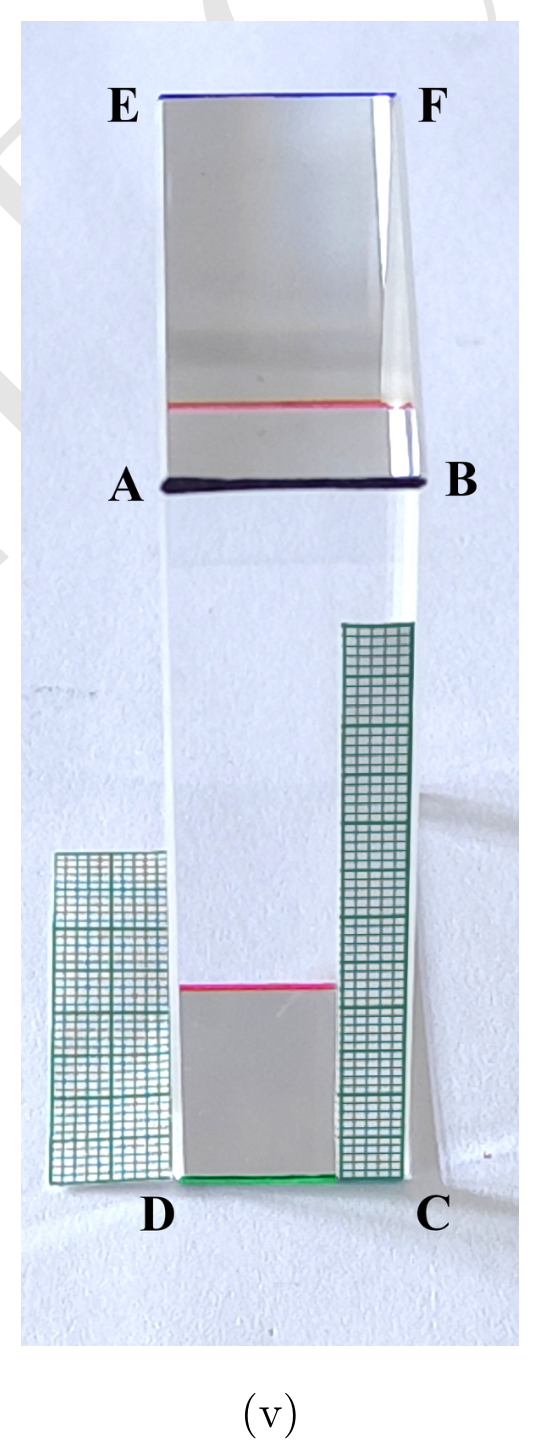
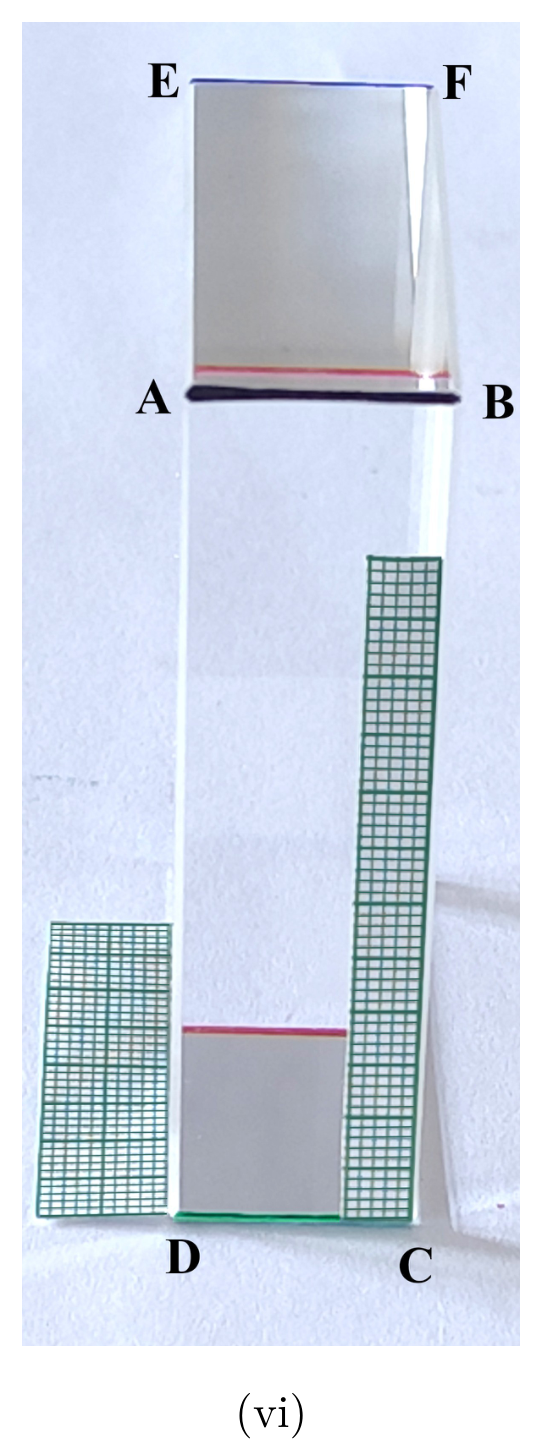
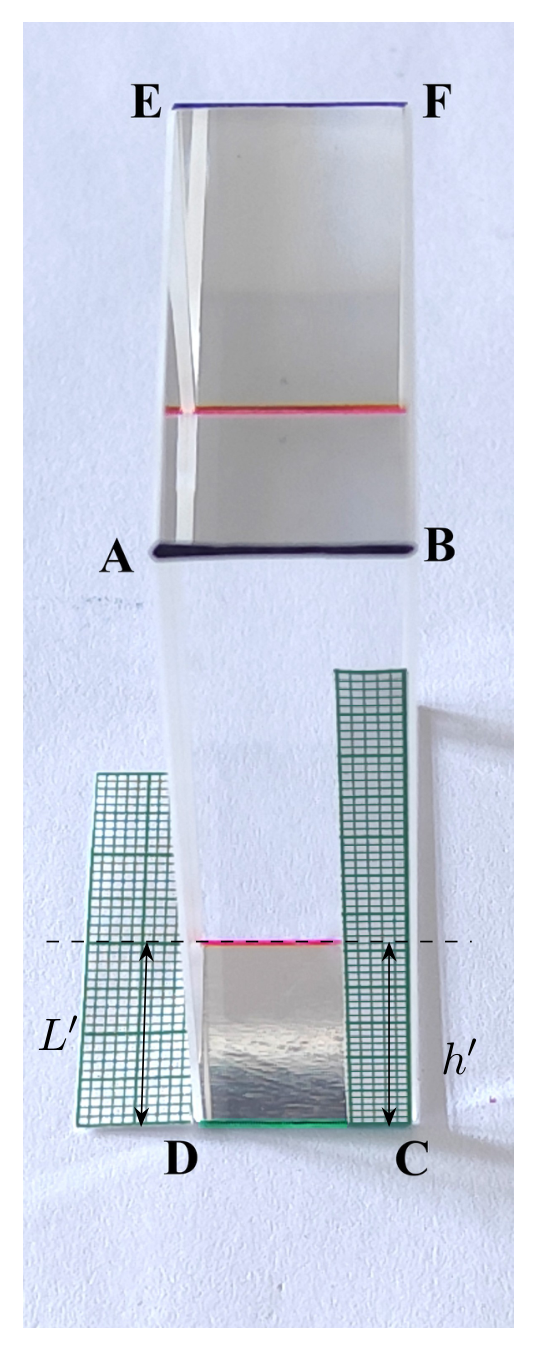
Consider a glass slab (ABCDHGFE) of dimensions . The slab is placed on its base (CDHG), and viewed at different viewing angles with the vertical face (ABCD) facing the observer (see Fig. (a)). The edges of the glass slab are coloured as shown in Fig. (a). A piece of graph paper is placed next to the base (CDHG). Another piece of graph paper is pasted on the vertical face (ABCD) of the slab (see Fig. (b)). The least count of both the pasted graph papers is .
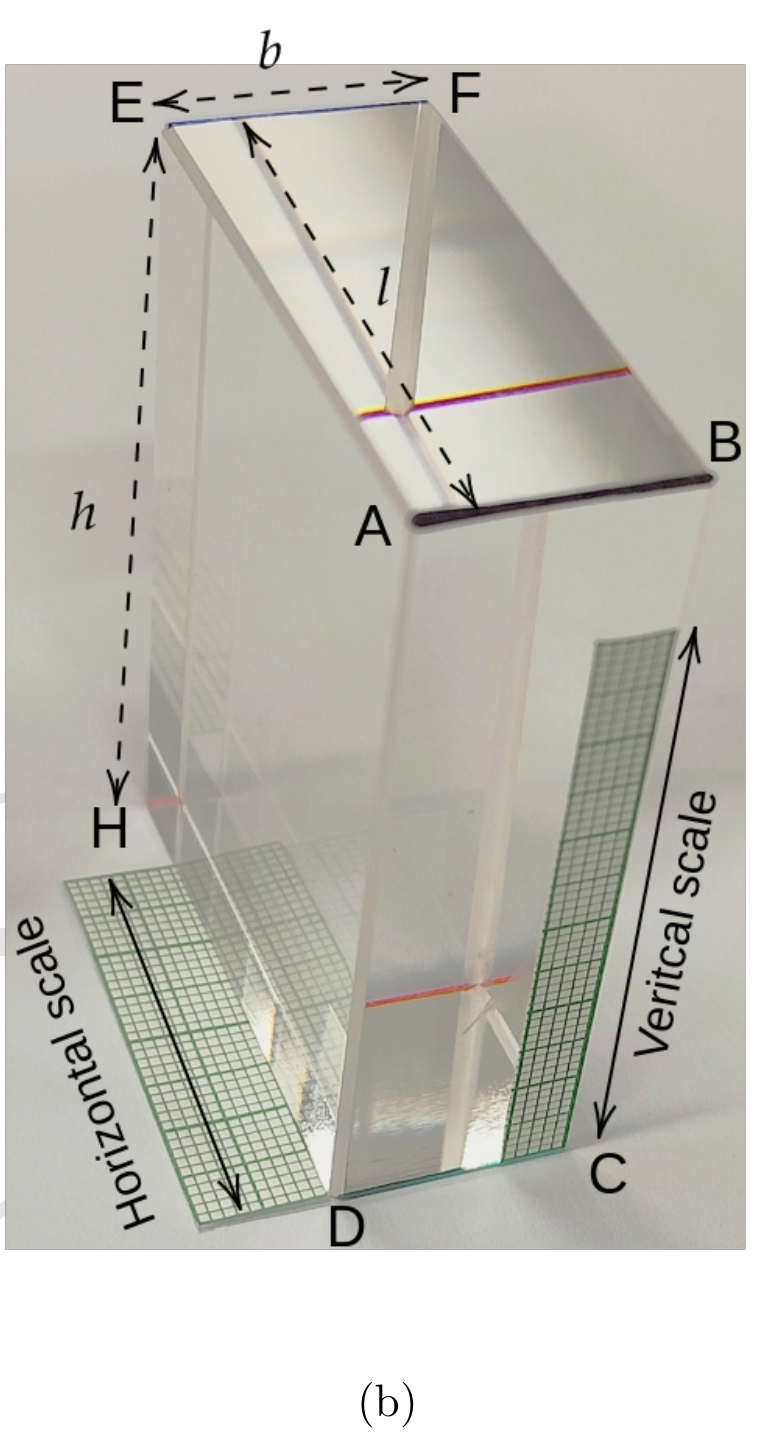
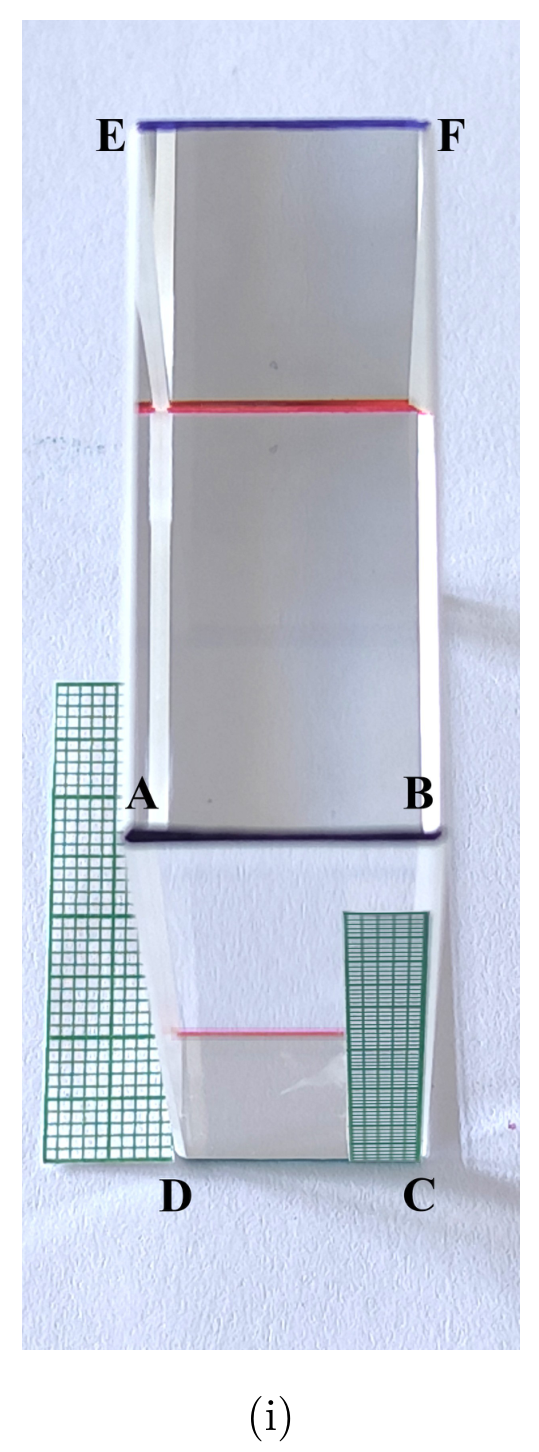
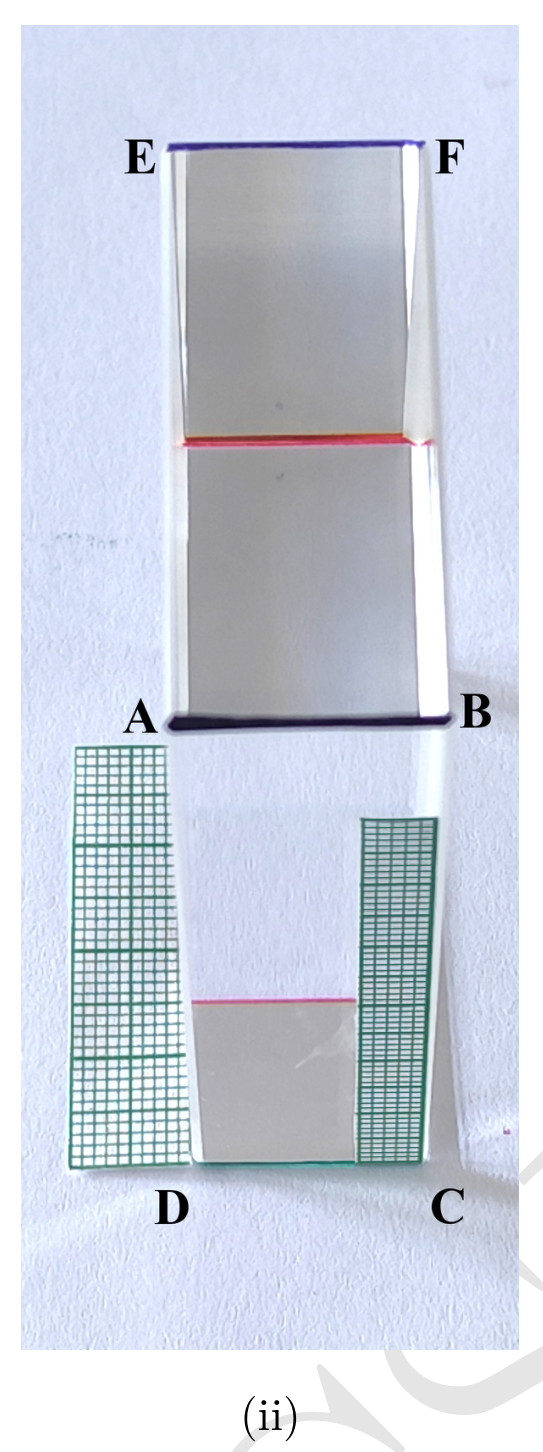
The task is to determine the refractive index of the glass slab from a series of photographs of the slab taken from different viewing angles (by lowering the eye position) shown in Figs. (i) to (vi) on the next page. The viewing angle decreases progressively from Figs. (i) to (vi). Take the refractive index of air to be . In this exercise, focus your attention on the red line visible through the vertical face (ABCD) only.
(a) Mark and state the measurable quantities in the photo given in the summary answer sheet, that can be used in subsequent parts for measuring the refractive index of the slab. [2 т.]
(b) Draw a ray diagram showing these measured quantities, and the relevant given dimensions of the slab. Derive an expression for the refractive index of the glass slab in terms of the measured quantities that you have decided to use. [4 т.]
(c) Calculate the value of , by plotting a linear graph. Report your datatable in the detailed answersheet. [6 т.]
**** END OF THE QUESTION PAPER ****
Отговори
1.63
Official key: refractive index1.63; accepted range1.60–1.70.
Решение
(a)
When viewed through the slab an edge GH is seen in the lower half of face ABCD. This allows to measure two distances , and which can be used to measure the refractive index as follows. Extend the image of the edge GH seen in the face ABCD. Note the positions where this dashed line coincides with the horizontal and vertical scales. The distance from the front edge of the glass slab to the dashed line on the horizontal scale is denoted by , and the distance from the bottom of the glass slab to the dashed line on the vertical scale is denoted by .
(b)
The side view of the image is shown below.
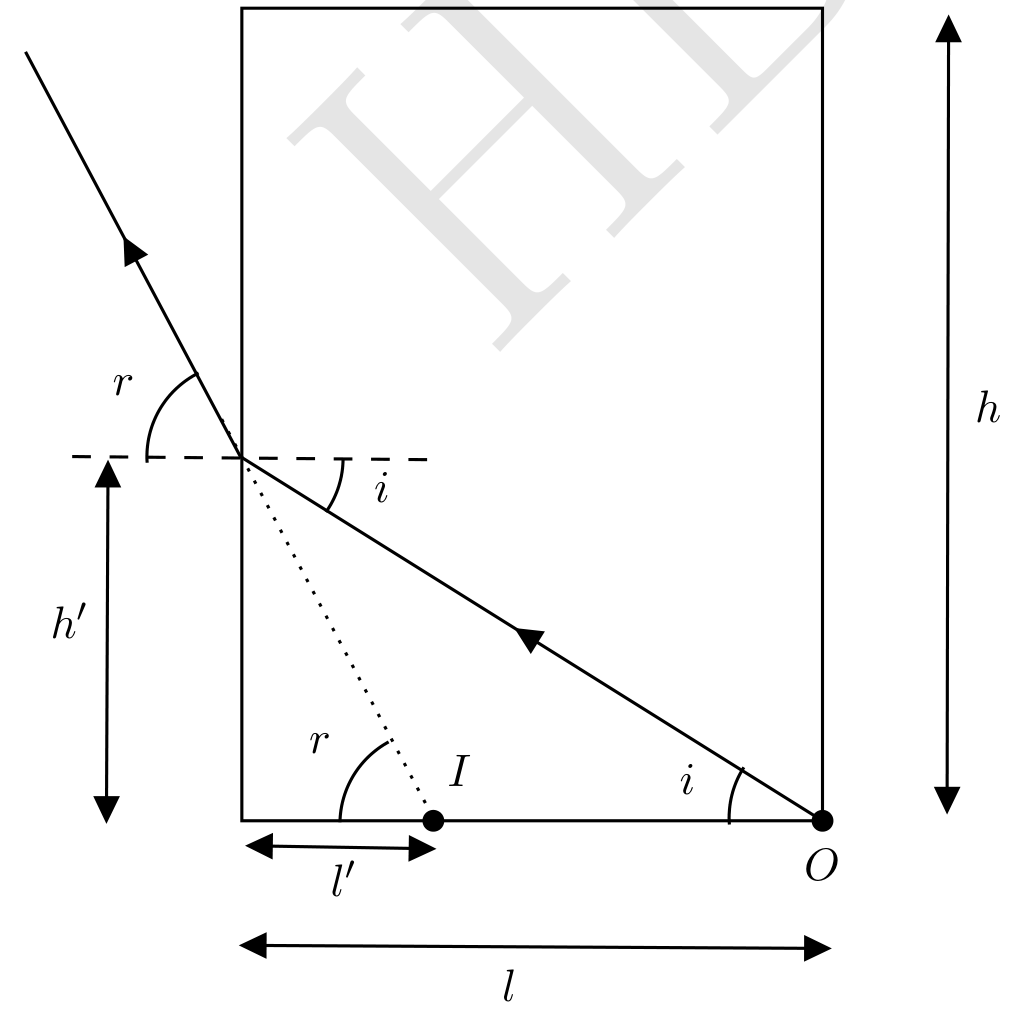
Using Snell’s law
(c)
The refractive index is given by
Rearranging the above equation, we get
The data from the six figures can be tabulated as follows
| Sr. No. | (cm) | (cm) | () | () |
|---|---|---|---|---|
| 1 | 3.4 | 1 | 11.56 | 1.00 |
| 2 | 3.1 | 1.5 | 9.61 | 2.25 |
| 3 | 2.8 | 1.8 | 7.84 | 3.24 |
| 4 | 2.6 | 2 | 6.76 | 4.00 |
| 5 | 2.2 | 2.3 | 4.84 | 5.29 |
| 6 | 1.8 | 2.5 | 3.24 | 6.25 |
The slope of the graph of vs will give the refractive index.
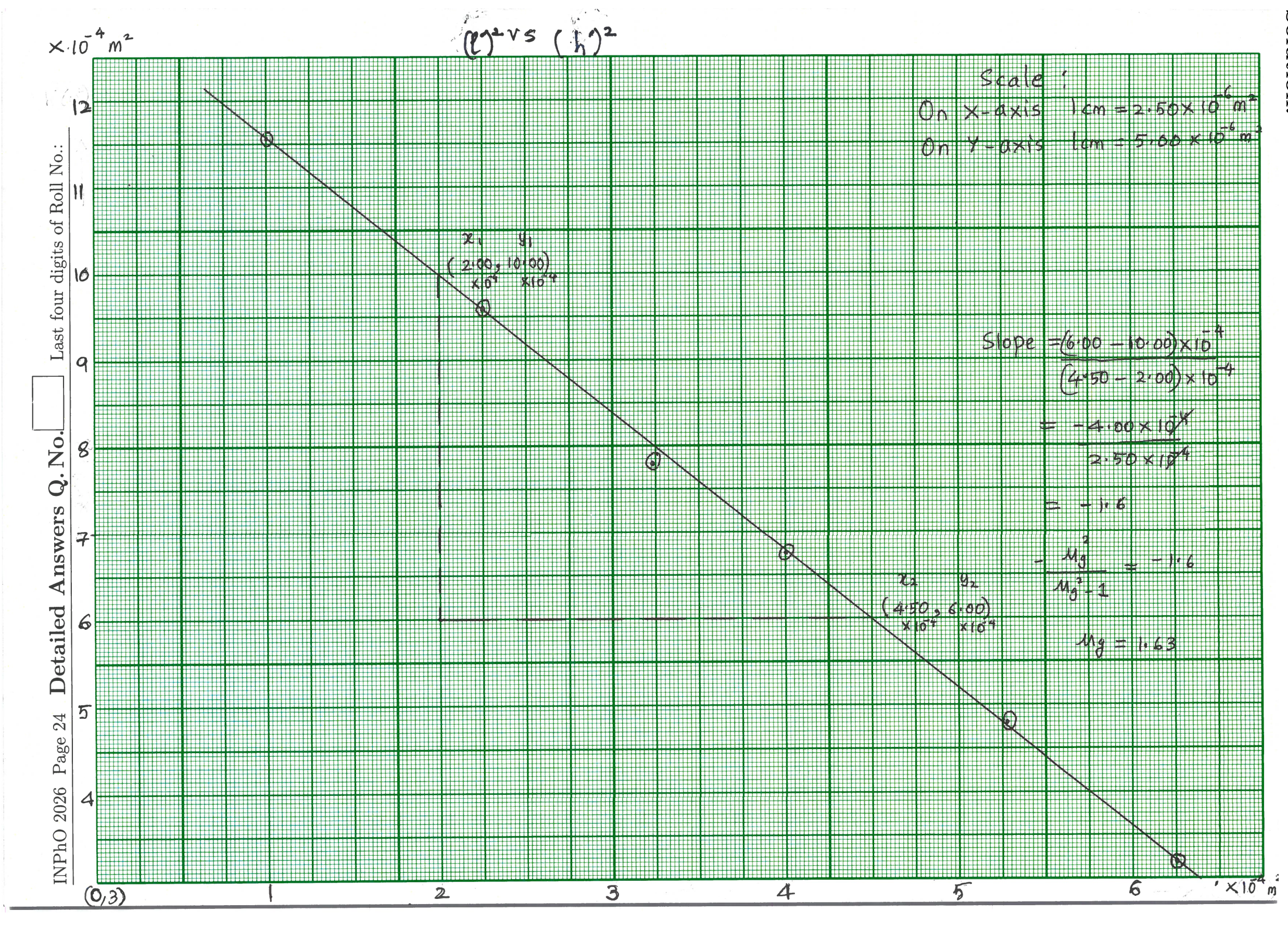
The slope of the graph is -1.60. The refractive index of the glass slab is 1.63. An accepted range of is 1.60–1.70.
Теми и трудност
Оценена трудност: 4/5.
Оптика · Пречупване
Предпоставки: Гимназиална подготовка, Разширена олимпиадна подготовка
Оригинал в Архива: INPhO2026-Question.pdf · официални решения: INPhO2026-Solution.pdf