IOAA 2007, Анализ на данни — Задача 2. The Moon’s age
The 1st International Olympiad on Astronomy and Astrophysics — Chiang Mai, Thailand — Experimental Competition (Data Analysis) — Monday, 3 December, 2007 · 3 декември 2007 г. · 8 т.
Внимание: Бележка към темата
The official marking scheme was written for a slightly different version of the questions (6, 7 and 7 points; Question 2 with GMT +02). Table 1 with the data for Question 3 is not in the archive.
Please read this first:
The time available is 3 hours for the experimental competition (Data analysis). There are three questions (and a set of data table).
Use only the pen provided.
Use only the front side of writing sheets. Write only inside the boxed area.
Begin each question on a separate sheet.
For each question, in addition to the blank writing sheets, there are the Answer Sheets where you must summarize the results you have obtained. Numerical results should be written with as many digits as are appropriate.
Write on the blank writing sheets whatever you consider is required for the solution of the question. Please use as little text as possible; express yourself primarily in equations, numbers, figures, and plots.
Fill the boxes at the top of each sheet of paper with your country code, your student code, the question number, for each question the consecutive number of each sheet (Page Number), and the total number of writing sheets used. If you use some blank writing sheets for notes that you do not wish to be marked, put a large X across the entire sheet and do not include it in your numbering.
Students given questions, writing sheet and answer sheets in English and national language can answer in any one sheet but must return both to the marker (examiner).
At the end of the exam, arrange all sheets for each problem in the following order:
- Answer Sheet(s)
- used writing sheets in order
- the sheets you do not wish to be marked
- unused sheets and the printed question
Place the papers inside the envelope and leave everything on your desk. You are not allowed to take any sheets of paper out of the room.
Some useful information for calculation
| Astronomical unit (A.U.) | 149,597,870 km |
| Mean distance, Earth to Moon | 384,399 km |
| Obliquity of the ecliptic | 23° 26' |
| Earth's mean radius | 6,371.0 km |
| Earth's mean velocity in orbit | 29.783 km/s |
| Sidereal year | 365.2564 days |
| Tropical year | 365.2422 days |
| Sidereal month | 27.3217 days |
| Synodic month | 29.5306 days |
| Mean sidereal day | 23h56m4s.091 of mean solar time |
| Mean solar day | 24h3m56s.555 of sidereal time |
Условие
The 60th anniversary celebrations of King Bhumibol Adulyadej's accession to the throne of Thailand (GMT +07) were held on the 8th to the 13th June, 2006. Photographs of the Moon taken at the same hour each night are shown below:
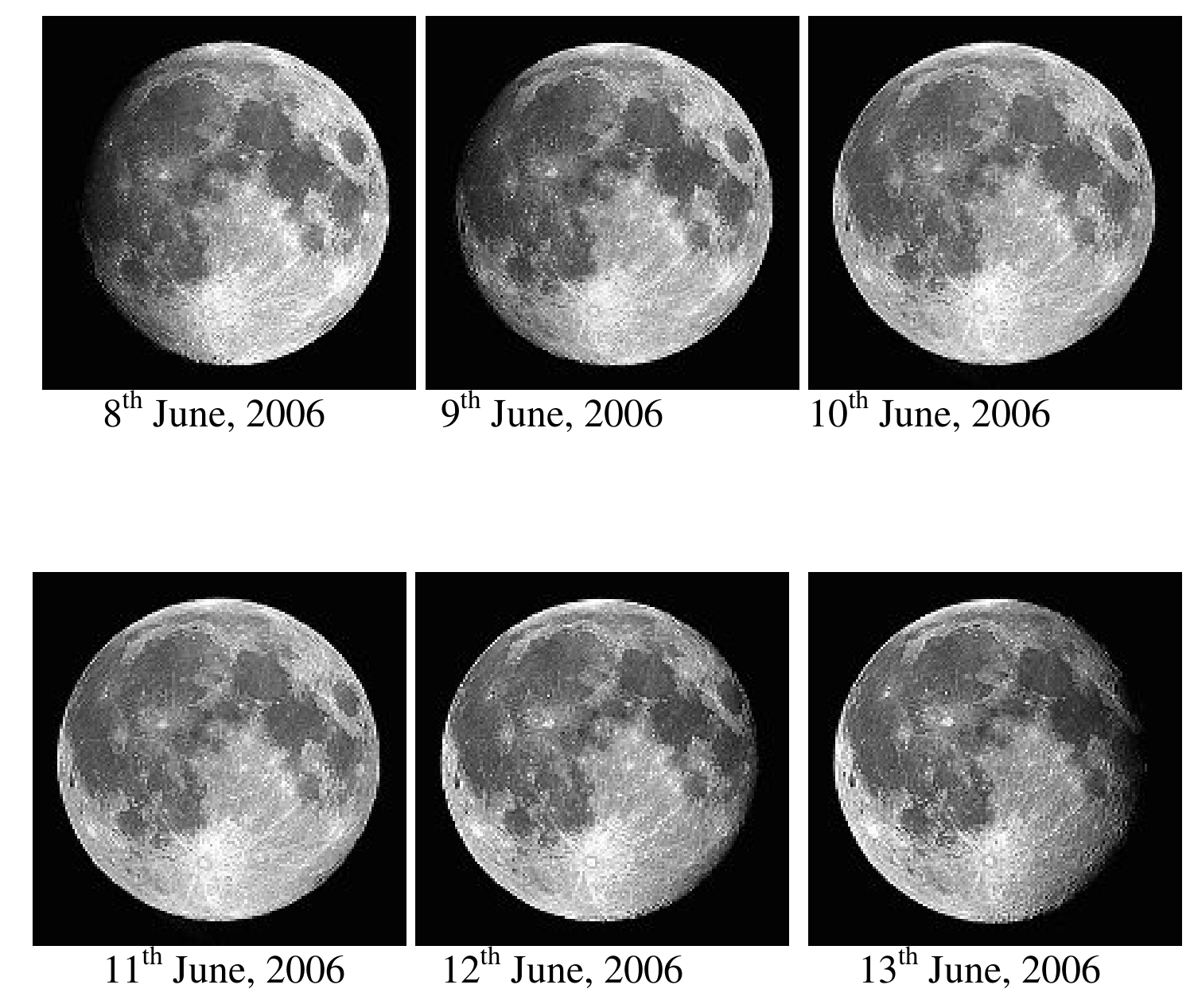
Assuming that Albert Einstein’s birth was at noon on 14th March, 1879, use the data provided above to find the Moon’s age (number of days after the new moon) on his birth date in Germany (GMT +01). Please show the method used for the calculation in detail. Estimate the errors in your calculation.
Отговори
20.9 days
Official answer 20.9 +/- 0.5 days; the marking scheme states the question with Germany at GMT +02 and without the noon assumption.
Решение
Question 2 The Moon’s age (7 points)
The 60th anniversary celebrations of King Bhumibol Adulyadej's accession to the throne of Thailand (GMT +07) were held on the 8th to the 13th June, 2006. It was found that the Moon’s age of each night was as shown below:
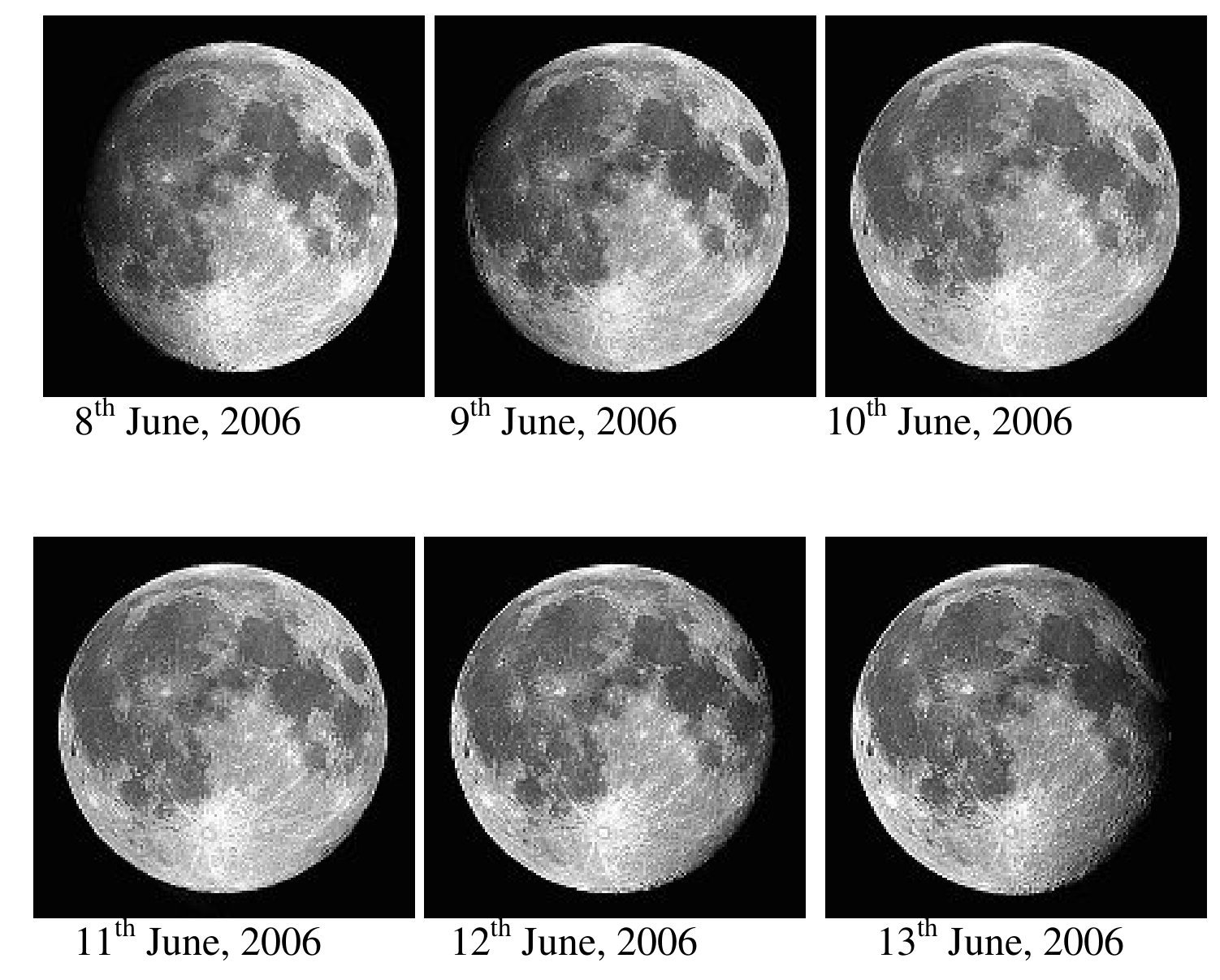
If Albert Einstein’s birthday is 14th March, 1879, using the data provided above, find the Moon’s age (with uncertainty) on his birth date in Germany (GMT +02). Please show the method used for the calculation in detail.
Answer
From the figures of the Moon’s phase depicted above, we can conclude that the full moon occurs on June 11th (+/- 0.5 day), 2006. We are going to use this full moon as the reference for calculating the Moon’s age on Albert Einstein’s birthday (March 14, 1879).
The student must find out that the approximate time span between June 11th, 2006 and March 14, 1879 is 127 years.
There are 31 leap years between the two years (i.e. 1880, 1884, 1888, 1892, 1896, 1904, 1908, 1912, 1916, 1920, 1924, 1928, 1932, 1936, 1940, 1944, 1948, 1952, 1956, 1960, 1964, 1968, 1972, 1976, 1980, 1984, 1988, 1992, 1996, 2000, and 2004).
So, there are days starting from January 1, 2006 to January 1, 1879. As a consequence, there are 46,475 days starting from June 11, 2006 to March 14, 1879.
Number of days / synodic month = 46,475/ 29.5306 = 1573.791254 or 1573 synodic months and 0.791254*29.5306 = 23.3662 days.
The remainder of days tells us the number of days into the synodic cycle we've gone. Since we are going backwards in time in these calculations (from 2006 to 1879), this is the number of days from the top of the cycle, rather than from the bottom. To convert to the number of days from the bottom of the cycle (full moon), we simply subtract this value from a full cycle (29.5306 days). This is 29.5306 - 23.3662 = 6.1644 days.
6.1644 days from the bottom of the cycle (full moon = 14.7653 days) or 14.7653 + 6.1644 = 20.9297 days into the synodic month. And that's our answer.
Finally, the Moon’s age on Albert Einstein’s birthday (March 14, 1879) is 20.9 +/- 0.5 days.
Marking Scheme:
The student must not use the difference between the time zone of Thailand and Germany to calculate the Moon’s age:
: 0.5 point (wrong answer = 0 point)
The student can point out that the June 11, 2006 is a full moon day (an experienced observer realize that a full moon day and a day before full moon , the Moon looks the same by eyes. However, they know that a day after the full moon day, the Moon looks a little bit darker):
: 1 point (wrong answer = 0 point)
The student can point out that there is an uncertainty in the full moon day = 0.5 day (as seen from pictures given in the question)
:1 point (an answer without any uncertainty = 0 point, the student uses an uncertainty 0.5 day but 1 day will get 0.5 points, an uncertainty 1 day will get 0 point)
The student gives the correct answer
5.5 points (if the answer is wrong, looks at the detail in the process of calculation. Missing one point of the concept used in the correct calculation = missing 0.5 points until the point is over)
An extra 0.2 point for additional considerations
Оригинал в Архива: exam_dataanalysis.pdf · официални решения: exam_dataan_solution.pdf