IOAA 2007, Теория — Задача 1
Theoretical Competition — 1st IOAA — December 5, 2007 · 5 декември 2007 г. · 30 т.
Условие
(30 points for 15 short questions, 2 points for each short question)
Show, in a few steps in the writing sheets, your method of solution. Write your final answers in the answer sheets provided. Partial credits will be given for answers without showing method of solution.
1.1 For an observer at latitude N and longitude W, estimate the time of sun rise on 21 December if the observer’s civil time is hours from GMT. Ignore refraction of the atmosphere and the size of the solar disc. [2 т.]
1.2 The largest angular separation between Venus and the Sun, when viewed from the Earth, is . Calculate the radius of Venus’s circular orbit in A.U. [2 т.]
1.3 The time interval between noon on 1 July and noon on 31 December is 183 solar days. What is this interval in sidereal days? [2 т.]
1.4 One night during a full Moon, the Moon subtends an angle of 0.46 degree to an observer. What is the observer’s distance to the Moon on that night? [2 т.]
1.5 An observer was able to measure the difference in the directions, due to the Earth’s motion around the Sun, to a star as distant as 100 parsecs away. What was the minimum angular difference in arc seconds this observer could measure? [2 т.]
1.6 A Sun-orbiting periodic comet is the farthest at 31.5 A.U. and the closest at 0.5 A.U.. What is the orbital period of this comet? [2 т.]
1.7 For the comet in question 1.6, what is the area (in square A.U. per year) swept by the line joining the comet and the Sun? [2 т.]
1.8 At what wavelength does a star with the surface temperature of 4000 K emit most intensely? [2 т.]
1.9 Calculate the total luminosity of a star whose surface temperature is 7500 K, and whose radius is 2.5 times that of our Sun. Give your answer in units of the solar luminosity, assuming the surface temperature of the Sun to be 5800 K. [2 т.]
1.10 A K star on the Main Sequence has a luminosity of . This star is observed to have a flux of . What is the distance to this star? You may neglect the atmospheric effect. [2 т.]
1.11 A supernova shines with a luminosity times that of the Sun. If such a supernova appears in our sky as bright as the Sun, how far away from us must it be located? [2 т.]
1.12 The (spin-flip) transition of atomic hydrogen at rest generates the electromagnetic wave of the frequency MHz. Such an emission from a gas cloud near the galactic center is observed to have a frequency MHz. Calculate the velocity of the gas cloud. Is it moving towards or away from the Earth? [2 т.]
1.13 A crater on the surface of the Moon has a diameter of 80 km. Is it possible to resolve this crater with naked eyes, assuming the eye pupil aperture is 5 mm ? [2 т.]
1.14 If the Sun were to collapse gravitationally to form a non-rotating black hole, what would be its event horizon (its Schwarzschild radius)? [2 т.]
1.15 The magnitude of the faintest star you can see with naked eyes is , whereas that of the brightest star in the sky is . What is the energy-flux ratio of the faintest to that of the brightest? [2 т.]
Отговори
1.1 7:10 am
The official solution gives “Ans. 7:10 am.”; the printed alternative solution arrives at 7:18 a.m.
1.2 0.72 A.U.
1.3 183.5 sidereal days
1.4 430000 km
1.5 0.02 arcsec
1.6 64 years
1.7 3.1 A.U.²/year
1.8 724 nm
1.9 17.5 Lsun
1.10 453 pc
1.11 0.485 pc
Also given as A.U. = 1.58 ly.
1.12 262.445 km/s
The gas cloud is approaching the observer (moving towards the Earth).
1.13 Yes: the minimum aperture needed is about 2.9 mm, so the 80 km crater can be resolved with the naked eye.
1.14 2.95 km
1.15
Решение
SOLUTION FOR QUESTION 1. (30 points for 15 short questions)
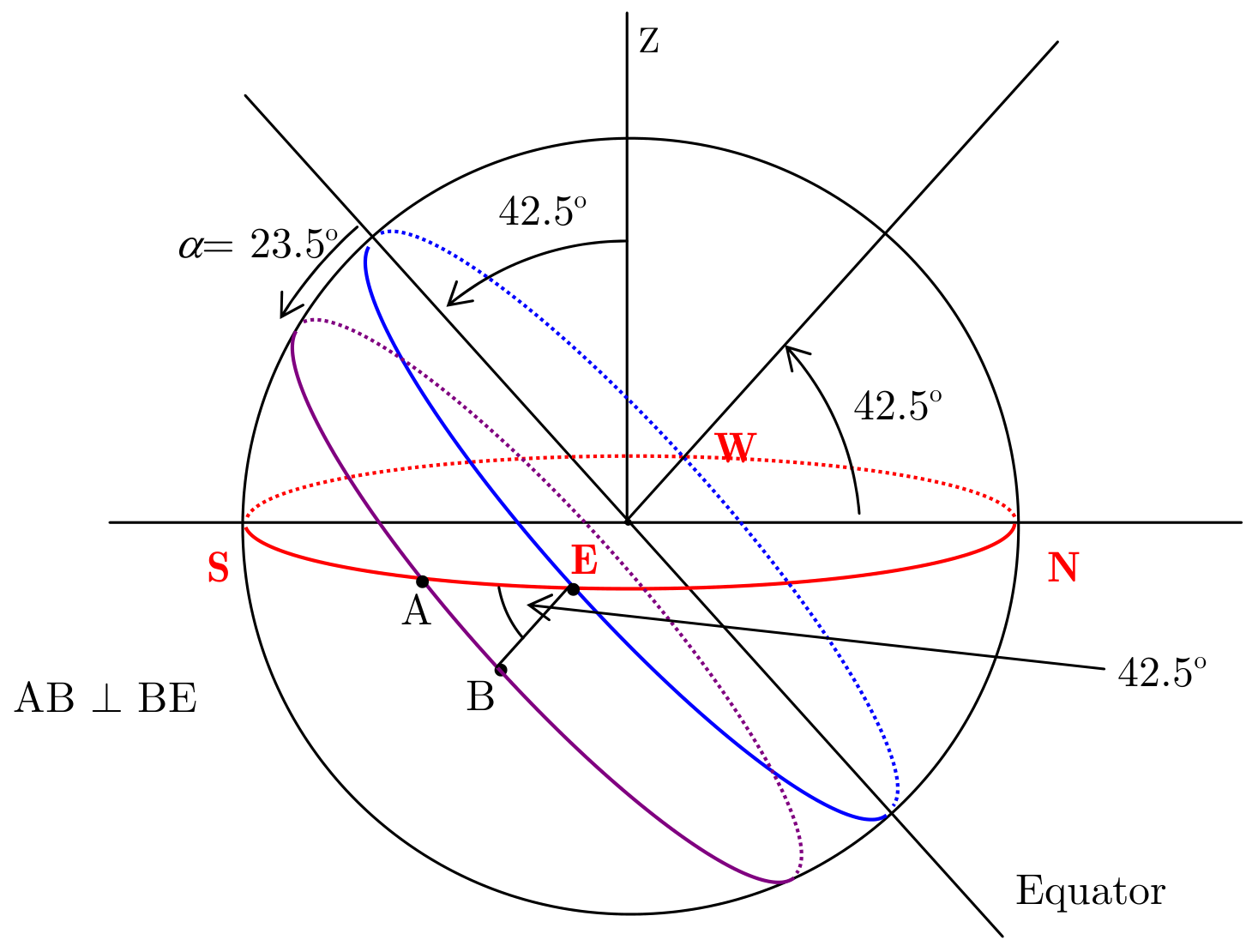
1.1
E = East point
local time = () hrs after 6:00 = 7:26 am. The official time at W should be 16 min. less.
Ans. 7:10 am.
Alternative solution (for 1.1)
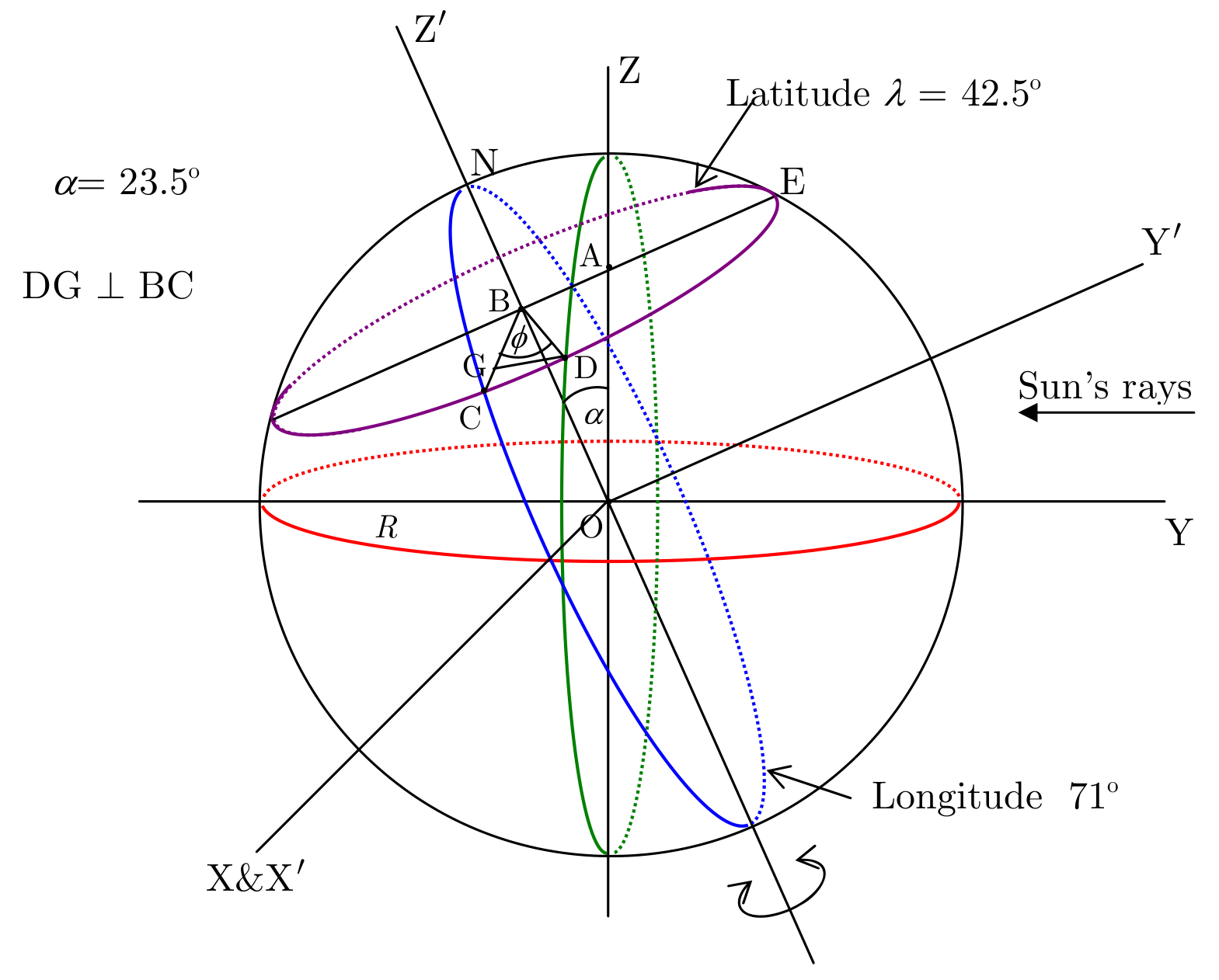
The Earth’s position relative to the Sun is shown in the figure.
Note that
Hence, the Sun will rise at hours. = 77.92 min. after 6 a.m.. This is at 7:18 a.m.
1.2
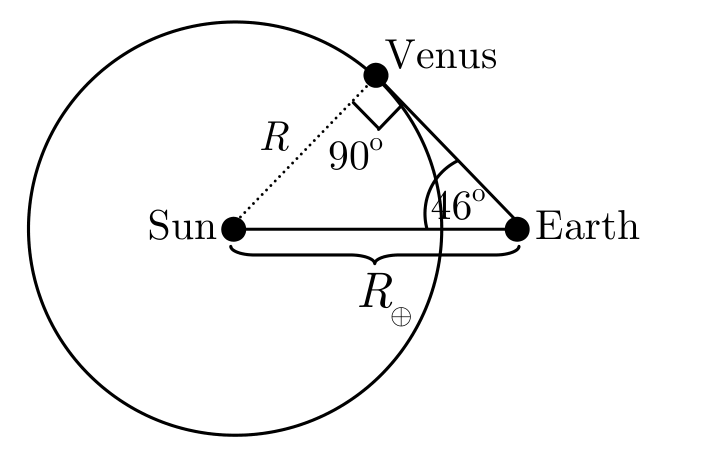
The angular separation is maximum when Sun, Venus and Earth form a right-angled triangle as shown.
Here
1.3 If the same face of the Earth were to face the Sun all the time then the Earth would make one complete turn relative to fixed stars in one solar year (365.25 solar days).
This implies that in 365.25 solar days our actual Earth makes (365.25+1) complete turns relative to fixed stars.
Hence 365.25 solar days are the same time interval as 366.25 sidereal days;
and
OR
1 solar day = 24 x 60 x 60 s = 86400 s
1 sidereal day = 23 x 3600 + 56 x 60 + 4.1 = 86164.1 s
183 solar days = 183.50 sidereal days
1.4 During a full Moon we see the whole face of the Moon.
Hence
1.5

1.6 According to Kepler’s third law we have
This constant is when is measured in years and in A.U.’s.
For this comet we have
1.7 According to Kepler’s second law we have;
The area is swept out at constant rate throughout the orbital motion.
Now, for this comet the area swept out in one orbital period is where is the semi-major axis and the semi-minor axis of the orbit.
Hence, the area swept out per year is
1.8 From the Wien’s displacement law
1.9 From the Stefan-Boltzmann law, the total power emitted is
1.10
1.11
Let be the distance to that supernova.
Then the flux intensity on Earth would be
This must be the same as
1.12 The difference in frequencies is due to the relativistic Doppler shift. Since the observed frequency of emission from the gas cloud is higher than the laboratory frequency , the gas cloud must be approaching the observer.
Hence,

1.13
A and B are two distant objects.
and are the central maxima of their diffracted images.
The angular position of the first minimum relative to central maximum of each diffraction pattern is given by .
According to Lord Rayleigh the minimum angle of resolution is .
Hence the images of A and B will be resolved if , .
We may take distance AB to be the diameter of the crater. Hence the diameter of the eye’s aperture must be, at least, .
Hence, it is possible to resolve the 80 km-diameter crater with naked eye.
1.14 The spherical boundary at which the escape velocity becomes equal to the speed of light is of radius
1.15 The flux ratio versus magnitude difference implies
So for a magnitude difference of we find a flux ratio of
And thus the visible stars range only over a factor of 1000 in brightness.
Оригинал в Архива: exam_theory.pdf · официални решения: exam_theory_solution.pdf