IOAA 2008, Теория — Задача 18. Theoretical Part 2 — Question 3
The 2nd International Olympiad on Astronomy and Astrophysics, Bandung, Indonesia, Saturday, 23 August 2008 — Theoretical Competition · 23 август 2008 г. · 100 т.
Внимание: Бележка към темата
The official key places the final short question 10 in long_sol.doc as question 1 and the final long question 1 in short_sol.doc as question 10. Solutions are matched by their statements. For short question 5 the key uses dark-energy density 6.7 × 10⁻³⁰ g/cm³, whereas the final question specifies 7.1 × 10⁻³⁰ g/cm³; the supplied solution is retained without recalculation. Printed numerical, unit and notation discrepancies in the original keys are preserved.
Please read this carefully:
- Every student receives problem sheets in English and/or in native language, an answer book and a scratch book.
- The time available is 5 hours for the theoretical competition. There are fifteen short questions (Theoretical Part 1), and three long questions (Theoretical Part 2).
- Use only Black or dark blue pen
- Use only the front side of answer sheets. Write only inside the boxed area.
- Begin answering each question on a separate sheet.
- Numerical results should be written with as many digits as are appropriate.
- Write on the blank answer sheets whatever you consider is required for the solution of each question. Please express your answer primarily in term of equations, numbers, figures, and plots. If necessary provide your answers with concise text. Full credit will be given to correct answer with detailed steps for each question. Underline your final result.
- Fill in the boxes at the top of each sheet of paper with your country code and your student code.
- At the end of the exam place the books inside the envelope and leave everything on your desk.
Astronomical and Physical Constants
| Quantity | Value |
|---|---|
| Astronomical unit (AU) | 149 597 870 691 m |
| Light year (ly) | m = 63,240 AU |
| Parsec (pc) | m = 206,265 AU |
| Sidereal year | 365.2564 days |
| Tropical year | 365.2422 days |
| Gregorian year | 365.2425 days |
| Sidereal month | 27.3217 days |
| Synodic month | 29.5306 days |
| Mean sidereal day | of mean solar time |
| Mean solar day | of sidereal time |
| Mean distance, Earth to Moon | 384 399 000 m |
| Earth mass () | kg |
| Earth mean radius | 6 371 000 m |
| Earth mean velocity in orbit | 29 783 m/s |
| Moon mass (M☽) | kg |
| Moon mean radius | 1 738 000 m |
| Sun mass () | kg |
| Sun radius () | m |
| Sun luminosity () | J s |
| Sun effective temperature () | 5 800 K |
| Sun apparent magnitude () | -26.8 |
| Sun absolute magnitude () | 4.82 |
| Sun absolute bolometric magnitude () | 4.72 |
| Speed of light () | m/s |
| Gravitational constant () | N m kg |
| Boltzmann constant () | J K |
| Stefan-Boltzmann constant () | J s m K |
| Planck constant () | J s |
| Electron charge () | C = esu |
| Electron mass () | amu = kg |
| Proton mass () | 1.00727647 amu = kg |
| Neutron mass () | 1.008664904 amu = kg |
| Deuterium nucleus mass () | 2.013553214 amu = kg |
| Hydrogen mass | 1.00794 amu = kg |
| Helium mass | 4.002603 amu = kg |
Conversion table
| 1 Å | 0.1 nm = m |
|---|---|
| 1 barn | m |
| 1 G | T |
| 1 erg | J = 1 dyne cm |
| 1 esu | C |
| 1 amu (atomic mass unit) | kg |
| 1 atm (atmosphere) | 101,325 Pa = 1.01325 bar |
| 1 dyne | N |
THEORETICAL PART 1
(300 points for 15 Theoretical Part-1 questions, 20 points for each question)
Show your method of solution step by step in the answer sheets completely as your final answer. The scratch sheet is to be used for your personal calculation and will not be marked. Partial credits will be given for answers without showing method of solution.
THEORETICAL PART 2
(300 points for 3 Theoretical Part-2, 100 points for each question)
Show your method of solution step by step in the answer sheets completely as your final answer. The scratch sheet is to be used for your personal calculation and will not be marked. Partial credits will be given for answers without showing method of solution.
Условие
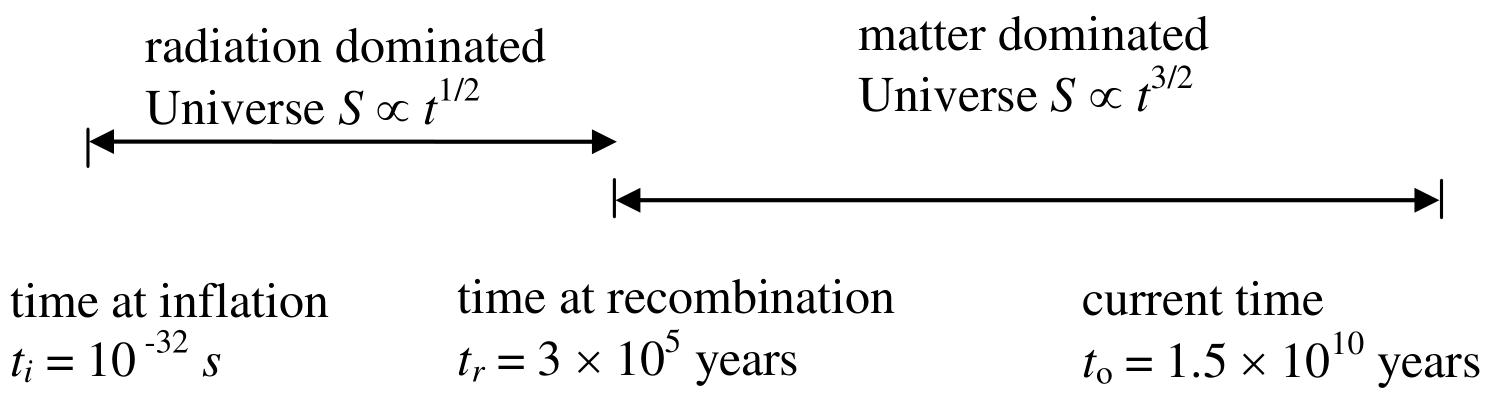
Measurement of the cosmic microwave background radiation (CMB) shows that its temperature is practically the same at every point in the sky to a very high degree of accuracy. Let us assume that light emitted at the moment of recombination ( K, years) is only reaching us now ( K, x years). Scale factor is defined as such and . Note that the radiation dominated period was between the time when the inflation stopped ( seconds) and the time when the recombination took place, while the matter dominated period started at the recombination time. During the radiation dominated period is proportional to , while during the matter dominated period is proportional to .
a. Estimate the horizon distances when recombination took place. Assume that temperature is proportional to , where is a scale factor of the size of the Universe.
b. Note: Horizon distance in degrees is defined as maximum separation between the two points in CMBR imprint such that the points could “see” each other at the time when the CMBR was emitted.
c. Consider two points in CMBR imprint which are currently observed at a separation angle . Could the two points communicate with each other using photon? (Answer with “YES” or “NO” and give the reason mathematically)
d. Estimate the size of our Universe at the end of inflation period.
Решение
a)
where , .
Scale factor is defined as such and .
Maximum distance between objects at the time of recombination
On the other hand , such that
From then and .
So,
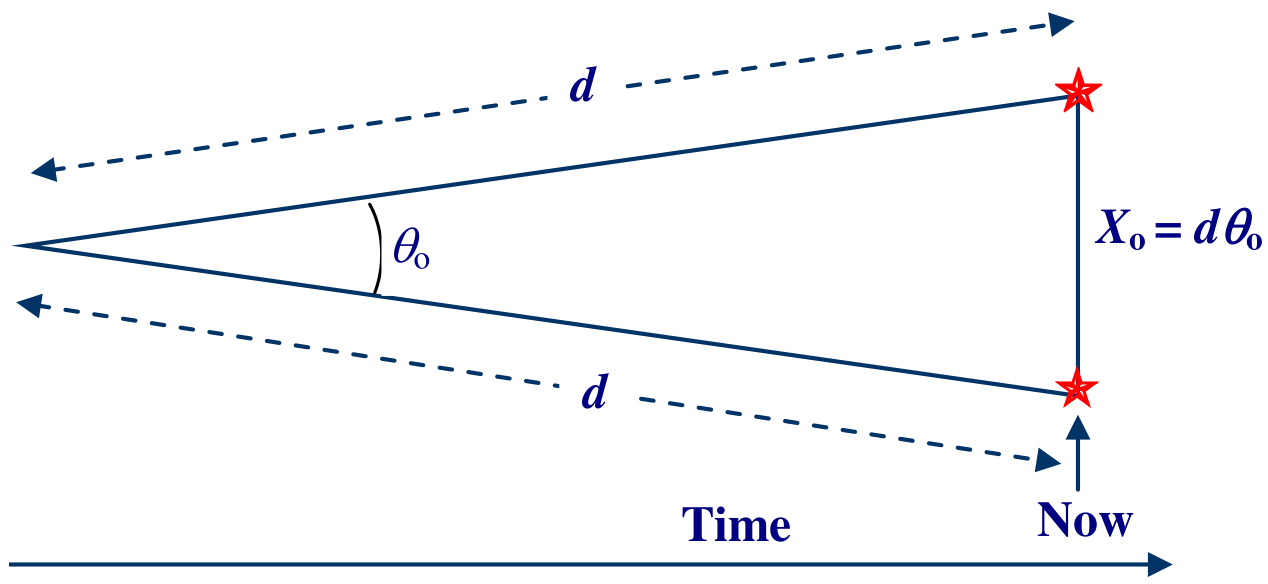
b)
NO, because (20%)
c)
From the time at recombination () to the current time () , we derive
The size of our universe at is
When the inflation stopped, the Universe was radiation dominated ( years to s), we get
The size of universe at the end of the inflation period was
Оригинал в Архива: 2008_Theory.pdf · официални решения: short_sol.doc · допълнителни данни: long_sol.doc · допълнителни данни: constants.doc