IOAA 2009, Теория — Задача 16. High Altitude Projectile
3rd International Olympiad on Astronomy and Astrophysics — Theoretical Competition · 45 т.
Внимание: Бележка към темата
The problem PDF's constants table has missing equation glyphs; the intact matching table and logarithm formula were recovered from original proceedings PDF 41, explicitly attributed. The full 147-page proceedings file and hash are retained, with a declared reading scope of 41 and47–67. Printed solution inconsistencies are retained and annotated: Q10 intermediate omits field factor/unit; Q12 negative sign and 3.21/3.19 mismatch; Q15 signed −1.5 and referenced but absent Figures 1/2; Q16(d) denominator minus sign; Q17 final m−5.2 versus preceding m+5.2. No missing figure or correction was invented.
Please read these instructions carefully
- Each student will receive problem sheets in English and/or in his/her native language.
- The available time for answering theoretical problems is 5 hours. You will have 15 short problems (Theoretical Part 1, Problem 1 to 15), and 2 long problems (Theoretical Part 2, Problem 16 and 17).
- Use only the pen that has been provided on your desk.
- Do Not use the back side of your writing sheets. Write only inside the boxed area.
- Yellow scratch papers are not considered in marking.
- Begin answering each problem in separate sheet.
- Fill in the boxes at the top of each sheet of your paper with your "country name", your "student code", "problem number", and total number of pages which is used to answer to that problem.
- Write the final answer for each problem in the box, labeled "Answer Sheet".
- Starting and the end of the exam will be announced by ringing a bell.
- The final answer in each question part must be accompanied by units, which should be in SI or appropriate units. 20% of the marks available for that part will be deducted for a correct answer without units.
- The required numerical accuracy for the final answer depends on the number of significant figures given in the data values in the problem. 20% of the marks available for the final answer in each question part will be deducted for answers without required accuracy as given in the problem. Use the constant values exactly as given in the table of constants.
- At the end of the exam put all papers, including scratch papers, inside the envelope and leave everything on your desk.
Table of Constants
The problem PDF's constants table has missing embedded equation glyphs. This table and useful formula are transcribed from the matching intact table on original PDF page 41 of IOAA2009_final.pdf (printed page 36), retaining the full proceedings source and its original page numbering.
(All constants are in SI)
| Parameter | Symbol | Value |
|---|---|---|
| Gravitational constant | ||
| Plank constant | ||
| Speed of light | ||
| Solar Mass | ||
| Solar radius | ||
| Solar luminosity | ||
| Apparent solar magnitude (V) | ||
| Solar constant | ||
| Mass of the Earth | ||
| Radius of the Earth | ||
| Mean density of the Earth | ||
| Gravitational acceleration at sea level | ||
| Tropical year | 365.24 days | |
| Sidereal year | 365.26 days | |
| Sidereal day | 86164 s | |
| Inclination of the equator with respect to the ecliptic | ||
| Parsec | pc | |
| Light year | ly | |
| Astronomical Unit | AU | |
| Solar distance from the center of the Galaxy | ||
| Hubble constant | ||
| Mass of electron | ||
| Mass of proton | ||
| Central wavelength of V-band | ||
| Refraction of star light at horizon | ||
| 3.1416 |
Useful mathematical formula:
Условие
A projectile which starts from the surface of the Earth at the sea level is launched with the initial speed of and with the projecting angle (with respect to the local horizon) of . and are the mass and radius of the Earth respectively. Ignore the air resistance and rotation of the Earth.
a Show that the orbit of the projectile is an ellipse with a semi-major axis of .
b Calculate the highest altitude of the projectile with respect to the Earth surface (in the unit of the Earth radius).
c What is the range of the projectile (distance between launching point and falling point) in the units of the earth radii?
d What is eccentricity (e) of this elliptical orbit?
e Find the time of flight for the projectile.
Отговори
- a
- b
- c
- d 0.5
- e 55.7 min
Решение
a)
Total energy of the projectile is
means that orbit might be ellipse or circle. As , the orbit is an ellipse. Total energy for an ellipse is
Then
(7 points)
b)
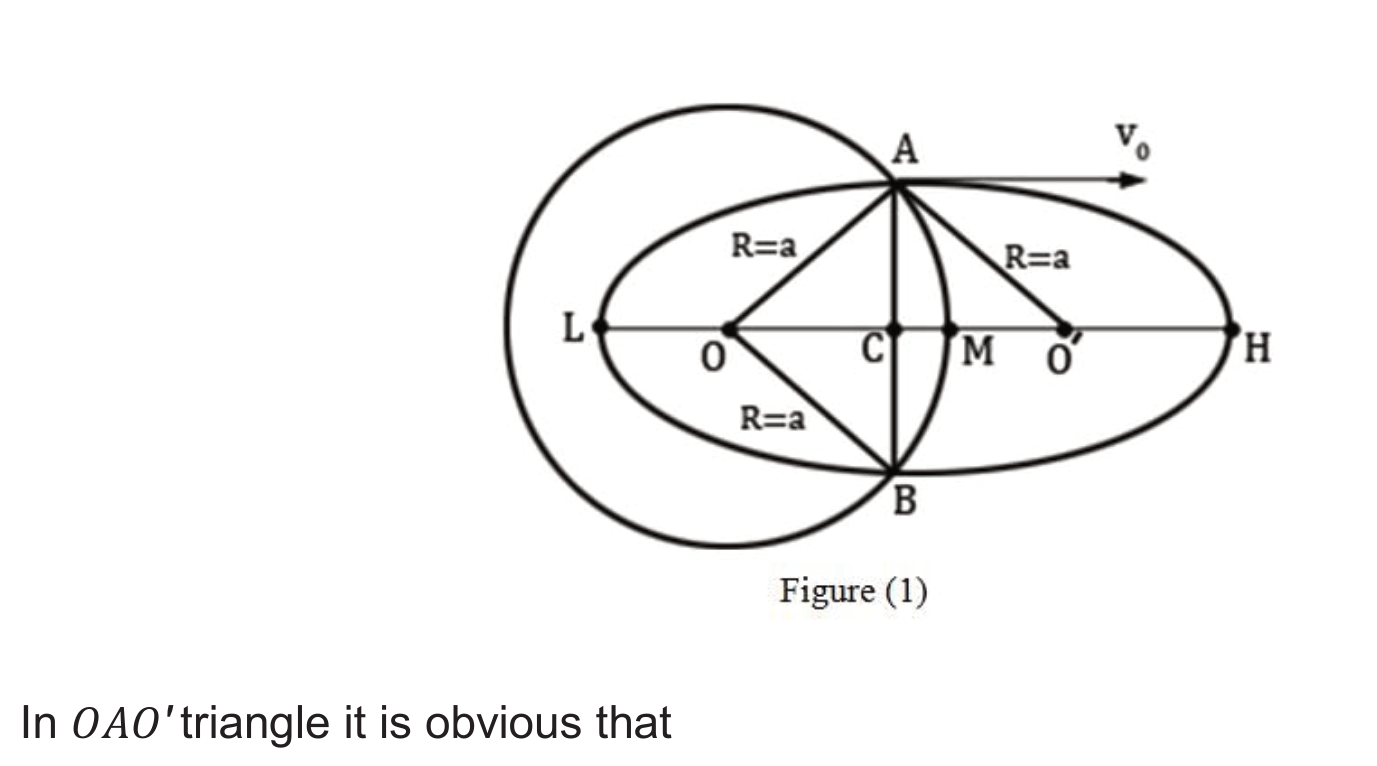
In figure (1) we have
[Figure (1): Earth and the elliptical projectile orbit.]
In triangle it is obvious that
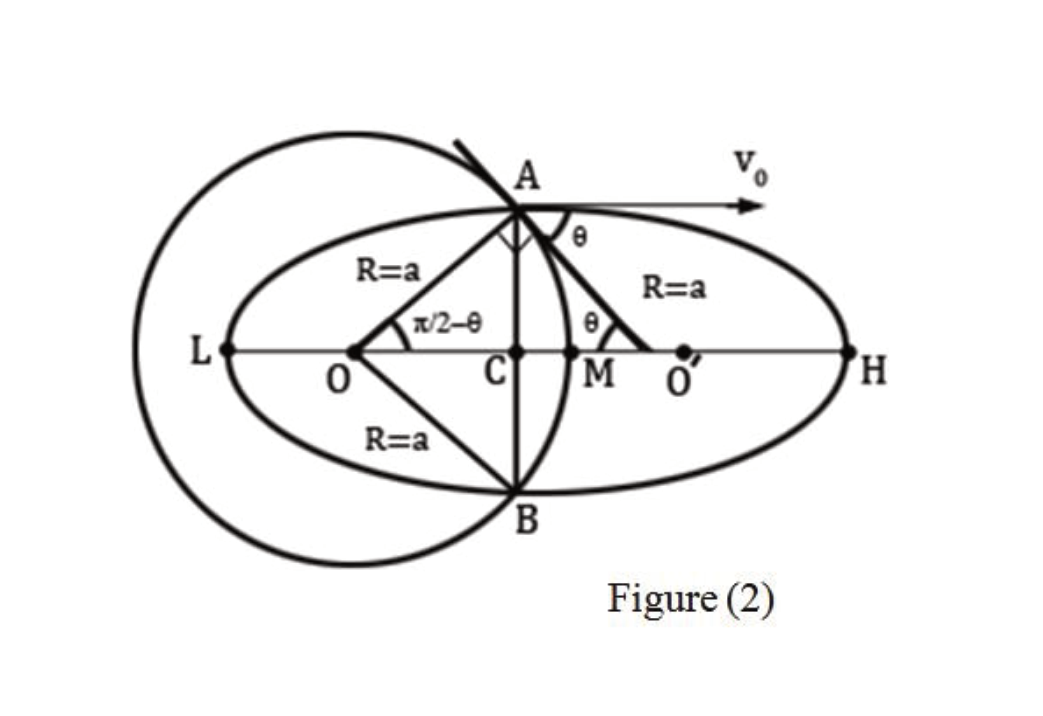
Then must be the center of the ellipse with the initial velocity vector parallel to the ellipse major-axis ().
In figure (2)
(15 points)
[Figure (2): projectile orbit with projection angle theta.]
c)
Range of the projectile is
(6 points)
d)
Start with ellipse equation in polar coordinates
For point A
(5 points)
Source note: the second denominator is printed with a minus sign, although this conflicts with the displayed result. The source formula is retained.
e)
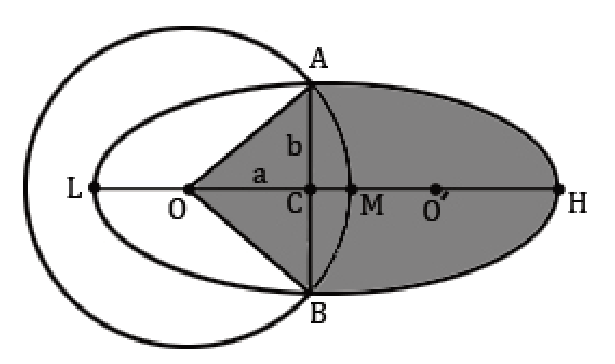
Using Kepler's second law
[Area swept during the projectile flight.]
Kepler's third law
(12 points)
Теми и трудност
Трудност: неоценена.
Небесна механика · Орбитална енергия и напускане · Закони на Кеплер · Орбитални елементи
Предпоставки: Разширена олимпиадна подготовка
Оригинал в Архива: 2009_Theory.pdf · официални решения: IOAA2009_final.pdf