IOAA 2011, Наблюдения, нощно небе — Задача 1. The Little Dolphin
Observing competition – night round · 25 т.
Указания
There are 2 questions, each worth 25 points. You have 80 minutes to solve them, of which :
(a) 25 minutes for reading the question and preparing for the observations,
(b) 30 minutes to perform all the observations at the telescope (for both questions),
(c) 25 minutes for calculations and finishing your work.
Additional time is allowed to move to and from the observing site.
Along with the questions you will receive a map of the sky, for use with both questions.
At the observing site you will find ready :
(a) a refracting telescope with a right-angle mirror and an eyepiece with an illuminated reticle, which can be rotated about the optical axis,
(b) a red torch, stopwatch, pencil, eraser and clipboard,
(c) a chair.
Note: the telescope is already aligned – do not change the position of the tripod!
The brightness of the reticle can be adjusted by turning the on-off switch.
You are allowed to take only the questions, answer sheet and blank paper for additional work with you to the telescope.
Only the answer sheet will be assessed. The additional worksheets will not be assessed.
Clearly mark every page of the answer sheet with your code number.
If you have difficulty with the equipment (not related to the question) or disturb the alignment of the telescope, call an assistant.
Условие
An asterism known as the Little Dolphin lies near a line connecting the stars α Peg (Markab) and β Peg (Scheat). It is marked with a circle on the large-scale map.
The map also shows the constellation of Delfinus, the Dolphin, with the brightest stars labelled with their Bayer designations (α, β, γ, δ and ε).
The coordinates of α and β Peg and the Little Dolphin (in right ascension order) are:
| Right Ascension | Declination | |
|---|---|---|
| Little Dolphin | ||
| β Peg | ||
| α Peg |
Based on your observations, make two drawings on the answer sheet :
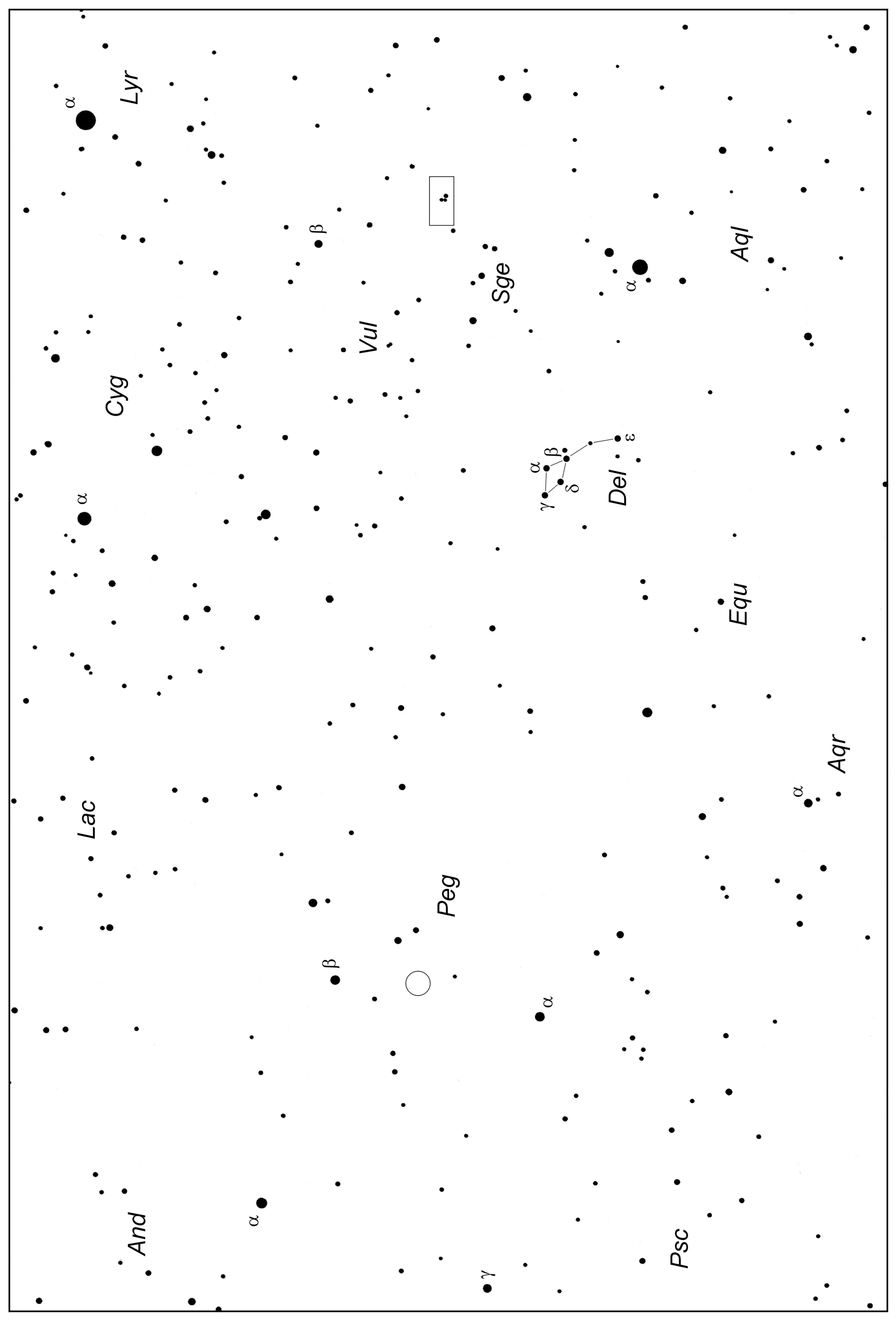
On Drawing 1 : Draw the view of the constellation Delphinus (Del) as seen through the finder scope. Include as many stars as you can see in the field of view.
With an arrow, mark the apparent direction of motion of the stars across the field of view of the finder scope caused by the rotation of the Earth.
Label the stars with the Bayer designations given on the map (α, β, γ, δ and ε).
Also label the brightest of these 5 stars “”.
Also label the faintest of these 5 stars “”.
On Drawing 2 : Draw the view of the Little Dolphin as seen through the larger telescope. Include as many stars as you can see in the field of view.
With an arrow, mark the apparent direction of motion of the stars across the field of view of the telescope caused by the rotation of the Earth.
Label the stars of the Little Dolphin α′, β′, γ′, δ′ and ε′ such that they match the labels of the stars in the constellation Delphinus as given on the map.
Label the brightest of these 5 stars “”.
Решение
Внимание: Непълно решение
В архива няма официално решение на тази задача.
Оригинал в Архива: 2011_Night_Sky.pdf