IOAA 2011, Наблюдения, планетариум — Задача 2. Mars
Observing competition – planetarium round · 25 т.
General instructions
There are 2 questions, each worth 25 points. You have 80 minutes to solve them, of which :
(a) 20 minutes for reading the question and preparing for the observations,
(b) 40 minutes to perform all the observations in the planetarium (20 minutes for each questions),
(c) 20 minutes for calculations and finishing your work.
Additional time is allowed to move to and from the planetarium.
Along with the questions you will be given a map of the sky, for use with both questions. The map is for epoch J 2000.0, using a polar projection with a linear scale in declination, and covers stars down to about magnitude. You will also be given paper for working and notes, writing implements, a pencil sharpener and an eraser.
Please take everything from the desk in the first room with you to the planetarium dome, as you will be going to a different room afterwards to finish your work.
At your place in the dome you will find a torch and clipboard. Please leave these two items behind for the next contestant.
Only answers given in the appropriate places on the question sheet and on the map of the sky will be assessed. The additional worksheets will not be assessed.
Clearly mark every page with your code number.
About the questions
Note: Azimuth is counted from to starting at S through W, N, E.
Условие
In Question 2 :
Four consecutive days on the surface of Mars will be shown.
There is a Martian base visible on the horizon.
During the Martian daytime the sky will be slightly brightened.
The moons of Mars and the other planets will not be displayed.
The local meridian will be continuously visible on the sky.
H) Give the areographic (Martian) latitude of the observer :
I) Give the altitudes of upper () and lower () culmination of :
Pollux (β Gem) : ; ,
Deneb (α Cyg) ; ,
J) Give the areocentric (Martian) declination of :
Regulus (α Leo) .
Toliman (α Cen) .
K) Sketch diagrams to illustrate your working in questions (I) and (J) above :
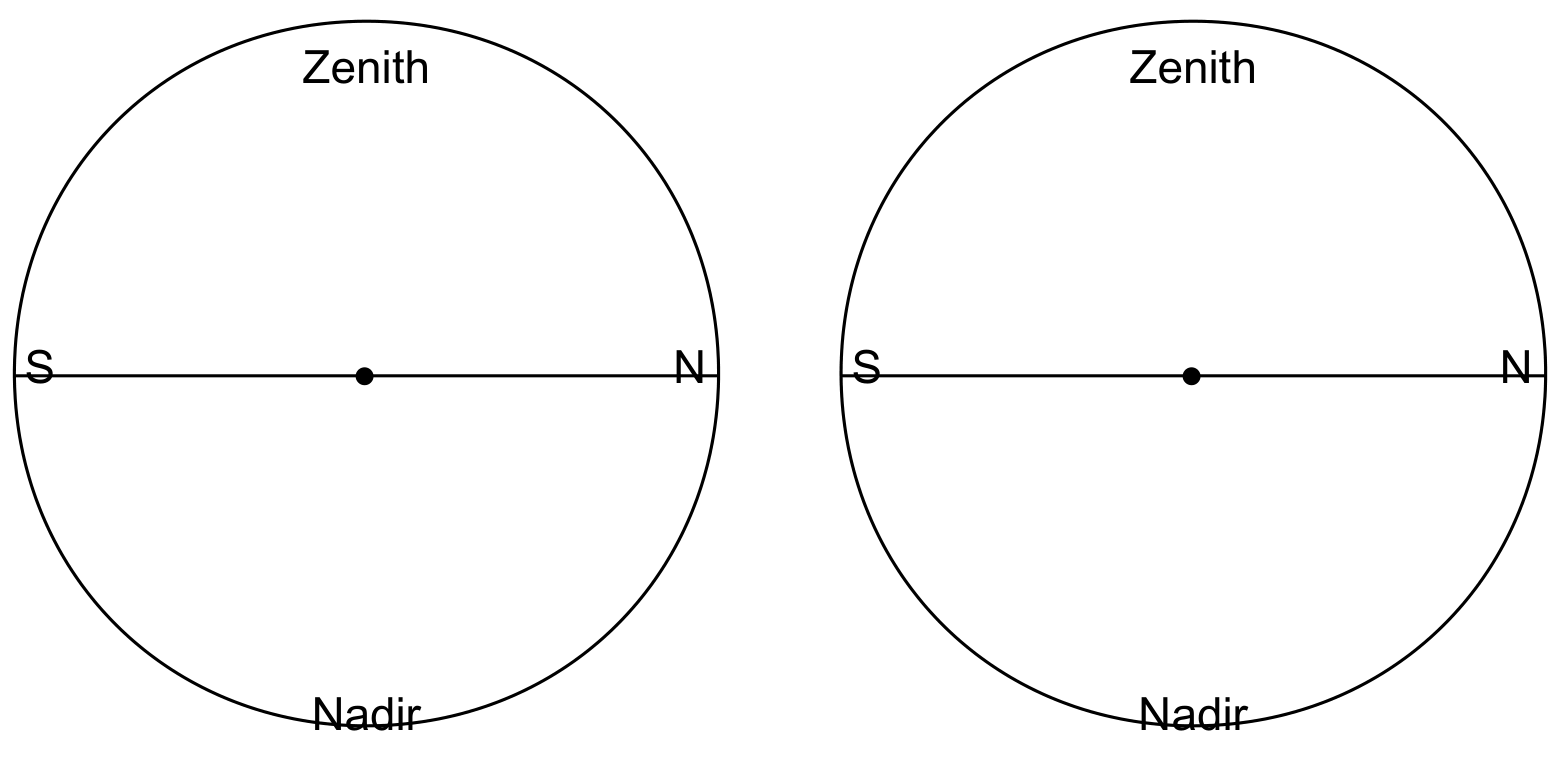
L) on the map of the sky, mark (with a cross) and label (“M”) the Martian celestial North Pole.
M) Give the azimuth of the observer as seen from the Martian base :
.
N) Estimate the location of the base on Mars, and circle the appropriate description :
a. near the Equator
b. near the northern Tropic circle
c. near the northern Arctic circle
d. near the North Pole
O) The time axis below shows the Martian year and the seasons in the northern hemisphere. Mark the date represented by the planetarium display on the axis.

Решение
Внимание: Непълно решение
В архива няма официално решение на тази задача.
Оригинал в Архива: 2011_Planetarium.pdf