IOAA 2013, Анализ на данни — Задача 4. Question 4
7th International Olympiad on Astronomy & Astrophysics — Data analysis
Table of Constants
| Group | Quantity | Value |
|---|---|---|
| Earth | Mass | |
| Earth | Radius | |
| Earth | Acceleration of gravity | |
| Earth | Obliquity of Ecliptic | |
| Earth | Length of Tropical Year | 365.2422 mean solar days |
| Earth | Length of Sidereal Year | 365.2564 mean solar days |
| Earth | Albedo | 0.39 |
| Moon | Mass | |
| Moon | Radius | |
| Moon | Mean distance from Earth | |
| Moon | Orbital inclination with the Ecliptic | |
| Moon | Albedo | 0.14 |
| Moon | Apparent magnitude (mean full moon) | −12.74 |
| Sun | Mass | |
| Sun | Luminosity | |
| Sun | Absolute Magnitude | 4.72 mag |
| Sun | Angular diameter | 0.5 degrees |
| Sun | Effective Surface Temperature | 5800 K |
| Jupiter | Orbit semi-major axis | 5.204 AU |
| Jupiter | Orbital period | 11.8618 yr |
| Distances and sizes | Diameter of human pupil | 6 mm |
| Distances and sizes | 1 AU | |
| Distances and sizes | 1 pc | 206,265 AU |
| Distances and sizes | Distance from Sun to Barnard’s Star | 1.83 pc |
| Distances and sizes | Mars orbit semi-major axis | 1.52 AU |
| Physical constants | Gravitational constant (G) | |
| Physical constants | Planck constant (h) | |
| Physical constants | Boltzmann constant | |
| Physical constants | Stefan-Boltzmann constant | |
| Physical constants | Hubble constant | |
| Physical constants | Speed of light | 299,792,458 m/s |
| Physical constants | Proton mass | |
| Physical constants | Deuterium mass | |
| Physical constants | Neutron mass | |
| Physical constants | Helium-3 mass | |
| Physical constants | Helium-4 mass |
Бележки за изданието
The archive PDF contains questions and inline official answers. The Hyades photograph is already annotated; no unannotated version or Hyades-stars.txt is present in the complete 19-entry year catalogue. All 35 input rows are printed in Question 4 and also supplied in DataHyades.xlsx. Source formula/numbering defects are retained: duplicate solution step 4 in Question 1, Figure 2/Figure 5 references, missing range dash for star 10, and incorrect right-ascension conversion in Question 4 and workbook. The workbook filters differences less than 10 rather than absolute differences. The reference star list also has printed value differences between its tables.
Условие
Calculate the distance of the Hyades cluster using the moving cluster method (Figure 5).
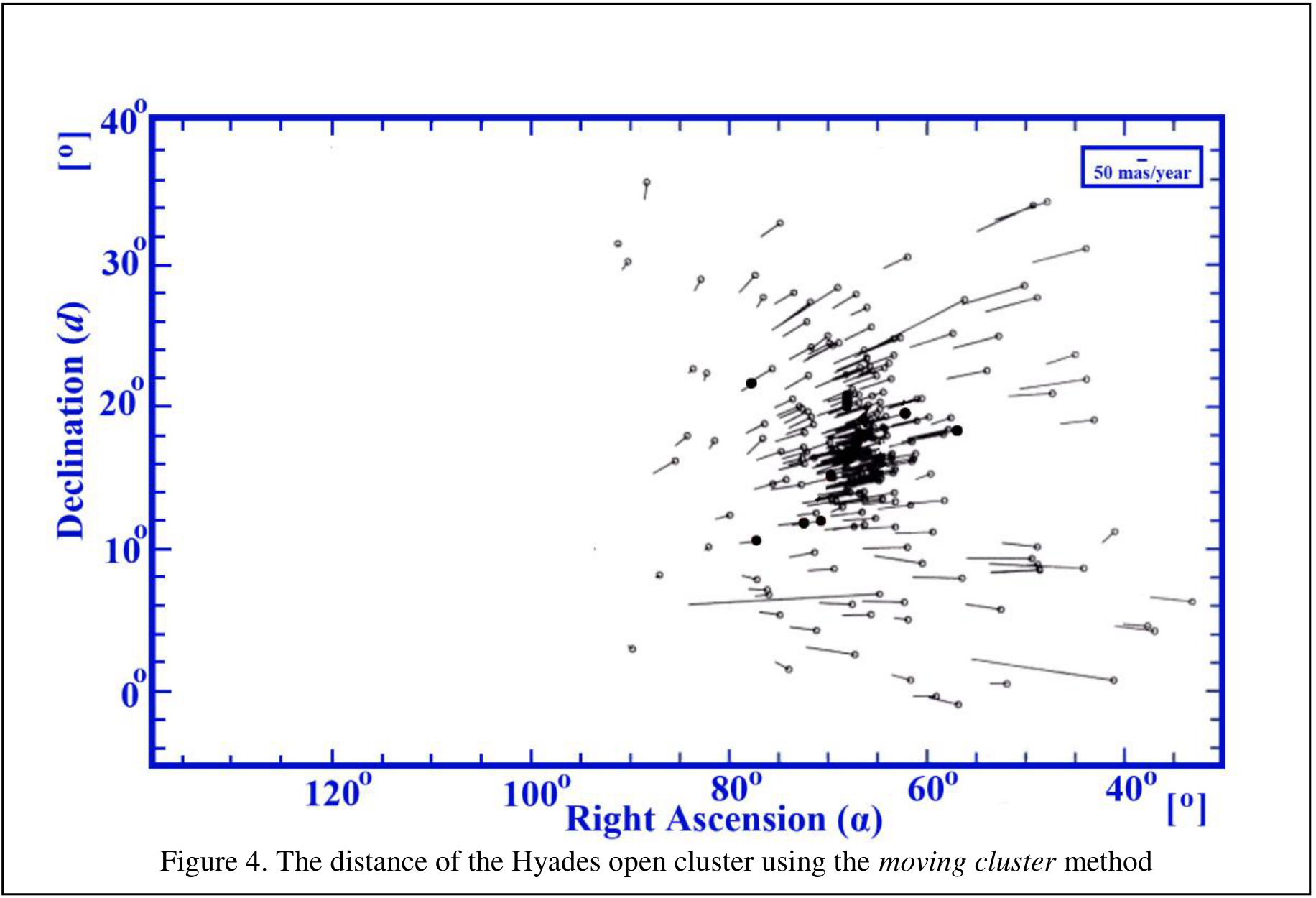
1.
In a Text file (Hyades-stars.txt) you are given a list of 35 stars from the field of the Hyades open cluster, observed by the Hipparcos space telescope.
The information listed in the columns of the text file for each of the 35 stars is: (a) The Hipparcos catalogue number (HIP). (b) Their right ascension (alpha – ) [h m s]. (c) Their declination (delta – ) [° ′ ″]. (d) Their trigonometric parallax (p – ) []. (e) Their proper motion in right ascension multiplied by (mu_axcosd – ) []. (f) Their proper motion in declination (mu_d – ) []. (g) Their radial velocity (v_r – ) [km/s].
| HIP | alpha [h m s] | delta [° ′ ″] | p | mu_axcosd | mu_d | v_r |
|---|---|---|---|---|---|---|
| 13834 | 2 58 5.08 | 20 40 7.7 | 31.41 | 234.79 | -31.64 | 28.10 |
| 14838 | 3 11 37.67 | 19 43 36.1 | 19.44 | 154.61 | -8.39 | 24.70 |
| 18170 | 3 53 9.96 | 17 19 37.8 | 24.14 | 143.97 | -29.93 | 35.00 |
| 18735 | 4 0 48.69 | 18 11 38.6 | 21.99 | 129.49 | -28.27 | 31.70 |
| 19554 | 4 11 20.20 | 5 31 22.9 | 25.89 | 146.86 | 5.00 | 36.60 |
| 20205 | 4 19 47.53 | 15 37 39.7 | 21.17 | 115.29 | -23.86 | 39.28 |
| 20261 | 4 20 36.24 | 15 5 43.8 | 21.20 | 108.79 | -20.67 | 36.20 |
| 20400 | 4 22 3.45 | 14 4 38.1 | 21.87 | 114.04 | -21.40 | 37.80 |
| 20455 | 4 22 56.03 | 17 32 33.3 | 21.29 | 107.75 | -28.84 | 39.65 |
| 20542 | 4 24 5.69 | 17 26 39.2 | 22.36 | 109.99 | -33.47 | 39.20 |
| 20635 | 4 25 22.10 | 22 17 38.3 | 21.27 | 105.49 | -44.14 | 38.60 |
| 20711 | 4 26 18.39 | 22 48 49.3 | 21.07 | 108.66 | -45.83 | 35.60 |
| 20713 | 4 26 20.67 | 15 37 6.0 | 20.86 | 114.66 | -33.30 | 40.80 |
| 20842 | 4 28 0.72 | 21 37 12.0 | 20.85 | 98.82 | -40.59 | 37.50 |
| 20885 | 4 28 34.43 | 15 57 44.0 | 20.66 | 104.76 | -15.01 | 40.17 |
| 20889 | 4 28 36.93 | 19 10 49.9 | 21.04 | 107.23 | -36.77 | 39.37 |
| 20894 | 4 28 39.67 | 15 52 15.4 | 21.89 | 108.66 | -26.39 | 38.90 |
| 20901 | 4 28 50.10 | 13 2 51.5 | 20.33 | 105.17 | -15.08 | 39.90 |
| 21029 | 4 30 33.57 | 16 11 38.7 | 22.54 | 104.98 | -25.14 | 41.00 |
| 21036 | 4 30 37.30 | 13 43 28.0 | 21.84 | 108.06 | -19.71 | 38.80 |
| 21039 | 4 30 38.83 | 15 41 31.0 | 22.55 | 104.17 | -24.29 | 39.56 |
| 21137 | 4 31 51.69 | 15 51 5.9 | 22.25 | 107.59 | -32.38 | 36.00 |
| 21152 | 4 32 4.74 | 5 24 36.1 | 23.13 | 114.15 | 6.17 | 39.80 |
| 21459 | 4 36 29.07 | 23 20 27.5 | 22.60 | 109.97 | -53.86 | 43.30 |
| 21589 | 4 38 9.40 | 12 30 39.1 | 21.79 | 101.73 | -14.90 | 44.70 |
| 21683 | 4 39 16.45 | 15 55 4.9 | 20.51 | 82.40 | -19.53 | 35.60 |
| 22044 | 4 44 25.77 | 11 8 46.2 | 20.73 | 98.87 | -13.47 | 39.60 |
| 22157 | 4 46 1.70 | 11 42 20.2 | 12.24 | 67.48 | -7.09 | 43.00 |
| 22176 | 4 46 16.78 | 18 44 5.5 | 10.81 | 73.03 | -69.79 | 44.11 |
| 22203 | 4 46 30.33 | 15 28 19.6 | 19.42 | 91.37 | -24.72 | 42.42 |
| 22565 | 4 51 22.41 | 18 50 23.8 | 17.27 | 79.66 | -32.76 | 36.80 |
| 22850 | 4 54 58.32 | 19 29 7.6 | 14.67 | 63.32 | -28.41 | 38.40 |
| 23497 | 5 3 5.70 | 21 35 24.2 | 20.01 | 68.94 | -40.85 | 38.00 |
| 23983 | 5 9 19.60 | 9 49 46.6 | 18.54 | 63.54 | -7.87 | 44.16 |
| 24019 | 5 9 45.06 | 28 1 50.2 | 18.28 | 55.86 | -60.57 | 44.90 |
Import the txt file in MS Excel
2.
Convert the coordinates in degrees (with 4 decimal points).
3.
Calculate the angular distance, , between each of the stars and the point of convergence, which is at (, ).
4.
Calculate the proper motion of each star, [], using and given in the list.
5.
Use the above data to calculate the distance, , for each star using the following equation:
where is the distance of the star in parsecs, is the radial velocity of the star in km/sec, is the angular distance between the star and the point of convergence that you have already estimated in step 3, while is the total proper motion estimated in step 4. Do all stars belong to the Hyades cluster? You can assume that any stars whose distance from the centre of the cluster () is larger than 10 pc, are not part of the cluster.
6.
Independently, calculate the distance, , of each star in the list using the trigonometric parallax angle, .
7.
Find the average distance of the Hyades cluster, and , and its standard deviation, and , for each method (moving cluster and trigonometric parallax methods).
8.
Which method is more accurate: (i) the moving cluster method, (ii) the trigonometric parallax method? Please answer with (i) or (ii).
Решение
Official solution and grading (macros are allowed).
(1)
The student should be able to import the ascii data of the txt file in the MS Excel spreadsheet application. (12 Points)
(2)
In order to calculate the angular distance (next step), all coordinates should be converted into decimal degrees. The students should be able to convert the [hours, min, sec] and the [°, ′, ″] into decimal degrees, using. For the right ascension: and for the declination: . All coordinates are positive, so the student does not have to worry about checking the sign, which is not trivial. (12 Points)
(3)
Using the cosine law, , the angular distance, , between each of the stars and the point of convergence should be calculated. (15 Points)
(4)
The student should easily calculate the proper motion of each star, by inserting the given equation, , in the spreadsheet. (9 Points)
(5)
Again, inserting the given equation, in the spreadsheet (remembering to divide the given values of by 1000 to get arcseconds), the student should be able to calculate the distance, , of each star. Any star whose distance from the centre of the cluster is larger than 10 pc should be omitted from the following calculations. (12 Points)
(6)
The trigonometric parallax distance is given by . This equation should be inserted in the spreadsheet. The result is in parsecs [pc]. (6 Points)
(7)
Using the statistical functions AVERAGE and STDEV of MS Excel, the student should easily calculate the average and the standard deviation of and . (6 Points)
(8)
The method with the smaller standard deviation is, obviously more accurate. (3 Point)
(macros are allowed)
DataHyades.xlsx — archived worked values
Point of convergence: R.A. 6h7m, displayed 90.1167 degrees; Dec. 6°56′, displayed 6.9333 degrees. . Values below are transcribed from the archived workbook, without recalculation. The workbook and printed solution use an incorrect right-ascension conversion; the distance filter is also one-sided. These source errors affect the worked results.
| HIP | [deg] | [deg] | [deg] | [marcsec] | r(mu) | r(p) |
|---|---|---|---|---|---|---|
| 13834 | 30.9681 | 20.6688 | 58.7411 | 236.9123 | 41.2182 | 31.8370 |
| 14838 | 45.1938 | 19.7267 | 45.3821 | 154.8375 | 34.1029 | 51.4403 |
| 18170 | 45.8861 | 17.3272 | 44.3591 | 147.0482 | 49.0988 | 41.4250 |
| 18735 | 60.0135 | 18.1941 | 31.3998 | 132.5400 | 30.7966 | 45.4752 |
| 19554 | 60.1889 | 5.5230 | 29.7796 | 146.9451 | 30.0661 | 38.6250 |
| 20205 | 60.3299 | 15.6277 | 30.4351 | 117.7331 | 41.3499 | 47.2367 |
| 20261 | 60.3434 | 15.0955 | 30.3047 | 110.7362 | 40.3045 | 47.1698 |
| 20400 | 60.3676 | 14.0773 | 30.0788 | 116.0305 | 39.8030 | 45.7247 |
| 20455 | 60.3822 | 17.5426 | 30.8759 | 111.5429 | 44.8354 | 46.9704 |
| 20542 | 60.4016 | 17.4442 | 30.8306 | 114.9697 | 42.9281 | 44.7227 |
| 20635 | 60.4228 | 22.2940 | 32.4706 | 114.3524 | 45.3124 | 47.0146 |
| 20711 | 60.4384 | 22.8137 | 32.6692 | 117.9296 | 40.8337 | 47.4608 |
| 20713 | 60.4391 | 15.6183 | 30.3306 | 119.3977 | 42.1745 | 47.9386 |
| 20842 | 60.4669 | 21.6200 | 32.1677 | 106.8314 | 46.5719 | 47.9616 |
| 20885 | 60.4762 | 15.9622 | 30.3765 | 105.8299 | 46.9330 | 48.4027 |
| 20889 | 60.4769 | 19.1805 | 31.2887 | 113.3592 | 44.5251 | 47.5285 |
| 20894 | 60.4777 | 15.8709 | 30.3534 | 111.8187 | 42.9752 | 45.6830 |
| 20901 | 60.4806 | 13.0476 | 29.7955 | 106.2456 | 45.3621 | 49.1884 |
| 21029 | 60.5093 | 16.1941 | 30.4021 | 107.9482 | 47.0107 | 44.3656 |
| 21036 | 60.5104 | 13.7244 | 29.8790 | 109.8428 | 42.8111 | 45.7875 |
| 21039 | 60.5108 | 15.6919 | 30.2804 | 106.9644 | 45.5544 | 44.3459 |
| 21137 | 60.5310 | 15.8516 | 30.2990 | 112.3569 | 39.4947 | 44.9438 |
| 21152 | 60.5347 | 5.4100 | 29.4452 | 114.3166 | 41.4596 | 43.2339 |
| 21459 | 60.6081 | 23.3410 | 32.7494 | 122.4512 | 47.9793 | 44.2478 |
| 21589 | 60.6359 | 12.5109 | 29.5662 | 102.8154 | 52.0285 | 45.8926 |
| 21683 | 60.6546 | 15.9180 | 30.1995 | 84.6828 | 51.6128 | 48.7567 |
| 22044 | 60.7405 | 11.1462 | 29.3006 | 99.7834 | 46.9812 | 48.2393 |
| 22157 | 60.7671 | 11.7056 | 29.3353 | 67.8514 | 75.1298 | 81.6993 |
| 22176 | 60.7713 | 18.7349 | 30.8814 | 101.0150 | 55.0891 | 92.5069 |
| 22203 | 60.7751 | 15.4721 | 29.9820 | 94.6549 | 54.5418 | 51.4933 |
| 22565 | 60.8562 | 18.8399 | 30.8390 | 86.1332 | 53.8098 | 57.9039 |
| 22850 | 60.9162 | 19.4854 | 30.9995 | 69.4014 | 70.1306 | 68.1663 |
| 23497 | 75.0516 | 21.5901 | 20.6527 | 80.1339 | 37.7052 | 49.9750 |
| 23983 | 75.1554 | 9.8296 | 15.0796 | 64.0255 | 39.2026 | 53.9374 |
| 24019 | 75.1625 | 28.0306 | 25.4054 | 82.3958 | 54.5970 | 54.7046 |
| r(mu) | r(p) | |
|---|---|---|
| average | 45.8380 | 49.7716 |
| stdev | 9.0740 | 11.0183 |
DataHyades.xlsx — residuals
| HIP | r(p)−r(m) | r(mu)−r0 | r(p)−r0 | ||
|---|---|---|---|---|---|
| 13834 | -9.3812 | -5.1218 | -14.5030 | -4.6198 | -17.9346 |
| 14838 | 17.3374 | -12.2371 | 5.1003 | -11.7351 | 1.6688 |
| 18170 | -7.6737 | 2.7588 | -4.9150 | 3.2608 | -8.3466 |
| 18735 | 14.6786 | -15.5434 | -0.8648 | -15.0414 | -4.2964 |
| 19554 | 8.5588 | -16.2739 | -7.7150 | -15.7719 | -11.1466 |
| 20205 | 5.8867 | -4.9901 | 0.8967 | -4.4881 | -2.5349 |
| 20261 | 6.8653 | -6.0355 | 0.8298 | -5.5335 | -2.6018 |
| 20400 | 5.9217 | -6.5370 | -0.6153 | -6.0350 | -4.0468 |
| 20455 | 2.1350 | -1.5046 | 0.6304 | -1.0026 | -2.8012 |
| 20542 | 1.7946 | -3.4119 | -1.6173 | -2.9099 | -5.0489 |
| 20635 | 1.7022 | -1.0276 | 0.6746 | -0.5256 | -2.7570 |
| 20711 | 6.6271 | -5.5063 | 1.1208 | -5.0043 | -2.3107 |
| 20713 | 5.7641 | -4.1655 | 1.5986 | -3.6634 | -1.8329 |
| 20842 | 1.3897 | 0.2319 | 1.6216 | 0.7339 | -1.8099 |
| 20885 | 1.4697 | 0.5930 | 2.0627 | 1.0950 | -1.3689 |
| 20889 | 3.0034 | -1.8149 | 1.1885 | -1.3129 | -2.2431 |
| 20894 | 2.7078 | -3.3648 | -0.6570 | -2.8628 | -4.0886 |
| 20901 | 3.8263 | -0.9779 | 2.8484 | -0.4759 | -0.5832 |
| 21029 | -2.6451 | 0.6707 | -1.9744 | 1.1727 | -5.4060 |
| 21036 | 2.9764 | -3.5289 | -0.5525 | -3.0269 | -3.9840 |
| 21039 | -1.2085 | -0.7856 | -1.9941 | -0.2836 | -5.4257 |
| 21137 | 5.4491 | -6.8453 | -1.3962 | -6.3433 | -4.8278 |
| 21152 | 1.7743 | -4.8804 | -3.1061 | -4.3784 | -6.5377 |
| 21459 | -3.7315 | 1.6393 | -2.0922 | 2.1413 | -5.5238 |
| 21589 | -6.1358 | 5.6885 | -0.4474 | 6.1905 | -3.8790 |
| 21683 | -2.8561 | 5.2728 | 2.4167 | 5.7748 | -1.0149 |
| 22044 | 1.2580 | 0.6412 | 1.8993 | 1.1432 | -1.5323 |
| 22157 | 6.5696 | 28.7898 | 35.3593 | 29.2918 | 31.9278 |
| 22176 | 37.4178 | 8.7491 | 46.1669 | 9.2511 | 42.7354 |
| 22203 | -3.0485 | 8.2018 | 5.1533 | 8.7038 | 1.7217 |
| 22565 | 4.0941 | 7.4698 | 11.5639 | 7.9718 | 8.1323 |
| 22850 | -1.9643 | 23.7906 | 21.8263 | 24.2926 | 18.3948 |
| 23497 | 12.2698 | -8.6348 | 3.6350 | -8.1327 | 0.2034 |
| 23983 | 14.7349 | -7.1374 | 7.5974 | -6.6354 | 4.1659 |
| 24019 | 0.1076 | 8.2570 | 8.3646 | 8.7590 | 4.9330 |
DataHyades.xlsx — without distant stars
| HIP | using r0: r(mu) | using r0: r(p) | using : r(mu) | using : r(p) |
|---|---|---|---|---|
| 13834 | 41.2182 | 31.8370 | 41.2182 | 31.8370 |
| 14838 | 34.1029 | 51.4403 | 34.1029 | 51.4403 |
| 18170 | 49.0988 | 41.4250 | 49.0988 | 41.4250 |
| 18735 | 30.7966 | 45.4752 | 30.7966 | 45.4752 |
| 19554 | 30.0661 | 38.6250 | 30.0661 | 38.6250 |
| 20205 | 41.3499 | 47.2367 | 41.3499 | 47.2367 |
| 20261 | 40.3045 | 47.1698 | 40.3045 | 47.1698 |
| 20400 | 39.8030 | 45.7247 | 39.8030 | 45.7247 |
| 20455 | 44.8354 | 46.9704 | 44.8354 | 46.9704 |
| 20542 | 42.9281 | 44.7227 | 42.9281 | 44.7227 |
| 20635 | 45.3124 | 47.0146 | 45.3124 | 47.0146 |
| 20711 | 40.8337 | 47.4608 | 40.8337 | 47.4608 |
| 20713 | 42.1745 | 47.9386 | 42.1745 | 47.9386 |
| 20842 | 46.5719 | 47.9616 | 46.5719 | 47.9616 |
| 20885 | 46.9330 | 48.4027 | 46.9330 | 48.4027 |
| 20889 | 44.5251 | 47.5285 | 44.5251 | 47.5285 |
| 20894 | 42.9752 | 45.6830 | 42.9752 | 45.6830 |
| 20901 | 45.3621 | 49.1884 | 45.3621 | 49.1884 |
| 21029 | 47.0107 | 44.3656 | 47.0107 | 44.3656 |
| 21036 | 42.8111 | 45.7875 | 42.8111 | 45.7875 |
| 21039 | 45.5544 | 44.3459 | 45.5544 | 44.3459 |
| 21137 | 39.4947 | 44.9438 | 39.4947 | 44.9438 |
| 21152 | 41.4596 | 43.2339 | 41.4596 | 43.2339 |
| 21459 | 47.9793 | 44.2478 | 47.9793 | 44.2478 |
| 21589 | 52.0285 | 45.8926 | 52.0285 | 45.8926 |
| 21683 | 51.6128 | 48.7567 | 51.6128 | 48.7567 |
| 22044 | 46.9812 | 48.2393 | 46.9812 | 48.2393 |
| 22157 | ||||
| 22176 | 55.0891 | 55.0891 | ||
| 22203 | 54.5418 | 51.4933 | 54.5418 | 51.4933 |
| 22565 | 53.8098 | 53.8098 | 57.9039 | |
| 22850 | ||||
| 23497 | 37.7052 | 49.9750 | 37.7052 | 49.9750 |
| 23983 | 39.2026 | 53.9374 | 39.2026 | 53.9374 |
| 24019 | 54.5970 | 54.7046 | 54.5970 | 54.7046 |
| using r0: r(mu) | using r0: r(p) | using | using | |
|---|---|---|---|---|
| average | 44.2142 | 46.5074 | 44.2142 | 46.8635 |
| stdev | 6.2857 | 4.2707 | 6.2857 | 4.6593 |
Теми и трудност
Трудност: неоценена.
Небесна сфера и сферична астрономия · Небесни координати
Предпоставки: Разширена олимпиадна подготовка
Оригинал в Архива: Data-Analysis.pdf · допълнителни данни: IOAA7-BrightStars-list.docx · допълнителни данни: IOAA7-Constants.doc · допълнителни данни: DataHyades.xlsx · допълнителни данни: 130501_P-24.11_B-4.17-rot.jpg · допълнителни данни: 130503_P-23.74_B-3.97_rot.jpg · допълнителни данни: 130505_P-23.34_B-3.76-rot.jpg · допълнителни данни: 130507_P-22.92_B-3.55-rot.jpg · допълнителни данни: 130509_P-22.46_B-3.33_rot.jpg · допълнителни данни: Stonyhurst.3 for Nov 09 to Nov 17 & Dec 28 to Jan 05 & June 28 to July 06 & May 07 to May 15_14cm.jpg · допълнителни данни: Stonyhurst.4 for Jan 06 to Jan 14 & Apr 28 to May 06 & July 07 to July 16 & Oct 31 to Nov 08_14cm.jpg