IOAA 2014, Теория — Задача 17. Cosmic Pendulum
THEORETICAL TEST Long problems — preliminary edition: Cosmic Pendulum
Внимание: Бележка към темата
Only the missing whole preliminary task 17 Cosmic Pendulum is transcribed here. Preliminary tasks 16 Eagles and 18 Antipod correspond to the existing final-paper problems 13/14 and keep their established routes. All 62 native preliminary/final pages were read to prove correspondence. The preliminary instructions say 16–19 long problems although the obtained packet prints 16–18. Referenced blank answer/draft forms and translated envelopes were not obtained. Original question/key symbol, figure-number and scientific discrepancies are preserved with local notes. Part awards 15/15/10/10 sum to 50; no aggregate score or overall time limit is printed.
Indications
1. The problems were elaborated concerning two aspects:
a. To cover merely all the subjects from the syllabus;
b. The average time for solving the items is about 15 minutes per a short problem;
2. In your folder you will find out the following:
a. Answer sheets
b. Draft sheets
c. The envelope with the subjects in English and the translated version of them in your mother tongue;
3. The solutions of the problems will be written down only on the answer sheets you receive on your desk. PLEASE WRITE ONLY ON THE PRINTED SIDE OF THE PAPER SHEET. DON’T USE THE REVERSE SIDE. The evaluator will not take into account what is written on the reverse of the answer sheet.
4. The draft sheets is for your own use to try calculation, write some numbers etc. BEWARE: These papers are not taken into account in evaluation, at the end of the test they will be collected separately . Everything you consider as part of the solutions have to be written on the answer sheets.
5. Each problem have to be started on a new distinct answer sheet.
6. On each answer sheet please fill in the designated boxes as follows:
a. In PROBLEM NO. box write down only the number of the problem: i.e. 1 to 15 for short problems, 16 to 19 for long problems. Each sheet containing the solutions of a certain problem, should have in the box the number of the problem;
b. In Student ID – fill in your ID you will find on your envelope, consisted of 3 letters and 2 digits.
c. In page no. box you will fill in the number of page, starting from 1. We advise you to fill this boxes after you finish the test
7. We don’t understand your language, but the mathematic language is universal, so use as more relationships as you think that your solution will be better understand by the evaluator. If you want to explain in words we kindly ask you to use short English propositions.
8. Use the pen you find out on the desk. It is advisable to use a pencil for the sketches.
9. At the end of the test:
a. Don’t forget to put in order your papers;
b. Put the answer sheets in the folder 1. Please verify that all the pages contain your ID, correct numbering of the problems and all pages are in the right order and numbered. This is an advantage of ease of understanding your solutions.
c. Verify with the assistant the correct number of answer sheets used fill in this number on the cover of the folder and sign.
d. Put the draft papers in the designated folder, Put the test papers back in the envelope.
e. Go to swim
GOOD LUCK !
Preliminary packet and retained final-paper owners
The preliminary cover/index prints 8th IOAA, Suceava – Gura Humorului – August 2014, and long problems 16. Eagles on the Caraiman Cross !, 17. Cosmic Pendulum, 18. From Romania .... to Antipod! ... a ballistic messenger. This page contains only the otherwise missing whole task17; the final edition contains Eagles13 and Antipod14 under their existing problem routes. The original full preliminary question/key PDFs remain the source citations.
The preliminary question variants are preserved as an attributed edition comparison: Eagles calls March21 the “summer equinox”, uses , and asks in B1 only the distance between the birds; the final says “vernal equinox”, uses , adds , and also asks the second bird’s distance from the cross. The preliminary intro includes the World War I/King Ferdinand I/Queen Maria/2013 Guinness memorial background. Antipod preliminary b asks for elements of the launching-speed vector relative to Earth’s centre; final b specifies magnitude and angle to the horizon. Preliminary becomes in the final question; both keys still use384400km. These are source editions of the retained whole tasks, not additional independent problems.
The obtained long PDFs contain no promised blank answer sheets,draft sheets or translated versions. The preliminary instruction range16–19 exceeds the three printed long tasks16–18; no missing task19 is invented.
Условие
A space shuttle (N) orbits the Earth in the equatorial plane on a circular trajectory with radius . From the spaceship. The shuttle has an arm designated to place satelites on the orbit. The arm is a metallic rod (negligible mass) with length . The arm is connected to the shuttle with frictionless mobile articulation. A satellite S is attached to the arm and let out from the shuttle. At a certain moment the angle between the rod and the shuttle’s orbit radius is , see figure 1. You know the mass of the Earth –M, and the gravitational constant G.
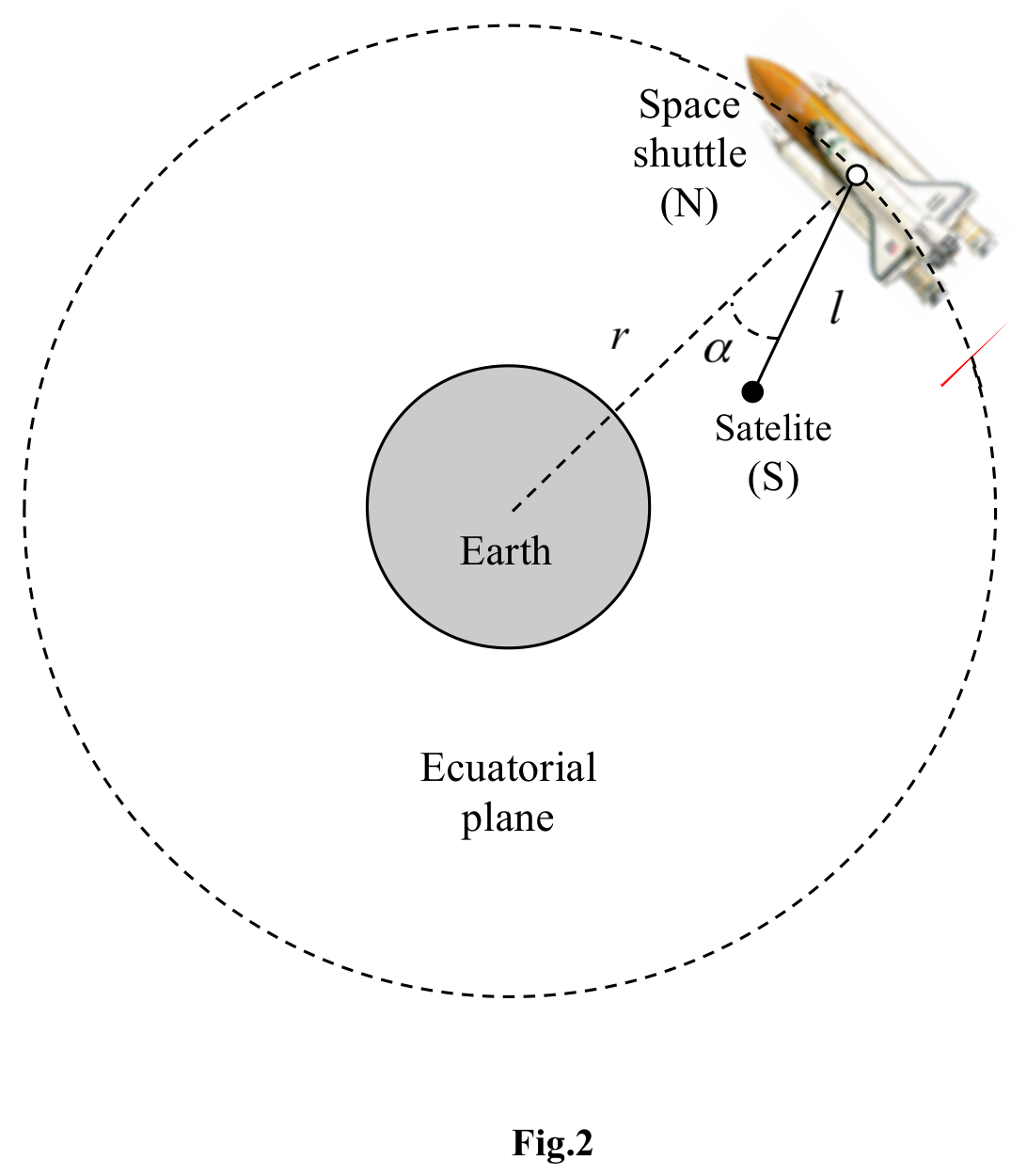
a) Find out the values of angle for which the configuration of the system shuttle – rod –satellite remains unchanged regardless to Earth (the system is in equilibrium), during orbiting the Earth. For each found value of angle , specify the type of the system equilibrium i.e. stable or unstable.
You will take in to account the following assumptions: the initial orbit of the shuttle is not affected by the presence of the satellite S, all the external friction-type interactions are negligible, the satelite – shuttle gravitational interaction is negligible too. The following data are known: , - the mass of the shuttle, the mass of the satelite . [15 т.]
b) In the moment of one stable equilibrium configuration, the rod with the satellite attached is slightly rotated with a very small angle in the orbital plane and then released. Demonstrate that the small oscillations of the satellite S relative to the shuttle are harmonically ones. Express the period of this cosmic pendulum as a function of the orbiting period T of the shuttle around the Earth. [15 т.]
It is known the linear harmonic oscillator equation:
Where : – the instantaneous angular deviation; – the period of the linear harmonic oscillator.
c) If we consider that the mass of the satellite S, is not negligible by comparison with the shuttle’s one in the conditions from point a) the evolution on the orbit of the shuttle would be influenced by the presence of the satellite S rigid attached to the shuttle by the rod. Identify and determine the consequences on the shuttle’s movement after one complete rotation around the Earth. [10 т.]
d) Propose a special technical maneuver which can cancels the influence of the non negligible mass satellite S on the shuttles movement. [10 т.]
Отговори
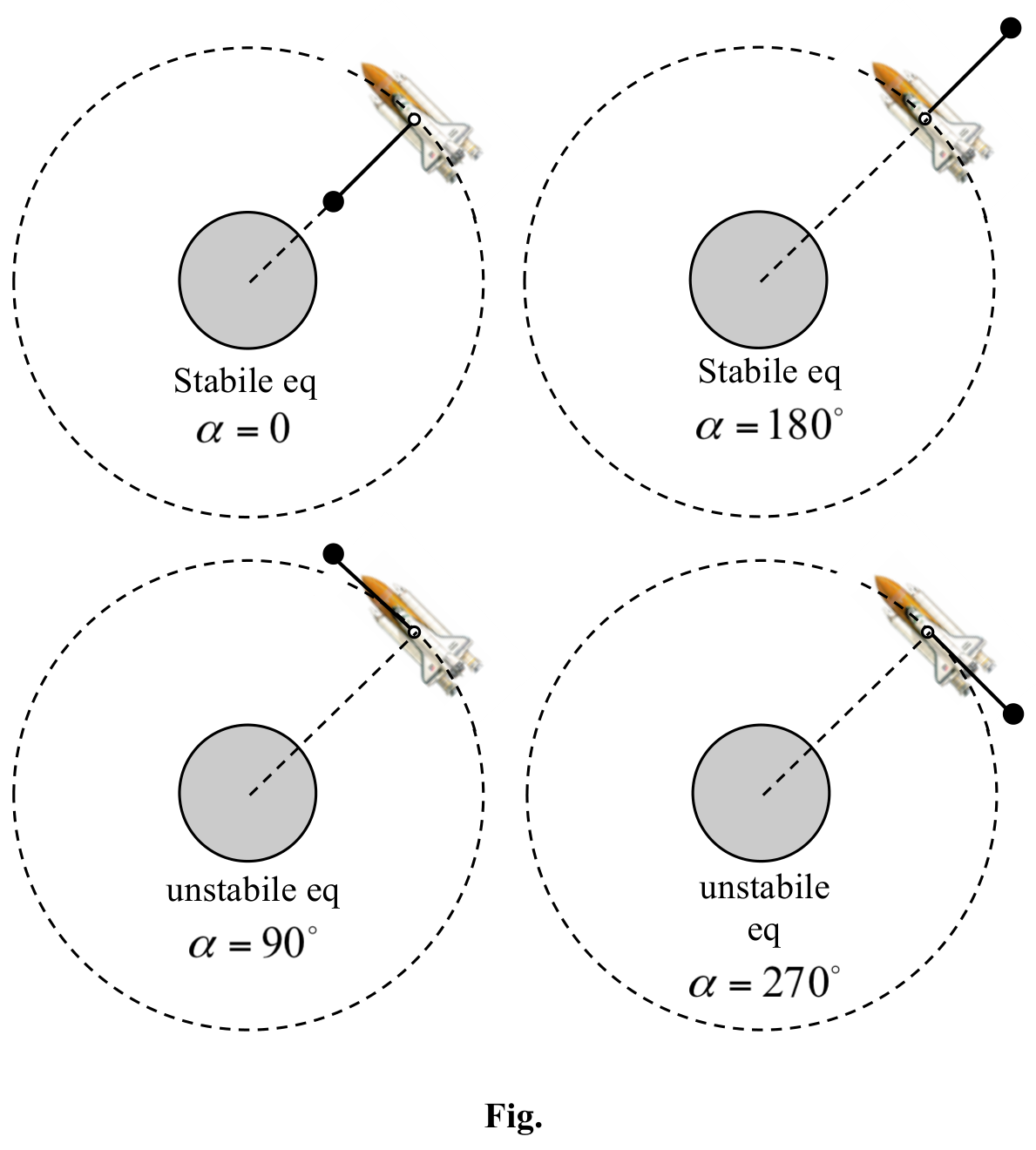
a) (echilibru stabil); (echilibru instabil).
Printed preliminary author key, page17.
b)
Printed preliminary key, page18.
c) The printed key gives , , , , and .
Printed preliminary key pages19–21; complete source derivation and discrepancies preserved below.
d)
Printed Romanian preliminary key page21 and original maneuver diagram page22.
Решение
Source edition: This is the author’s solution and marking scheme in the archived preliminary long-problem packet, not a solution supplied in the final two-problem edition. The repeated key introduction uses gravitational constant , while the primary question says and the worked equations below use . The repeated question/diagram on key14–15 correspond to the complete primary question retained above; the differing constant symbol remains attributed here. Original Romanian conclusions and labels are retained.
Long problem 2. Marking scheme - Cosmic Pendulum
| Part | Points |
|---|---|
| a) | 15 |
| b) | 15 |
| c) | 10 |
| d) | 10 |
The four printed awards sum to 50; no aggregate task or paper total is printed.
a)
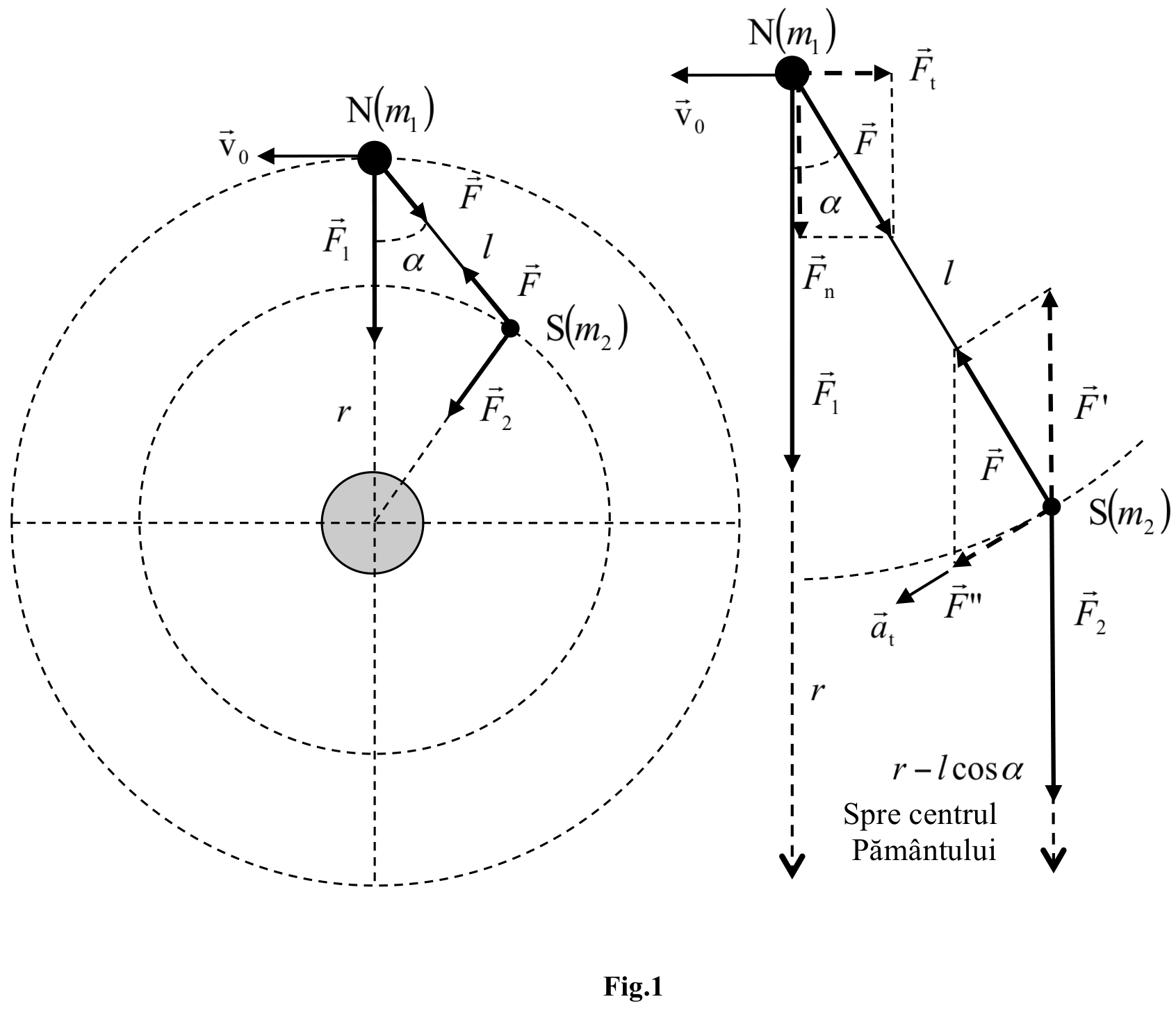
In figure 1 are represented the forces in the system.
– the gravitational attraction force acting on the shuttle due to the Earth;
– the gravitational attraction force acting on the satelite due to the Earth;
– the tension force in the suspension rod.
For a value of the movement equations are:
For the shuttle on circular orbit around the Earth:
For the satelite on circular orbit around the Earth:
If the gravitational interaction between the shuttle and the satellite is negligible results:
The revolution time of the shuttle around the Earth:
The tension force in the rod.
The satellite movement regardless to the shuttle is non uniform circular one, described by the equation:
The solutions of this equation is .
If during the system evolution the configuration of the system remains the same results:
As seen in the pictures.
b)
Coresponding to the position with , the movement equation of the satellite displaced from equilibrium position with a very small angle :
Which represents the linear harmonic oscillator;
Thus the period of the small oscillations will be
c)
Observation: If and , the results are already found:
Corresponding to the initial circulae orbit with radius , the total mechanical energy of the system shuttle – Earth is:
After one complete rotation, the tangential component of the tension in the rod , acting on the shuttle will determine the change of the radius of the orbit i.e. . The total energy of the system will be:
The variation of the mechanical energy after a complete rotation
Thus
The variation of the altitude due to the action of the satellite will be:
The potential energy v
Thus
reprezentând variația energiei cinetice a navei, după o rotație completă în jurul Pământului;
rezultat care constituie “paradoxul sateliților”, adică, atunci când altitudinea orbitei navei scade, viteza navei crește;
Source note: The key prints the coefficient-one denominator after its factor-three/factor-two expansion. It also writes here, although part b defines . Both printed expressions and the repeated energy-algebra line are retained without replacing them by a derived correction.
d)
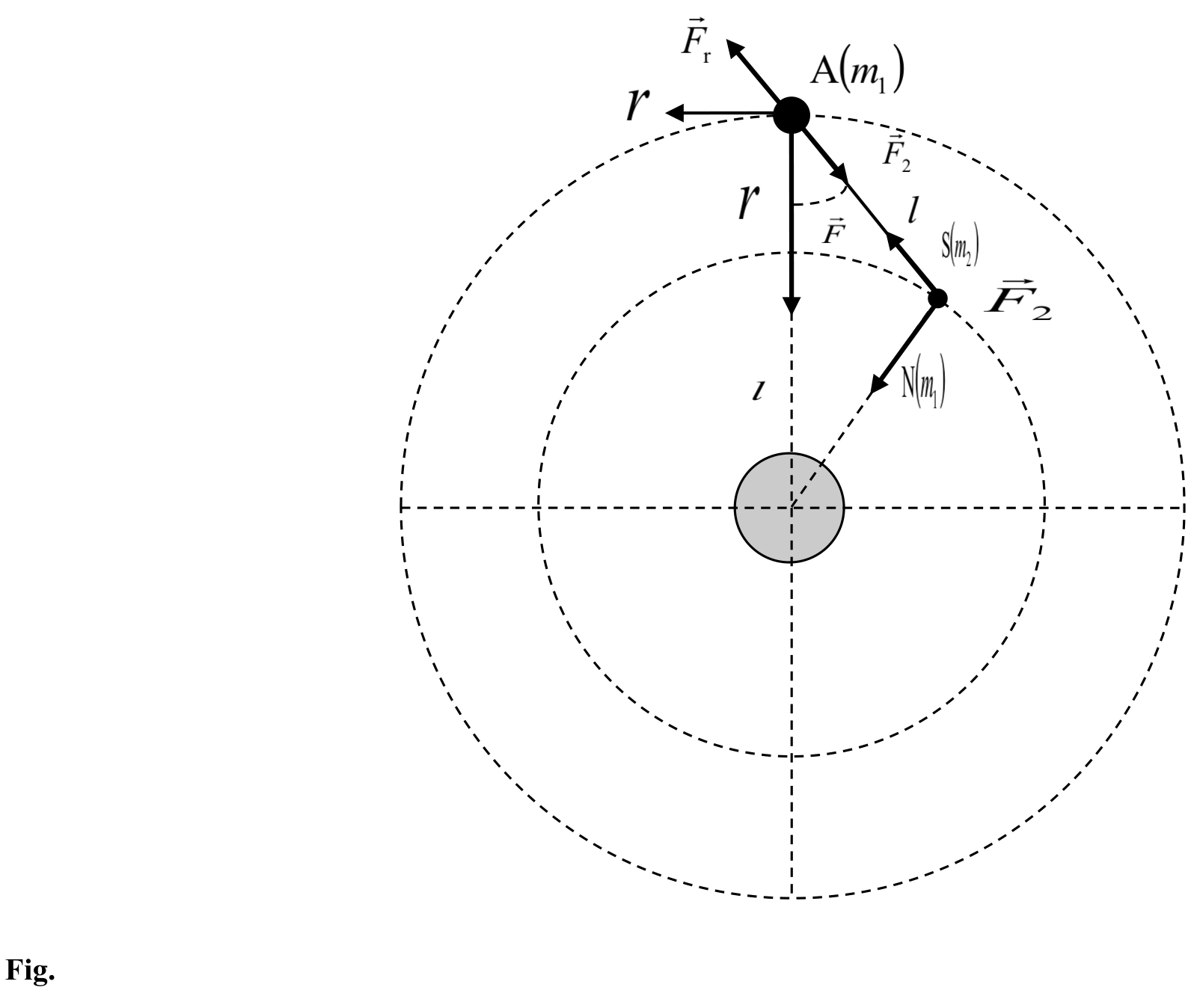
Manevra tehnică propusă este reprezentată în figura alăturată: o forță reactivă, egală în modul și de sens contrar cu tensiunea din tijă:
astfel încât forța rezultantă care acționează asupra navei să rămână forța de atracție gravitațională din partea Pământului:
Теми и трудност
Оценена трудност: 4/5.
Небесна механика · Механика · Орбитално движение · Орбитална енергия и напускане · Механични трептения
Предпоставки: Гимназиална подготовка, Разширена олимпиадна подготовка
Оригинал в Архива: th_long_ver1.pdf · официални решения: th_long_ver1_sol.pdf