IOAA 2014, Теория, предварителен вариант — Задача 1. Lagrange Points
8th International Olympiad on Astronomy and Astrophysics, Suceava - Gura Humorului - August 2014 — THEORETICAL TEST, 15 short problems
Indications
- The problems were elaborated concerning two aspects: a) To cover merely all the subjects from the syllabus;
b) The average time for solving the items is about 15 minutes per a short problem; - In your folder you will find out the following: a) Answer sheets
b) Draft sheets
c) The envelope with the subjects in English and the translated version of them in your mother tongue; - The solutions of the problems will be written down only on the answer sheets you receive on your desk. PLEASE WRITE ONLY ON THE PRINTED SIDE OF THE PAPER SHEET. DON’T USE THE REVERSE SIDE. The evaluator will not take into account what is written on the reverse of the answer sheet.
- The draft sheets is for your own use to try calculation, write some numbers etc. BEWARE: These papers are not taken into account in evaluation, at the end of the test they will be collected separately . Everything you consider as part of the solutions have to be written on the answer sheets.
- Each problem have to be started on a new distinct answer sheet.
- On each answer sheet please fill in the designated boxes as follows: a) In PROBLEM NO. box write down only the number of the problem: i.e. 1 – 15 for short problems, 16 – 19 for long problems. Each sheet containing the solutions of a certain problem, should have in the box the number of the problem;
b) In Student ID – fill in your ID you will find on your envelope, consisted of 3 letters and 2 digits.
c) In page no. box you will fill in the number of page, starting from 1. We advise you to fill this boxes after you finish the test - We don’t understand your language, but the mathematic language is universal, so use as more relationships as you think that your solution will be better understand by the evaluator. If you want to explain in words we kindly ask you to use short English propositions.
- Use the pen you find out on the desk. It is advisable to use a pencil for the sketches.
- At the end of the test: a) Don’t forget to put in order your papers;
b) Put the answer sheets in the folder 1. Please verify that all the pages contain your ID, correct numbering of the problems and all pages are in the right order and numbered. This is an advantage of ease of understanding your solutions.
c) Verify with the assistant the correct number of answer sheets used fill in this number on the cover of the folder and sign.
d) Put the draft papers in the designated folder, Put the test papers back in the envelope.
e) Go to swim
GOOD LUCK !
Условие
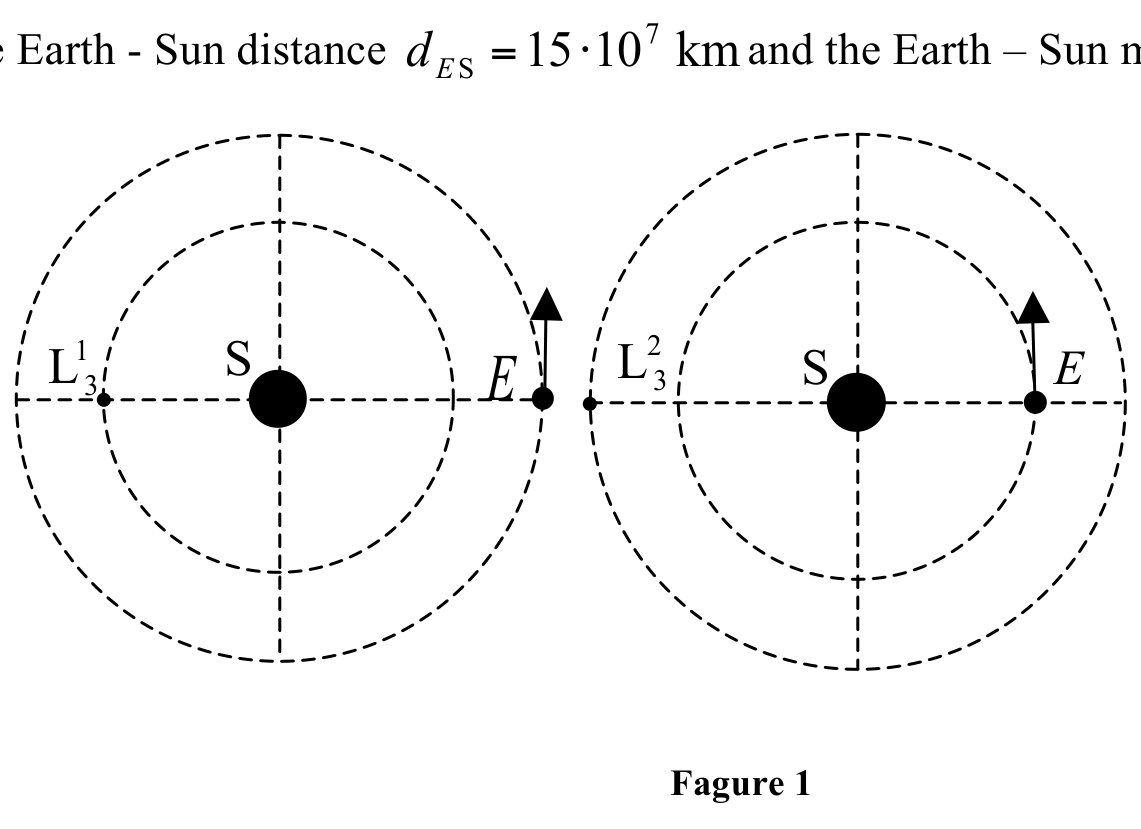
The Lagrange points are the five positions in an orbital configuration, where a small object is stationary relative to two big bodies, only gravitationally interacting with them. For example, an artificial satellite relative to Earth and Moon, or relative to Earth and Sun. In the Figure 1 are sketched two possible orbits of Earth relative to Sun and of a small satellite relative to the Sun. Find out which of the two points and could be the real Lagrange point relative to the system Earth – Sun, and calculate its position relative to Sun. You know the following data: the Earth - Sun distance and the Earth – Sun mass ratio
Отговори
37.54 km
The official solution finds that (the outer point, of Figure 1) is the Lagrange point, at Km (printed unit) beyond the Earth–Sun distance on the far side of the Sun.
Решение
Problem 1. Marking scheme Lagrange Point
| 1. | Correct derivation of forces’ equilibrium | 6 points |
| 2. | Correct identification of the Lagrange point | 2 points |
| 3. | Correct calculation of the position of Lagrange point | 2 points |
| 4. | Deduction for incorrect value | 1 point |
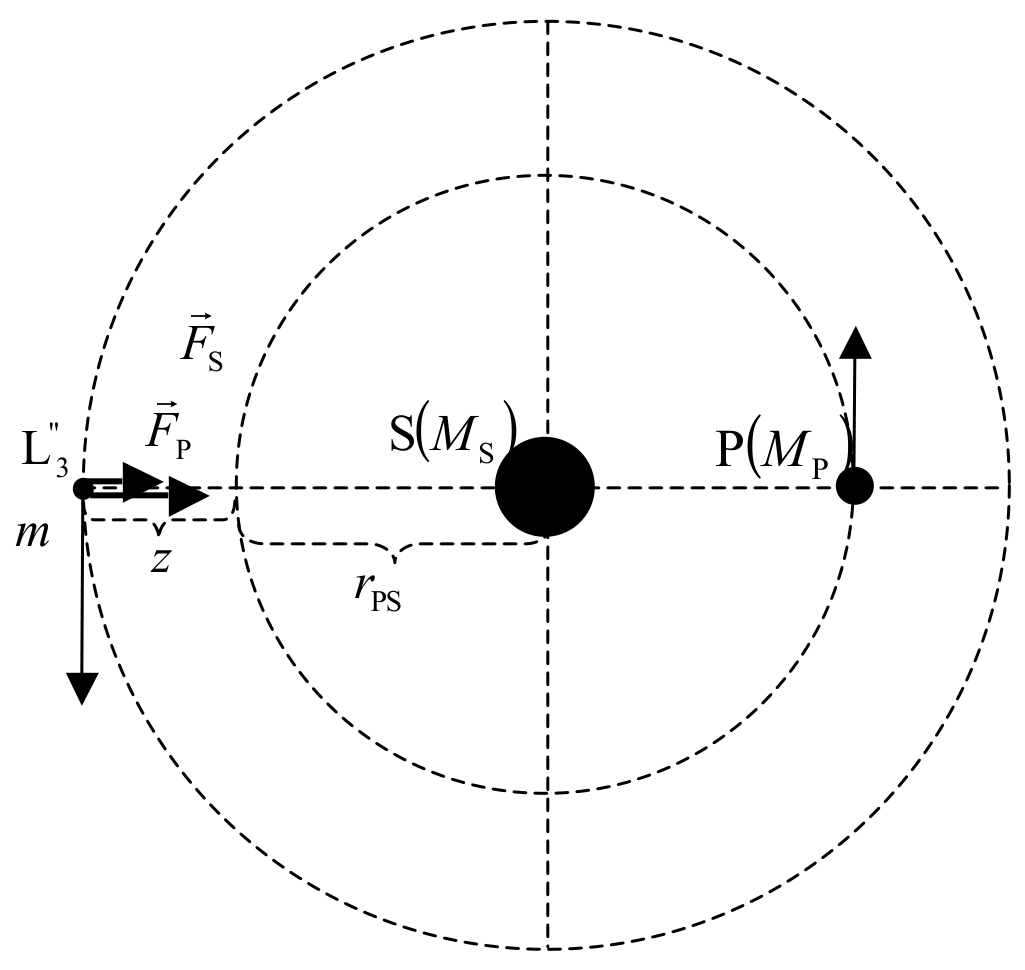
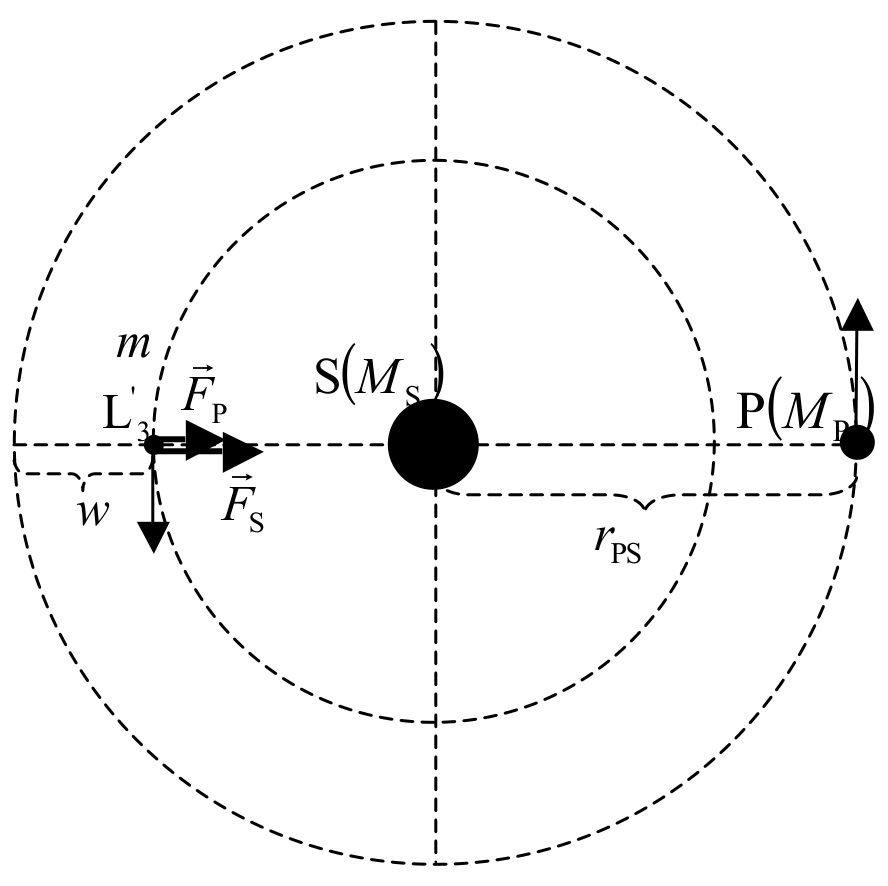
According to the notations in fig.1.1 and fig. 2.1
2 points
The sign “+” for position and „– “for
Using the assumption that
2points
The rotation speed
……2p
The final relation
The value has to be positive, thus the is the position of one Lagrange point ……2p
……2p
Оригинал в Архива: th_short_ver1.pdf · официални решения: th_short_ver1_sol.pdf