IOAA 2014, Теория, предварителен вариант — Задача 10. The density of the star
8th International Olympiad on Astronomy and Astrophysics, Suceava - Gura Humorului - August 2014 — THEORETICAL TEST, 15 short problems
Indications
- The problems were elaborated concerning two aspects: a) To cover merely all the subjects from the syllabus;
b) The average time for solving the items is about 15 minutes per a short problem; - In your folder you will find out the following: a) Answer sheets
b) Draft sheets
c) The envelope with the subjects in English and the translated version of them in your mother tongue; - The solutions of the problems will be written down only on the answer sheets you receive on your desk. PLEASE WRITE ONLY ON THE PRINTED SIDE OF THE PAPER SHEET. DON’T USE THE REVERSE SIDE. The evaluator will not take into account what is written on the reverse of the answer sheet.
- The draft sheets is for your own use to try calculation, write some numbers etc. BEWARE: These papers are not taken into account in evaluation, at the end of the test they will be collected separately . Everything you consider as part of the solutions have to be written on the answer sheets.
- Each problem have to be started on a new distinct answer sheet.
- On each answer sheet please fill in the designated boxes as follows: a) In PROBLEM NO. box write down only the number of the problem: i.e. 1 – 15 for short problems, 16 – 19 for long problems. Each sheet containing the solutions of a certain problem, should have in the box the number of the problem;
b) In Student ID – fill in your ID you will find on your envelope, consisted of 3 letters and 2 digits.
c) In page no. box you will fill in the number of page, starting from 1. We advise you to fill this boxes after you finish the test - We don’t understand your language, but the mathematic language is universal, so use as more relationships as you think that your solution will be better understand by the evaluator. If you want to explain in words we kindly ask you to use short English propositions.
- Use the pen you find out on the desk. It is advisable to use a pencil for the sketches.
- At the end of the test: a) Don’t forget to put in order your papers;
b) Put the answer sheets in the folder 1. Please verify that all the pages contain your ID, correct numbering of the problems and all pages are in the right order and numbered. This is an advantage of ease of understanding your solutions.
c) Verify with the assistant the correct number of answer sheets used fill in this number on the cover of the folder and sign.
d) Put the draft papers in the designated folder, Put the test papers back in the envelope.
e) Go to swim
GOOD LUCK !
Условие
In a very simple model, a star is assumed to be a sphere of gas in a state of equilibrium in its on gravitational field. The stellar gas is consisted of plasma, i.e. hydrogen and helium atoms, completely ionized. Find an expression for the value of the mass of the star if you know: radius of the star; the temperature of the star; the relative proportion of hydrogen in the mass of the star; molar mass of the hydrogen; molar mass of the helium; universal gas constant; gravitation constant. You may use the formula of the pressure of radiation inside the star , where is a known constant. The rotation of the star is negligible.
Отговори
The official solution ends with the density of the star (the statement asks for the mass); it writes the radiation pressure as (without the fourth power of given in the statement).
Решение
Problem 10. Marking scheme The density of the star
- Correct reasoning for finding the expression of the inner stellar gas (2) — 2 points
- Correct expression for the equilibrium condition — 2 puncte
- The correct conduct of calculations, and obtain the final correct result — 2 puncte
- Correct solution and reasoning — 4 points
Detailed solution
The hydrostatic equilibrium inside the star means that in each point of the inside of the star the gravitational forces are compensated by the hydrostatic pressure forces. That means that the mater of the star remains localized in a region of space.
The total pressure of the stellar gas has two components: the pressure due to the movement of the stellar –gas particles and the pressure due to the emitted radiation by the stellar-gas particles , thus:
In order to calculate the gravitational pressure of the stellar /gas let’s consider a narrow cylinder with section area ,along the radius of the star . See the figure bellow. If the total gravitational force acting on this cylinder is than the gravitational pressure exert by the gas –column is
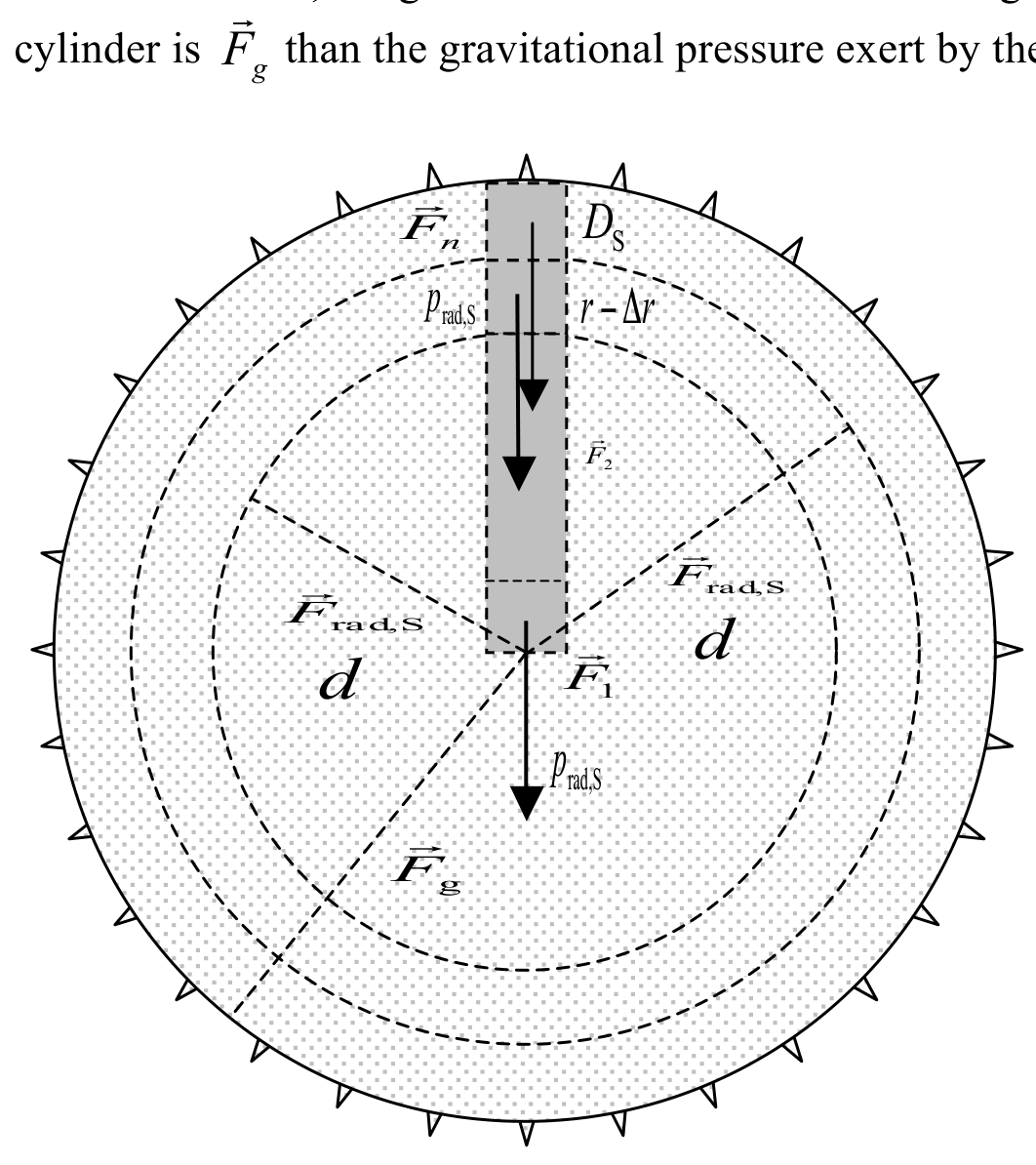
In order to calculate let divide the cylinder in n identically small cylinders each of it with height and mass Considering an homogenous star :
………………………………………………..
Thus the gravitational pressure is
Using the relations (1) and (2) in the pressures equilibrium relationship
Results :
This is an second degree equation in
Where the coefficients are
The positive solution is the valid one i.e.
Оригинал в Архива: th_short_ver1.pdf · официални решения: th_short_ver1_sol.pdf