IOAA 2015, data-analysis — Задача 2. Problem 2
Автор: Olympiads XYZ · транскрипция на официалните материали
Проверена срещу оригинала на 13.9.2026 от същия модел, който я е транскрибирал (без независима проверка)
International Olympiad on Astronomy and Astrophysics — Data Analysis Problem (Central Java - Indonesia, 2015)
Внимание: Бележка към темата
Решенията не са в този прозорец (страниците 1–6 са само на задачника); Soluțiilor файлът не е прочетен тук.
Условие
BVRIJHKLMN photometry of 2 stars from the constellation Cassiopeia is given in Table 5. For both stars it is believed that their light is affected by extinction by diffuse Interstellar Medium (ISM) only. Assuming that the observation is done from outside the atmosphere.
Table 5 BVRIJHKLMN photometry of two stars in Cassiopeia
| Star | MK class | ||||||||||
|---|---|---|---|---|---|---|---|---|---|---|---|
| HD 4817 | K3Iab | 8.08 | 6.18 | 4.73 | 3.64 | 2.76 | 1.86 | 1.54 | 1.32 | 1.59 | - |
| HD 11092 | K4II | 8.66 | 6.57 | - | - | 3.10 | 2.14 | 1.63 | 1.41 | 1.65 | 1.44 |
Table 6 intrinsic colours for selected sp. types and luminosity classes
| II | Iab / Ia | |
| F0 | - | 0.15 |
| G0 | 0.73 | 0.82 |
| K0 | 1.06 | 1.18 |
| K3 | 1.40 | 1.42 |
| K4 | 1.42 | 1.50 |
Table 7 Infrared intrinsic colours for selected sp. types of supergiant stars
| F0 | 0.20 | 0.31 | 0.36 | 0.51 | 0.60 | 0.64 | 0.65 | 0.82 |
| G0 | 0.55 | 0.90 | 1.14 | 1.52 | 1.71 | 1.72 | 1.72 | 1.98 |
| K0 | 0.95 | 1.59 | 2.01 | 2.64 | 2.80 | 2.87 | 2.79 | 3.14 |
| K3 | 1.13 | 1.96 | 2.41 | 3.14 | 3.25 | 3.39 | 3.25 | 3.63 |
| K4 | 1.20 | 2.13 | 2.59 | 3.37 | 3.44 | 3.62 | 3.46 | 3.84 |
Table 8 Infrared intrinsic colours for selected sp. types of giant stars
| K0 | 0.60 | 1.03 | 1.23 | 1.72 | 1.94 | 1.97 | 1.90 | 1.92 |
| K3 | 0.86 | 1.39 | 1.84 | 2.40 | 2.69 | 2.82 | 2.70 | 2.73 |
| K4 | 0.96 | 1.61 | 2.16 | 2.77 | 3.05 | 3.22 | 3.08 | 3.02 |
Table 9 Effective wavelengths of selected photometric filters
| Filter | B | V | R | I | J | H | K | L | M | N |
|---|---|---|---|---|---|---|---|---|---|---|
| /nm | 450 | 555 | 670 | 870 | 1200 | 1620 | 2200 | 3500 | 5000 | 9000 |
a) Using the data given in Tables 5 to 9, plot as a function of for filters B, V, R, I, J, H, K, L, M, N for both stars. Fit approximate curves by eye (in particular, note that as ). X is each band in the photometric system.
b) Using the graphs obtained in a), estimate for each star. ( is the absorption in V, and is the color excess)
Now apply these results in order to derive a distance estimate for IC 342, a spiral galaxy in Cassiopeia obscured by Milky Way. You should assume that the properties of the ISM in IC 342 are similar to those of the ISM in our Galaxy.
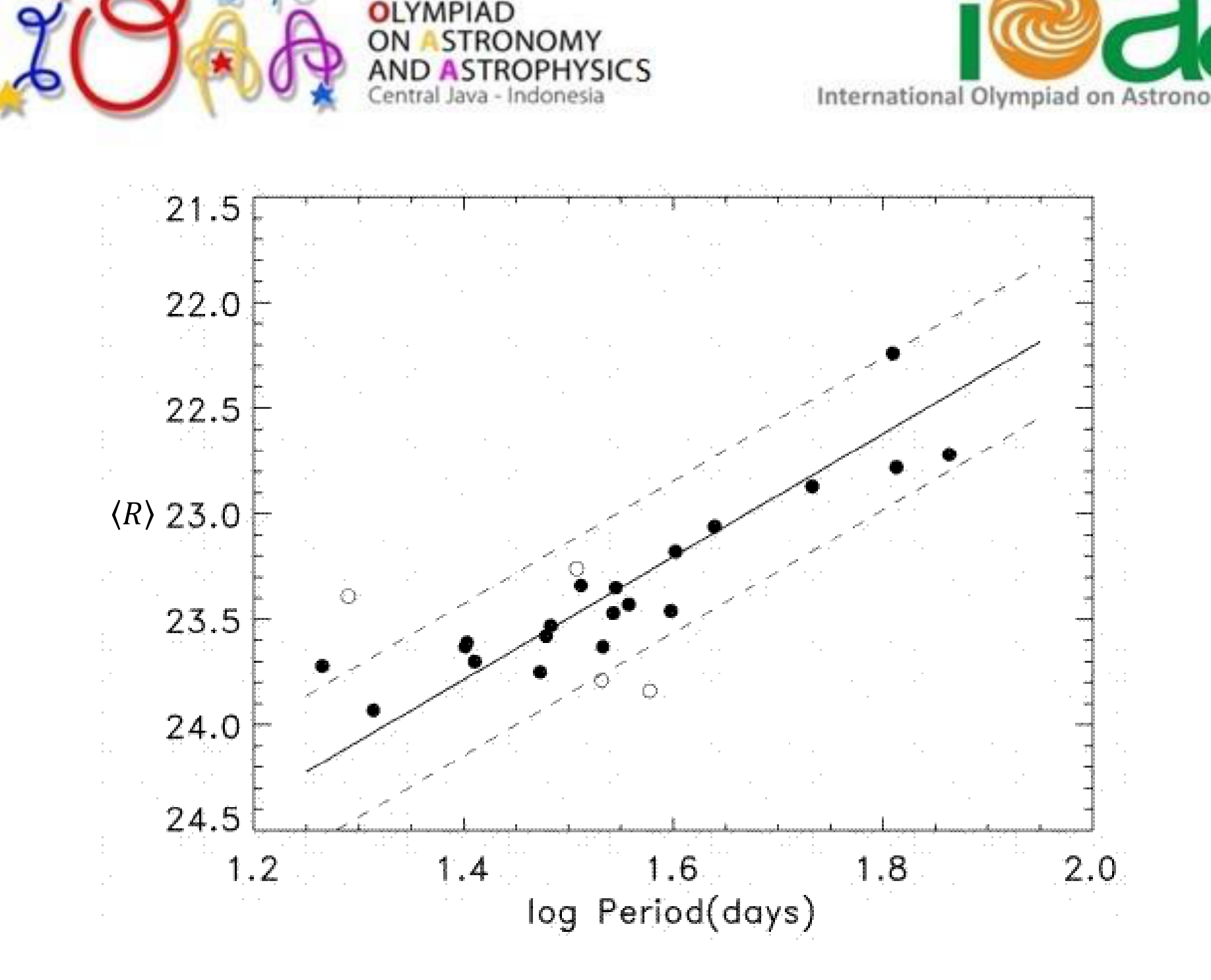
c) Using the period-magnitude diagrams for 20 Cepheids from IC 342 (Figures 2 and 3) and assuming the period-luminosity relations: where and are the mean absolute magnitudes in filters R and I, find for objects in IC 342. Find the distance to IC 342.
Решение
Покажи официалното решение
Оригинал в Архива: IOAA 2015 Data Analysis Problems ver 20150730_1717.pdf · официални решения: DataAnalysis_sol.pdf