IOAA 2016 — Задача 1. Group Examination
Автор: Olympiads XYZ · транскрипция на официалните материали
Проверена срещу оригинала на 13.9.2026 от същия модел, който я е транскрибирал (без независима проверка)
Group Examination · 50 т.
Внимание: Бележка към темата
Solutions incomplete in this window: continuation on solutions pages 7-8 handled by another window.
Условие
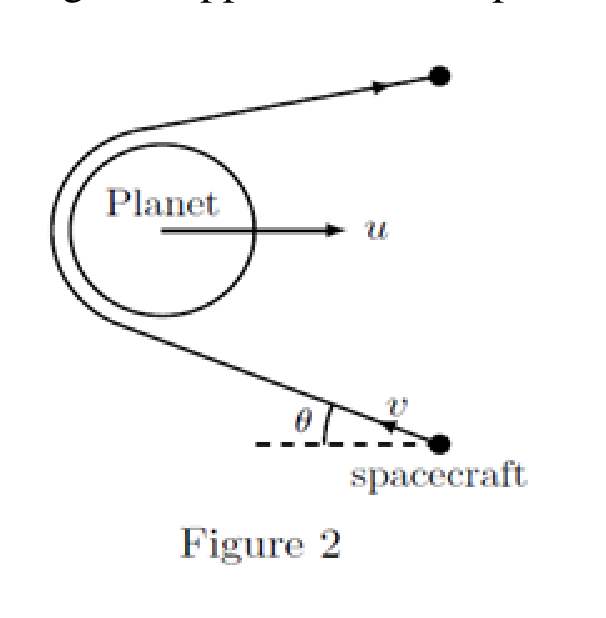
(G1) A spacecraft of mass and velocity approaches a massive planet of mass and orbital velocity , as measured by an inertial observer. We consider a special case, where the incoming trajectory of the spacecraft is designed in a way such that velocity vector of the planet does not change direction due to the gravitational boost given to the spacecraft. In this case, the gravitational boost to the velocity the spacecraft can be estimated using conservation laws by measuring asymptotic velocity of the spacecraft before and after the interaction and angle of approach of the spacecraft.
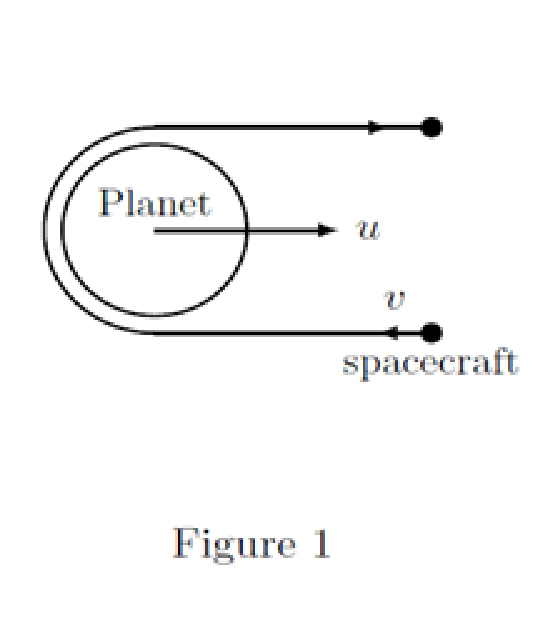
G1.1 What will be the final velocity of the spacecraft, if and are exactly anti-parallel (see Figure 1). [3 т.]
G1.2 Simplify the expression for the case where . [1 т.]
G1.3 If angle between and is and (see Figure 2), use results above to write expression for the magnitude of final velocity . [3 т.]
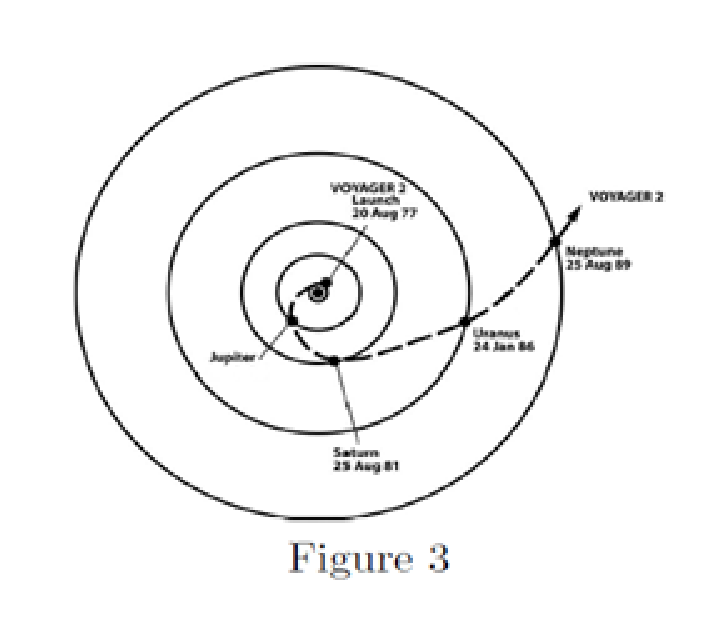
G1.4 Table on the last page gives data of Voyager-2 spacecraft for a few months in the year 1979 as it passed close to Jupiter. Assume that the observer is located at the centre of the Sun. The distance from the observer is given in AU and is heliocentric ecliptic longitude in degrees. Assume all objects to be in the ecliptic plane. Assume that the orbit of the Earth to be circular. Plot appropriate column against the date of observation to find the date at which the spacecraft was closest to the Jupiter, and label the graph as G1.4. [8 т.]
G1.5 Find the Earth-Jupiter distance, on the day of the encounter. [4 т.]
G1.6 On the day of the encounter, around what standard time had the Jupiter transited the meridian in the sky of Bhubaneswar (20.27° N; 85.84°E; UT + 05:30)? [6 т.]
G1.7 Speed of the spacecraft (in km s⁻¹) as measured by the same observer on some dates before the encounter and some dates after the encounter are given below. Here day n is the date of encounter. Use these data to find the orbital speed of Jupiter on the date of encounter and angle .
| date | n-45 | n-35 | n-25 | n-15 | n-5 | n |
|---|---|---|---|---|---|---|
| vtot | 10.1408 | 10.0187 | 9.9078 | 9.8389 | 10.2516 | 25.5150 |
| date | n+5 | n+15 | n+25 | n+35 | n+45 | |
| vtot | 21.8636 | 21.7022 | 21.5580 | 21.3812 | 21.2365 |
G1.8 Find eccentricity, , of Jupiter's orbit. [8 т.]
G1.9 Find heliocentric ecliptic longitude, , of Jupiter's perihelion point. [5 т.]
Решение
Покажи официалното решение
Оригинал в Архива: ioaa-qp-team.pdf · официални решения: team_sol.pdf