IOAA 2016, theory — Задача 10. Gravitational Lensing Telescope
Автор: Olympiads XYZ · транскрипция на официалните материали
Проверена срещу оригинала на 13.9.2026 от същия модел, който я е транскрибирал (без независима проверка)
Theoretical Examination · 20 т.
Внимание: Бележка към темата
Решенията липсват — в този прозорец е показан само документът с задачи.
Условие
Einstein's General Theory of Relativity predicts bending of light around massive bodies. For simplicity, we assume that the bending of light happens at a single point for each light ray, as shown in the figure. The angle of bending, , is given by
where is the Schwarzschild radius associated with that gravitational body. We call , the distance of the incoming light ray from the parallel -axis passing through the centre of the body, as the "impact parameter".
A massive body thus behaves somewhat like a focusing lens. The light rays coming from infinite distance beyond a massive body, and having the same impact parameter , converge at a point along the axis, at a distance from the centre of the massive body. An observer at that point will benefit from huge amplification due to this gravitational focusing. The massive body in this case is being used as a Gravitational Lensing Telescope for amplification of distant signals.
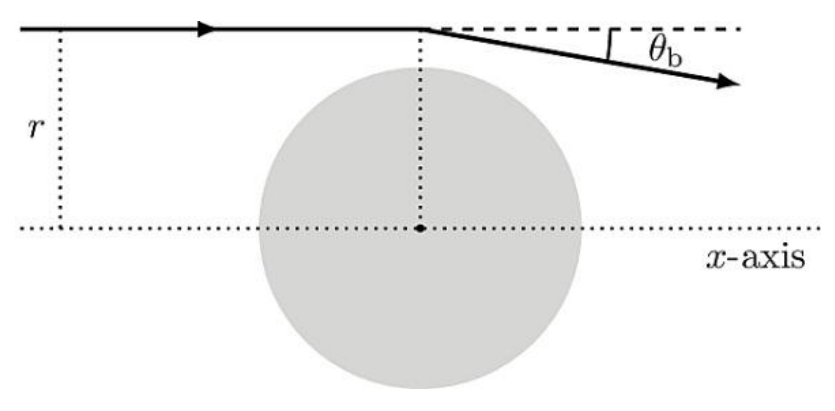
T10.1 Consider the possibility of our Sun as a gravitational lensing telescope. Calculate the shortest distance, , from the centre of the Sun (in A.U.) at which the light rays can get focused. [6 т.]
T10.2 Consider a small circular detector of radius , kept at a distance centered on the -axis and perpendicular to it. Note that only the light rays which pass within a certain annulus (ring) of width (where ) around the Sun would encounter the detector. The amplification factor at the detector is defined as the ratio of the intensity of the light incident on the detector in the presence of the Sun and the intensity in the absence of the Sun.
Express the amplification factor, , at the detector in terms of and . [8 т.]
T10.3 Consider a spherical mass distribution, such as dark matter in a galaxy cluster, through which light rays can pass while undergoing gravitational bending. Assume for simplicity that for the gravitational bending with impact parameter, , only the mass enclosed inside the radius is relevant.
What should be the mass distribution, , such that the gravitational lens behaves like an ideal optical convex lens? [6 т.]
Решение
Покажи официалното решение
Оригинал в Архива: theory-qp.pdf · официални решения: theory_sol.pdf