IOAA 2016, Теория, английски — Задача 4. Shadows
Theoretical Examination · 10 т.
Внимание: Бележка към темата
Both archived English question editions print T12 AstroSat, but both 27-page English worked keys substitute T12 Exoplanets. No matching AstroSat solution was found in the inspected full year inventory. Summary Answer Sheets and Cover Sheet named by the instructions were not found in this archived source pack. Instructions specify 13 questions totalling 300 points; both question editions contain 12 questions totalling 250 points. Printed numerical/formula discrepancies are retained: T8 uses c/lambda_max for nu_max and prints 1233 pi then 3813; T9 numerical velocity denominator lacks a power of ten and the stated semimajor axis is 20933 km; T11.4 prints a direct rather than inverse mass ratio in the radius-cubed relation; T11.7 prose says 166.67 Hz while its mass calculation uses 142.86 Hz. No inferred corrections are substituted.
Instructions to the Contestants
(1) Total time duration of this examination is five hours.
(2) This examination consists of
| Questions | Marks each | Total |
|---|---|---|
| Question 1 to 5 | 10 | 10 x 5 = 50 marks |
| Question 6 to 10 | 20 | 20 x 5 = 100 marks |
| Question 11 to 13 | 50 | 50 x 3 = 150 marks |
| Total | 300 marks |
(3) Inside the envelope you will find
a. Question paper in English
b. Question paper in your native language (if applicable)
c. Table of Constants in English
d. Table of Constants in your native language (if applicable)
e. A set of Summary Answersheets
f. Cover Sheet
(4) Use only black or blue pen for writing. For figures, you may use pencils.
(5) There is no negative marking.
(6) Some marks will be deducted if the final answer is given without detailed solution.
(7) Some marks will be deducted if the final answers have inappropriate number of significant digits, no units or wrong units.
(8) The necessary values of fundamental and astronomical constants should be taken from the Table of Constants provided to you.
(9) Instructions regarding using the answersheets
a. For each question a separate Summary Answersheet has been provided. Final answer(s) for each question / each part of the question must be written in the corresponding box in the Summary Answersheet. Write your contestant code and page number on each Summary Answersheet.
b. You should also show detailed solution in the blank space provided on each Summary Answersheet. If necessary, you can ask for extra blank sheets from the invigilators.
c. Use separate blank sheets for each question.
d. Write your contestant code, question number and page number on FRONT side of each blank sheet. Write your contestant code and page number on the BACK side of each blank sheet.
e. The page numbers should be continuous, i.e., if you use 20 sheets for the entire examination (including the Summary Answersheets), the page numbers should run from 1 to 40.
f. Write only inside the boxed area.
g. For the work that you do not want to be evaluated, cross that part out.
(10) At the end of the examination
a. On the Cover Sheet, clearly write page numbers for each question.
b. Check that you have written your contestant code on all pages.
c. Put the Cover Sheet, all Summary Answersheets, blank sheets and rough sheets inside the envelope. You may keep question paper and Table of Constants with you.
Table of Constants
Fundamental Constants
| Name | Symbol | Value |
|---|---|---|
| Speed of light in vacuum | ||
| Planck constant | ||
| Boltzmann constant | ||
| Stefan-Boltzmann constant | ||
| Elementary charge | ||
| Gravitational constant | ||
| Gas constant | ||
| Avogadro constant | ||
| Wien's displacement constant | ||
| Mass of electron | ||
| Mass of proton | ||
| Mass of neutron | ||
| Atomic mass unit |
Astronomical Constants
| Name | Symbol | Value |
|---|---|---|
| Parsec | pc | |
| Astronomical unit | ||
| Mass of the Sun | ||
| Radius of the Sun | ||
| Luminosity of the Sun | ||
| Apparent magnitude of the Sun at midday | ||
| Solar constant | ||
| Angular diameter of the Sun | ||
| Mass of the Earth | ||
| Radius of the Earth | ||
| Tropical year | solar days |
Условие
An observer in the northern hemisphere noticed that the length of the shortest shadow of a 1.000 m vertical stick on a day was 1.732 m. On the same day, the length of the longest shadow of the same vertical stick was measured to be 5.671 m.
Find the latitude, , of the observer and declination of the Sun, , on that day. Assume the Sun to be a point source and ignore atmospheric refraction.
Решение
As the longest shadow of the Sun on the given day is of finite length, the Sun is circumpolar for this observer on this day. [2.0]
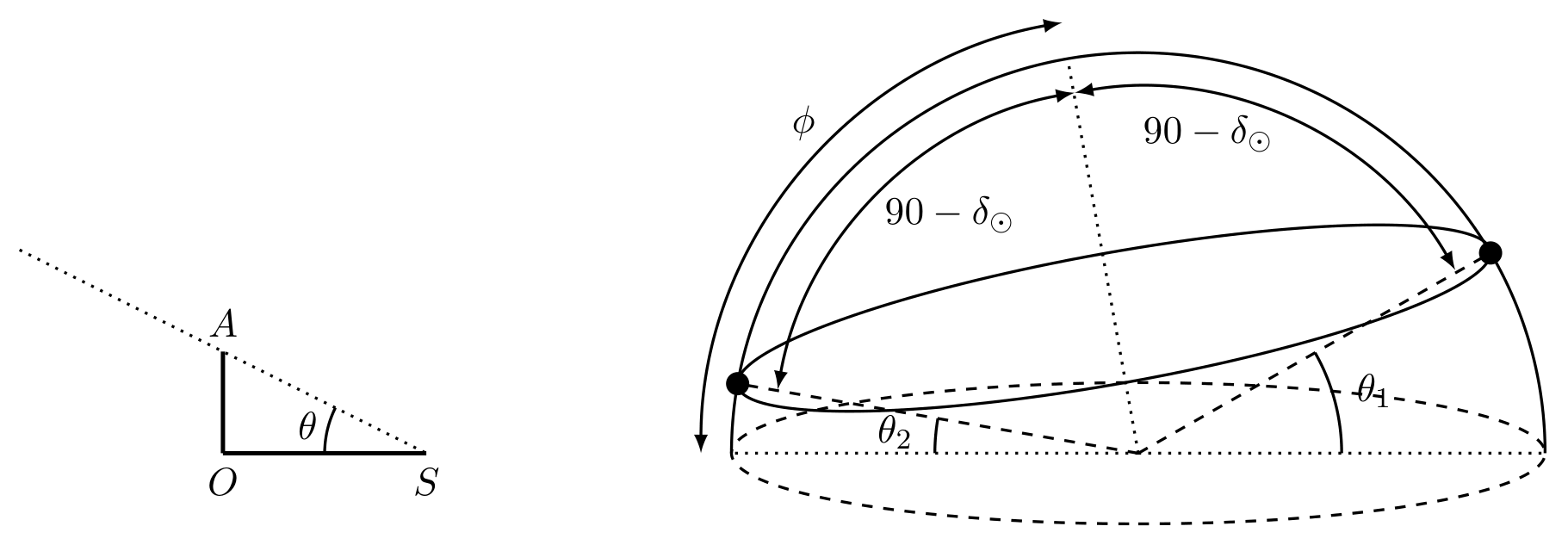
In the figure above, the left panel shows the shadow formed by stick (of length 1.000 m), and the right panel shows the Sun's location in two cases.
For an altitude of the Sun,
[1.0]
Let and be altitude in two extreme cases.
[1.0]
[1.5]
[1.0]
[1.5]
Solving,
[1.0]
[1.0]
Given high accuracy of shadow length, only ±0.5° is allowed.
One can also solve the question by manipulating and , to get and .
Оригинал в Архива: theory-qp.pdf · официални решения: theory_sol.pdf · допълнителни данни: tableofconstants.pdf · допълнителни данни: tableofconstants.pdf · допълнителни данни: Instructions_theory.pdf · допълнителни данни: Instructions_theory.pdf · допълнителни данни: theory.pdf · допълнителни данни: theory.pdf