IOAA 2017, Теория — Задача 10. GOTO
IOAA 2017 — Theoretical Examination · 25 т.
Original Examination Instructions
The theoretical examination lasts for 5 hours and is worth a total of 300 marks.
Dedicated IOAA Summary Answer Sheets are provided for writing your answers. Enter the final answers into the appropriate boxes in the corresponding Summary Answer Sheet. On each Summary Answer Sheet, please fill in
- Student Code (Country Code and 1 digit)
There are Answer Sheets for carrying out detailed work/rough work. On each Answer Sheet, please fill in
- Student Code (Country Code and 1 digit)
- Question no.
- Page no. and total number of pages.
Start each problem on a separate Answer Sheet. Please write only on the printed side of the sheet. Do not use the reverse side. If you have written something on any sheet which you do not want to be evaluated, cross it out.
Use as many mathematical expressions as you think may help the evaluator to better understand your solutions. The evaluator may not understand your language. If it is necessary to explain something in words, please use short phrases (if possible in English).
You are not allowed to leave your work desk without permission. If you need any assistance (malfunctioning calculator, need to visit a restroom, need more Answer Sheets, etc.), please draw the attention of the proctor using the Help card.
The beginning and end of the examination will be indicated by a long sound signal. Additionally, there will be a buzzer sound, fifteen minutes before the end of the examination (before the final sound signal).
At the end of the examination you must stop writing immediately. Sort and put your sheets in separate stacks, a) Stack 1: Summary Answer Sheets, Answer Sheets of part 1
b) Stack 2: Summary Answer Sheets, Answer Sheets of part 2
c) Stack 3: Summary Answer Sheets, Answer Sheets of part 3
d) Stack 4: question papers and paper sheets you do not want to be graded.Wait at your table until your envelope is collected. Once all envelopes are collected, your student guide will escort you out of the examination room.
A list of constants and a table of the mark distribution for this exam are given on the next two pages.
Original List of Constants
Earth
| Quantity | Value |
|---|---|
| Mass () | kg |
| Radius () | m |
| Acceleration of gravity () | |
| Obliquity of Ecliptic | |
| Length of Tropical Year | 365.2422 mean solar days |
| Length of Sidereal Year | 365.2564 mean solar days |
| Albedo | 0.39 |
Moon
| Quantity | Value |
|---|---|
| Mass (M with subscript ☾) | kg |
| Radius (R with subscript ☾) | m |
| Mean distance from Earth | m |
| Orbital inclination with the Ecliptic | |
| Albedo | 0.14 |
| Apparent magnitude (mean full moon) | −12.74 |
Sun
| Quantity | Value |
|---|---|
| Mass () | kg |
| Radius () | m |
| Luminosity () | W |
| Absolute Magnitude () | 4.80 mag |
| Angular diameter | 0.5 degrees |
| Rotational velocity in the Galaxy | |
| Distance from Galactic centre | 8.5 kpc |
Jupiter
| Quantity | Value |
|---|---|
| Mass | kg |
| Orbital semi-major axis | 5.20 au |
| Orbital period | 11.86 year |
Saturn
| Quantity | Value |
|---|---|
| Mass | kg |
| Orbital semi-major axis | 9.58 au |
| Orbital period | 29.45 year |
Physical constants
| Quantity | Value |
|---|---|
| 1 au | m |
| 1 pc | 206,265 au |
| Gravitational constant () | |
| Planck constant () | |
| Boltzmann constant () | |
| Stefan-Boltzmann constant () | |
| Hubble constant () | |
| Speed of light in vacuum () | |
| Proton mass | |
| Deuterium mass | |
| Neutron mass | |
| Helium-3 mass | |
| Helium-4 mass |
Original Mark Distribution
| Problem number | Marks |
|---|---|
| T1 | 10 |
| T2 | 10 |
| T3 | 10 |
| T4 | 10 |
| T5 | 10 |
| T6 | 15 |
| T7 | 20 |
| T8 | 20 |
| T9 | 20 |
| T10 | 25 |
| T11 | 50 |
| T12 | 40 |
| T13 | 60 |
| Total | 300 |
Условие
The Gravitational-Wave Optical Transient Observer (GOTO) aims to carry out searches of optical counterparts of any Gravitational Wave (GW) sources within an hour of their detection by the LIGO and VIRGO experiments. The survey needs to cover a big area on the sky in a short time to search all possible regions constrained by the GW experiments before the optical burst signal, if any, fades away. The GOTO telescope array is composed of 4 identical reflective telescopes, each with 40-cm diameter aperture and f-ratio of 2.5, working together to image large regions of the sky. For simplicity, we assume that the telescopes’ fields-of-view (FoV) do not overlap with one another.
a) Calculate the projected angular size per mm at the focal plane, i.e. plate scale, of each telescope. [6 т.]
b) If the zero-point magnitude (i.e. the magnitude at which the count rate detected by the detector is 1 count per second) of the telescope system is 18.5 mag, calculate the minimum time needed to reach 21 mag at Signal-to-Noise Ratio (SNR) = 5 for a point source. We first assume that the noise is dominated by both the Read-Out Noise (RON) at 10 counts/pixel and the CCD dark (thermal) noise (DN) rate of 1 count/pix/minute. The CCDs used with the GOTO have a 6-micron pixel size and gain (conversion factor between photo-electron and data count) of 1. The typical seeing at the observatory site is around 1.0 arcsec.
The Signal-to-Noise Ratio is defined as
where is the exposure time. [8 т.]
c) Normally when the exposure time is long and the source count is high then Poisson noise from the source is also significant. Determine the relation between SNR and exposure time in the case that the noise is dominated by Poisson noise of the source. Recalculate the minimum exposure time required to reach 21 mag with SNR = 5 from part b) if Poisson noise is also taken into consideration. The Poisson noise (standard deviation) of the source is given by . In reality, there is also the sky background which can be an important source of Poisson noise. For our purpose here, please ignore any sky background in the calculation. [6 т.]
d) The typical localisation uncertainty of the GW detector is about 100 square-degrees and we would like to cover the entire possible location of any candidate within an hour after the GW is detected. Estimate the minimum side length of the square CCD needed for each telescope in terms of the number of pixels. You may assume that the time taken for the CCD read-out and the pointing change are negligible. [5 т.]
Решение
a) Solution
For any two points on the sky separated by small angular distance , at the focal plane of the telescope the distance is
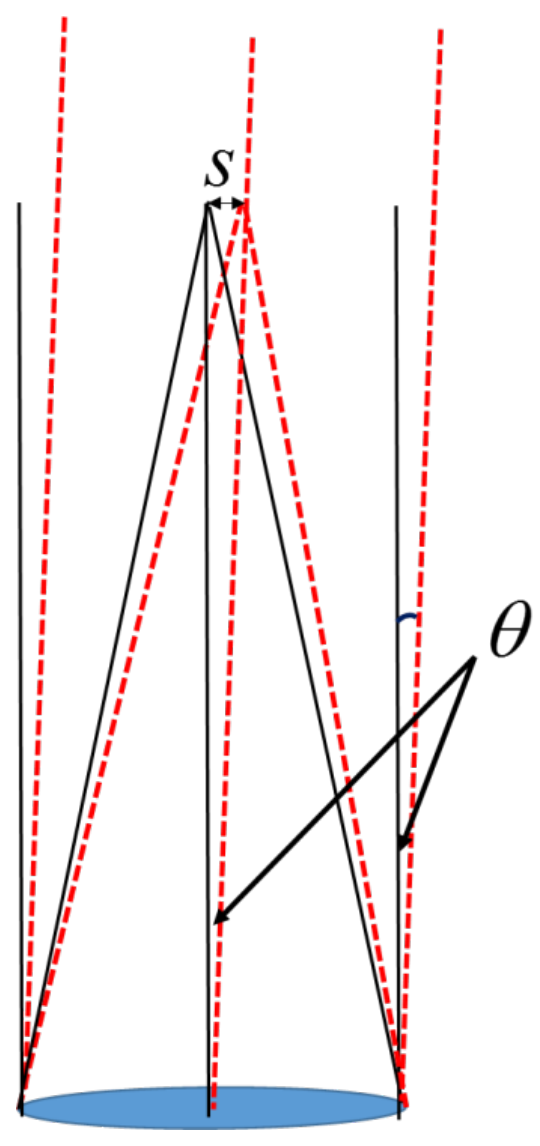
[0.5 Mark]
where is the focal length
for small angle
Then plate scale is
[0.5 Mark]
[1 Mark]
Plate scale . [1 Mark]
If student correctly quote the formula for plate scale will also get the full mark for the above calculation.
Plate Scale . [1 Mark]
Plate Scale . [1 Mark]
b) Solution
From plate scale calculated in a) size of a star for typical seeing 1 arcsec
[1 Mark]
→ light from star is mostly contained within pixel. [1 Mark]
Alternative solution: If a student gets the correct answer for 1 arcsec = 0.8 pixel but clearly explain that the chosen aperture size is “seeing” or a circular aperture with radius (where is not larger than seeing) and calculate the total number of pixels must be the closest round-up integer.
And correctly use
Then the student will be awarded full mark for the relevant parts. This is also apply to part c).
From the definition of the Zero-point magnitude given in the question
[2 Mark]
, ZP = 18.5
→ source count rate per second. [1 Mark]
Signal-to-noise ratio
[1 Mark]
Solve quadratic equation
[1 Mark]
[1 Mark]
c) Solution
If we include the source Poisson noise,
[1 Mark]
For the Poisson noise dominated case
[1 Mark]
Hence . [1 Mark]
Re-calculate exposure time
[1 Mark]
Solve quadratic equation
[1 marks]
[1 marks]
d) Solution
In 1 hr, one can observe [1 mark] → 5 pointing (round down to the nearest integer). [1 mark]
Therefore, we need to cover → one pointing need to cover
[1 mark]
or deg per pointing per telescope. [1 mark]
calculate size of each CCD pixels [1 mark]
pixels → 6589 pixels (pixel number need to be integer)
Therefore, we need minimum CCD size = pixels. [1 mark]
Answer 6588 pixel is also eligible for the mark.
Source marking discrepancy: the question gives a)6 and d)5 marks; the repeated key prompts print a)5 and d)6 marks. The worked grading steps are retained literally.
Бележки за изданието
The original question and key contain several differing expressions. The Galactic-arm question uses a flat curve beyond 5 kpc and its worked key uses 2 kpc. The HI survey key prints differing flux-threshold exponents and an unusual Hubble-constant unit. The Bethlehem key has differing multiplication and remainder values. The Galactic Outflow key heading says T2 while its full prompt matches T9. GOTO assigns a different pair of marks to parts a) and d) in the question and key. The Shipwreck key prints differing sidereal-time values in its main and alternative methods. Visible missing-font glyph squares and the Exomoon key’s grading dependency are preserved. The original constants table prints the acceleration unit as m·s^-1. These printed forms remain literal.
Оригинал в Архива: Theory.pdf · официални решения: Theory_Solution.pdf