IOAA 2017, Теория — Задача 13. Exomoon
IOAA 2017 — Theoretical Examination · 60 т.
Original Examination Instructions
The theoretical examination lasts for 5 hours and is worth a total of 300 marks.
Dedicated IOAA Summary Answer Sheets are provided for writing your answers. Enter the final answers into the appropriate boxes in the corresponding Summary Answer Sheet. On each Summary Answer Sheet, please fill in
- Student Code (Country Code and 1 digit)
There are Answer Sheets for carrying out detailed work/rough work. On each Answer Sheet, please fill in
- Student Code (Country Code and 1 digit)
- Question no.
- Page no. and total number of pages.
Start each problem on a separate Answer Sheet. Please write only on the printed side of the sheet. Do not use the reverse side. If you have written something on any sheet which you do not want to be evaluated, cross it out.
Use as many mathematical expressions as you think may help the evaluator to better understand your solutions. The evaluator may not understand your language. If it is necessary to explain something in words, please use short phrases (if possible in English).
You are not allowed to leave your work desk without permission. If you need any assistance (malfunctioning calculator, need to visit a restroom, need more Answer Sheets, etc.), please draw the attention of the proctor using the Help card.
The beginning and end of the examination will be indicated by a long sound signal. Additionally, there will be a buzzer sound, fifteen minutes before the end of the examination (before the final sound signal).
At the end of the examination you must stop writing immediately. Sort and put your sheets in separate stacks, a) Stack 1: Summary Answer Sheets, Answer Sheets of part 1
b) Stack 2: Summary Answer Sheets, Answer Sheets of part 2
c) Stack 3: Summary Answer Sheets, Answer Sheets of part 3
d) Stack 4: question papers and paper sheets you do not want to be graded.Wait at your table until your envelope is collected. Once all envelopes are collected, your student guide will escort you out of the examination room.
A list of constants and a table of the mark distribution for this exam are given on the next two pages.
Original List of Constants
Earth
| Quantity | Value |
|---|---|
| Mass () | kg |
| Radius () | m |
| Acceleration of gravity () | |
| Obliquity of Ecliptic | |
| Length of Tropical Year | 365.2422 mean solar days |
| Length of Sidereal Year | 365.2564 mean solar days |
| Albedo | 0.39 |
Moon
| Quantity | Value |
|---|---|
| Mass (M with subscript ☾) | kg |
| Radius (R with subscript ☾) | m |
| Mean distance from Earth | m |
| Orbital inclination with the Ecliptic | |
| Albedo | 0.14 |
| Apparent magnitude (mean full moon) | −12.74 |
Sun
| Quantity | Value |
|---|---|
| Mass () | kg |
| Radius () | m |
| Luminosity () | W |
| Absolute Magnitude () | 4.80 mag |
| Angular diameter | 0.5 degrees |
| Rotational velocity in the Galaxy | |
| Distance from Galactic centre | 8.5 kpc |
Jupiter
| Quantity | Value |
|---|---|
| Mass | kg |
| Orbital semi-major axis | 5.20 au |
| Orbital period | 11.86 year |
Saturn
| Quantity | Value |
|---|---|
| Mass | kg |
| Orbital semi-major axis | 9.58 au |
| Orbital period | 29.45 year |
Physical constants
| Quantity | Value |
|---|---|
| 1 au | m |
| 1 pc | 206,265 au |
| Gravitational constant () | |
| Planck constant () | |
| Boltzmann constant () | |
| Stefan-Boltzmann constant () | |
| Hubble constant () | |
| Speed of light in vacuum () | |
| Proton mass | |
| Deuterium mass | |
| Neutron mass | |
| Helium-3 mass | |
| Helium-4 mass |
Original Mark Distribution
| Problem number | Marks |
|---|---|
| T1 | 10 |
| T2 | 10 |
| T3 | 10 |
| T4 | 10 |
| T5 | 10 |
| T6 | 15 |
| T7 | 20 |
| T8 | 20 |
| T9 | 20 |
| T10 | 25 |
| T11 | 50 |
| T12 | 40 |
| T13 | 60 |
| Total | 300 |
Условие
Exomoons are natural satellites of exoplanets. The gravitational influence of such a moon will affect the position of the planet relative to the planet-moon barycentre, resulting in Transit Timing Variations (, TTVs) as the observed transit of the planet occurs earlier or later than the predicted time of transit for a planet without a moon.
The motion of the planet around the planet-moon barycentre will also induce Transit Duration Variations (, TDVs) as the observed transit duration is shorter or longer than the predicted transit duration for a planet without a moon.
We will consider edge-on circular orbits with the following parameters
- is the planet mass
- is the moon mass
- is the planet-moon barycentre’s period around the host star
- is the moon’s period around the planet
- is the distance of the planet-moon barycentre to the star
- is the distance of the moon to the planet-moon barycentre
- is the moon phase, when the moon is in opposition to the star
- is the mean transit duration of the planet (as if it has no moon)
We will only consider the orbit of a prograde moon orbiting in the same plane as the planet's orbit. Example phases of the moon, as observed by distant observers, are shown in the figure below.
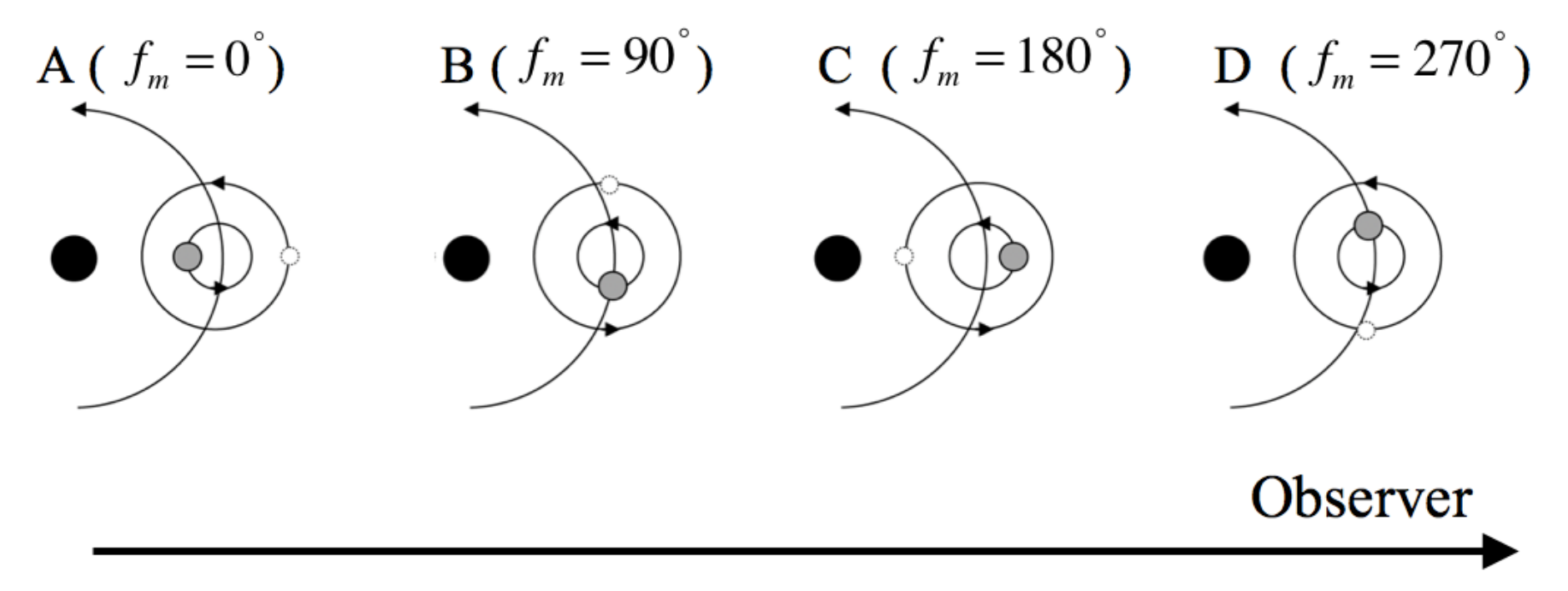
Phase of the moon. Black, grey and white circles represent the star, planet and moon, respectively.
a) We define where is the predicted transit time without the moon, and is the observed transit time with the moon. Show that
A positive value of indicates that the transit occurs later than the predicted time of transit for a planet without a moon. [10 т.]
b) Similarly, we define where is the predicted transit duration without the moon, and is the observed transit duration with the moon. We can assume that the planet’s velocity around the star is much bigger than the moon’s velocity around the planet-moon barycentre, and also the moon does not change phase during the transit. Show that
A positive value of indicates that the transit duration is longer than the predicted transit duration without a moon. [13 т.]
An exoplanet is observed transiting a main-sequence solar-type star (, , spectral class: G2V). The planet has an edge-on circular orbit with a period of 3.50 days. From the observational data, the planet has a mass of and a radius of . The observed relation between and can be written as
c) Assume that the moon’s mass is much smaller than the planet’s mass. Find the mean transit duration of the planet () in days. [6 т.]
d) Find the moon’s period () in days [7 т.]
e) Estimate the distance of the moon to the planet-moon barycentre () in units of Earth radii. Also find the moon mass () in units of Earth mass. [7 т.]
f) The Hill sphere is a region around a planet within which the planet’s gravity dominates. The radius of the Hill sphere can be written as
where is the host star mass.
Find the value of the constant (Hint: for a massive host star, the radius of the Hill sphere of the system is approximately equal to the distance between the planet and the Lagrange point or ). Hence, find the radius of the Hill sphere of this planetary system in units of Earth radii. [11 т.]
g) The Roche limit is the minimum orbital radius at which a satellite can orbit without being torn apart by tidal forces. Take the Roche limit as
where and are the density of the planet and moon, respectively and is the planet’s radius. Assuming that the moon is a rocky moon with the same density as the Earth, find the Roche limit of the system. [3 т.]
h) Does the moon have a stable orbit? (YES / NO) [3 т.]
Решение
a) Solution
From centre of mass for planet-moon system, the distance of the moon to the planet-moon barycenter can be written as,
[2.0]
where is distance of the planet to the planet-moon barycentre.
For the observers on the Earth, projection distance of the planet to the planet-moon barycenter is
[3.0]
From angular velocity, TTV signal can be calculated from
[1.0]
[2.0]
[2.0]
b) Solution
The velocity of planet-moon barycenter around the star is
[1.0]
The velocity of planet around the planet-moon barycentre is
[1.0]
Therefore, the transverse velocity of planet around the planet-moon barycentre is
[3.0]
Average transit duration can be written as
[2.0]
where is the distance of the planet has to cross in order to complete the transit. The transit duration with exomoon can be written as
[2.0]
Therefore, the TDV signal is
[1.0]
In case
[2.0]
[1.0]
c) Solution
From Kepler’s third’s law, assume that the moon mass is much smaller than the planet mass, the distance of the planet-moon barycentre to the star is
[1.0]
The mean transit duration of the planet can be calculated from the transit duration of exoplanet without exomoon.
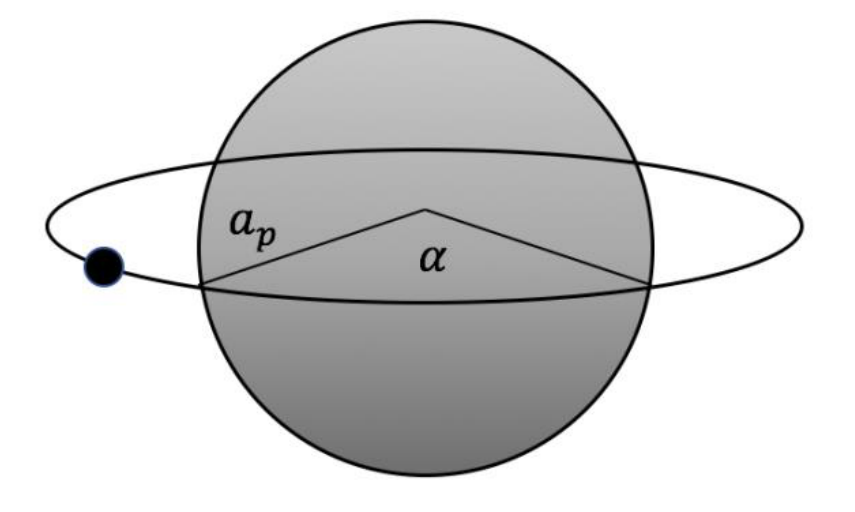
[1.0]
[2.0]
[2.0]
d) Solution
The TTV signal is 90 degrees out of phase with the TDV signal in edge-on circular orbit system. Therefore, the relation between the TTV and TDV signals is,
[3.0]
The observed relation between and can be written as
Therefore
[2.0]
[2.0]
e) Solution
From Kepler third law, assuming that moon is small and can be neglected, the distance of the moon to the planet-moon barycentre is
[1.0]
[2.0]
From the observed relation between and , the moon mass is
[2.0]
[2.0]
f) Solution
For planet-moon system, the angular velocity of barycenter of planet-moon system is
[2.0]
For exomoon at Lagrange point or ,
[1.0]
[3.0]
Since and
[1.0]
For , . [1.0]
[1.0]
The radius of the Hill sphere of this planetary system is
[2.0]
g) Solution
From Roche limit equation
[3.0]
h) Solution
Stable orbit because the distance between the moon and planet-moon barycentre is between Roche limit and Hill sphere radius (). [3.0]
Mark only if students get the answers for e) & g) & h). Students obtain full mark if answer “YES” for , and vice versa.
The printed grading dependency includes h) itself; it remains literal. The stability inequality is strict in the native source.
Бележки за изданието
The original question and key contain several differing expressions. The Galactic-arm question uses a flat curve beyond 5 kpc and its worked key uses 2 kpc. The HI survey key prints differing flux-threshold exponents and an unusual Hubble-constant unit. The Bethlehem key has differing multiplication and remainder values. The Galactic Outflow key heading says T2 while its full prompt matches T9. GOTO assigns a different pair of marks to parts a) and d) in the question and key. The Shipwreck key prints differing sidereal-time values in its main and alternative methods. Visible missing-font glyph squares and the Exomoon key’s grading dependency are preserved. The original constants table prints the acceleration unit as m·s^-1. These printed forms remain literal.
Оригинал в Архива: Theory.pdf · официални решения: Theory_Solution.pdf