IOAA 2017, Теория — Задача 2. Earth's Transit Zone
IOAA 2017 — Theoretical Examination · 10 т.
Original Examination Instructions
The theoretical examination lasts for 5 hours and is worth a total of 300 marks.
Dedicated IOAA Summary Answer Sheets are provided for writing your answers. Enter the final answers into the appropriate boxes in the corresponding Summary Answer Sheet. On each Summary Answer Sheet, please fill in
- Student Code (Country Code and 1 digit)
There are Answer Sheets for carrying out detailed work/rough work. On each Answer Sheet, please fill in
- Student Code (Country Code and 1 digit)
- Question no.
- Page no. and total number of pages.
Start each problem on a separate Answer Sheet. Please write only on the printed side of the sheet. Do not use the reverse side. If you have written something on any sheet which you do not want to be evaluated, cross it out.
Use as many mathematical expressions as you think may help the evaluator to better understand your solutions. The evaluator may not understand your language. If it is necessary to explain something in words, please use short phrases (if possible in English).
You are not allowed to leave your work desk without permission. If you need any assistance (malfunctioning calculator, need to visit a restroom, need more Answer Sheets, etc.), please draw the attention of the proctor using the Help card.
The beginning and end of the examination will be indicated by a long sound signal. Additionally, there will be a buzzer sound, fifteen minutes before the end of the examination (before the final sound signal).
At the end of the examination you must stop writing immediately. Sort and put your sheets in separate stacks, a) Stack 1: Summary Answer Sheets, Answer Sheets of part 1
b) Stack 2: Summary Answer Sheets, Answer Sheets of part 2
c) Stack 3: Summary Answer Sheets, Answer Sheets of part 3
d) Stack 4: question papers and paper sheets you do not want to be graded.Wait at your table until your envelope is collected. Once all envelopes are collected, your student guide will escort you out of the examination room.
A list of constants and a table of the mark distribution for this exam are given on the next two pages.
Original List of Constants
Earth
| Quantity | Value |
|---|---|
| Mass () | kg |
| Radius () | m |
| Acceleration of gravity () | |
| Obliquity of Ecliptic | |
| Length of Tropical Year | 365.2422 mean solar days |
| Length of Sidereal Year | 365.2564 mean solar days |
| Albedo | 0.39 |
Moon
| Quantity | Value |
|---|---|
| Mass (M with subscript ☾) | kg |
| Radius (R with subscript ☾) | m |
| Mean distance from Earth | m |
| Orbital inclination with the Ecliptic | |
| Albedo | 0.14 |
| Apparent magnitude (mean full moon) | −12.74 |
Sun
| Quantity | Value |
|---|---|
| Mass () | kg |
| Radius () | m |
| Luminosity () | W |
| Absolute Magnitude () | 4.80 mag |
| Angular diameter | 0.5 degrees |
| Rotational velocity in the Galaxy | |
| Distance from Galactic centre | 8.5 kpc |
Jupiter
| Quantity | Value |
|---|---|
| Mass | kg |
| Orbital semi-major axis | 5.20 au |
| Orbital period | 11.86 year |
Saturn
| Quantity | Value |
|---|---|
| Mass | kg |
| Orbital semi-major axis | 9.58 au |
| Orbital period | 29.45 year |
Physical constants
| Quantity | Value |
|---|---|
| 1 au | m |
| 1 pc | 206,265 au |
| Gravitational constant () | |
| Planck constant () | |
| Boltzmann constant () | |
| Stefan-Boltzmann constant () | |
| Hubble constant () | |
| Speed of light in vacuum () | |
| Proton mass | |
| Deuterium mass | |
| Neutron mass | |
| Helium-3 mass | |
| Helium-4 mass |
Original Mark Distribution
| Problem number | Marks |
|---|---|
| T1 | 10 |
| T2 | 10 |
| T3 | 10 |
| T4 | 10 |
| T5 | 10 |
| T6 | 15 |
| T7 | 20 |
| T8 | 20 |
| T9 | 20 |
| T10 | 25 |
| T11 | 50 |
| T12 | 40 |
| T13 | 60 |
| Total | 300 |
Условие
Earth's transit zone is an area where extrasolar observers (located far away from the Solar System) can detect the Earth transiting across the Sun. For observers on the Earth, this area is the projection of a band around the Earth's ecliptic onto the celestial plane (light grey area in the left figure). Assume that the Earth has a circular orbit of 1 au.
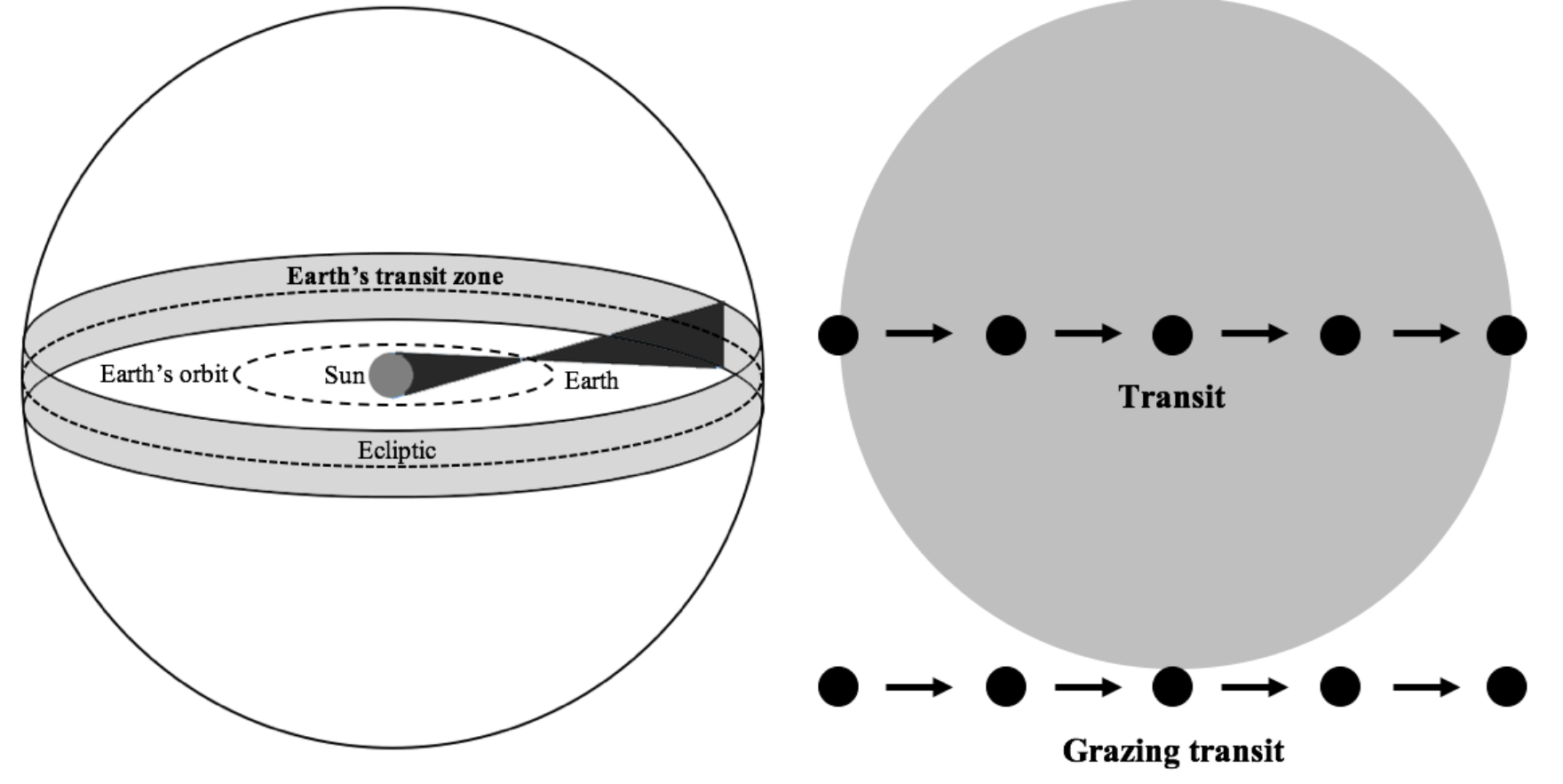
a) Find the angular width of that part of the Earth's transit zone in degrees, in which the extrasolar observers can detect Earth's total transit (when the whole of the Earth's disk passes in front of the Sun). [5 т.]
b) Find the angular width of that part of the Earth's transit zone in degrees, where the extrasolar observers can detect at least Earth's grazing transit (when any part of the Earth's disk passes in front of the Sun). [5 т.]
Решение
a) Solution
For Earth’s transit, the whole Earth’s disk should pass in front of the Sun.
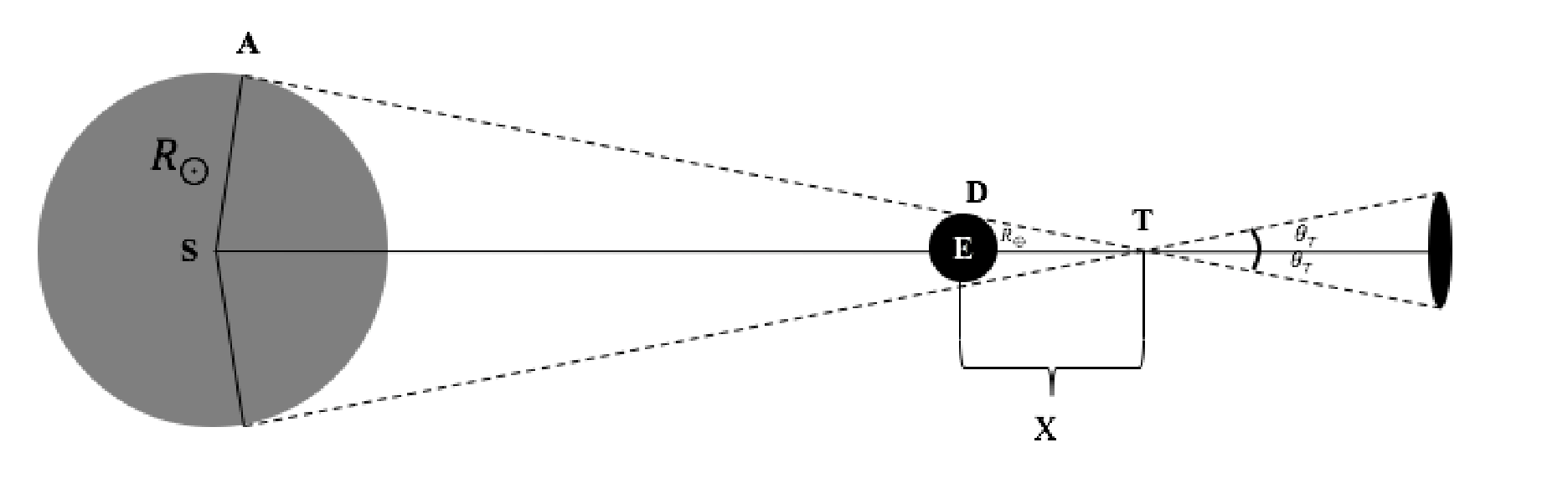
From : [1.0]
[1.0]
The half angular size of the Earth’s Transit Zone with transit can be written as,
[1.0]
Solution with is acceptable with full mark.
The angular size of the Earth’s Transit Zone with transit is
[1.0]
[1.0]
b) Solution
For Earth’s grazing transit, any part of the Earth’s disk should pass in front of the Sun.
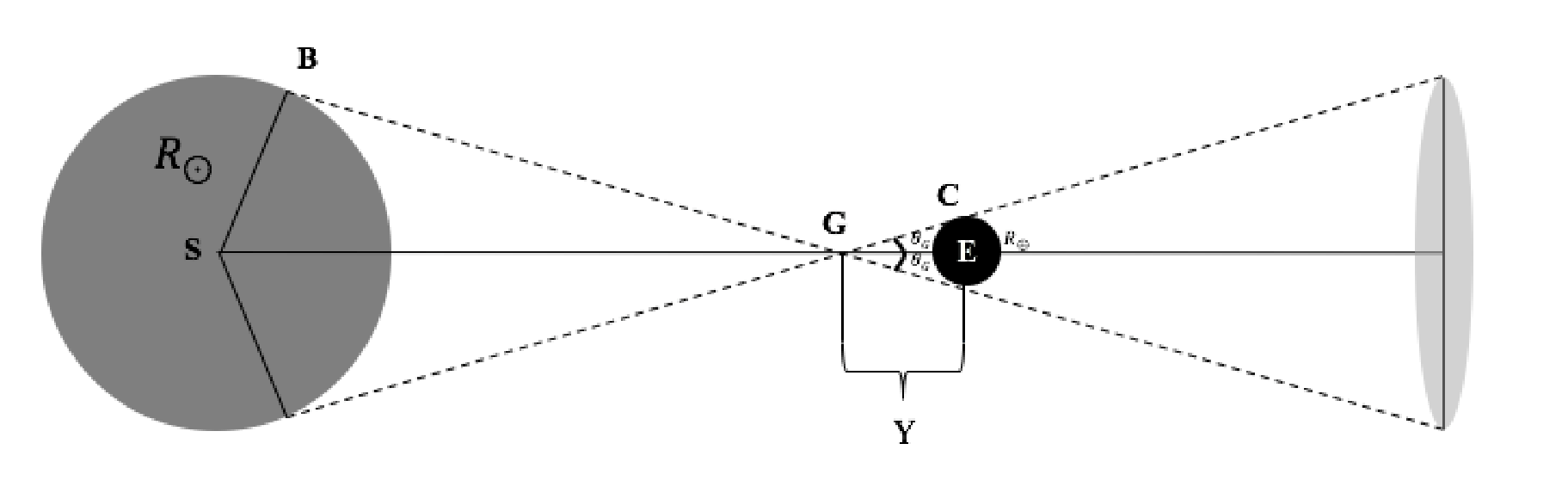
From : [1.0]
[1.0]
The angular size of the Earth’s Transit Zone with transit can be written as,
[1.0]
Solution with is acceptable with full mark.
The angular size of the Earth’s Transit Zone with grazing transit is
[1.0]
[1.0]
Source display note: the Sun’s radius subscript in these printed key equations appears as a missing-glyph box; preserves that appearance. The original geometric figures show the solar symbol.
Бележки за изданието
The original question and key contain several differing expressions. The Galactic-arm question uses a flat curve beyond 5 kpc and its worked key uses 2 kpc. The HI survey key prints differing flux-threshold exponents and an unusual Hubble-constant unit. The Bethlehem key has differing multiplication and remainder values. The Galactic Outflow key heading says T2 while its full prompt matches T9. GOTO assigns a different pair of marks to parts a) and d) in the question and key. The Shipwreck key prints differing sidereal-time values in its main and alternative methods. Visible missing-font glyph squares and the Exomoon key’s grading dependency are preserved. The original constants table prints the acceleration unit as m·s^-1. These printed forms remain literal.
Оригинал в Архива: Theory.pdf · официални решения: Theory_Solution.pdf