IOAA 2018, Теория — Задача 4. Height of a Hill
Theoretical Competition · 10 т.
Указания
- The theoretical competition will be 5 hours in duration and is marked out of a total of 300 points.
- There are Answer Sheets for carrying out detailed work/rough work. On each Answer Sheet, please fill in
- Student Code
- Question No.
- Page no. and total number of pages.
- Start each problem on a separate Answer Sheet. Please write only on the printed side of the sheet. Do not use the reverse side. If you have written something on any sheet which you do not want to be marked, cross it out.
- Please remember that the graders may not understand your language. As far as possible, write your solutions only using mathematical expressions and numbers. If it is necessary to explain something in words, please use short phrases (if possible in English).
- You are not allowed to leave your working desk without permission. If you need any assistance (malfunctioning calculator, need to visit a restroom, need more Answer Sheets, etc.), please put up your hand to signal the proctor.
- The beginning and end of the competition will be indicated by a long sound signal. Additionally, there will be a short sound signal fifteen minutes before the end of the competition (before the final long sound signal).
- At the end of the competition you must stop writing immediately. Sort and put your sheets in separate stacks,
- (a) Stack 1: answer sheets of part 1
- (b) Stack 2: answer sheets of part 2
- (c) Stack 3: answer sheets of part 3
- (d) Stack 4: question papers and paper sheets that you do not want to be graded.
- Wait at your table until your envelope is collected. Once all envelopes are collected, your student guide will escort you out of the competition room.
- A list of constants for this competition is given on the next page.
Point distribution of this exam
| Problem number | Points |
|---|---|
| T1 | 10 |
| T2 | 10 |
| T3 | 10 |
| T4 | 10 |
| T5 | 10 |
| T6 | 25 |
| T7 | 25 |
| T8 | 25 |
| T9 | 25 |
| T10 | 75 |
| T11 | 75 |
| Total | 300 |
Table of constants
| Mass () | kg | Earth |
| Radius () | m | |
| Acceleration of gravity () | 9.81 ms | |
| Obliquity of Ecliptic | 23°27′ | |
| Length of Tropical Year | 365.2422 mean solar days | |
| Length of Sidereal Year | 365.2564 mean solar days | |
| Albedo | 0.39 | |
| Mass (☾) | kg | Moon |
| Radius (☾) | m | |
| Mean Earth-Moon distance | m | |
| Orbital inclination with the Ecliptic | 5.14° | |
| Albedo | 0.14 | |
| Apparent magnitude (mean full moon) | −12.74 | |
| Mass () | kg | Sun |
| Radius () | m | |
| Luminosity () | W | |
| Absolute Magnitude | 4.80 mag | |
| Surface Temperature | 5772 K | |
| Angular diameter at Earth | 30′ | |
| Orbital velocity in Galaxy | 220 kms | |
| Distance from Galactic center | 8.5 kpc | |
| 1 au | m | Physical constants |
| 1 pc | 206265 au | |
| Gravitational constant () | Nmkg | |
| Planck constant () | Js | |
| Boltzmann constant () | JK | |
| Stefan-Boltzmann constant () | WmK | |
| Hubble constant () | 67.8 kmsMpc | |
| Speed of light in vacuum () | 299792458 ms | |
| Magnetic Permeability of free space () | Hm | |
| 1 Jansky (Jy) | W mHz |
Rayleigh-Jeans law is given by , which is the power emitted per unit emitting area, per steradian, per unit frequency.
Условие
Two friends wanted to measure the height of the hill next to their village (latitude φ=40°). One of the friends climbed to the top of the hill and she agreed to send a light signal to her friend in the village as soon as she sees the sunset. On March 21, when they did this experiment, the friend in village received the light signal 4.1 minutes after the sunset from the village. Estimate the height of the hill and horizon distance for the person at the hill top. Ignore atmospheric refraction.
Отговори
602 m
Height of the hill H = 602 m; horizon distance D = 87.6 km.
Решение
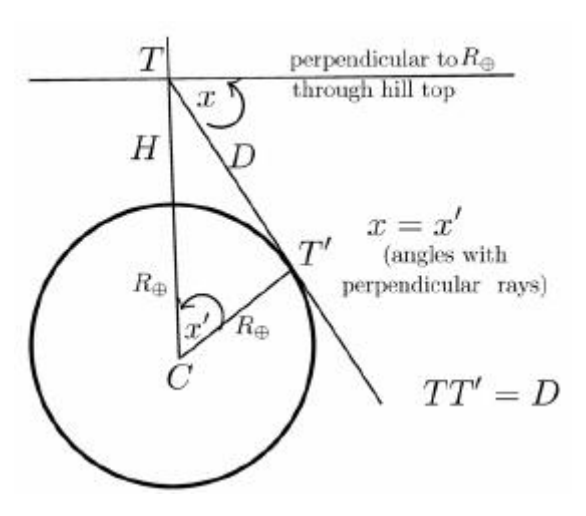
First we should realise that the Sun doesn’t set vertically. It sets at an angle of . Thus, the horizon depression x will be
(4 points)
Let the height of the mountain be H. Let C be the centre of the Earth, point T - hill top and point T’ is the point on the horizon as seen from T. Thus,
metres (3 points)
The distance of horizon (from base of the mountain, along the surface of the earth) is found from the rectangular triangle TCT’ as
km
Alternatively, km (3 points)
Оригинал в Архива: Theory Problems.pdf · официални решения: Theory Solutions.pdf