IOAA 2018, Теория — Задача 9. Radio Galaxy
Theoretical Competition · 25 т.
Указания
- The theoretical competition will be 5 hours in duration and is marked out of a total of 300 points.
- There are Answer Sheets for carrying out detailed work/rough work. On each Answer Sheet, please fill in
- Student Code
- Question No.
- Page no. and total number of pages.
- Start each problem on a separate Answer Sheet. Please write only on the printed side of the sheet. Do not use the reverse side. If you have written something on any sheet which you do not want to be marked, cross it out.
- Please remember that the graders may not understand your language. As far as possible, write your solutions only using mathematical expressions and numbers. If it is necessary to explain something in words, please use short phrases (if possible in English).
- You are not allowed to leave your working desk without permission. If you need any assistance (malfunctioning calculator, need to visit a restroom, need more Answer Sheets, etc.), please put up your hand to signal the proctor.
- The beginning and end of the competition will be indicated by a long sound signal. Additionally, there will be a short sound signal fifteen minutes before the end of the competition (before the final long sound signal).
- At the end of the competition you must stop writing immediately. Sort and put your sheets in separate stacks,
- (a) Stack 1: answer sheets of part 1
- (b) Stack 2: answer sheets of part 2
- (c) Stack 3: answer sheets of part 3
- (d) Stack 4: question papers and paper sheets that you do not want to be graded.
- Wait at your table until your envelope is collected. Once all envelopes are collected, your student guide will escort you out of the competition room.
- A list of constants for this competition is given on the next page.
Point distribution of this exam
| Problem number | Points |
|---|---|
| T1 | 10 |
| T2 | 10 |
| T3 | 10 |
| T4 | 10 |
| T5 | 10 |
| T6 | 25 |
| T7 | 25 |
| T8 | 25 |
| T9 | 25 |
| T10 | 75 |
| T11 | 75 |
| Total | 300 |
Table of constants
| Mass () | kg | Earth |
| Radius () | m | |
| Acceleration of gravity () | 9.81 ms | |
| Obliquity of Ecliptic | 23°27′ | |
| Length of Tropical Year | 365.2422 mean solar days | |
| Length of Sidereal Year | 365.2564 mean solar days | |
| Albedo | 0.39 | |
| Mass (☾) | kg | Moon |
| Radius (☾) | m | |
| Mean Earth-Moon distance | m | |
| Orbital inclination with the Ecliptic | 5.14° | |
| Albedo | 0.14 | |
| Apparent magnitude (mean full moon) | −12.74 | |
| Mass () | kg | Sun |
| Radius () | m | |
| Luminosity () | W | |
| Absolute Magnitude | 4.80 mag | |
| Surface Temperature | 5772 K | |
| Angular diameter at Earth | 30′ | |
| Orbital velocity in Galaxy | 220 kms | |
| Distance from Galactic center | 8.5 kpc | |
| 1 au | m | Physical constants |
| 1 pc | 206265 au | |
| Gravitational constant () | Nmkg | |
| Planck constant () | Js | |
| Boltzmann constant () | JK | |
| Stefan-Boltzmann constant () | WmK | |
| Hubble constant () | 67.8 kmsMpc | |
| Speed of light in vacuum () | 299792458 ms | |
| Magnetic Permeability of free space () | Hm | |
| 1 Jansky (Jy) | W mHz |
Rayleigh-Jeans law is given by , which is the power emitted per unit emitting area, per steradian, per unit frequency.
Условие
An observer wants to use the Five-hundred-meter Aperture Spherical radio Telescope (FAST) in China to observe a radio galaxy at redshift of . We assume that the radio source is compact compared to the beam size of the telescope at the observing frequencies, i.e., the source is point-like as seen through the telescope. To detect a point source with FAST, it must be sufficiently strong (bright) relative to the noise level (for single polarization observations), σ, which depends on the bandwidth, , and the integration time (the radio astronomy equivalent of exposure time), t, as follows:
where is the system temperature (about 150 K in the frequency range of 0.28 GHz – 0.56 GHz and 25 K in the frequency range of 1.05 GHz – 1.45 GHz), and A = 4.6x10 m is the effective area of the telescope taking into account the total efficiency of the instrument.
This radio galaxy has an observed continuum flux density of at an observing frequency of 0.4 GHz. The bandwidth for the continuum observation centered at 0.4 GHz is 2.8×10 Hz.
(a) In order to detect the continuum flux density at 0.4 GHz with a signal-to-noise ratio of 30 (a so-called 30σ detection), what is the required integration time, t?
(b) We want to search for the neutral Hydrogen (HI) in the galaxy using 21cm absorption line. The HI 21cm line, with rest frame frequency of 1.4204 GHz. Calculate the observed frequency (υ) of the HI line for this galaxy.
(c) The radio continuum emission from this galaxy can be described by a power law , with a spectral index of . Calculate the continuum flux density at for this galaxy.
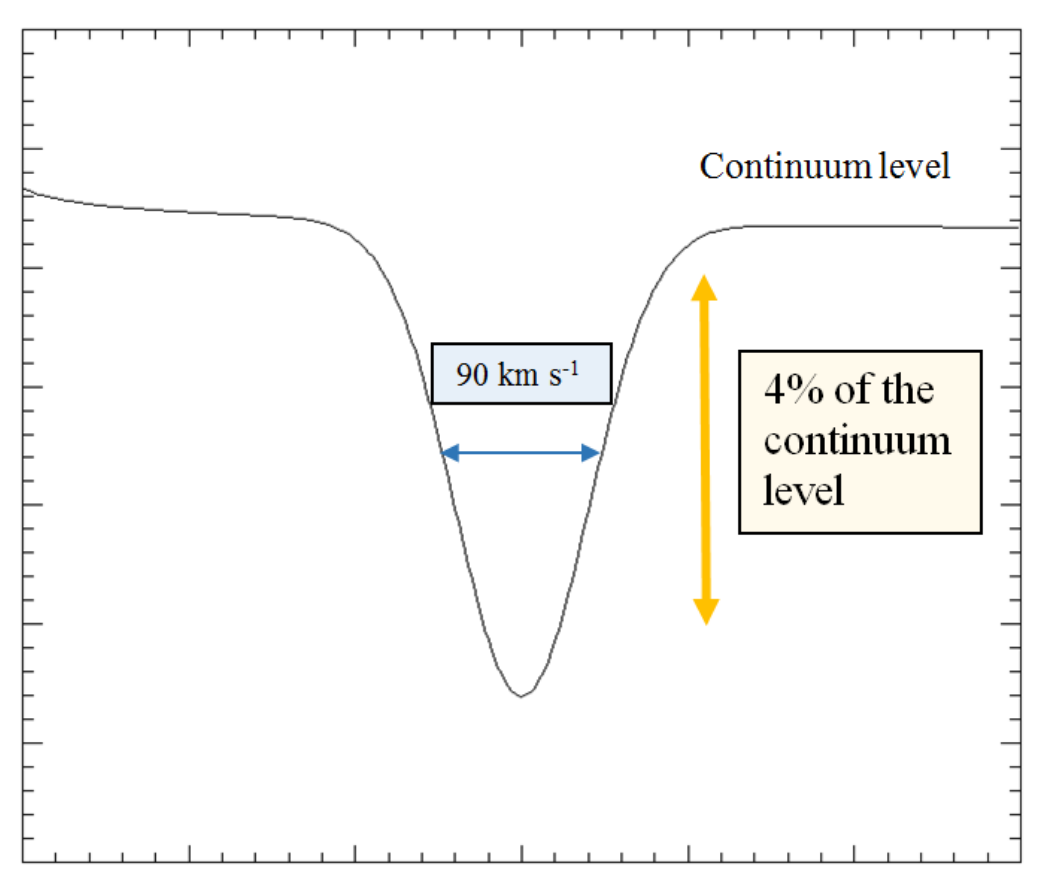
(d) The line width of the HI 21cm absorption line is 90 km/s. Calculate the line width in Hz at the observing frequency of . According to Figure 1, the HI 21cm line absorbs 4% of the continuum flux density (on average) over the line width of 90 kms. In order to detect the absorption line at ≥3σ in three consecutive 30 kms channels, what is the required integration time?
Отговори
(a) 42 s
More exactly 41.8 s.
(b) 1.34 GHz
(c) 0.00196 Jy
(d) 24700 s
Line width 0.402 MHz; t ≈ 24700 s ≈ 6.9 hours.
Решение
(a) for signal to noise ratio of 30 of flux density of 2.5×10 Jy,
(4 points)
= 150 K , = 280 MHz,
Using the equation above, ~ 42 s (more exactly 41.8 s) (3 points)
(b) = 1.4204 GHz / (1+z) = 1.4204/1.06 = 1.34 GHz (3 points)
(c) (3 points)
(d) Line width : 90 kms / c × = 90 / (2.9979×10) × 1.34 GHz = 0.402 MHz (2 points)
4% of 1.96×10 Jy continuum = 7.84×10 Jy (1 point)
≥ 3 means = 7.84×10 Jy / 3 = 2.61×10 Jy = 2.61×10 WmHz (values around 2.6×10 Jy are ok)
in three consecutive 30 kms channels: = 0.402 MHz/3 = 0.134 MHz (6 points)
= 25 K
Using equation (1), = 24700s ≈ 6.9 hours (3 points)
Оригинал в Архива: Theory Problems.pdf · официални решения: Theory Solutions.pdf