IOAA 2019, theory — Задача 14. Photographing a nanosatellite
Автор: Olympiads XYZ · транскрипция на официалните материали
Проверена срещу оригинала на 13.9.2026 от същия модел, който я е транскрибирал (без независима проверка)
Theory problem sheet · 60 т.
Условие
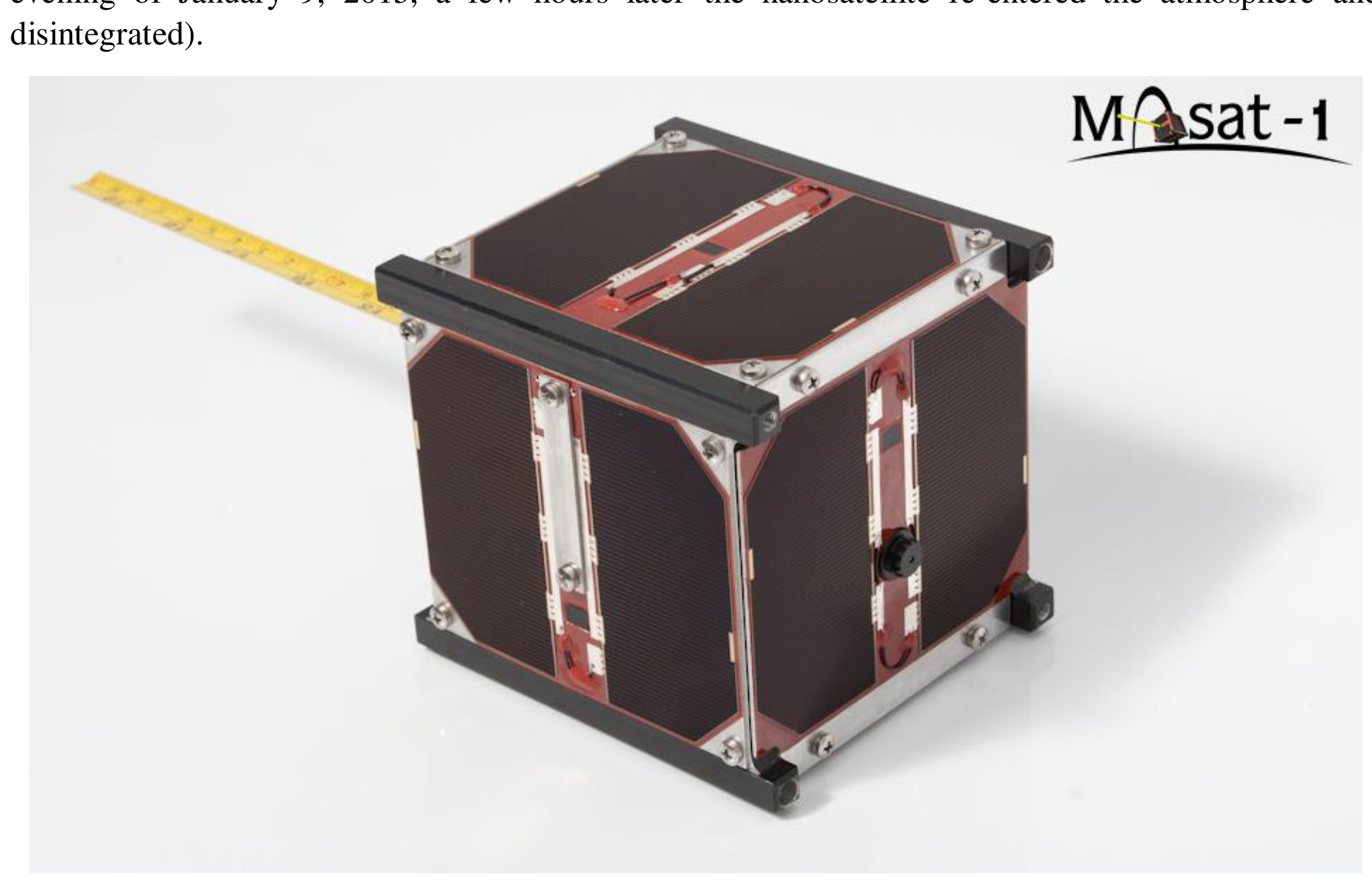
The very first, entirely Hungarian-made, satellite was "MASAT-1", a nanosatellite "cubesat". It was made mostly of aluminium with total mass 1 kg, sides length l = 10 cm and a longer communication aerial. It was designed and prepared at the Technical University of Budapest (BME) in 2009 by students. The launch occurred on February 13, 2012, using a Vega rocket from the Kourou launch site – together with several other cubesats from other countries. It operated successfully right up to the last minutes of its lifetime (the transmitted last data packages were captured by radio receivers on the evening of January 9, 2015, a few hours later the nanosatellite re-entered the atmosphere and disintegrated).
a) Calculate the apparent visual magnitude of this cubesat under ideal observational circumstances, i.e. when it was at the local zenith of the observing site (Baja, Hungary) at midnight. Omit all atmospheric effects, and consider the Earth to be a sphere. The albedo of a specular aluminium plate is .
Hint: Use a comparison of MASAT–1 with the Full Moon. [10 т.]
b) What was the Observatory’s answer to the MASAT team; would it ever be possible to photograph their nanosatellite with the existing equipment at the observatory? Mark "YES" or "NO" on the answer sheet. Support your answer with detailed calculations. [42 т.]
c) What would have been the answer if they had taken into account the blurring effect of the atmosphere, the so-called seeing? In Hungary the typical FWHM (Full Width at Half Maximum) value of the blurred stellar images – which can be approximated by a symmetric 2D Gaussian profile close to the zenith – is about 3.5”. Mark "YES" or "NO" or "Close to the limit" on the answer sheet. Support your answer with a short calculation.
Hint: Although the illumination of the seeing spot in the focal plane can be approximated by a symmetric 2D Gaussian profile, you can take it to be homogeneous in your calculation. [8 т.]
Решение
Покажи официалното решение
Оригинал в Архива: TH-problem-final.pdf · официални решения: TH-solution-final.pdf