IOAA 2021, Теория — Задача 10. Terrestrial Transit (15 points).
Theory — Q10-1, English (Official) — Terrestrial Transit (15 points) · 15 т.
Solar System
| Object | Mean radius (km) | Mass (kg) | Semi-major axis (au) | Eccentricity |
|---|---|---|---|---|
| Sun | 695 500 | --- | --- | |
| Mercury | 2 440 | 0.387 | 0.206 | |
| Venus | 6 052 | 0.723 | 0.007 | |
| Earth | 6 378 | 1.000000 | 0.016 710 | |
| Moon | 1 737 | 0.002572 | 0.054 900 | |
| Mars | 3 390 | 1.524 | 0.093 | |
| Jupiter | 69 911 | 5.203 | 0.048 | |
| Saturn | 58 232 | 9.537 | 0.054 | |
| Uranus | 25 362 | 19.189 | 0.047 | |
| Neptune | 24 622 | 30.070 | 0.009 |
Astronomical Data
| 1 parsec | = | ||
| = | |||
| = | |||
| 1 astronomical unit | 1 au | = | |
| 1 jansky | 1 Jy | = | |
| Hubble constant | = | ||
| Solar luminosity | = | ||
| Apparent angular diameter of Sun | = | ||
| Effective temperature of Sun | = | ||
| Obliquity of the ecliptic (Earth) | = | ||
| Inclination of the lunar orbit w.r.t. ecliptic | = | ||
| Apparent visual magnitude of full moon | = | ||
| North Ecliptic Pole (J2000.0) | |||
| North Galactic Pole (J2000.0) | |||
| 1 sidereal day | = | ||
| 1 tropical year | = | ||
| 1 sidereal year | = |
Условие
Note: Assume perfect circular orbits in both questions below.
10.1 An alien astronomer from a distant planetary system is observing the Sun. Suddenly, the brightness of the Sun drops due to the transit of the Earth in front of it. What is the maximum duration that this transit may last (in hours)? Assume that the planet where the astronomer observes from, does not move relative to the Sun. [5 т.]
10.2 Imagine that the transit of a given exoplanet as seen from Earth lasts 31 minutes. The host star is a red dwarf, with mass and radius that are 10% of the mass and radius of the Sun. What is the minimum orbital period this exoplanet may have (in days)? [10 т.]
Отговори
- 10.1 12.97 h
- 10.2 2.3 days
Решение
10.1
The maximum duration occurs if Earth passes exactly along the diameter of the Sun. Now consider the following figure, where Sun rays are depicted as traveling to the right towards the hypothetical distant observer (reason why they can be considered parallel):
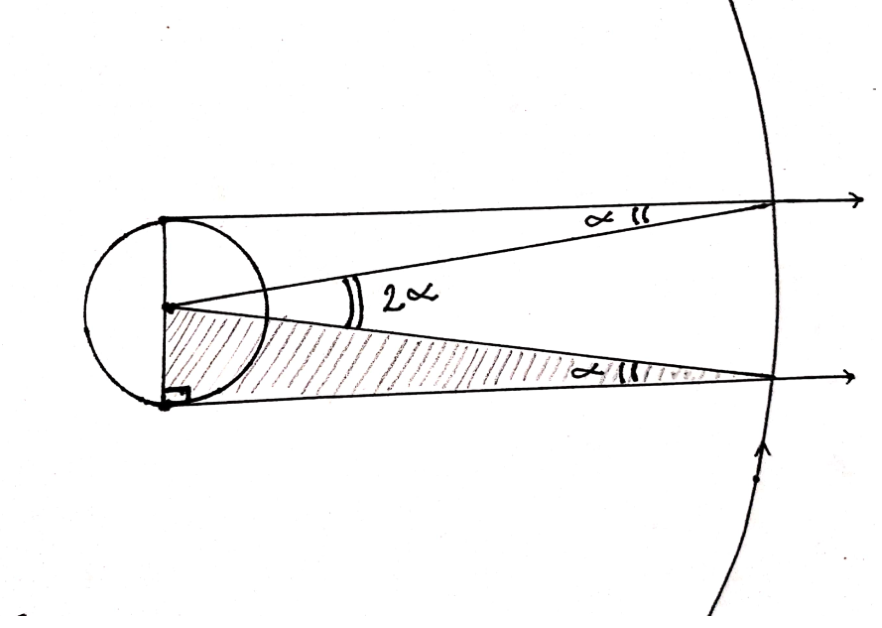
The arc along the circumference associated to the transit, , can be easily found looking at the shaded triangle:
[2 points]
being the orbital radius of the Earth. Now the time of the transit can be found by considering the angular velocity of the Earth, for instance by means of the following proportionality relations:
[2 points]
Substituting with the known values for these quantities we get, i.e.,
[1 point]
10.2
First of all it must be said that the minimum orbital period is obtained if we assume that the transit occurs along the diameter of the star. In other cases, the planet would be crossing a shorter path in front of the star during the same time, meaning that it would have a smaller angular velocity and therefore a longer period.
That said, it means that we can resort to the same expression of 10.1, yet this time we need 2 additional elements:
- Using the small angle approximation:
[1 point]
- Invoking the full expression for the orbital period:
[1 point]
Combining these results, we get:
[2 points]
And solving for :
[2 points]
Finally putting this last result back into the expression for the orbital period:
[2 points]
At this point, just a numerical evaluation is needed, though a more elegant solution can be achieved by means of scaling relations by noting that this very same expression must be true in the case of the Earth-Sun system as seen from far away. Having that 31 minutes is the 4% of 12.94h:
[2 points]
These values were inspired by the planetary system Trappist 1.
Оригинал в Архива: TQ-10-Q.pdf · официални решения: TQ10.pdf · допълнителни данни: TQ-10-A.pdf · допълнителни данни: Standard-Table-of-constants.docx.pdf · допълнителни данни: TQ-G.pdf · допълнителни данни: data.pdf