IOAA 2021 — Задача 1. Lucy: The First Mission to the Trojan Asteroids (15 points).
Автор: Olympiads XYZ · транскрипция на официалните материали
Проверена срещу оригинала на 13.9.2026 от същия модел, който я е транскрибирал (без независима проверка)
Theory — Q13-1 — English (Official) — Lucy: The First Mission to the Trojan Asteroids (15 points). · 15 т.
Внимание: Бележка към темата
No official solutions document is present; answers are unknown.
Условие
CCD cameras on space probes are very sensitive and exposed to space weather conditions. Intense radiation passing through the CCD produces electron-hole pairs in the silicon of the CCD chip. The rate at which these pairs are produced is an important parameter when operating cameras on board spacecraft and can be calculated for radiation of any given energy.
A high energy particle or photon of radiation passing through the CCD will deposit some energy in the chip with each electron-hole pair it creates. The 'stopping power' of silicon for a given type of particle can be measured as the energy per areal density () that the silicon 'takes away' from the travelling particle.
NASA's Lucy mission will be the first to study the Trojan asteroids and will revolutionize our understanding of the formation of the Solar System. One of the instruments on board is L'LORRI (Lucy LOng Range Reconnaissance Imager), which contains a sensitive CCD in order to produce detailed images of the Trojan asteroids. Unfortunately, the radiation around Jupiter is very intense and it can generate a lot of 'noise' in the pixels of the CCD.
Let us assume that an average charged particle trapped in Jupiter's magnetic field has an energy of and that the flux of such particles in this region is equivalent to about 600 electrons . Also assume that for each electron-hole pair which a particle passing through a pixel creates, it deposits exactly the excitation energy of the pair in that pixel. After the pixel crosses a threshold number of electron-hole pairs it is 'excited' and no more pairs can be produced in that pixel. Any remaining energy in the particle is passed to the next pixel (and so on).
Using the data given below for the CCD chip in the L'LORRI camera, answer the following questions:
CCD Data:
- Exposure time of an image = 30 ms
- Pixels on the CCD = 1024 x 1024
- CCD Area = 13 mm x 13 mm
- CCD chip thickness = 0.06 cm
- Density of silicon,
- Excitation energy of single pair = 2.36 eV
- Excitation threshold of a single pixel = 250 pairs
- Stopping power' of silicon for a 15 MeV electron = 3.012 MeV
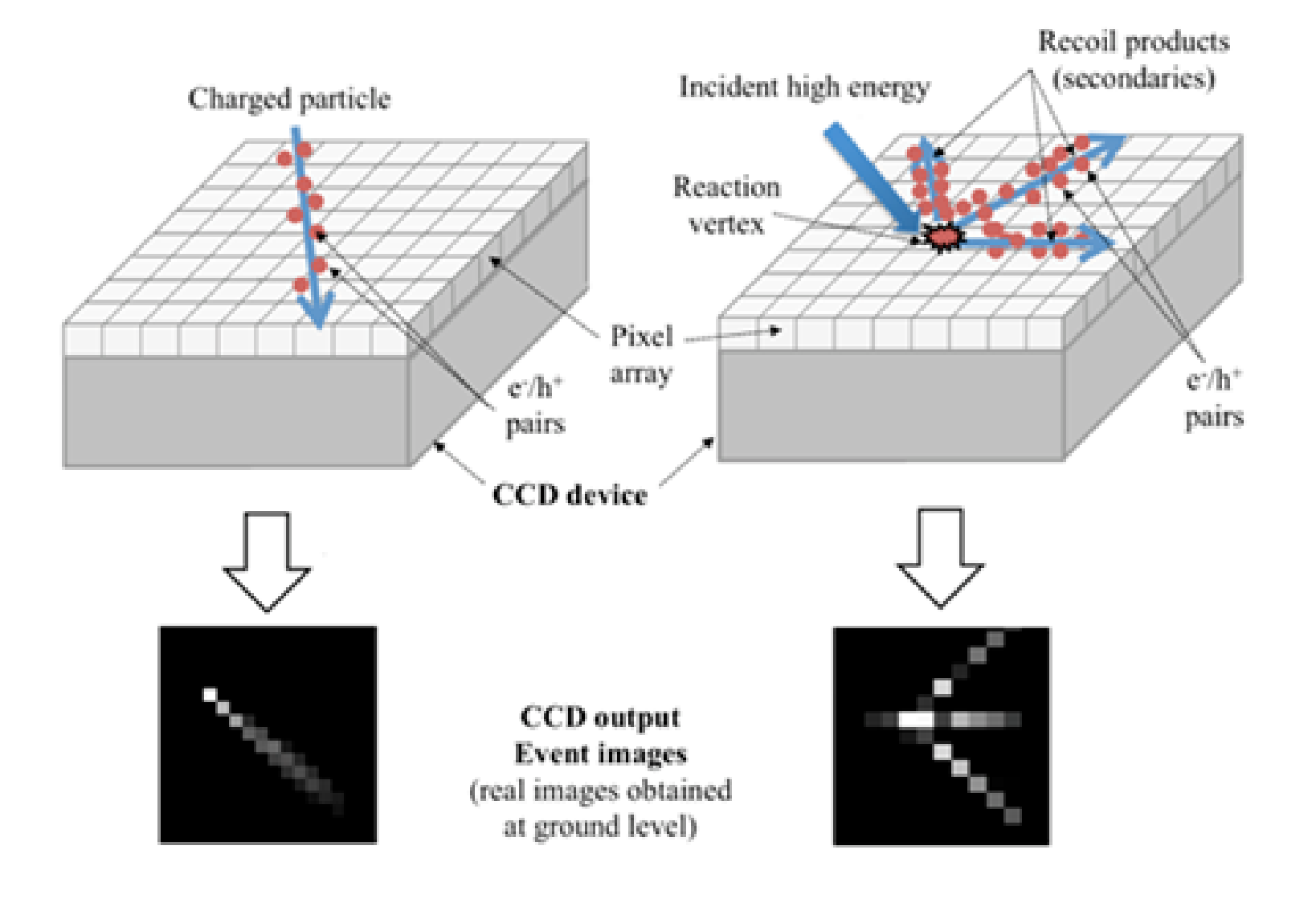
13.1 How many pixels will be excited by one such particle of radiation passing through the CCD when the spacecraft is near Jupiter's orbit? [10 т.]
13.2 Given the radiation flux near Jupiter, what percentage of the total number of pixels in an image will be excited? [5 т.]
Решение
Внимание: Непълно решение
No solutions document is present in the archive for this paper.
Оригинал в Архива: TQ-13-Q.pdf