IOAA 2021 — Задача 1. Cosmic String (55 points).
Автор: Olympiads XYZ · транскрипция на официалните материали
Проверена срещу оригинала на 13.9.2026 от същия модел, който я е транскрибирал (без независима проверка)
Theory — Q15 · Cosmic String (55 points) · English (Official) · 55 т.
Внимание: Бележка към темата
No official solutions available; answer fields are incomplete.
Условие
Introduction
According to our current understanding, just after the Big Bang, when the Universe was extremely hot, the electromagnetic force, the strong nuclear force as well as the weak nuclear force were unified as one Grand Unified (GUT) force.
When the Universe cooled down to , the strong nuclear force decoupled from the electroweak force. Later, when the temperature reduced to , the weak force decoupled from the electromagnetic force. These transitions happened in a rapid succession within a small fraction of a second after the Big Bang. It is thought that these phase transitions produced a variety of peculiar objects, called vacuum defects, which may still be observed today.
This question will discuss properties of one such possible type of defect called cosmic strings and their observational effects.
Note 1. Unless otherwise stated use the laws of Newtonian Mechanics
Note 2. You will use the following constants:
- Stefan Boltzmann Constant
- The reduced Planck constant
- Universal Radiation Constant
- Planck Temperature
Note 3. Recall that the gravitational field satisfies the Gauss theorem:
Where is the mass enclosed by the surface A.
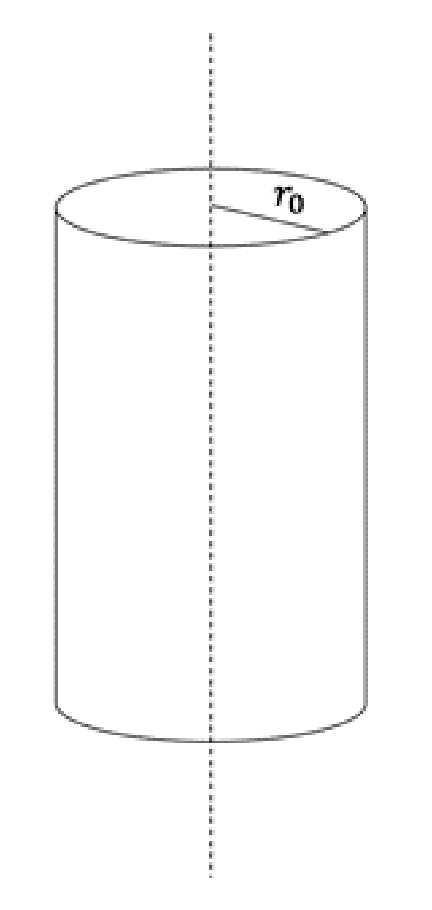
Consider now a cosmic string as a photon gas inside a very long cylinder of radius with adiabatic walls, and in thermal equilibrium at temperature .
So far, in part and , we have neglected the internal pressure of the photon gas inside the string. If we include it in our analysis, we need to consider the General Theory of Relativity.
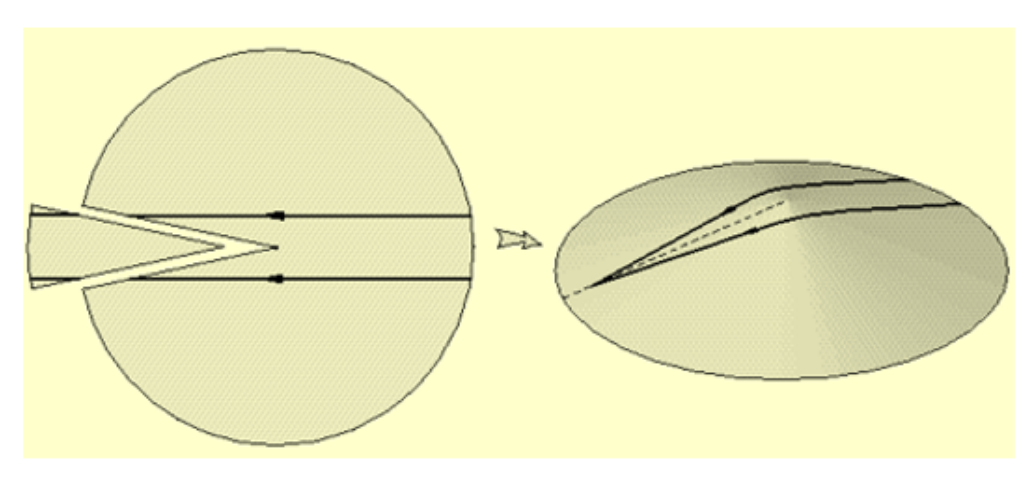
After solving the Einstein field equations, one finds that the spacetime around a cosmic string is conical as if a narrow wedge were removed from a flat sheet and the edges connected, as shown below.
http://www.ctc.cam.ac.uk/outreach/origins/cosmic_structures_five.php
A remarkable result of this model is light deflection by a cosmic string, which leads to the possibility of detection through gravitational lensing.
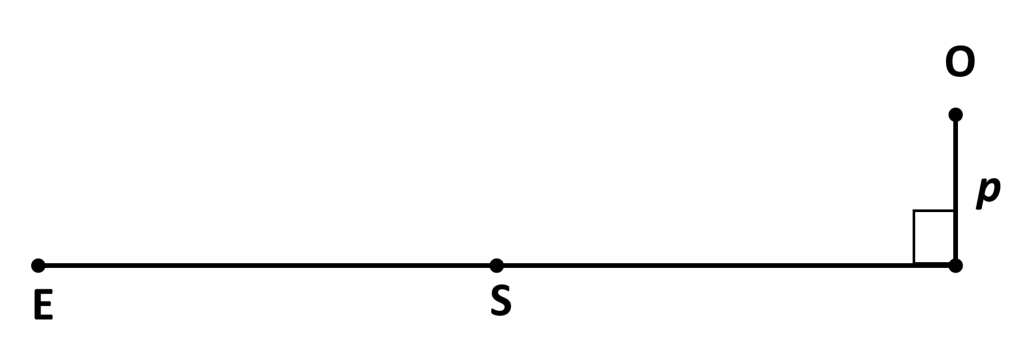
The angle of deflection (in radians) of a light ray coming from a distant quasar (O in the figure below), as the light passes close to a cosmic string (S in the figure below) and eventually reaching an observer on the Earth, (E in the figure below), is
and is independent of the parameter, , as shown in the figure below:
In the figure and are in a plane perpendicular to the string. The distance between the observer and the string is and the distance between the observer and the source is
A.1 Write an expression in terms of the constants , and for the gravitational field produced by the string, . Consider the cases and independently [6 т.]
A.2 Write an expression in terms of the constants , and for . [1 т.]
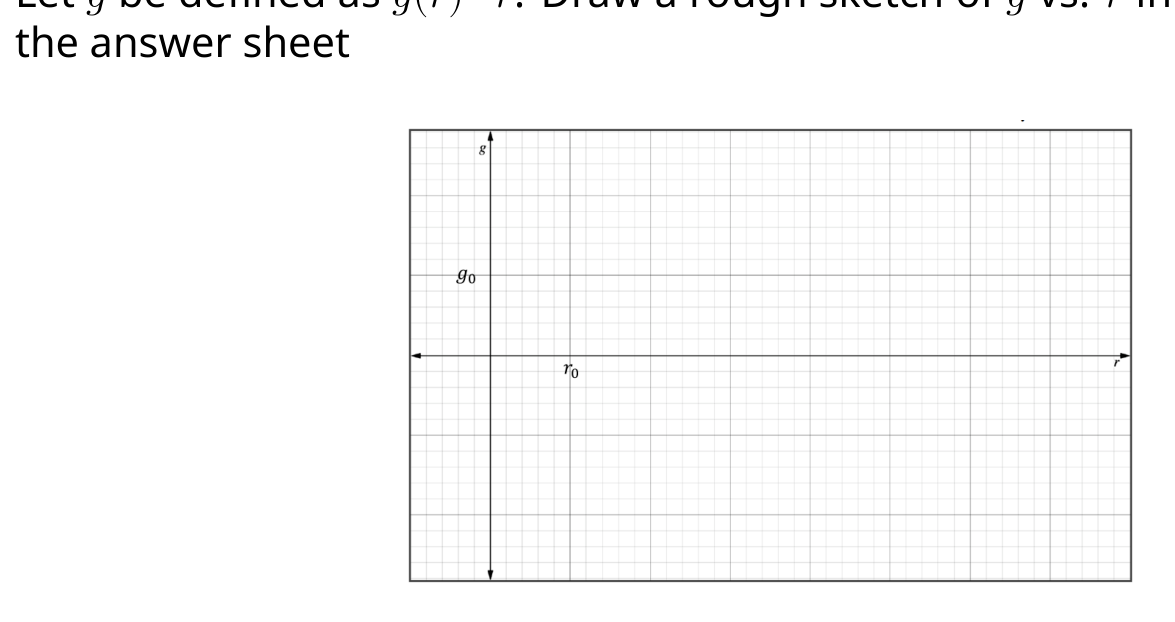
A.3 Let be defined as . Draw a rough sketch of vs. in the figure given in the answer sheet [3 т.]
A.4 It is possible to define a stable orbit around a Cosmic String. For circular orbits of radius and period , the following relation is attained
where and are constants. Find and in terms of and [4 т.]
A.5 The following three questions refers to a classical newtonian particle moving with speed when at a distance from the string. You will need to use the result below:
Show that the gravitational potential energy of the particle is
where is any fixed distance. [3 т.]
A.6 What is the maximum distance, , from the string, that the particle can reach? [4 т.]
A.7 Is it possible for the particle to escape the gravitational field? Write YES/NO in the answer sheet. [1 т.]
B.1 What is the energy density of the string in terms of , , and ? [2 т.]
B.2 The radius is related to the temperature vía
where is the reduced Planck constant, and is the speed of light in vacuum, is the Boltzmann constant, and and are integer numbers. Determine and [4 т.]
B.3 What is the mass per unit length, , of the string in terms of and ? [2 т.]
B.4 Express the inequality for the weak field condition, defined as
only in terms of and . [5 т.]
B.5 Calculate for
- [3 т.]
B.6 Does the weak field condition hold for ? Answer YES or NOT. Does the weak field condition hold for ? Answer YES or NOT. [1 т.]
C.1 Although the angle of deflection does not depend on parameter , an Earth-based observer will be able to see more than one image only if the value of is within a certain range. Find a condition on the value of the parameter in terms of , , and temperature , for an Earth-based observer to see more than one image of the object [6 т.]
C.2 In case the observer sees more than one image, what is the angular separation between each pair? Find an expression in terms of , and [6 т.]
C.3 If , determine the minimum size of an optical telescope needed to resolve this lensing event produced by GUT string. [4 т.]
Отговори
Покажи отговорите
Решение
Внимание: Непълно решение
No official solutions document was provided in the archive for this paper.
Оригинал в Архива: TQ-15-Q.pdf