IOAA 2021, Теория — Задача 3. Mars (10 points).
Theory — Q3-1 English (Official) — Mars (10 points). · 10 т.
Standard Table of Constants — values used in this problem
Universal gravitational constant: .
Standard Table of Constants — values used in this problem
Mars: mean radius ; mass .
Условие
A spacecraft of mass approaches in a parabolic orbit , with respect to Mars. When the spacecraft reaches point of least distance to the center of Mars, , it undergoes an instantaneous deceleration using its rockets and goes into a perfectly calculated orbit so that it will touch the Martian surface exactly at point , diametrically opposite , as shown in the figure.
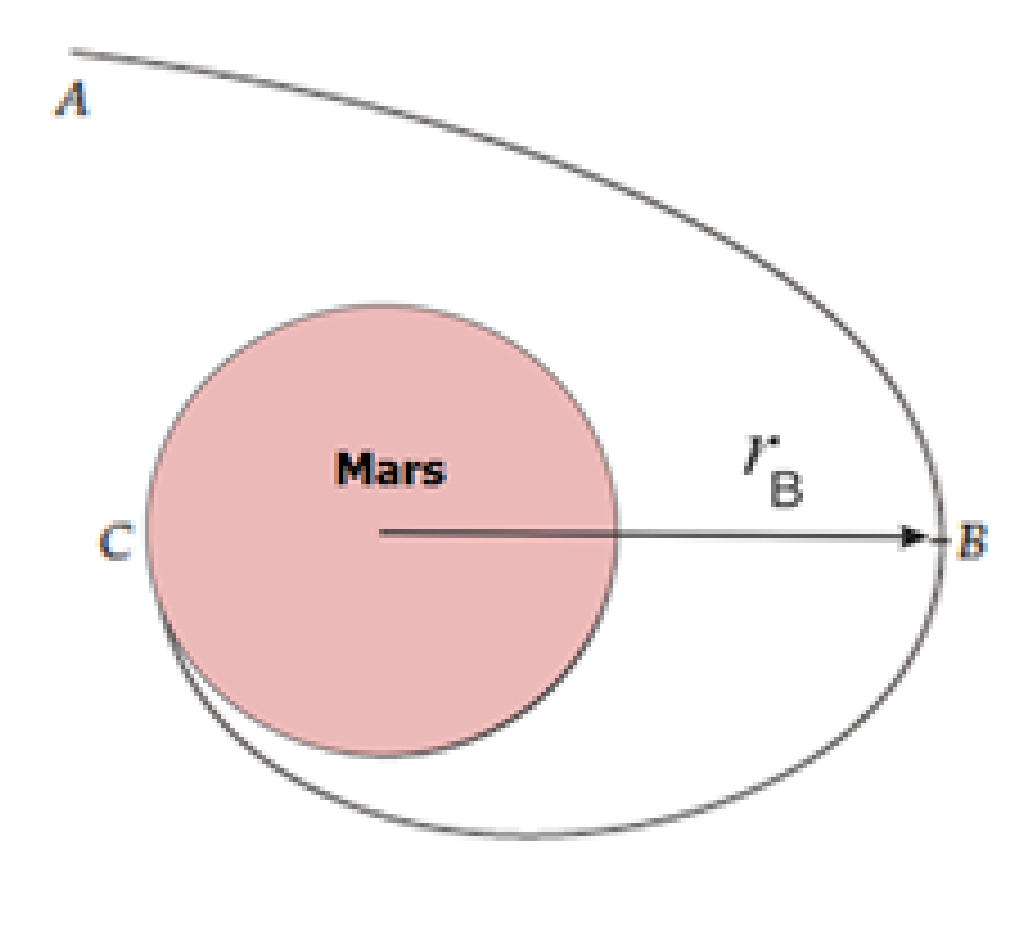
3.1 Determine the speed of the spacecraft at point just before the deceleration. [3 т.]
3.2 Calculate the total energy of the spacecraft as it is moving between points B and C. [4 т.]
3.3 Calculate the speed of the spacecraft at point . [3 т.]
Отговори
- 3.1 3.55 km/s
- 3.2 J
Решение
Внимание: Непълно решение
Official TQ3.pdf ends after 3.2 Solution A. The promised second method and all of 3.3 are absent; combined Theory Solutions.pdf page 3 has the same ending, with TQ4 starting on page 4.
3.1 Since the path between A and B is parabolic, the total energy of the spacecraft is zero,
So, when you get to point B, then
[1 point]
From where
[1 point]
Replacing with available values
[1 point]
3.2 There are two possible solutions
Solution A
Immediately after breaking the total energy and the angular momentum change since the braking force is tangential, but along the elliptical path BC the values with which it passes through are conserved and take on during the entire journey. C; then applying conservation of energy between points B’ (immediately after braking) and C as well as conservation of the angular momentum between B' and C, we have
[1 point]
[1 point]
From these two equations we solve for and it's result is used to calculate the total energy in C which gives us:
[2 points]
In both methods, this and next, two points for getting the equation and two points for calculation + negative sign + unit.
Оригинал в Архива: TQ-3-Q.pdf · официални решения: TQ3.pdf · допълнителни данни: TQ-3-A.pdf · допълнителни данни: Standard-Table-of-constants.docx.pdf · допълнителни данни: TQ-G.pdf · допълнителни данни: data.pdf