IOAA 2021 — Задача 1. Menkalinan (β Aurigae) (13 points).
Автор: Olympiads XYZ · транскрипция на официалните материали
Проверена срещу оригинала на 13.9.2026 от същия модел, който я е транскрибирал (без независима проверка)
Theory — 14th IOAA, International Olympiad on Astronomy and Astrophysics — Q7-1 / Q7-2, English (Official) · 13 т.
Условие
Almost half of the stars that we see are either binary or multiple star systems. A well-known example of this is Menkalinan (Beta Aurigae), which was initially thought to be a single star, but today recognised as a binary system comprising two stars that we will refer to as Menkalinan A and B. In the following figure, a spectrum of the system (obtained by the observatory of the Universidad de los Andes, in Bogotá) is shown:
Spectrum of Menkalinan binary system in the region of . Y-axis is for the relative flux, and X-axis measures wavelengths. Menkalinan A is marked as A in the graph, and Menkalinan B is marked as B.
Answer the following questions using the plot and noting that the wavelength of line in the laboratory frame is . Assume circular orbits, and assume that the binary system as a whole is at rest with respect to the observer.
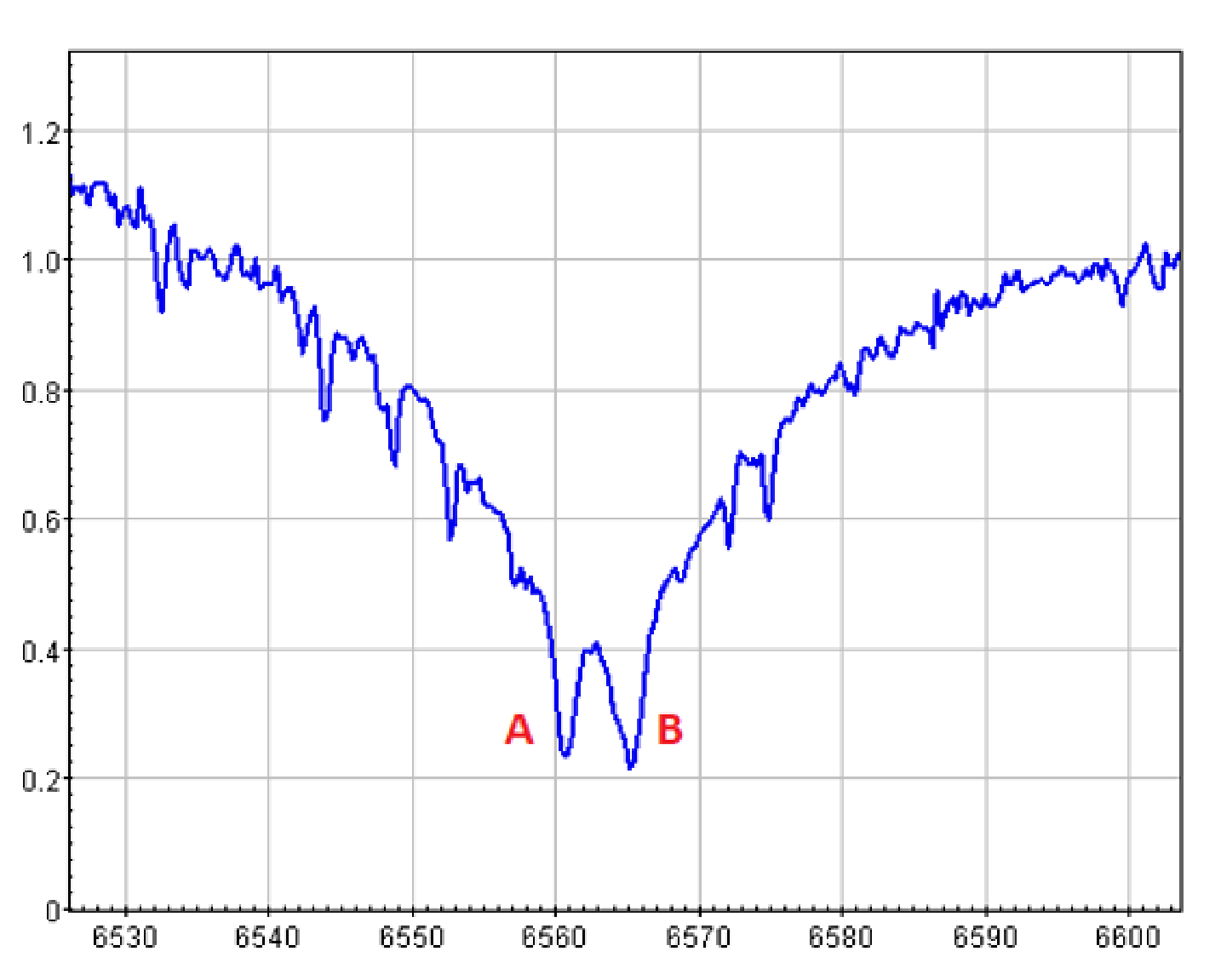
7.1 In the spectrum, we can see the line for each star in the system. Calculate the line-of-sight velocity of each star (km/s) and determine, at the time of this observation, which of the two stars is moving towards us. [5 т.]
7.2 The binary system is located light years from Earth and has an orbital period of days. The semi-major axis for Menkalinan B (smaller star) was measured to be . If the mass ratio of the two components is , find the total mass of the system (in solar masses). [4 т.]
7.3 Calculate the individual masses of Menkalinan and in solar masses. [2 т.]
7.4 Since Menkalinan and are main sequence stars, use the relation:
to estimate the luminosity of each star (in solar luminosity). [2 т.]
Решение
Внимание: Непълно решение
В архива липсва файл с официални решения за тази задача.
Оригинал в Архива: TQ-7-Q.pdf