IOAA 2023, Теория — Задача 6. Bolometer
IOAA 2023 — Theoretical competition · 13 т.
Указания
- Do not touch envelopes until the start of the examination.
- The theoretical examination lasts for 5 hours and is worth a total of 250 marks.
- There are Answer Sheets for carrying out detailed work and Working Sheets for rough work, which are already marked with your student code and question number.
- Use only the answer sheets for a particular question for your answer. Please write only on the printed side of the sheet. Do not use the reverse side. If you have written something on any sheet which you do not want to be evaluated, cross it out.
- Use as many mathematical expressions as you think may help the evaluator to better understand your solutions. The evaluator may not understand your language. If it is necessary to explain something in words, please use short phrases (if possible in English).
- You are not allowed to leave your work desk without permission. If you need any assistance (malfunctioning calculator, need to visit a restroom, etc.), please draw the attention of the supervisor.
- The beginning and end of the examination will be indicated by the supervisor. The remaining time will be displayed on a clock.
- At the end of the examination you must stop writing immediately. Put everything back in the envelope and leave it on the table.
- Once all envelopes are collected, your student guide will escort you out of the examination room.
- A list of constants and useful relations are included in the envelope.
Table of Constants
Fundamental constants
| Constant | Symbol | Value |
|---|---|---|
| Speed of light in vacuum | ||
| Planck constant | ||
| Boltzmann constant | ||
| Stefan-Boltzmann constant | ||
| Elementary charge | ||
| Universal gravitational constant | ||
| Universal electric constant | ||
| Universal gas constant | ||
| Avogadro constant | ||
| Wien’s displacement constant | ||
| Mass of electron | ||
| Mass of proton | ||
| Mass of neutron | ||
| Mass of Helium nucleus | ||
| Atomic mass unit (a.m.u., Dalton) |
Astronomical data
| Data | Symbol | Value |
|---|---|---|
| Hubble constant | ||
| North Ecliptic Pole () | ||
| North Galactic Pole () | ||
| 1 jansky | ||
| 1 parsec | ||
| 1 astronomical unit (au) | ||
| 1 sidereal day | ||
| 1 tropical year | solar days | |
| 1 sidereal year | solar days |
Approximations and Gauss’s formulae
Approximations
Gauss’s formulae
Spherical law of cosines:
Spherical law of sines: .
The Sun, Earth and Moon
The Sun
| Data | Symbol | Value |
|---|---|---|
| Solar luminosity | ||
| Apparent angular diameter of Sun | ||
| Effective temperature of Sun | ||
| Apparent visual magnitude | ||
| Absolute visual magnitude | ||
| Apparent bolometric magnitude | ||
| Absolute bolometric magnitude | ||
| Distance of the Sun from the Galactic centre |
The Earth and Moon
| Data | Symbol | Value |
|---|---|---|
| Obliquity of the ecliptic (Earth) | ||
| Platonic year (period of precession of Earth’s axis) | years | |
| Apparent visual magnitude of full Moon | ||
| Apparent angular diameter of Moon | ||
| Inclination of the lunar orbit to the ecliptic | ||
| Inclination of the lunar equator to its orbital plane | ||
| Lunar sidereal month | ||
| Synodic month | ||
| Tropical month | ||
| Anomalistic month (the average time between two successive Moon’s perigees) | ||
| Draconic month (time between two successive transits of the Moon through the same node) |
The Solar System
| Object | Mean radius [km] | Mass [kg] | Semimajor axis [au] | Eccentricity |
|---|---|---|---|---|
| Sun | — | — | ||
| Mercury | ||||
| Venus | ||||
| Earth | ||||
| Moon | (range –) | |||
| Mars | ||||
| Jupiter | ||||
| Saturn | ||||
| Uranus | ||||
| Neptune |
General Marking Scheme
| Case | Marking |
|---|---|
| Using incorrect physical concept (despite correct answers) | No points given |
| Giving correct answer without detailed calculation | Deduct 50% of the marks for that part |
| Minor mistakes in the calculations, e.g., wrong signs, symbols, substitutions | Deduct 20% of the marks for that part |
| Units missing from final answers | Deduct 0.5 pts |
| Too few or too many significant figures in the final answer | Deduct 0.5 pts |
| Error resulting from another error in an earlier part for which the student already lost marks, if the answer is physically reasonable. | Full points (i.e., no deductions) |
| Error resulting from another error in an earlier part, where the student should have realised the answer was physically unreasonable. | Deduct 20% of the marks for that part |
For example, if due to an error in an earlier part, the student calculates the mass of a star as instead of , they will only lose marks for the earlier part. However, if, for the same reason, a student calculates the mass as , they should realize this is wrong (a few times the Earth’s mass) and thus should lose some marks for this part as well.
Условие
The entrance cavity of a particular bolometer is a cone with an opening angle of , the surface of which has an energy absorption coefficient of . Assume that there is no scattering of the incident radiation on the walls of the cavity, only multiple mirror-like (specular) reflections. This bolometer is connected to a cooler which keeps the bolometer cavity surface at practically temperature. The instrument is orbiting at from the Sun and is pointed directly at the centre of the Solar disk.
Calculate the temperature of a black body which would radiate the same amount of energy as the entire bolometer opening does per unit surface area.
Note: the opening angle is defined as twice the angle between the axis of the cone and its generatrix.
Решение
From the table of constants, the Solar luminosity and , therefore the distance to the bolometer is:
and the surface area of a sphere of that radius is:
and the incident flux is:
(3 points)
The incoming radiation can be assumed to be initially parallel to the axis of the cone. As the rays hit the surface they are reflected, after the first reflection the rays are travelling at to their original path (). They next meet the surface at and are reflected by , and so on with each reflection, such that after reflections the ray will be sent back out of the aperture as shown in the figure below. These exiting rays are what we are interested in; all the energy entering the bolometer itself is removed by the 100% efficient cooler.
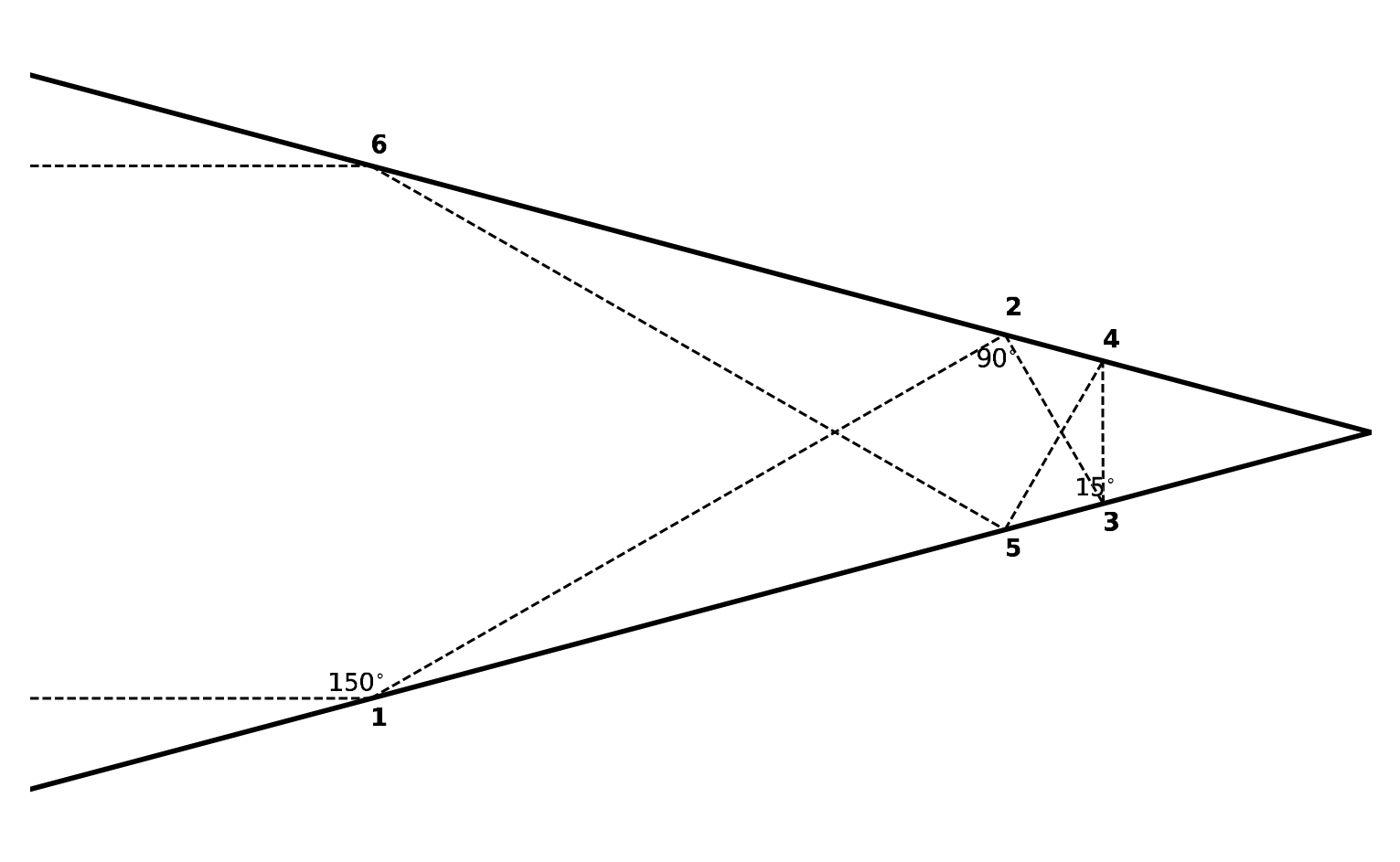
(conceptually difficult: 4 points)
Thus the fraction of energy leaving the bolometer will be given by:
(2 points)
Treating the opening as if it were a black body radiator, we can apply the Stefan-Boltzmann law:
(1 point)
and
(2 points)
From the table of constants: , therefore the effective temperature is:
(1 point)
Original PDF comments
The original solution PDF contains two comments attributed to IOAA on this page:
“In previuos erratic version it was "... - 1".”
“In previous erratic version it was L_2/L_1 = ...”
Бележки за изданието
The English question packet includes a Ukrainian answer form for problem 9. The constants table prints Earth’s obliquity as 23.5′ and the Moon’s semimajor axis in km under an au heading. In the eclipse key, the magnitude addition and luminosity-ratio labels differ from its derivation and results; the original PDF correction comments are retained. Aldebaran’s key prints 4412 km/h and then uses 4416 in the angular-speed numerator. The X-ray question and key allocate points to parts (c) and (d) differently. DART’s alternative calculation prints both 0.17622 and 0.17662 m/s. The LISA key labels the component-mass calculation Part (b), repeats one algebra line and prints the period factor with a positive square. These printed discrepancies remain literal.
Оригинал в Архива: theory.pdf · официални решения: th_solutions.pdf