IOAA 2024, Теория — Задача 11. T11. Ground Tracks
IOAA 2024 — Theory Examination, English (Official) · 75 т.
Внимание: Бележка към темата
The printed instructions refer to blank Detailed Worksheets and a summary Answer Sheet. Those forms are absent from the available 2024 archive packet. The complete question booklet, solution booklet and separate marking scheme are included. Printed source inconsistencies are identified in the relevant tasks and retained without silently changing the source.
T2: The solution first gives and later substitutes , while retaining its boxed . The main double-sum potential expression also omits the factor used for unique pairs in the appendix. These printed expressions are retained; the marking scheme allows valid alternative estimates.
T6: The question names Palomar 4; the solution's repeated question names Palomar 6. The solution gives mag but substitutes in the following surface-brightness line. The native question and printed calculation are retained.
T7: The printed expansion on solution page 13 has where the preceding cosine-law equation would give . It is retained as printed; the subsequent sunrise calculation sets .
T10: Solution page 25 prints the unit of as m rather than . In (j), the final vector prints 77.59 m/s after previously using 77.76 m/s; the magnitude uses 77.76 m/s. These printed values are retained.
T11: The question gives Maceió's longitude as , while solution (e) uses . The solution's printed margin marks total 11 points in (g), versus 12 points in the question and separate marking scheme; its (j) heading and marks total 7 points, versus 6 in the question and separate marking scheme. All three sources are retained with their original point values.
Common solar-system table: The native solar-system table labels the semi-major-axis column AU, while explicitly giving the Moon's entry in km; its printed unit is retained.
Указания
- The theoretical competition will be 5 hours in duration and is marked out of a total of 300 points.
- There are Detailed Worksheets for carrying out detailed work / rough work. On each of the Detailed Worksheets, please fill in Student Code, Question No., Page no. and total number of pages.
- Start each problem on a new page of the Detailed Worksheets. Please write only on the printed side of the sheet. Do not use the reverse side. If you have written something on any sheet which you do not want to be marked, cross it out.
- There is a summary Answer Sheet with your student ID code for your final answers.
- Please remember that the graders may not understand your language. As far as possible, write your solutions only using mathematical expressions and numbers. If it is necessary to explain something in words, please use short phrases (if possible in English).
- You are not allowed to leave your exam desk without permission. If you need any assistance (malfunctioning calculator, need to visit a restroom, need more Detailed Worksheets, etc.), please put up your hand to signal the invigilator.
- The beginning and end of the competition will be indicated by a long sound signal. Additionally, there will be a short sound signal fifteen minutes before the end of the competition (before the final long sound signal).
- Wait at your table until your envelope is collected. Once all envelopes are collected, your student guide will escort you out of the competition room.
- A list of constants for this competition is given on the next page.
Fundamental Constants
| Constant | Value |
|---|---|
| Speed of light in a vacuum | |
| Planck constant | |
| Boltzmann constant | |
| Stefan-Boltzmann constant | |
| Elementary charge | |
| Universal Gravitational constant | |
| Universal gas constant | |
| Avogadro constant | |
| Wien's displacement law | |
| Mass of the electron | |
| Mass of the proton | |
| Mass of the neutron |
Astronomical Data and Solar Magnitudes
| Astronomical Data | Value |
|---|---|
| 1 parsec | |
| 1 Astronomical Unit (AU) | |
| 1 Jansky | |
| Hubble constant | |
| Solar luminosity | |
| Angular diameter of the Sun (from Earth) | |
| Effective temperature of the Sun | |
| Obliquity of the ecliptic | |
| Inclination of the Moon's orbit (to ecliptic) | |
| Magnitude of full Moon | |
| Coordinates of North Ecliptic Pole | |
| Coordinates of North Galactic Pole | |
| Sidereal day | |
| Tropical year | solar days |
| Sidereal year | solar days |
Solar Magnitudes
| Apparent Visual | Absolute Visual | Apparent Bolometric | Absolute Bolometric |
|---|---|---|---|
Solar System, Spherical Trigonometry and Calculus
Solar System Data
| Object | Radius (km) | Mass (kg) | Semi-major axis (AU) | Orbital eccentricity | Albedo |
|---|---|---|---|---|---|
| Sun | 695500 | n/a | n/a | n/a | |
| Mercury | 2440 | 0.387 | 0.206 | 0.088 | |
| Venus | 6052 | 0.723 | 0.007 | 0.76 | |
| Earth | 6378 | 1.000 | 0.016710 | 0.31 | |
| Moon | 1737 | 0.054900 | 0.11 | ||
| Mars | 3390 | 1.524 | 0.093 | 0.25 | |
| Jupiter | 69911 | 5.203 | 0.048 | 0.51 | |
| Saturn | 58232 | 9.537 | 0.054 | 0.34 | |
| Uranus | 25362 | 19.189 | 0.047 | 0.30 | |
| Neptune | 24622 | 30.070 | 0.009 | 0.29 |
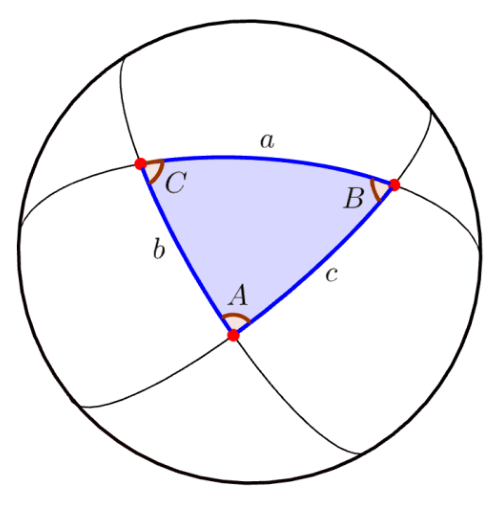
Spherical Trigonometry
Cosine formula:
Sine formula:
Four parts formula:
Calculus
Chain Rule:
Product Rule:
Условие
The projection of a satellite's orbit onto the Earth's surface is called its ground track. At a given instant, one can imagine a radial line drawn outward from the centre of the Earth to the satellite. The intersection between the Earth's spherical surface and this radial line is a point on the ground track.
The location of this point is specified by its geocentric latitude and longitude. The ground track is then essentially the figure traced by this point as the satellite moves around the Earth.
Part I: Sun-Synchronous Orbits (25 т.)
It is particularly interesting to analyse the ground track of a so-called Sun-Synchronous orbit. This is a nearly polar orbit around a planet where the satellite passes over any given point on the planet's surface at the same mean local solar time. This property is especially interesting for satellite imaging, ensuring similar illumination conditions over different days.
The figure below shows the ground track of a satellite in a Sun-Synchronous orbit. Its inclination angle () - the angle between the satellite orbital plane and the Earth's equatorial plane - falls within the range . The graph depicts five complete orbits of the satellite.
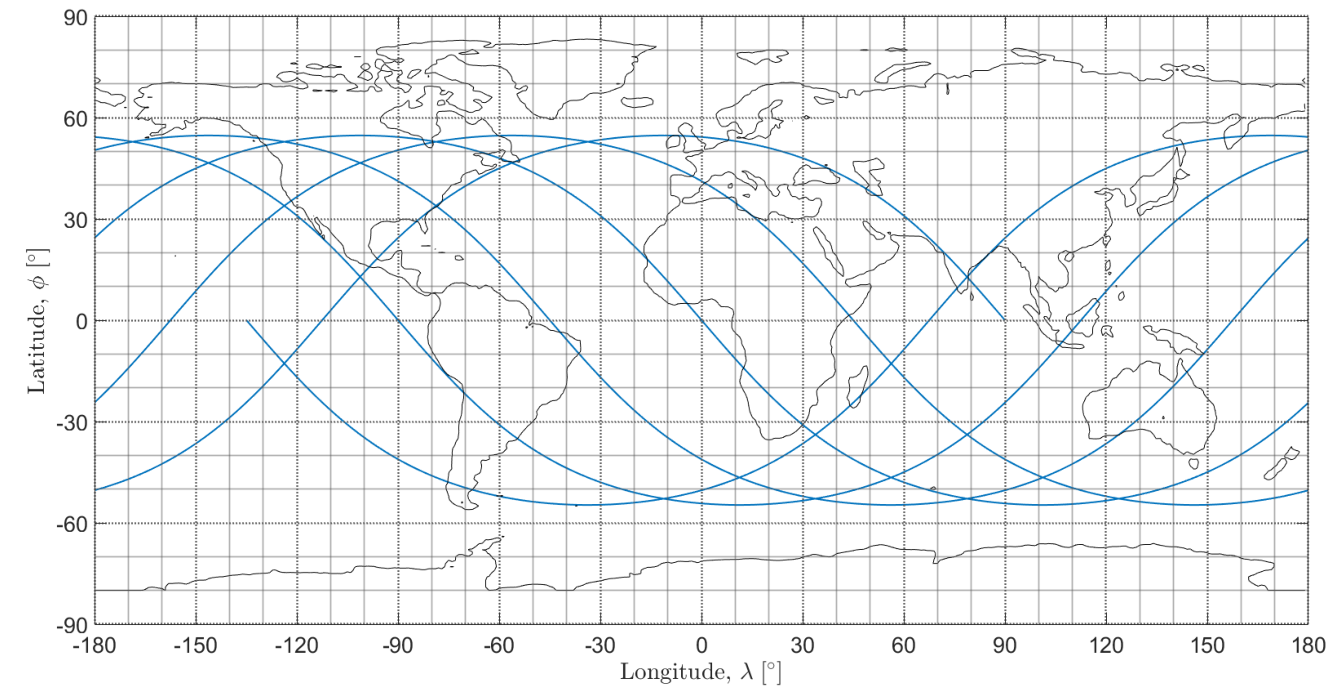
For the questions in Part I, assume that the Earth's orbit around the Sun is circular.
(a) Determine the nodal precession rate for the orbit in rad/s. [3 т.]
(b) Based on the ground track shown in Figure 2, determine the inclination of the satellite's orbit (in degrees) and estimate its orbital period (in minutes). Consider that the orbital period of the satellite is shorter than one sidereal day. [8 т.]
(c) Calculate the semi-major axis of the orbit in km. [2 т.]
(d) Determine the number of orbits completed by the satellite until it returns to the same position on Earth. [1 т.]
(e) As seen in Figure 2, the ground track crosses the Brazilian city of Maceió and also Chorzów , in Poland. Knowing that the ground track crosses Maceió at noon (local time), determine the local time that the satellite track crosses Chorzów. Hint: specifically for this task, you may neglect the effects of nodal precession. [11 т.]
Part II: Tundra orbits (50 т.)
A Tundra orbit is a type of geosynchronous elliptical orbit characterised by a high inclination. The apogee is positioned over a specific geographic region, allowing for prolonged visibility and coverage over that area. This orbit ensures that a satellite spends the majority of its orbital period over the northern - or southern - hemisphere, making it particularly useful for communications and weather observation over high-latitude regions.
The image below represents the ground track of a satellite in a Tundra orbit with an argument of perigee equal to . The satellite orbits the Earth in the same direction as its rotation. For the following items, you can ignore the effects of the Earth's oblateness.
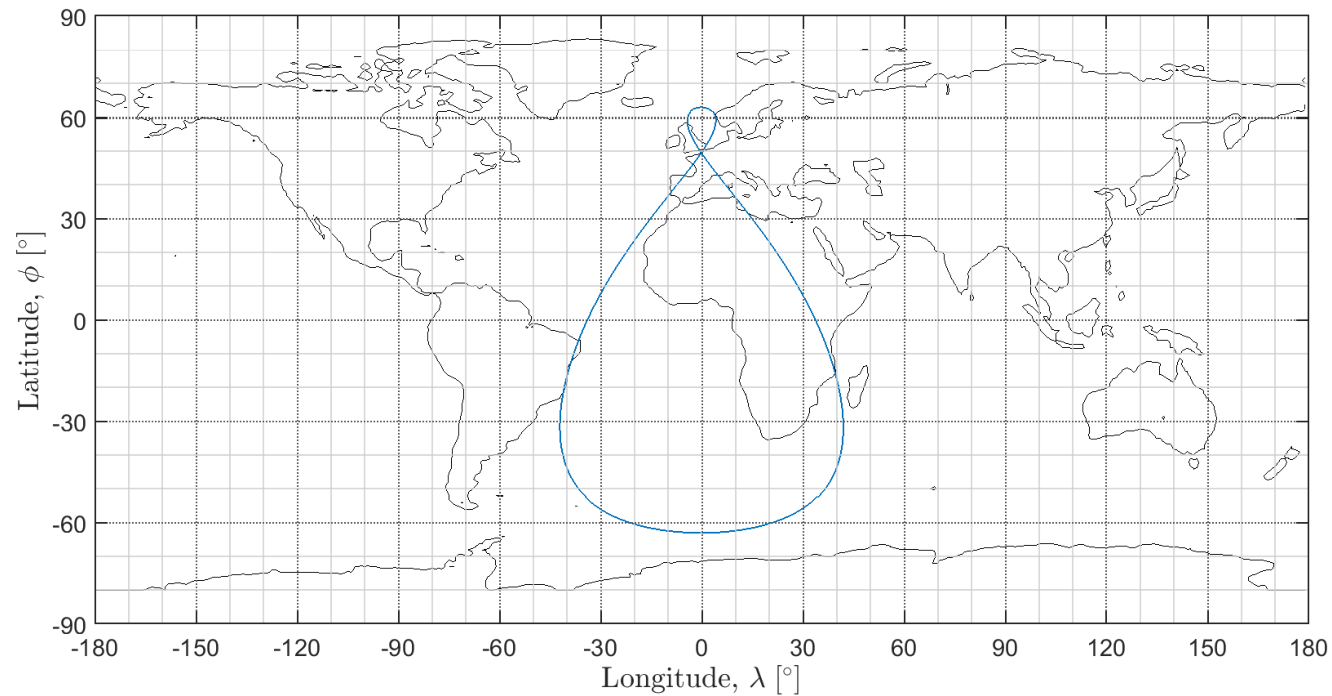
(f) Based on the graph above, give the inclination of the satellite's orbit (in degrees), its orbital period (in minutes), and its semi-major axis (in km). [4 т.]
(g) Show that the time a satellite spends in the northern hemisphere is given by
where is the eccentricity of the orbit and is its orbital period. [12 т.]
(h) Estimate numerically the eccentricity of its orbit. You can consider that the eccentricity is so small that and . [10 т.]
(i) From the ground track, we can observe that the satellite exhibits retrograde motion in both its northern and southern hemisphere trajectories. Find the true anomaly (in degrees) of the satellite at the beginning and end of its retrograde motion in the southern hemisphere. [18 т.]
(j) It is also noticeable that the ground track of a Tundra orbit has the shape of a figure-8, similar to an analemma, so that the satellite passes over the same point on Earth in a single orbit. Calculate the minimum eccentricity the orbit would need to have for this property to cease occurring. Use the same orbital inclination as the orbit in Figure 3. [6 т.]
Решение
The location of this point is specified by its geocentric latitude and longitude. The ground track is then essentially the figure traced by this point as the satellite moves around the Earth.
Part I: Sun-Synchronous Orbits (25 points)
(a) Solution: Since the orbit is Sun-Synchronous, this means that the satellite's line of nodes must drift 360° along one sidereal year. This ensures that the satellite will always pass over a given meridian at the same local mean solar time. Hence,
[1.0] [2.0]
(b) Solution: After one orbit, the difference in longitude perceived by the satellite on the ground track is associated with the combined effects of the rotation of the Earth and nodal precession. This is expressed by
[2.0]
From the Ground Track, and for five orbits. Therefore, knowing the value of , the angular velocity of the rotation of our planet,
[2.0]
Although is significantly smaller than , it is conceptually important to include the nodal precession rate in the formula.
The inclination of the orbit can be obtained directly from the Ground Track. Taking any of the two points of the orbit with the largest (absolute) value of latitude, one finds
[2.0]
Since , is the supplementary angle of the inclination:
[2.0]
(c) Solution: Having calculated the period associated with the orbit, the semi-major axis is directly obtained from
[2.0]
(d) Solution: Since the orbit is sun-synchronous, the satellite completes an integer number of orbits during one solar day. Hence,
[1.0]
(e) Solution: The satellite takes more than 2 orbits and less than 3 orbits to go from Poland to Brazil. Using as reference the point ahead of Maceió that is exactly 3 orbits after Chorzów,
Using sine law in the following spherical triangle,
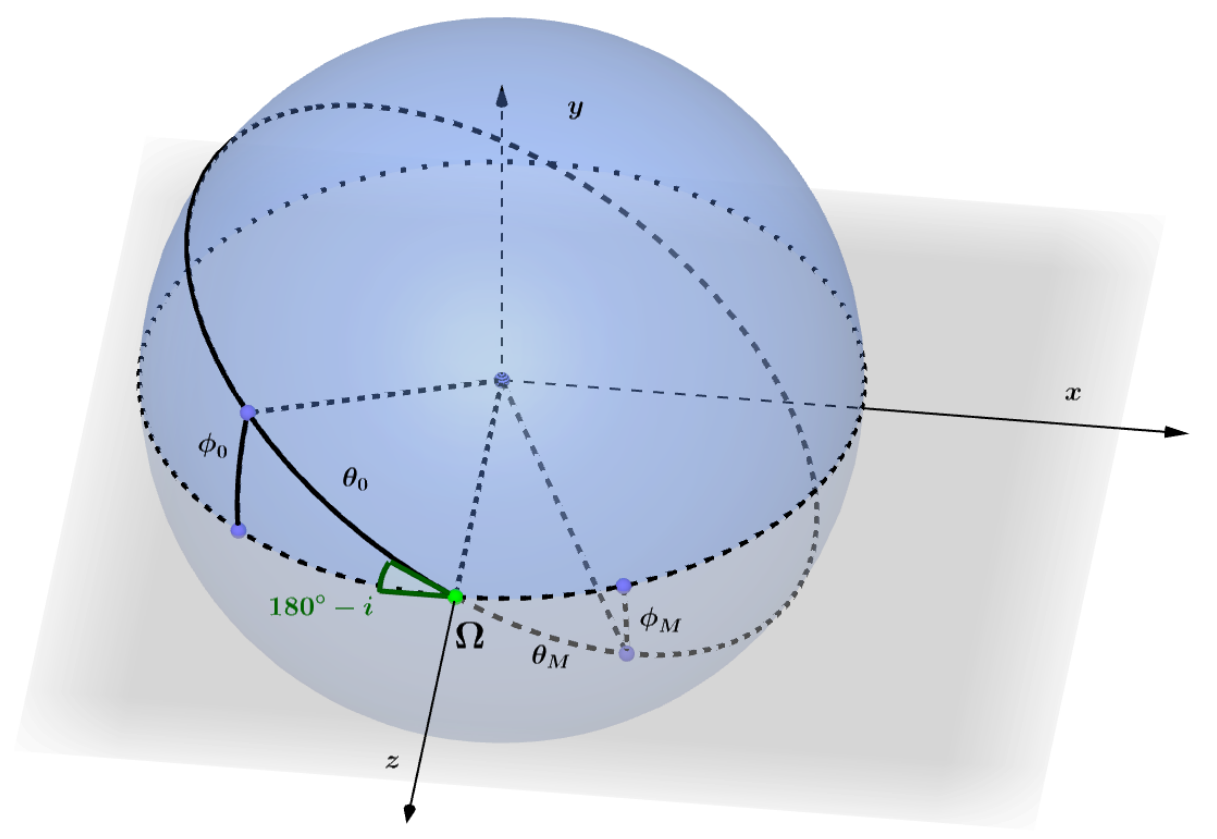
[2.0]
The angle the satellite traveled will depend on how many complete orbits it took and the angle from the final whole orbit to Maceió:
[3.0]
by the graph, , which results in knowing its orbit is circular, [1.0]
[1.0]
The local time at Chorzów in which the satellite passes by will be, considering ,
[3.0]
[1.0]
Part II: Tundra orbits (50 points)
(f) Solution: For the inclination, we need to take the maximum latitude reached by the satellite, which gives us . [1.0] For the period, we have to realize that in one orbit, the Earth's rotation does not cause a shift in the orbit, so it must be geosynchronous, that is . [1.0] For the semi-major axis, we apply Kepler's Third Law:
[2.0]
(g) Solution: We will first find the expression for the area divided by the semi-latus rectum as a function of eccentricity so then we can apply the Kepler's Second Law to find the required time. To do this, we will use the projection of the area of a circle when it is inclined by an angle , as shown in the figure below:
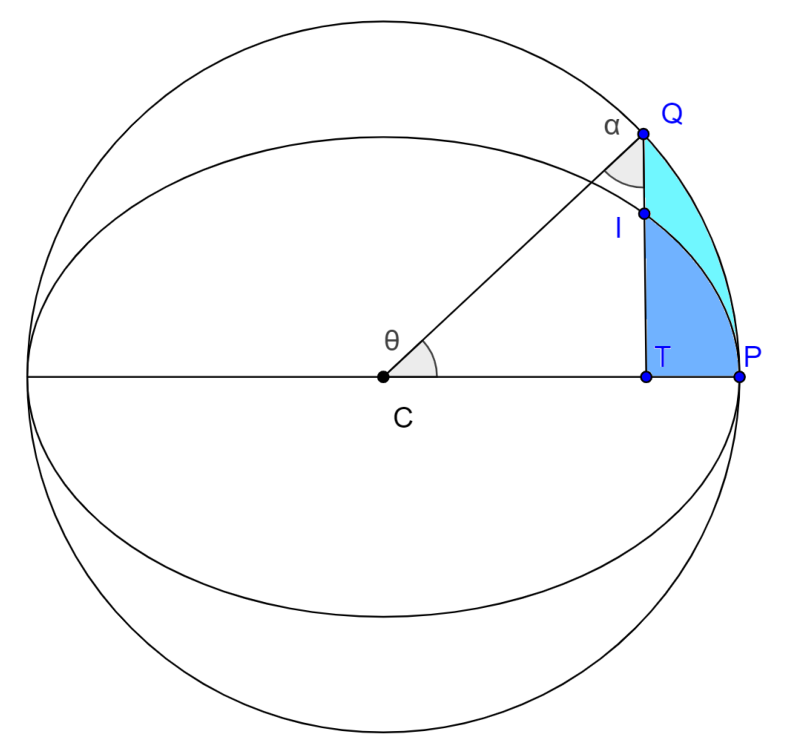
Thus, we will first calculate the hatched area of the circle figure
[4.0]
We can also use that and . Therefore:
Now, we project this area,
[3.0]
Thus, the area covered by the satellite's position vector from one semi-latus rectum to the other will be given by twice the area found above, as we can see from the image, so that the area on the perigee side is given by
For the apogee side, it is enough to know that , where is the area of the whole ellipse. Therefore, we have:
[2.0]
Using Kepler's Second Law, we can write:
[2.0]
Using that and , we have:
(h) (10 points) Estimate numerically the eccentricity of its orbit. You can consider that the eccentricity is so small that and .
Solution: Between the two consecutive passages through the semi-latus rectum, we can use the following equation:
[2.0]
Where is the variation in longitude of the satellite between its passages through the semi-latus rectum, as shown in the image below.
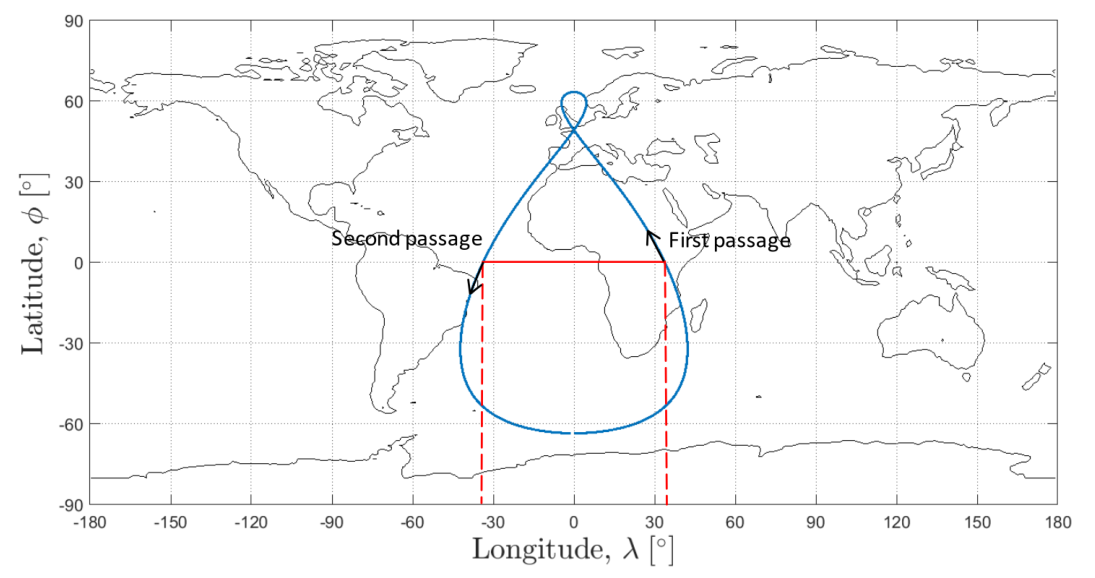
Therefore, we can write using the expression of the last item
As (the orbit is geosynchronous), we will get:
[2.0]
Considering that from the graph (it is important to note that this value should be negative by the figure), [2.0] we find from the above formula, by iteration, . If we use the approximations and given in the statement, we find:
[3.0]
which gives us an approximate answer [1.0]
(i) (18 points) From the ground track, we can observe that the satellite exhibits a retrograde motion in both its northern and southern hemisphere trajectories. Find the true anomaly (in degrees) of the satellite at the beginning and end of its retrograde motion in the southern hemisphere.
Solution: At the start and end points of retrograde motion, we have , where is the right ascension angular velocity of the satellite. To find this velocity, we use the following spherical triangle: [2.0]
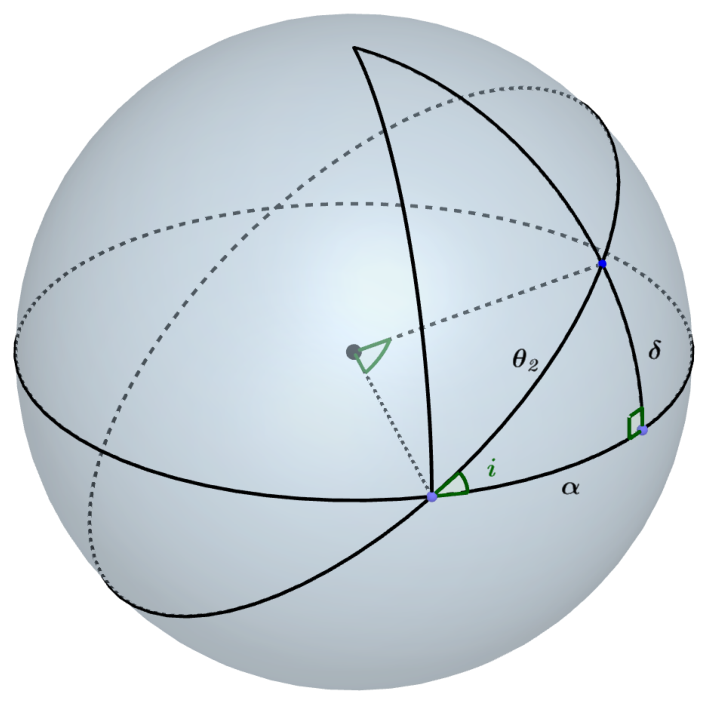
where , and it is known that:
[1.0]
[1.0]
We substitute from the first expression into the second expression, obtaining:
We then derive the above expression with respect to time - it is possible to skip the derivative step by just decomposing the satellite's angular velocity vector.
[2.0]
Using the Cosine Law expression to replace , we finally have:
[2.0]
We can then calculate the value of as a function of the distance of the satellite from the center of the Earth, using the conservation of angular momentum:
[2.0]
We still have the polar expression for the distance as a function of the polar radius, given by:
[2.0]
Substituting everything into the expression that gives the condition for the start or end of retrograde motion, we find:
[2.0]
From the graph, we find the latitude - or declination - of the start or end of retrograde motion, given by . Thus, substituting all the variables into the above equation and solving for , we find: and as solutions. [2.0] [2.0]
(j) (7 points) It is also noticeable that the ground track of a Tundra orbit has the shape of a figure-8, similar to an analemma, so that the satellite passes over the same point on Earth in a single orbit. Calculate the minimum eccentricity the orbit would need to have for this property to cease occurring. Use the same orbital inclination from the orbit in Figure 3.
Solution: For the figure-8 shape not to form, we need the inversion of motion in the northern hemisphere to occur exactly at the apogee position . Therefore, we will use exactly the same expression as the previous item, but with and eccentricity as the unknown variable . For the value of , as the satellite is at the position of maximum declination, . We have:
[2.0] [1.0] [1.0]
Solving the above equation, we obtain: [3.0]
Separate Marking Scheme — T11
(a)
- 1 point: identifying, by any means, that the nodal precession rate is per year. This could be in a written form, image or directly with a formula.
- 2 points: correct final result. -1 point if the student writes a negative value.
(b)
- 2 points: obtaining the expression for the difference in longitude as a function of the orbital period.
- 2 points: correct final result for the period. Note that the values of λ selected by the students may vary.
- 2 point: correctly identifying in the graph the value of maximum latitude.
- 2 points: taking the supplementary angle of the maximum latitude as the inclination.
(c)
- 2 points: correctly calculating the semi-major axis.
(d)
- 1 point: correctly calculating the number of orbits.
(e)
- 2 points: correctly finding the relation of and .
- 3 points: Correctly equating that the total angle travelled by the satellite depends on the number of whole orbits n, and . It is also possible to equate using and different , using , i.e., doing the inverse procedure of the solution.
- 1 point: Correctly considering . (it is also possible to consider if the previous equation had the signal of the angles swapped.
- 1 point: Correctly equating with .
- 3 points: Correctly equating the time in function of and . -1.5 points if the student didn’t correct local time for longitude.
- 1 point: correct final answer.
(f)
- 1 point: Correctly estimating i through the graph
- 1 point: Correct value for T using argument of geosynchronous orbit. If the student directly writes the (well-known) values for a period and semi-major axis for the geosynchronous orbit without any calculation, all credits should still be given.
- 2 points: Correct value for a using Kepler’s 3rd law.
(g)
- 2 points: understanding that the elapsed time to be calculated is the movement between the semi-latus rectum.
- 2 points: Correctly equating Areas of the equivalent circle for Kepler 2nd law. Alternative: obtaining the eccentric anomaly at the semi-latus rectum as a function of the eccentricity.
- 4 points: Correctly multiplying area of circle by (b/a) and applying correct simplifications. Alternative: obtaining the mean anomaly as a function of the eccentricity.
- 2 points: Correctly arriving at the formula for the area of apogee. Alternative: obtaining an expression for the elapsed time t as a function of the eccentricity.
- 2 points: Correctly applying Kepler 2nd law. Alternative: obtaining the ratio .
(h)
- 2 points: Correctly relating the and using the semi-latus rectum
- 2 points: Correctly simplifying previous equation to get it in function of and e.
- 2 points: Correct value for measured from the graph. -1 point if has the same absolute value but positive.
- 3 points: Applying correct approximations or solving Equation using iteration.
- 1 points: Correct numerical value for e. It is only necessary one significant figure.
(i)
- 2 points: correctly identifying the condition for a retrograde motion to occur - .
- 2 points: obtaining formulas to relate and to i and the true anomaly.
- 2 points: calculating the expression for the projected velocity of the satellite. If the student decomposes the velocity vector directly and the final result is correct, the 2 points of the previous step should be awarded.
- 2 points: correct expression for If the student uses equivalent expressions that lead to the same results, the 2 points should still be given.
- 2 points: using conservation of angular momentum to obtain
- 2 points: substituting the expression for the polar radius.
- 2 points: correct final equation.
- 2 points: correctly reading the value of from the graph.
- 2 points: correctly calculating the values of .
(j)
- 2 points: Correctly reasoning that, in the limiting case, the point of inversion will occur in the aphelion.
- 1 point: when satellite is in its northernmost position.
- 2 points: Correctly substitute values in the previous item formula
- 1 point: correctly calculating the numerical value using an iteration method.
General Rules for Marking
These are general guidelines for the grading of all problems. All of the rules listed below refer to deductions on specific items in the marking scheme.
| Case | Marking |
|---|---|
| Using absurd physical or mathematical concepts (despite correct answers) | No points given |
| Giving correct answer but the method is unclear | Deduct 50% of the marks for final answer |
| Minor mistakes in the calculations, e.g., wrong signs, numerical constants | Deduct 20% of the marks for that part, unless there is a physical incoherence |
| Too many or too few significant figures ( where is the expected number of significant figures) | Deduct 50% of the marks for final answer |
| Correct answer but missing or wrong units | No points given for final answer |
| For numerical values, the answer is not within a 5% precision range | No points given for final answer, unless differently stated in the problem or marking scheme |
| Error resulting from an earlier part error, for which the student already lost marks, if the answer is physically reasonable | No double penalization, full points given |
| Error resulting from an earlier part error, if the answer is physically unreasonable | No points given |
First example: If due to an error in an earlier item, the student calculates the speed of a satellite as instead of , they will only lose marks for the earlier item. However, if, for the same reason, a student calculates the velocity of the satellite as , they should realize this is wrong (higher than the speed of light) and thus should lose some marks for this item as well.
Second example: Consider a question that requires a student to determine the temperature of a planet that orbits a star with luminosity at a distance . To answer correctly, the student must calculate the star's radiant flux, the power incident on the planet, the power radiated by the planet, and then, using the condition of thermal equilibrium, the planet's temperature. If the student only calculates the radiant flux and arrives at the correct final answer without clearly explaining the other steps, they will receive marks only for the flux calculation, but not for the other steps, neither for the final answer.
Оригинал в Архива: theory_examination_304b6eb66a8940d79fccc404cf1ba9ab_preview.pdf · официални решения: theory solutions.pdf · допълнителни данни: theory marking scheme.pdf