IOAA 2024, Теория — Задача 6. T6. Cluster Photography
IOAA 2024 — Theory Examination, English (Official) · 20 т.
Внимание: Бележка към темата
The printed instructions refer to blank Detailed Worksheets and a summary Answer Sheet. Those forms are absent from the available 2024 archive packet. The complete question booklet, solution booklet and separate marking scheme are included. Printed source inconsistencies are identified in the relevant tasks and retained without silently changing the source.
T2: The solution first gives and later substitutes , while retaining its boxed . The main double-sum potential expression also omits the factor used for unique pairs in the appendix. These printed expressions are retained; the marking scheme allows valid alternative estimates.
T6: The question names Palomar 4; the solution's repeated question names Palomar 6. The solution gives mag but substitutes in the following surface-brightness line. The native question and printed calculation are retained.
T7: The printed expansion on solution page 13 has where the preceding cosine-law equation would give . It is retained as printed; the subsequent sunrise calculation sets .
T10: Solution page 25 prints the unit of as m rather than . In (j), the final vector prints 77.59 m/s after previously using 77.76 m/s; the magnitude uses 77.76 m/s. These printed values are retained.
T11: The question gives Maceió's longitude as , while solution (e) uses . The solution's printed margin marks total 11 points in (g), versus 12 points in the question and separate marking scheme; its (j) heading and marks total 7 points, versus 6 in the question and separate marking scheme. All three sources are retained with their original point values.
Common solar-system table: The native solar-system table labels the semi-major-axis column AU, while explicitly giving the Moon's entry in km; its printed unit is retained.
Указания
- The theoretical competition will be 5 hours in duration and is marked out of a total of 300 points.
- There are Detailed Worksheets for carrying out detailed work / rough work. On each of the Detailed Worksheets, please fill in Student Code, Question No., Page no. and total number of pages.
- Start each problem on a new page of the Detailed Worksheets. Please write only on the printed side of the sheet. Do not use the reverse side. If you have written something on any sheet which you do not want to be marked, cross it out.
- There is a summary Answer Sheet with your student ID code for your final answers.
- Please remember that the graders may not understand your language. As far as possible, write your solutions only using mathematical expressions and numbers. If it is necessary to explain something in words, please use short phrases (if possible in English).
- You are not allowed to leave your exam desk without permission. If you need any assistance (malfunctioning calculator, need to visit a restroom, need more Detailed Worksheets, etc.), please put up your hand to signal the invigilator.
- The beginning and end of the competition will be indicated by a long sound signal. Additionally, there will be a short sound signal fifteen minutes before the end of the competition (before the final long sound signal).
- Wait at your table until your envelope is collected. Once all envelopes are collected, your student guide will escort you out of the competition room.
- A list of constants for this competition is given on the next page.
Fundamental Constants
| Constant | Value |
|---|---|
| Speed of light in a vacuum | |
| Planck constant | |
| Boltzmann constant | |
| Stefan-Boltzmann constant | |
| Elementary charge | |
| Universal Gravitational constant | |
| Universal gas constant | |
| Avogadro constant | |
| Wien's displacement law | |
| Mass of the electron | |
| Mass of the proton | |
| Mass of the neutron |
Astronomical Data and Solar Magnitudes
| Astronomical Data | Value |
|---|---|
| 1 parsec | |
| 1 Astronomical Unit (AU) | |
| 1 Jansky | |
| Hubble constant | |
| Solar luminosity | |
| Angular diameter of the Sun (from Earth) | |
| Effective temperature of the Sun | |
| Obliquity of the ecliptic | |
| Inclination of the Moon's orbit (to ecliptic) | |
| Magnitude of full Moon | |
| Coordinates of North Ecliptic Pole | |
| Coordinates of North Galactic Pole | |
| Sidereal day | |
| Tropical year | solar days |
| Sidereal year | solar days |
Solar Magnitudes
| Apparent Visual | Absolute Visual | Apparent Bolometric | Absolute Bolometric |
|---|---|---|---|
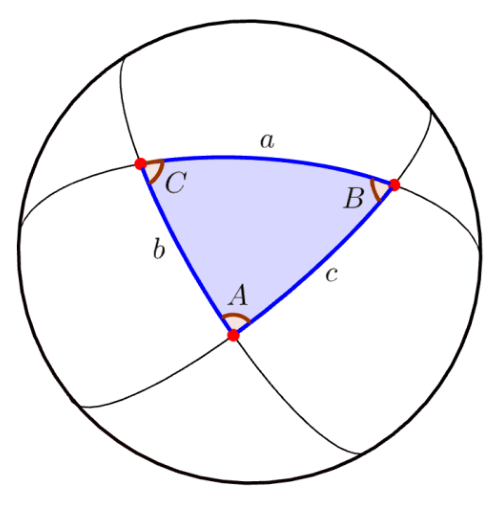
Solar System, Spherical Trigonometry and Calculus
Solar System Data
| Object | Radius (km) | Mass (kg) | Semi-major axis (AU) | Orbital eccentricity | Albedo |
|---|---|---|---|---|---|
| Sun | 695500 | n/a | n/a | n/a | |
| Mercury | 2440 | 0.387 | 0.206 | 0.088 | |
| Venus | 6052 | 0.723 | 0.007 | 0.76 | |
| Earth | 6378 | 1.000 | 0.016710 | 0.31 | |
| Moon | 1737 | 0.054900 | 0.11 | ||
| Mars | 3390 | 1.524 | 0.093 | 0.25 | |
| Jupiter | 69911 | 5.203 | 0.048 | 0.51 | |
| Saturn | 58232 | 9.537 | 0.054 | 0.34 | |
| Uranus | 25362 | 19.189 | 0.047 | 0.30 | |
| Neptune | 24622 | 30.070 | 0.009 | 0.29 |
Spherical Trigonometry
Cosine formula:
Sine formula:
Four parts formula:
Calculus
Chain Rule:
Product Rule:
Условие
An astronomer takes pictures, in the -band, of a faint celestial target, from a place with no light pollution. The selected target is the globular cluster Palomar 4, which has an angular diameter of and a uniform surface brightness in the -band of . The observation equipment consists of one reflector telescope, with diameter and f-ratio , and a prime focus CCD with quantum efficiency and square pixels with size .
Given data:
- -band central wavelength:
- -band bandwidth:
- Photon flux for a 0-magnitude object in the -band: 10000 counts/nm/cm²/s
(a) Calculate the plate scale (the angle of sky projected per unit length of the sensor) of the observation equipment in arcmin/mm. [3 т.]
(b) Estimate the number of pixels, , covered by the cluster image on the CCD. [4 т.]
(c) With an exposure time of seconds, the astronomer obtains a signal-to-noise ratio of . Compute the brightness of the sky at the observation site, knowing that the CCD has a readout noise (standard deviation) of 5 counts per pixel and dark noise of 6 counts per pixel per minute. Give your answer in mag/arcsec. You may find useful: and . [13 т.]
Решение
Solution:
The plate scale is simply the angular size of the image per unit length as projected at the focal plane. Hence, for small angles,
[1.0]
where is the angular size of the image, is the unit length, and is the focal length of the telescope, which is given by (D × F-ratio). [0.5]
[1.5]
(b) Given the plate scale, the diameter of the image on the focal plane is
[1.0]
This implies that the area covered by the image is
which can be divided by the area of a single pixel to estimate the pixel coverage
[2.0]
Since there are other methods to estimate such quantity, the accepted range is
[1.0]
(c) The signal-to-noise ratio is given by the expression
[3.0]
where,
The noise values associated with the CCD operation can be easily calculated:
[2.0]
Now, the apparent visual magnitude of the globular cluster must be calculated,
with being the solid angle subtended by the globular cluster,
[1.0]
Hence,
[1.0]
and the associated flux of photons can now be evaluated using the 0-magnitude as a reference:
[1.0]
With the calculated parameters, the total source count is:
[1.0]
By referring to the signal-to-noise ratio expression and substituting the values,
[1.0]
The inverse procedure to determine the Total Source Count is taken:
[1.0]
which implies
[1.0]
and finally, since
[1.0]
Considering the accepted range of pixels from the previous item, the accepted answers for the brightness of the sky fall within the interval
Separate Marking Scheme — T6
(a)
- 1 point: correctly defining the concept of plate scale, even if directly with the formula.
- 0.5 point: correctly calculating the focal length of the telescope by using the focal ratio. If the expression is directly used in the formula for the plate scale, points should still be awarded.
- 1.5 points: correct final answer.
(b)
- 1 point: calculating the diameter of the image in the focal plane using the plate scale. If this step is implicit within the estimation of the number of pixels covered by the image, points should still be awarded.
- 2 points: estimating the number of pixels covered by the image using a consistent method. The two suggested approaches are: estimate the area of the image and divide by the area of a single pixel or estimate the number of pixels corresponding to a diameter. However, if any other plausible method is developed, full credits should be awarded.
- 1 point: correct final answer within the specified range. If the student uses only 2 significant figures, include the acceptable values of 15000 and 16000 pixels.
(c)
- 3 points: correctly defining the signal-to-noise ratio formula. If the student neglects the term associated with Dark Noise with valid arguments, full credits should be awarded.
- 2 points: calculating the photon counts associated with CCD noise (1 point for each term). If the term related to Dark Noise was neglected in the previous step - with plausible argumentation, the 1 point from calculating should still be given.
- 1 point: calculating the solid angle subtended by the globular cluster.
- 1 point: calculating the apparent magnitude of the cluster in the V-band.
- 1 point: calculating the photon flux of the globular cluster. If the correct expression for the photon flux is replaced directly in the calculation of the source count (next step), full credits should still be awarded.
- 1 point: calculating the photon counts associated with the globular cluster. 0.5 point should be given for the correct expression of the source count even if the calculated value for is incorrect.
- 1 point: using the signal-to-noise ratio for estimating the sky count.
- 1 point: applying the inverse procedure to estimate the flux of photons from the sky.
- 1 point: applying the inverse procedure to estimate the magnitude of the sky.
- 1 point: applying the inverse procedure to estimate the surface brightness of the sky. If the final value does not fall within the given range, deduct 0.5 point.
General Rules for Marking
These are general guidelines for the grading of all problems. All of the rules listed below refer to deductions on specific items in the marking scheme.
| Case | Marking |
|---|---|
| Using absurd physical or mathematical concepts (despite correct answers) | No points given |
| Giving correct answer but the method is unclear | Deduct 50% of the marks for final answer |
| Minor mistakes in the calculations, e.g., wrong signs, numerical constants | Deduct 20% of the marks for that part, unless there is a physical incoherence |
| Too many or too few significant figures ( where is the expected number of significant figures) | Deduct 50% of the marks for final answer |
| Correct answer but missing or wrong units | No points given for final answer |
| For numerical values, the answer is not within a 5% precision range | No points given for final answer, unless differently stated in the problem or marking scheme |
| Error resulting from an earlier part error, for which the student already lost marks, if the answer is physically reasonable | No double penalization, full points given |
| Error resulting from an earlier part error, if the answer is physically unreasonable | No points given |
First example: If due to an error in an earlier item, the student calculates the speed of a satellite as instead of , they will only lose marks for the earlier item. However, if, for the same reason, a student calculates the velocity of the satellite as , they should realize this is wrong (higher than the speed of light) and thus should lose some marks for this item as well.
Second example: Consider a question that requires a student to determine the temperature of a planet that orbits a star with luminosity at a distance . To answer correctly, the student must calculate the star's radiant flux, the power incident on the planet, the power radiated by the planet, and then, using the condition of thermal equilibrium, the planet's temperature. If the student only calculates the radiant flux and arrives at the correct final answer without clearly explaining the other steps, they will receive marks only for the flux calculation, but not for the other steps, neither for the final answer.
Оригинал в Архива: theory_examination_304b6eb66a8940d79fccc404cf1ba9ab_preview.pdf · официални решения: theory solutions.pdf · допълнителни данни: theory marking scheme.pdf