IOAA 2025, Наблюдение · планетариум — OP02. Observer on a Ringed Planet
18th IOAA · Observation Exam: Planetarium · 25 т.
Внимание: Бележка към темата
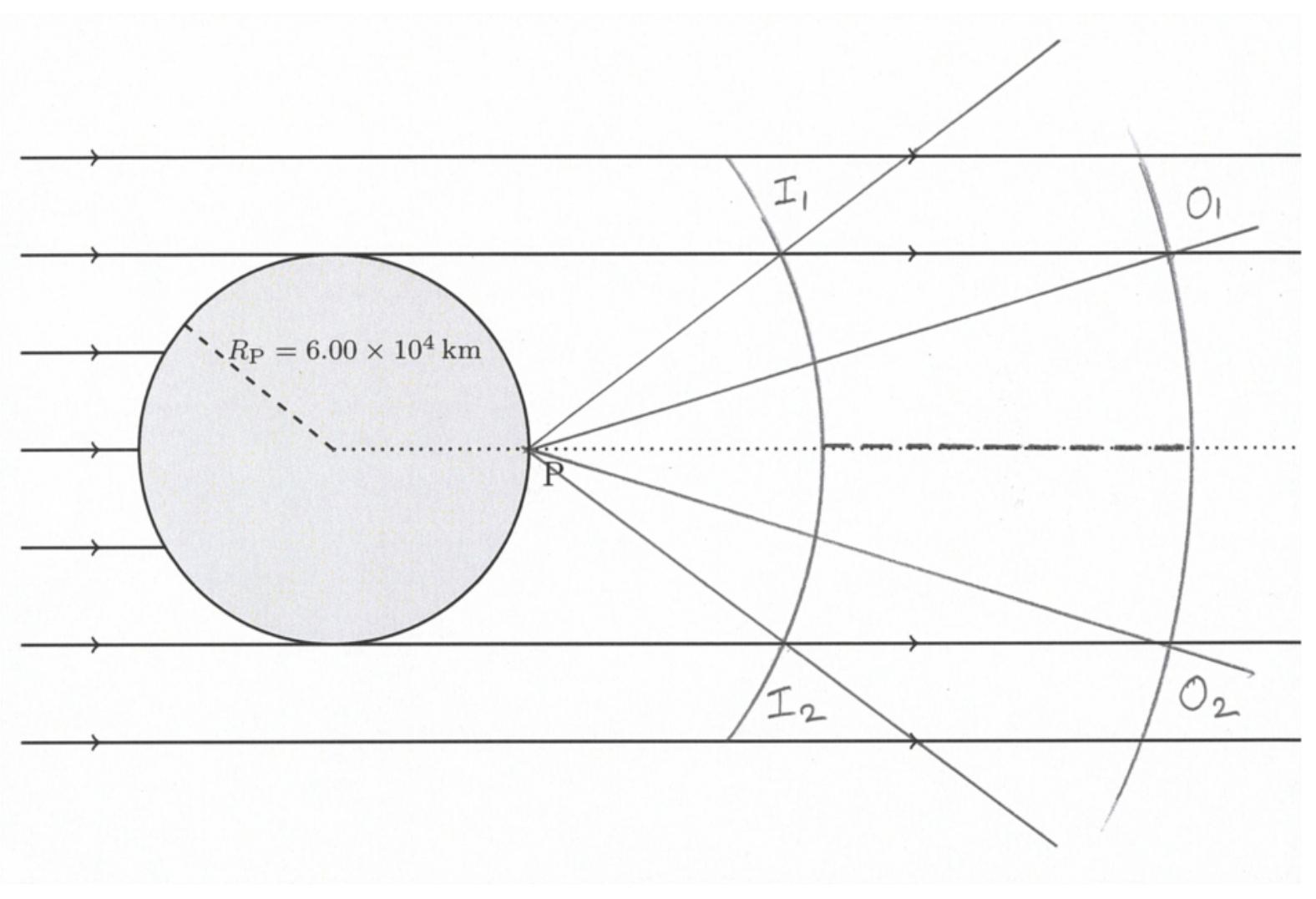
The original exam uses a timed Digistar dome projection; the accompanying script package is linked separately. The archive supplies the maps, OP02 sky image and full official key. The Summary Answersheet already contains solution arcs for OP02.2; these are presented with the solution, while the unmarked original question diagram is kept in the statement. Printed wording such as “Stereoscopic” in the key and the marking tolerance labels is retained.
Условие
For this question use sky map Map-OP02.
The sky projected on the planetarium dome is as seen by an observer on some hypothetical ringed planet. The observer is located very near to the equator of the planet.
Assume that the ring lies in the equatorial plane of the planet and the distance of the planet from its parent star is more than 15 au. Note that except for the 10 moons of this planet no other object from this planetary system (other planets, their satellites, asteroids and even the parent star) are visible on the projected sky.
At the start of the question the sky will make 3 full rotations at the rate of 1 rotation every minute. After that the sky will stop rotating at the observer’s midnight. This sky view will remain on the dome for next 7 minutes.
Solve the following questions once the sky stops rotating.
OP02.1 (8 т.)
Mark the positions of any 4 (only 4) out of the 10 visible moons of the planet with a sign and label them as “M” in the sky map.
OP02.2 (12 т.)
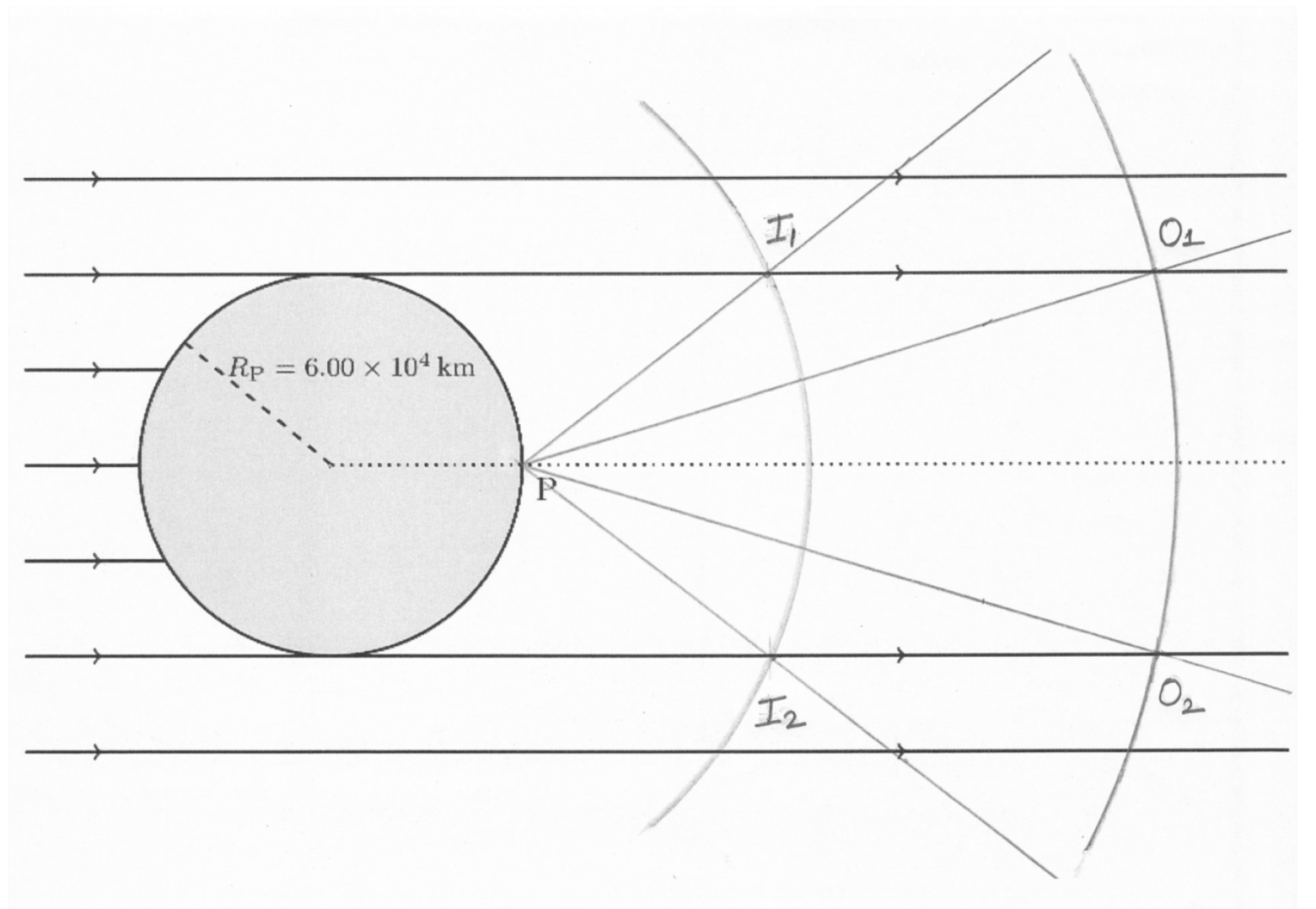
The figure shown below is as seen from the top of the north pole of the planet (grey circle) and the horizontal lines are parallel light rays from its parent star.
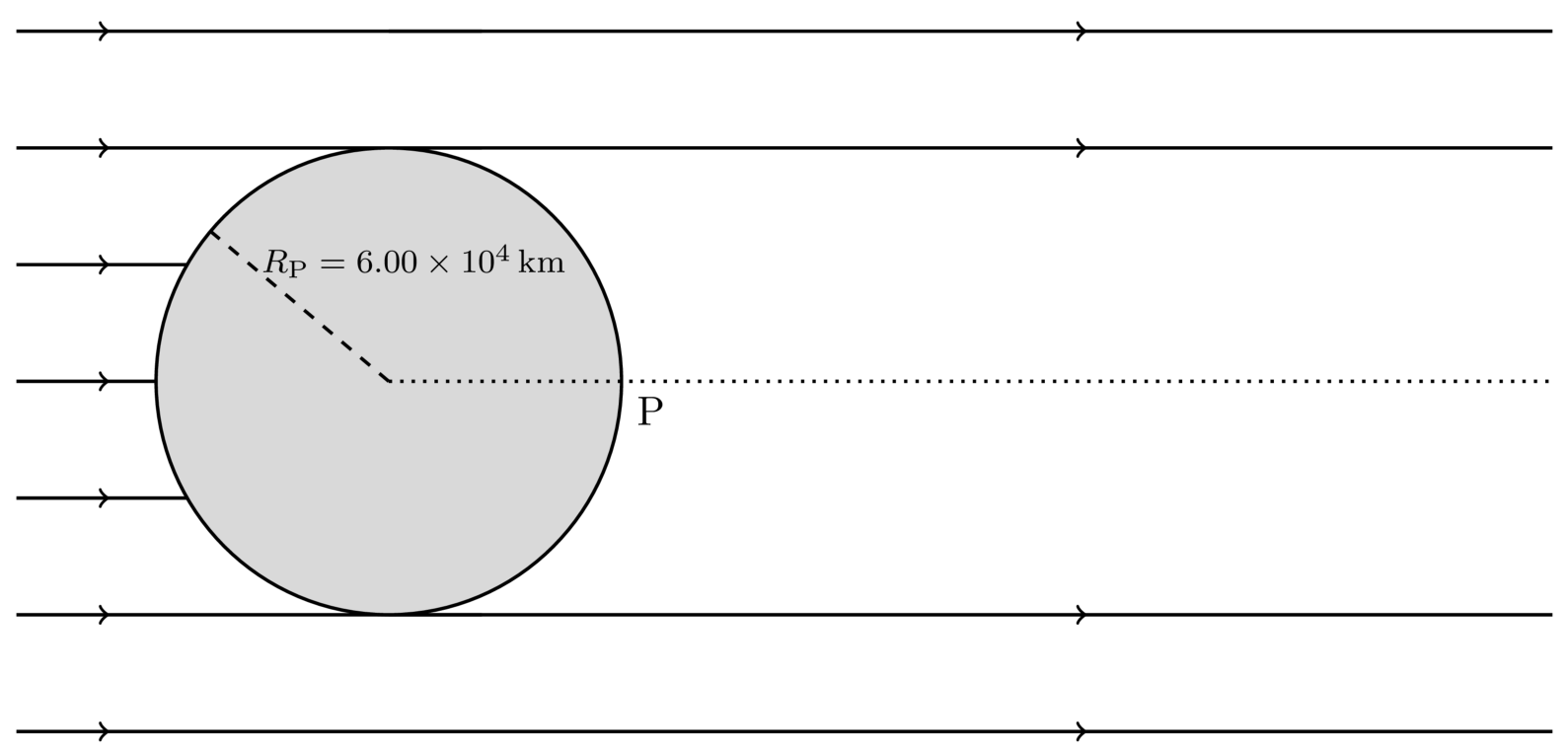
Using the view of the ring on the dome, draw the inner and outer boundaries of the ring on this diagram, reproduced in the Summary Answersheet. Your sketch must be to scale.
OP02.3 (5 т.)
Use the diagram above to determine the width of the ring, (in km), given that the radius of the planet is .
Map-OP02
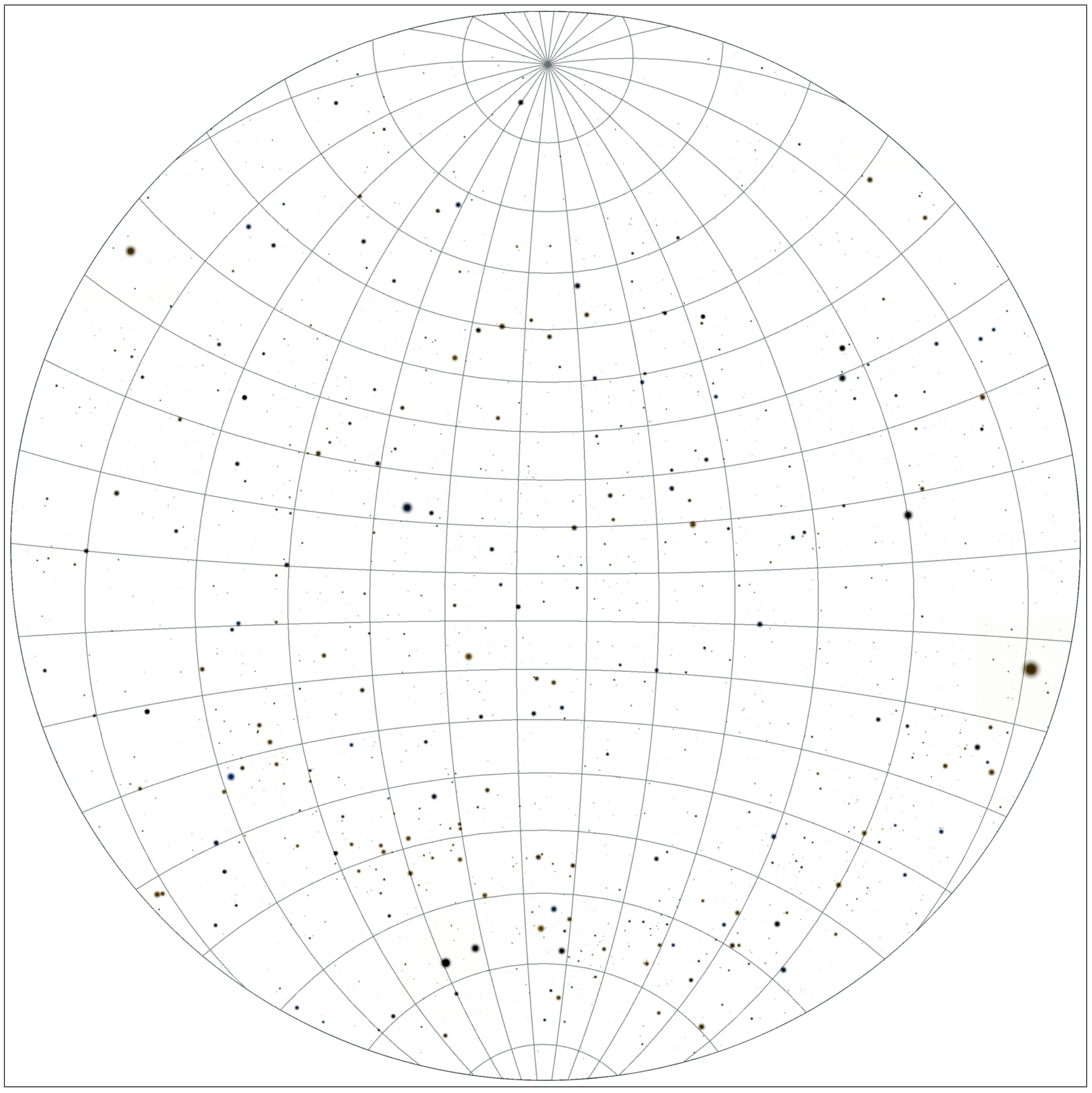
Archived planetarium view
Original accompanying image problem2_view.png.
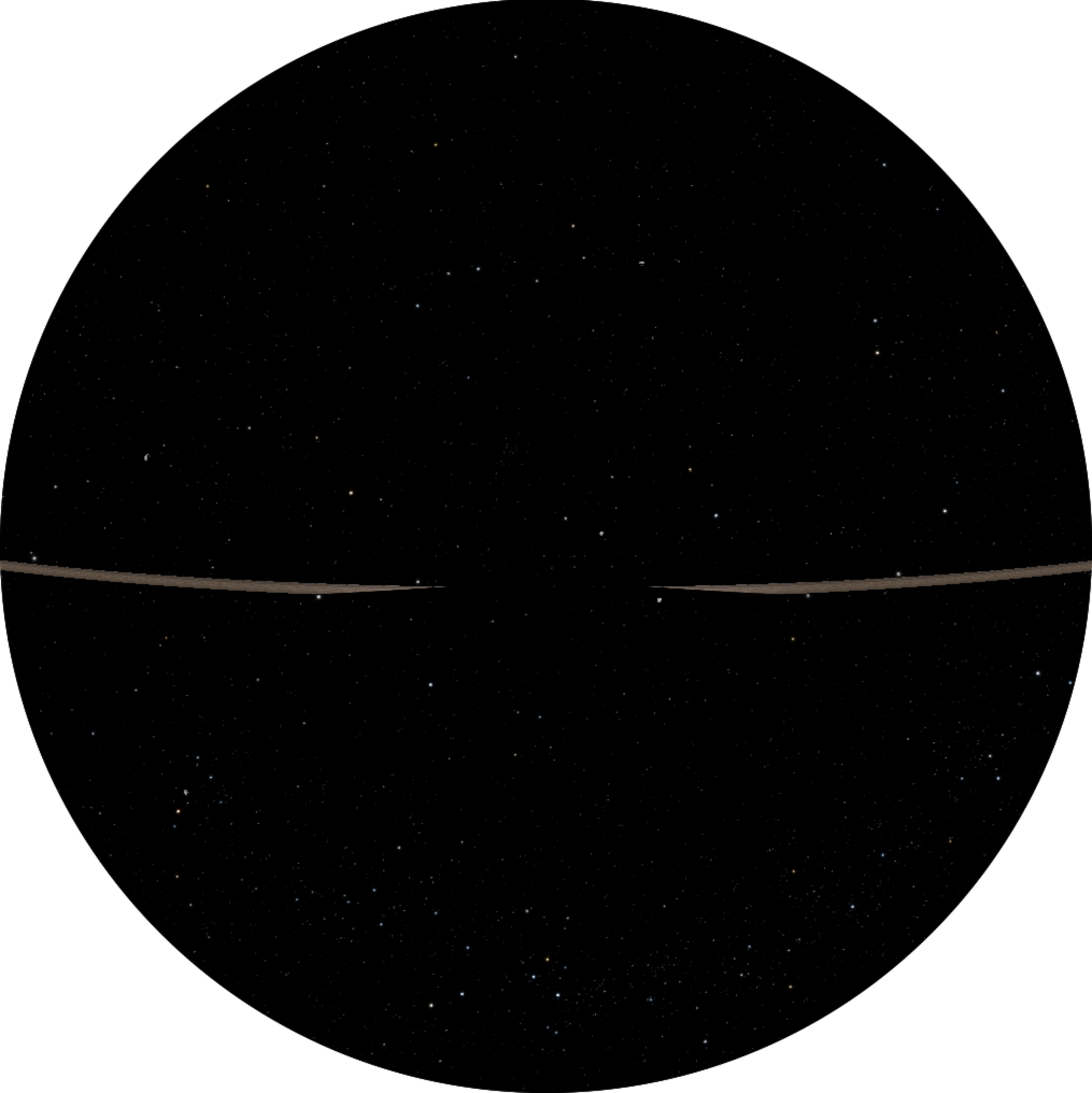
Summary Answersheet · OP02
Contestant Code: ______. Page No. SA-3 (FRONT).
| Question | Final answers | Marks |
|---|---|---|
| OP02.1 | Use Map-OP02. | 8.0 |
| OP02.2 | Diagram space (see the original planet diagram above). | 12.0 |
| OP02.3 | ______ km | 5.0 |
Total: ______.
End of Summary Answersheet. Page SA-4 (BACK): DO NOT WRITE.
The archived Summary Answersheet already contains the blue solution arcs and red tolerance boxes in OP02.2. These marks are preserved with the official solution below.
Original projection resources
The original Digistar planetarium script package is preserved in the archive. It requires a compatible planetarium environment; the static maps and archived OP02 image do not reproduce the timed sky projection.
Решение
OP02.1
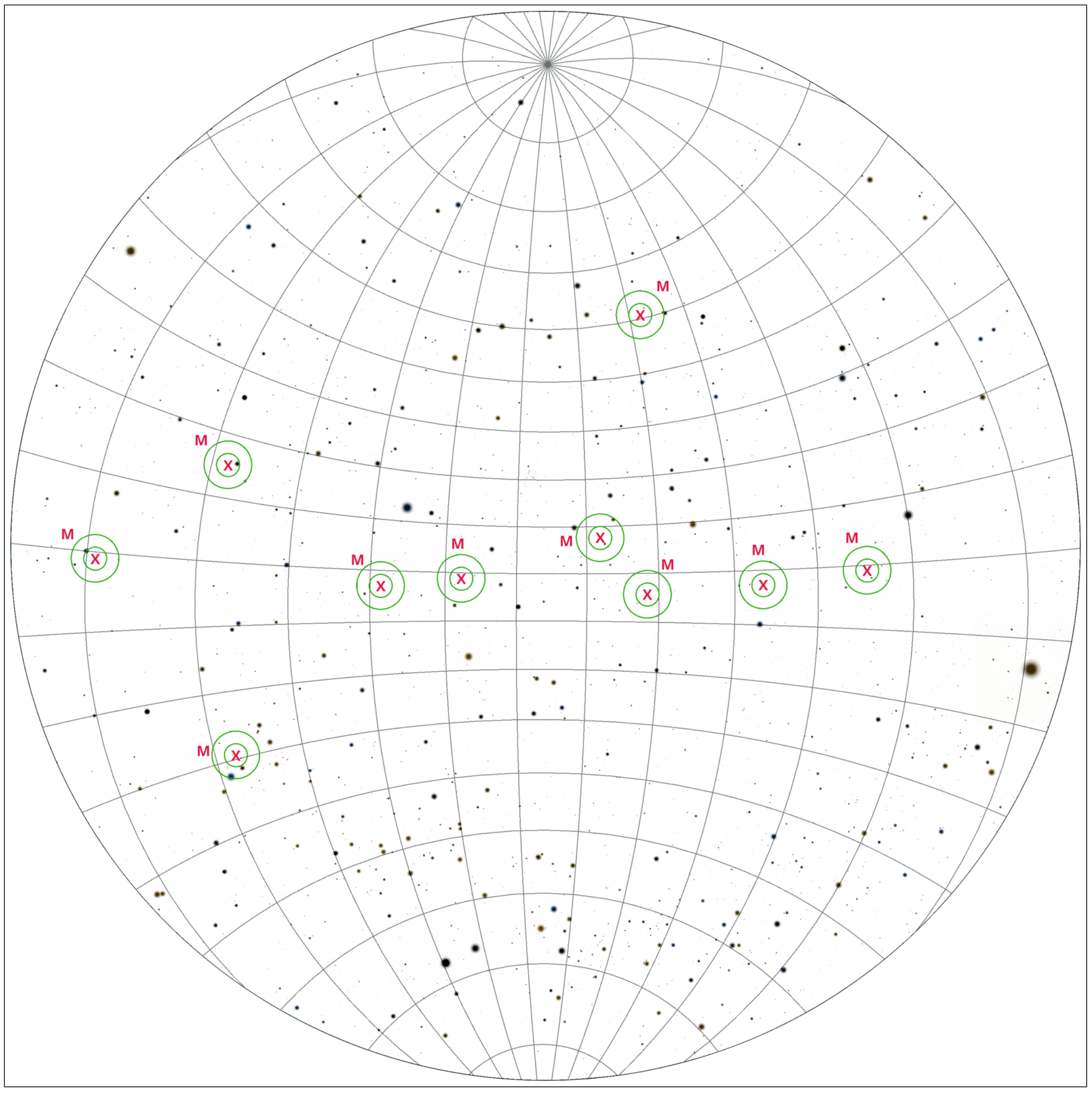
For each moon:
| Criterion | Marks |
|---|---|
| Centre of the within the inner circle | 2.0 |
| Centre of the between the inner and outer circles | 1.0 |
Use 4 correctly placed moons for marking. Every incorrectly placed moon beyond 4 gets , upto a minimum of 0.
OP02.2
The different angular extents of the shadow on the inner and outer edges of the ring are visible on the dome. These edges may be marked on the sky map (using convenient positions of the stars nearby).
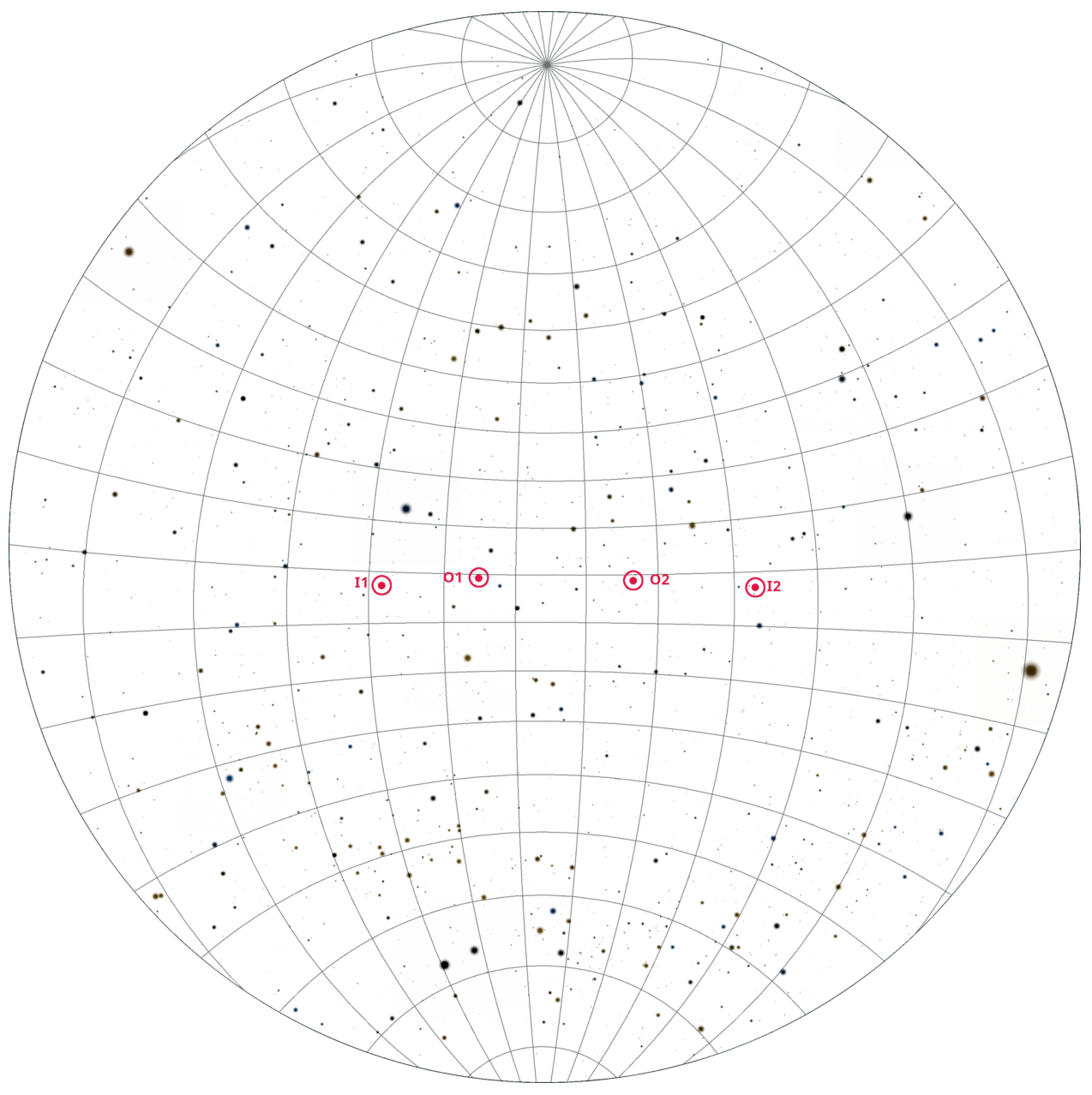
From the grid of the RA lines on the map the angular sizes are measured to be:
Inner edge:
Outer edge:
These angles need to be used in the schematic diagram to locate the rings.
Place a protractor with its baseline along the dotted line, and with its origin at P (the position of the observer).
Find the line of sight to the inner edge that subtends an angle of at P.
Extend this line to intersect the tangent ray.
This point marks one end of the shadow on the inner ring.
Similarly, find the other ends of the shadow on the inner edge.
Draw a circular arc (with centre at the centre of the planet) passing through these two points of intersection to show the inner edge of the ring.
Repeat for the outer edge.
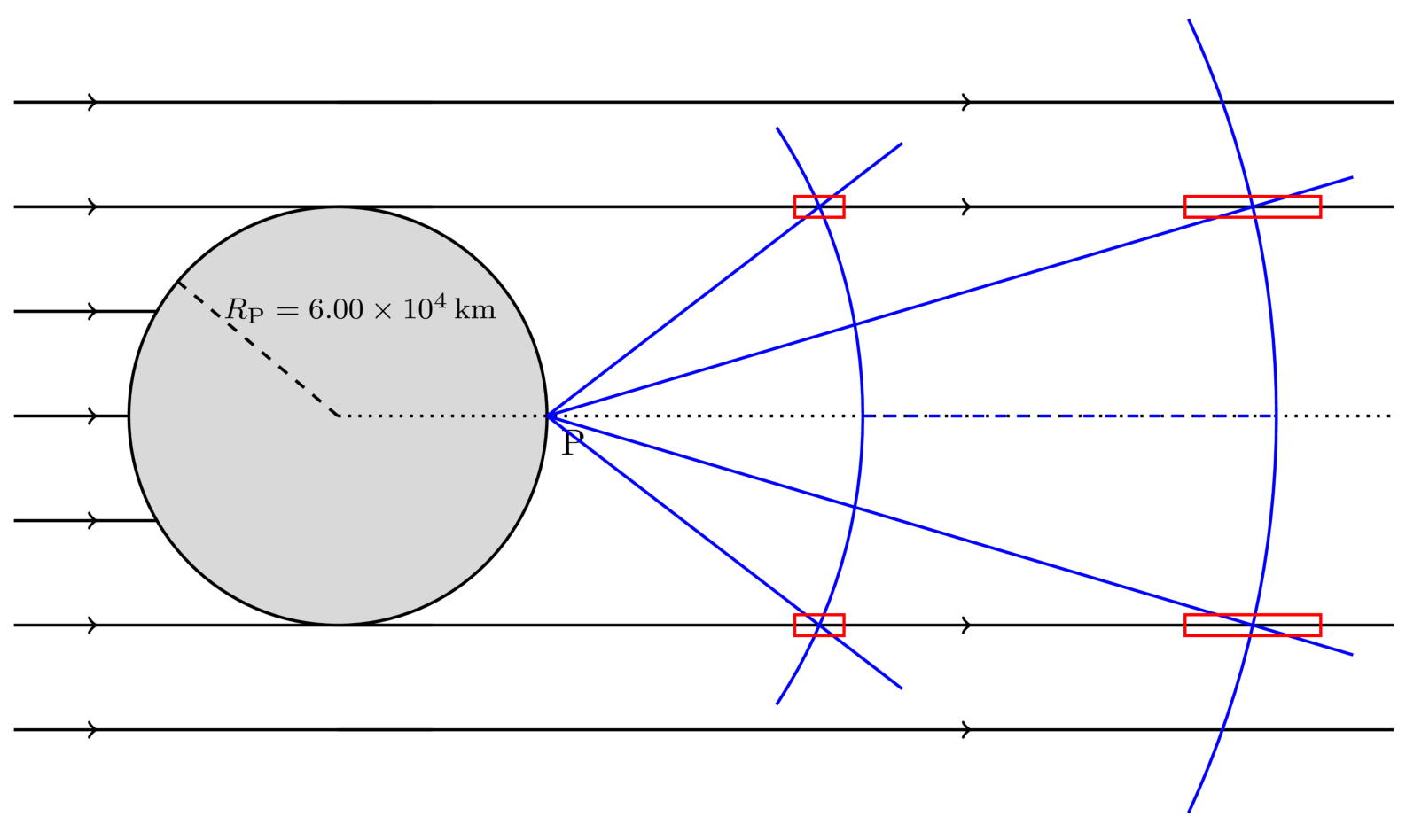
| Criterion | Marks |
|---|---|
| Marking of each of the four intersection points of the edges with light ray within the box | 2.5 |
| Circular arcs of edges drawn | 2.0 |
The archived Summary Answersheet, page SA-3, also contains these blue arcs and red tolerance boxes.
OP02.3
Once the edges of the ring are drawn, the width can be calculated by measuring the difference of their distances from the centre of the planet. Use a ruler to measure these distances. Also measure the radius of the planet on the diagram with the ruler to find the calibration.
We find,
Distance between the two rings along the dotted line: 3.8 cm
Radius of the planet on the diagram: 2 cm equivalent to (given)
Therefore,
Tolerance on values of radii of inner and outer edges:
| Half credit lower limit | Full credit range | Half credit upper limit |
|---|---|---|
| to |
Оригинал в Архива: Observation-Planetarium-Questions.pdf · официални решения: Observation-Planetarium-Solutions.pdf · допълнителни данни: Map-OP01.pdf · допълнителни данни: Map-OP02.pdf · допълнителни данни: Map-OP01-Solutions.pdf · допълнителни данни: Map-OP02-Solutions.pdf · допълнителни данни: OP-Instructions.pdf · допълнителни данни: Observation-Planetarium-Summary-Answersheet.pdf · допълнителни данни: problem2_view.png