IOAA 2025, Наблюдения, телескоп — Задача 2. Lensing Time Delay
Observation Exam: Telescope · 25 т.
Условие
Gravitational lensing can result in multiple images of a background source if the source, the lensing object and the observer are nearly aligned. These multiple images take different times to reach the observer, and if the background source is variable, each image shows the same feature in its variability after specific time delays. These time delay measurements are extremely useful to estimate the current expansion rate of the Universe, the Hubble constant.
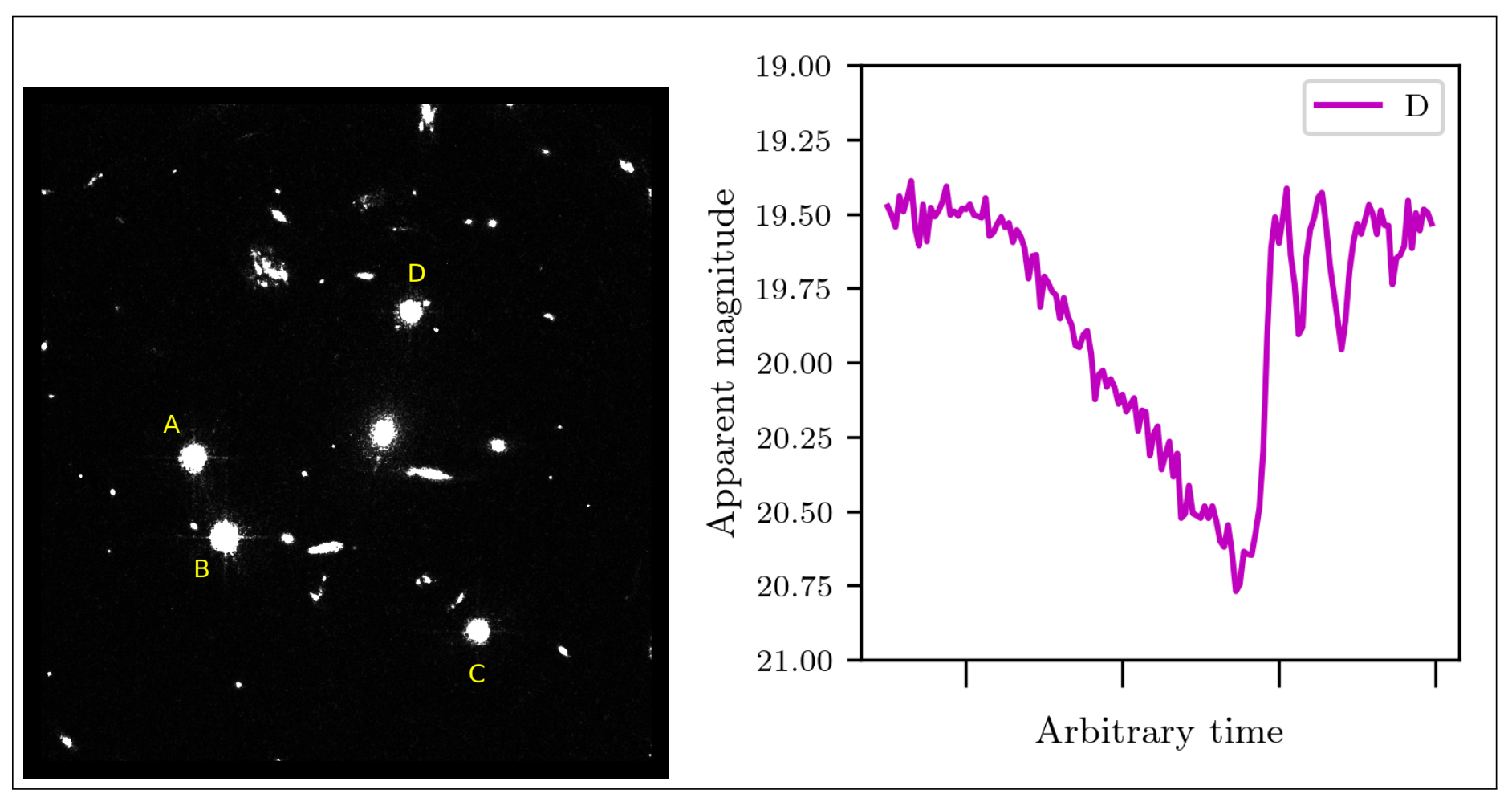
We will consider the gravitational lens system shown in the above figure. The left hand panel shows a galaxy cluster (lens) together with 4 images of a background quasar formed due to gravitational lensing. The 4 images, labelled A, B, C and D, have different fluxes as each image is magnified by a different amount. For any given image the magnification does not change with time. Light takes the largest time to travel for the image labelled D.
The light coming from this quasar is variable, and astronomers have monitored this system for more than a decade now. The right hand panel of the figure shows the light curve for the image D.
On the screen opposite to your station you will see a movie of the gravitational lens system. This movie is 28 s long and will loop 6 times with a breaks of 1 minute or 2 minutes between runs. Every second on the watch corresponds to 250.0 days in the actual lens system.
(OT02.1) Let the time delays of image D with respect to images A, B and C be given as , , and , respectively. Find these time delays, taking any necessary steps to reduce the uncertainty in your results. [25 т.]
Отговори
(OT02.1) tDA = 1694 d, tDB = 1651 d, tDC = 2485 d
The solution states: d, d and d.
Решение
The solution is , and .
| Pointing towards the screen | 1.0 |
| Choice of correct eyepiece | 1.0 |
For each of images A, B, C, D
| Timings of image | 2.0 |
| At least one reading | 1.0 |
| Extra reading (0.5 each, maximum 1.0) | 1.0 |
Calculation of time differences
| Calculation each of , and | 3.0 |
| Half credit lower limit | Full credit range | Half credit upper limit |
|---|---|---|
| Value d | Value d to Value d | Value d |
| Scaling from seconds to days for each interval | 1.0 |
| Correct order () | 3.0 |
Оригинал в Архива: Observation-Telescope-Questions.pdf · официални решения: Observation-Telescope-Solutions.pdf