IOAA 2025, Теория — Задача 4. Balmer Decrement
IOAA 2025 — Theory Examination · 15 т.
Theory Examination Instructions
You are given an envelope marked B. Please verify the Contestant Code printed on it. Inside you will find:
- This Instruction Sheet and/or This Instruction Sheet in your native language (if applicable)
- Data Sheet and/or Data Sheet in your native language (if applicable)
- A set of Working Sheets
- One envelope marked S (please verify the Contestant Code marked on it).
You are allowed to open the envelope S only when the whistle is blown to mark the start of the examination.
Inside the envelope S you will find the following:
- Question Paper and/or Question Paper in your native language (if applicable)
- A set of Summary Answersheets.
Total duration of this examination is 5 hours.
This examination consists of the following questions:
| Questions | Marks each | Subtotal |
|---|---|---|
| T01 and T02 | 10 | marks |
| T03 and T04 | 15 | marks |
| T05–T08 | 20 | marks |
| T09 and T10 | 35 | marks |
| T11 and T12 | 50 | marks |
| Total | 300 marks |
Writing your answers:
Summary Answersheet:
- For each question a separate Summary Answersheet has been provided. Write your contestant code on each page of the Summary Answersheet.
- Final answer(s) for each question / each part of a question must be written in the corresponding box in the Summary Answersheet.
Working Sheets:
- Your detailed work must be shown on the Working Sheet.
- Write your Contestant Code on both sides of each Working Sheet.
- Start a new question on a fresh Working Sheet. Write the question number in the box provided at the top.
- Both sides of the Working Sheet should be used. Write only inside the boxed area.
- For rough work that you do not want to be evaluated, clearly strike that part out.
- For each question write the page number in the box provided at the top of the Working Sheet, starting with 1 (each sheet has 2 pages). For example, if you use only 1 Working Sheet for T01, the question number and page number should be “T01, 1” and “T01, 2” on the FRONT and BACK of that Working Sheet, respectively. Next, if you use 2 Working Sheets for T02, the question number and page number should be “T02, 1” and “T02, 2” for the first Working Sheet, and “T02, 3” and “T02, 4” on the second Working Sheet.
- You may ask for extra Working Sheets, if required.
- Note that failure to mark the Working Sheets, as instructed above, may result in your answers not being evaluated.
At the end of the examination:
- Check that you have correctly written your Contestant Code and page numbers on all used sheets.
- Arrange your sheets in the following way: Summary Answersheet of each question (starting with T01) followed by Working Sheet(s) used for that question.
- Similarly stack the Summary Answersheet and Working Sheet(s) used for each question, in sequence.
- Place the bunch of all your used sheets arranged in the above manner inside the smaller envelope S. All Summary Answersheets must be placed inside the envelope S irrespective of whether you have used them or not.
- Only the contents of the smaller envelope S will be evaluated. Any sheet that is not placed inside this envelope will not be evaluated.
- Place the smaller envelope S inside the bigger envelope B.
- All other sheets, namely, Instruction Sheet(s), Question Paper(s), Data Sheet(s) and unused Working Sheet(s) should be placed directly inside the bigger envelope B.
- Tie the thread seal on the envelope B.
- Hand over the envelope B to the examiner. Make sure that no sheet is left on the table, except the green and the red card.
General Instructions:
- If you need a visit to the toilet during the examination, please raise your hand holding the green card kept on your table. You will be escorted by a volunteer.
- If you need any other help during the examination, please raise your hand holding the red card kept on your table.
- Use only black or blue pen for writing. For drawing, you may use a pencil.
- Some marks may be deducted if the final answer is given without detailed solution.
- Some marks may be deducted if the final answers have improper number of significant digits, no units or wrong units.
- The necessary values of fundamental and astronomical constants should be taken from the Data Sheet provided to you.
Original IOAA 2025 Data Sheet
Universal constants
| Quantity | Symbol | Value |
|---|---|---|
| Avogadro constant | ||
| Boltzmann constant | ||
| Charge of electron | ||
| Planck constant | ||
| Speed of light in vacuum | ||
| Universal gravitational constant | ||
| Universal gas constant | ||
| Stefan-Boltzmann constant | ||
| Wien’s displacement constant | ||
| Permittivity of free space | ||
| Permeability of free space | ||
| Mass of electron | ||
| Mass of proton | ||
| Mass of neutron | ||
| Mass of deuteron | ||
| Mass of He nucleus |
Astronomical data
| Quantity | Symbol | Value |
|---|---|---|
| Mass of Sun | ||
| Radius of Sun | ||
| Luminosity of Sun | ||
| Effective temperature of Sun | ||
| Apparent magnitude of Sun (in V-band) | ||
| Absolute magnitude of Sun (in V-band) | ||
| Apparent bolometric magnitude of Sun | ||
| Absolute bolometric magnitude of Sun | ||
| Solar constant (above atmosphere of Earth) | ||
| Apparent angular diameter of Sun (from Earth) | ||
| Mass of Earth | ||
| Radius of Earth | ||
| Axial tilt of Earth | ||
| Inclination of the lunar orbit w.r.t. the ecliptic | ||
| Mass of Jupiter | ||
| Radius of Jupiter | ||
| 1 Astronomical Unit | 1 au | |
| 1 parsec | 1 pc | |
| 1 light-year | 1 ly | |
| 1 jansky | 1 Jy | |
| 1 tropical year | solar days ; | |
| 1 sidereal year | solar days ; | |
| Rate of precession of Vernal Equinox | per years |
Calculus related formulas
- .
- .
- .
- .
- .
- ; for .
- ; for .
Условие
Consider a main sequence star surrounded by a nebula. The observed V-band magnitude of the star is 11.315 mag. The ionised region of nebula close to the star emits H and H lines; their wavelengths are and , respectively. The theoretically predicted ratio of fluxes in H to H lines is . However, when this radiation passes through the outer portion of the cold dusty nebula, the observed emission fluxes of H and H lines are and , respectively.
The extinction is a function of wavelength and is expressed as
Here, is the extinction curve and denotes the colour excess in the filter bands B and V. The extinction curve (with in ) is given as follows.
where, is the ratio of total-to-selective extinction.
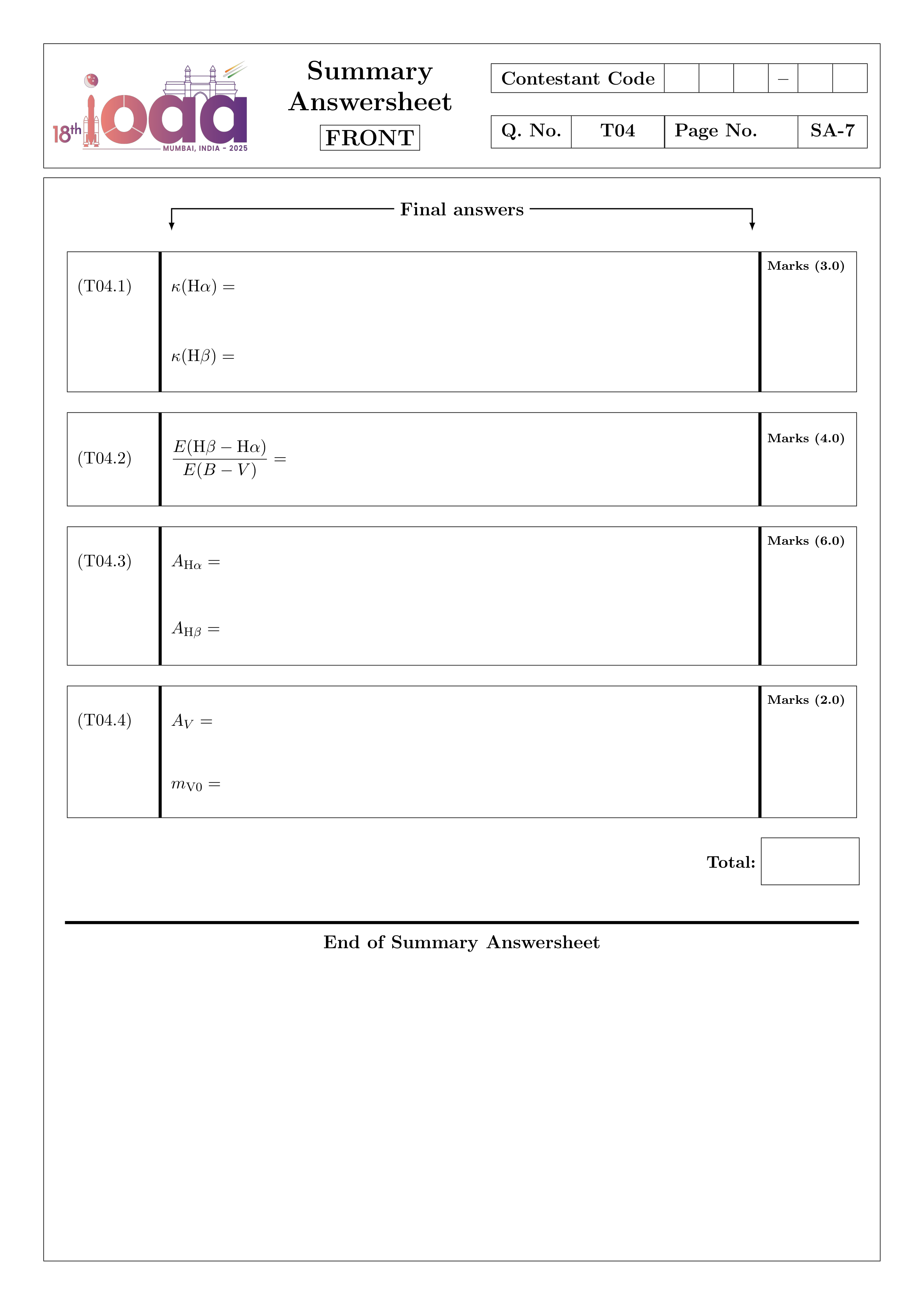
(T04.1) Find the values of and . [3 т.]
(T04.2) Find the value of the ratio of colour excess . [4 т.]
(T04.3) Estimate the extinction due to nebula, and , at H and H wavelengths, respectively. [6 т.]
(T04.4) Estimate the extinction of the nebula () and the apparent magnitude of the star in the V band, , in the absence of the nebula. [2 т.]

Решение
(T04.1)
For H substituting in equation for , we get
Similarly, for H we have
For :
| Half credit lower limit | Full credit range | Half credit upper limit |
|---|---|---|
| 3.6 to 3.7 |
(T04.2)
Credit of only 2.0 marks if answer is given without showing earlier expression relating color excess to extinction .
| Half credit lower limit | Full credit range | Half credit upper limit |
|---|---|---|
| 1.2 to 1.3 |
(T04.3)
If and represent the observed and emitted fluxes at wavelength , respectively, then the extinction is given by the equation
Given, ,
From extinction curve, we have . Equating these two, we obtain
This gives,
Full credit for between 0.69–0.73, no credit outside this range. Other values do not change when rounded to 2 significant digits.
For :
| Half credit lower limit | Full credit range | Half credit upper limit |
|---|---|---|
| 1.6 to 1.8 |
For :
| Half credit lower limit | Full credit range | Half credit upper limit |
|---|---|---|
| 2.5 to 2.6 |
(T04.4)
For :
| Half credit lower limit | Full credit range | Half credit upper limit |
|---|---|---|
| to |
For :
| Half credit lower limit | Full credit range | Half credit upper limit |
|---|---|---|
| to |
General Marking Principles
General Marking Principles
- STRICT adherence to given marking scheme.
- No double penalty – deduction only at the original place of error; no further penalty in consequent steps, if they are otherwise correct – if final answer is physically unviable or dimensionally incorrect, deduct for final answer also.
- Significant figures: one more or one less than appropriate no. of significant figures allowed with full credit.
- Units / dimensions:
- In cases where units are not mentioned in the Summary Answersheet, 0.5 deduction for missing units.
- For missing units on the same kind of quantities in a given part, deduct only once.
- For wrong dimensions in final answer because of some error in earlier steps, no credit for final answer, irrespective of no-double penalty principle.
- If expression is asked in terms of x, y, …: deduction of final part credit if expression is not in terms of appropriate quantities.
- Cumulative part marking: all previous part credits to be added if final expression / number is correct (unless otherwise specified).
- Final answer not in Summary Answersheet, but present inside: if final answer is present on Working Sheet, but not transferred on Summary Answersheet, it is to be credited.
Бележки за изданието
The printed question, key and blank answer sheets contain differing expressions and units. The Balmer key uses different rounded colour excesses; the quasar scale changes its angular unit; the neutron-star key prints differing mass-rate units/values. The black-hole-shadow question prints an unsquared radial speed in its comparison equation, while the repeated key uses a square. Atmospheric Seeing asks for a diameter but its key describes a radius. The nucleosynthesis key changes strict inequalities, has a differently grouped decay exponent, and includes an extra time-arrow field also present on its answer sheet. The stellar-profile key omits a factor in one line that appears in the next. The Hawking key prints a separation step differing from its integral and a horizon volume differing from its prose radius. Its answer sheet labels a temperature field with “s”. These native forms are preserved, including every original blank answer page.
Оригинал в Архива: Theory-Questions.pdf · официални решения: Theory-Solution.pdf · допълнителни данни: Theory-Summary-Answersheet.pdf · допълнителни данни: Theory-Instructions.pdf · допълнителни данни: Data_Sheet.pdf · допълнителни данни: IOAA2025_General_Marking_Scheme.pdf