IOM 2016, Теория — Задача 1. «Three Pulleys»
The 1st International Olympiad of Metropolises. Physics. 7 September 2016 · 30 т.
Условие
A light inextensible rope is threaded through three identical pulleys. Two pulleys are fixed (cannot rotate) while the third can frictionlessly rotate about an immobile horizontal axis. The pulleys and the rope lie in the same vertical plane. To prevent the rope from sliding off the pulleys the latter have grooves. Coefficient of friction between a pulley groove and the rope is . The mass of the rotating pulley is kg. When evaluating its moment of inertia one can neglect the groove and the central hole and consider the pulley to be a uniform disk. The left end of the rope (see the Figure) is loaded with a weight g and the right end with a weight . Initially the system is held at rest.
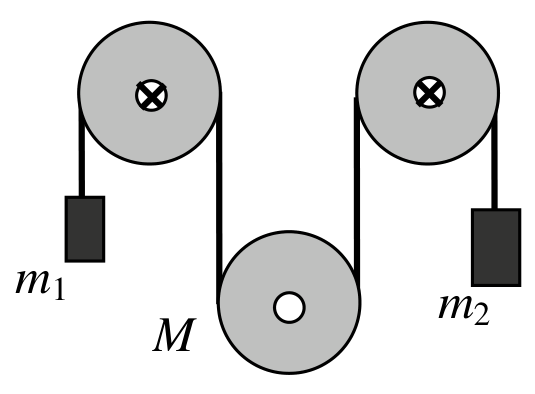
1) Evaluate the ratio of tensions in the sliding rope on both sides of a fixed pulley. Express your answer via the coefficient of friction and calculate its numerical value. [4 т.]
2) Determine the critical value of required for setting the system in motion after it has been released. Express in terms of the quantities specified in the problem and write down an explicit formula. [3 т.]
3) Evaluate the numerical value of found above. [1 т.]
4) Determine an acceleration of (absolute value) after the system has been released if its mass is greater by the factor than the critical mass found in 3). Express the answer in terms of the quantities specified in the problem and write down an explicit formula. [4 т.]
5) Express the acceleration found in 4) as a fraction of gravitational acceleration . [1 т.]
6) Determine an acceleration of (absolute value) after the system has been released if its mass is greater by the factor than the critical mass found in 3). Express the answer in terms of the quantities specified in the problem and write down an explicit formula. [4 т.]
7) Express the acceleration found in 6) as a fraction of gravitational acceleration . [1 т.]
8) Under the condition specified in 6) evaluate a tangential acceleration (absolute value) of the rotating pulley circumference right after the system has been released. Express the answer as a fraction of gravitational acceleration . [4 т.]
9) Suppose a value of exceeds the critical mass found in 3) and now mass of the rotating pulley can be varied. Determine the values of for which a type of relative motion of the rope and the rotating pulley remain the same for any . Write down a formula and express it in terms of the quantities specified in the problem. [4 т.]
10) Evaluate the ratio of rope tensions on both sides of the rotating pulley if the value of is specified in 4) while the pulley mass is less by the factor than the value specified in the problem. The coefficient of friction between the pulley and the rope remains the same. Write down the answer as a simple fraction. [4 т.]
TOTAL score of the problem is 30 points.
Отговори
1)
Tension of the «downstream» rope section is greater by the factor of 2.
2)
3) 800 g
4)
5)
6)
7)
8)
9)
The rope does not slide under the rotating pulley for any m2.
10)
Tension on the «right» to the rotating pulley is 14/11 of the tension on the «left».
Решение
TABLE OF ANSWERS:
| № | Answer | Maximum score |
|---|---|---|
| 1 | Tension of the «downstream» rope section is greater by the factor of . | 4 |
| 2 | . | 3 |
| 3 | 800 g. | 1 |
| 4 | . | 4 |
| 5 | . | 1 |
| 6 | . | 4 |
| 7 | . | 1 |
| 8 | . | 4 |
| 9 | When or the rope does not slide under the rotating pulley for any . | 4 |
| 10 | Tension on the « right» to the rotating pulley is of the tension on the « left». | 4 |
| Total | 30 |
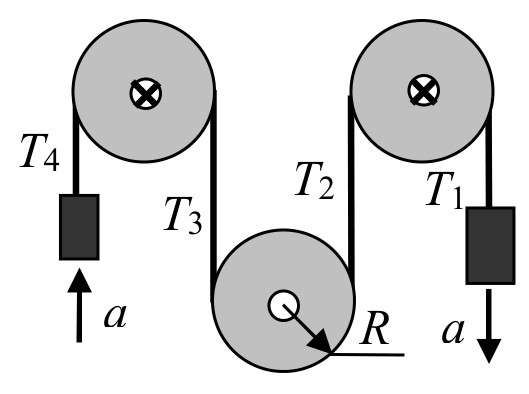
Proposed Solution:
- If the weights are in motion the rope has to slide over the fixed pulleys. Therefore for any rope element of a length in a pulley groove the absolute value of friction force equals , where is a normal force exerted by the pulley. The friction force balances a net tangential force of rope tension . The force pressing the rope element to the pulley is the normal component of the net tension force . Here is the angular size of the rope element). Thus and the tension of the rope sliding over a fixed pulley varies according to an exponential law .
Suppose that the weight is moving downward and the rope tensions are labeled in the Figure. Then according to the exponential law and where .
2, 3) Now let us write down equations of motion of the weights. Since the rope is inextensible the absolute value of a weight acceleration is the same. Let the vertical axis be directed upward. Then one obtains for tensions :
Concerning the rotating pulley, the rope does not have to slide under it and they can rotate together. If this is the case the net tension for any rope element is still balanced by a friction force, although now it is static friction (). The net torque exerted on the rotating pulley due to friction is . Besides, if there is no sliding, a tangential acceleration of the pulley circumference equals a linear acceleration of the weights and rope, so an angular acceleration of the pulley is . Since the pulley moment of inertia can be approximated by , the equation of angular motion becomes , whence . Substituting here the tensions found above one obtains the acceleration of weights and rope (providing the rope does not slide under the rotating pulley):
This equation is correct if two conditions are met: (we assume that the system is moving) and (we assume the rope does not slide under the rotating pulley, otherwise and ). The considered motion is realised if g (otherwise friction force holds the system at rest) and if kg (for a greater the rope slides under the «middle» pulley). One can see that if is a bit more than 800 g the above conditions are met and the system starts moving as soon as it has been released.
4, 5) For kg both inequalities derived above are satisfied, so .
6, 7) When increases to kg the second inequality no longer holds. This means that the rope is now sliding under the rotating pulley and . The angular acceleration of the pulley is . Using expressions for the tensions derived above one obtains:
- Equation of angular motion for the rotating pulley now becomes:
Substituting here the expressions for and the acceleration one obtains:
Obviously this acceleration does not exceed , as it should be.
9, 10) Notice that if kg, the condition holds true for any , i.e. there is no sliding. Therefore acceleration of the «lightweight» pulley can be evaluated according to the equation derived in 4). Substituting and one obtains: . Then and , whence .
Оригинал в Архива: teor.pdf · официални решения: phys-teor-sol-en.pdf