IOM 2016, Теория — Задача 1. Circulation of carbon dioxide
1st Olympiad of Metropolises — Chemistry, Theoretical Problems, Official English version · 7 септември 2016 г.
Original cover
Country: ______
Name: ______
1st Olympiad of Metropolises
Chemistry
Theoretical Problems
7 September 2016
Moscow, Russia
Chemistry. Theoretical problems. Official English version
Указания
- Begin only when the START command is given. You have 4.5 hours to work on the problems.
- Use only the pen and calculator provided.
- All results must be written in the appropriate boxes within the text. Anything written elsewhere will not be graded. Use the reverse of the problem pages if you need scratch paper.
- Write relevant calculations in the appropriate boxes when necessary. If you provide only correct end results for complicated questions, you will receive no score.
- Raise your hand if you have any questions concerning the text of the problems.
- Raise your hand if you need a restroom break.
- The official English version of this examination is available on request only for clarification.
Original key cover
1st Olympiad of Metropolises
Chemistry
Theoretical Problems with solutions
7 September 2016
Moscow, Russia
Chemistry. Theoretical problems with solutions. Official English version
Условие
Constants
| Constants | Value |
|---|---|
| Avogadro constant: | |
| Gas constant: | |
| Zero of the Celsius scale: |
Consider all gases ideal throughout the exam.
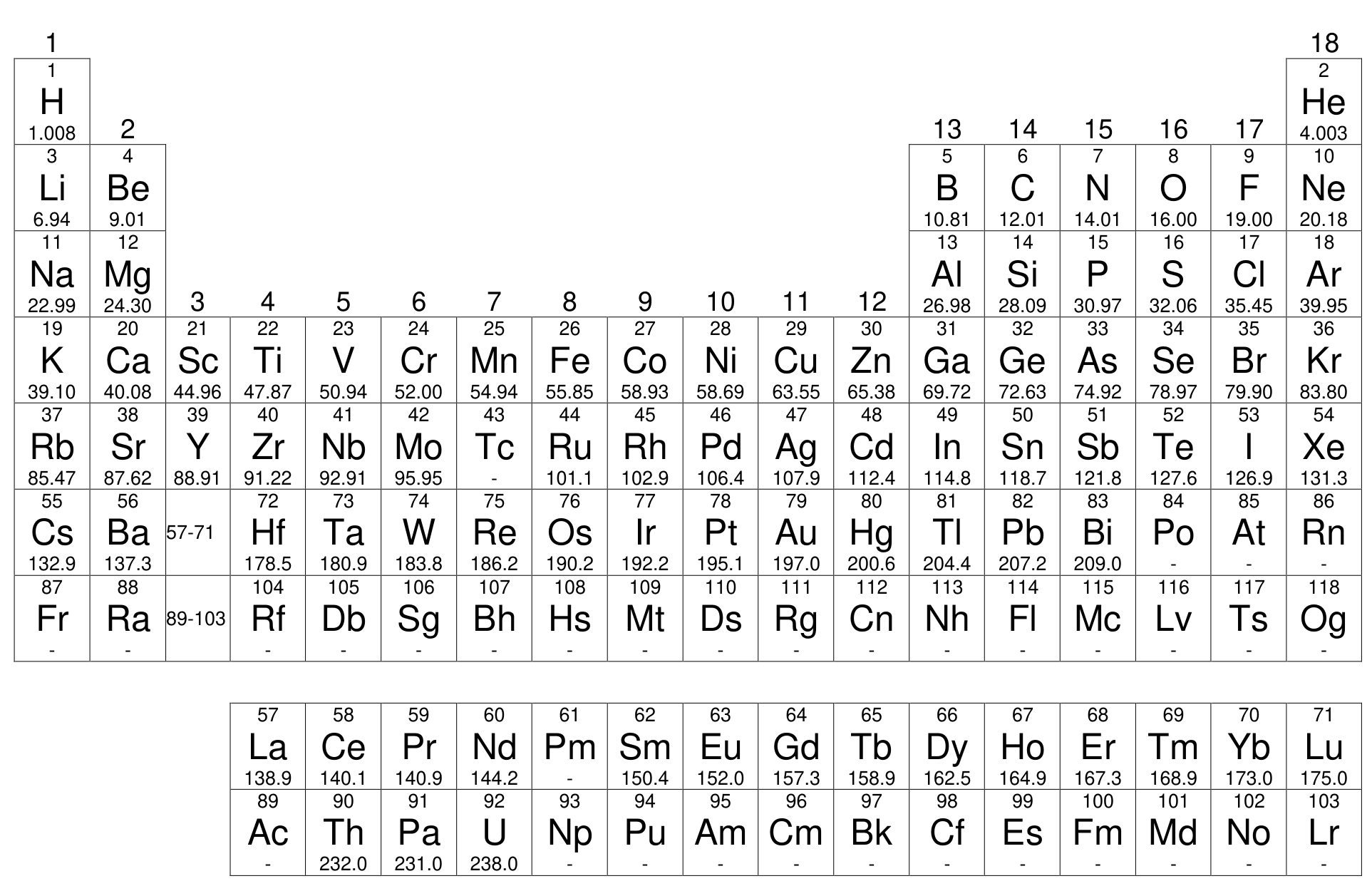
Periodic table with relative atomic masses
Problem 1. Circulation of carbon dioxide (12 marks)
| Question | 1 | 2 | 3 | 4 | Total |
|---|---|---|---|---|---|
| Points | 2 | 6 | 4 | 8 | 20 |
Moscow is one of the greenest metropolises of the world. Green area in Moscow occupies , that is about of the total area (without the new territories). Under the action of light green plants absorb carbon dioxide and evolve oxygen in a photosynthesis process, which is described by the simplified equation:
where denote all carbohydrates formed.
1 Determine the signs of enthalpy and Gibbs energy for the above reaction.
| Function | ||
|---|---|---|
| Sign (+, −, 0) |
[2 т.]
2 Calculate the volume of (in , at and ) and the mass of carbohydrates (in kg) formed during a sunny summer day (8 h) in Moscow. The necessary information:
- solar energy absorbed by Moscow region in summer time – ;
- the Gibbs energy of photosynthesis is of ;
- green plants absorb ~10% of the available solar energy;
- 25% of the absorbed energy is used for the photosynthesis process.
Calculations:
_______
______ kg [6 т.]
At the same time there are 4 million of cars in Moscow that strongly pollute the air of the city.
3 How many kilometers (in average) can a typical Moscow car run during one day so that all carbon dioxide from the car exhaust be completely absorbed by green plants within the city? Assume that the formula of car fuel is , the fuel density is , the fuel consumption by an average car in the city is .
Calculations:
The car run = _____ km [4 т.]
In addition to natural photosynthesis, can be also utilized by artificial chemical processes designed by chemical engineers. In these processes, is converted to various useful organic and inorganic substances such as fuels, fertilizers, polymer and construction materials.
4 Write one reaction equation for each process which converts to a useful substance with a mass content of carbon:
a) 12%;
b) 20%;
c) 37.5%;
d) 75%.
Hint. In all products, the molecule (the formula unit) contains one carbon atom.
a) Substance – ______
Reaction equation: ______
b) Substance – ______
Reaction equation: ______
c) Substance – ______
Reaction equation: ______
d) Substance – ______
Reaction equation: ______ [8 т.]
Решение
Official answers and grading scheme
1 Determine the signs of enthalpy and Gibbs energy for the above reaction.
| Function | ||
|---|---|---|
| Sign (+, −, 0) | + | + |
1 pt for each correct answer, total – 2 pts.
2 Calculate the volume of consumed (in , at and ) and the mass of carbohydrates formed (in kg) during a sunny summer day (8 h) in Moscow. The necessary information:
- solar energy absorbed by Moscow region in summer time – ;
- the Gibbs energy of photosynthesis is of ;
- green plants absorb ~10% of the available solar energy;
- 25% of the absorbed energy is used for the photosynthesis process.
Calculations:
Energy absorbed by the plants:
2 pts
The quantity of and :
2 pts
The molar volume of a gas at and :
1 pt
1 pt
Total – 6 pts
3 Calculations:
1 pt
1 pt
1 pt
The average run for one car is:
1 pt
The car run =
Total – 4 pts
4 a) Substance –
Reaction equation:
b) Substance – urea,
Reaction equation:
c) Substance –
Reaction equation:
d) Substance –
Reaction equation:
Each substance – 1 pt
Each balanced equation – 1 pt (0.5 pts – if not balanced, but with correct substances)
Total – 8 pts
Бележка от източника
The five native whole theoretical problems and all available official keys are retained. Each original problem heading says 12 marks, while its printed score grid totals 20, 24, 30, 59 or 25; these source contradictions remain visible. In Problem 2 the grid gives 3/6 points for requests 4/5, while the actual key gives 2/4. Problem 3 gives M/N 3/3 points in the answer table and 4/2 in the detailed rubric. Problem 5 request 7 prints 1.5, 1.5 and 2 points but states 4 points in total. Native spelling, formulas, a missing radical dot in one blank answer equation, a missing slash in d[CC]dt, and the missing [M] factor in the printed CC-rate result are preserved without scientific correction. Empty calculation workspaces are represented by their printed response labels and blank fields; molecular answer grids, cyclic-form checkbox tables and scientific axes retain exact original crops. Source question page 10 contains only continuing answer cells; solution pages 18–20 contain the blank repeated Sugars assignment, followed by its detailed key on 21–22.
Оригинал в Архива: Problems.pdf · официални решения: Solutions.pdf