IOM 2018, Теория — Задача 3. «In a galaxy Far, Far Away...»
Problem 3: «In a galaxy Far, Far Away...» · 40 т.
Условие
A planet-ocean moves along an almost circular orbit around a star X in a distant galaxy. The axis of the planet proper rotation is normal to the orbital plane and the angular velocity of its proper rotation equals the angular velocity of orbital rotation around the star (directions of both rotations are the same). The planet consists mostly of water, however, it has a solid nucleus in which nuclear decay and gravitational differentiation of depths go on; these processes generate an additional heat outflow from within the planet. Nevertheless, the entire planet is covered with an ice crust. The ice surface is rough and polluted with cosmic dust, so it warms up quickly on the dayside and the radiation into space comes only from the planet surface.
Information on the system X and beyond (can be used in any part of the assignment):
- radius of the star X, m;
- radius of the orbit of the planet-ocean, m;
- free fall acceleration on the surface of planet-ocean, ;
- maximum temperature at the equator on the dayside of planet-ocean, K, and temperature at a pole, K;
- water density, , and ice density, ;
- water heat of fusion, J/g, and vaporization heat, J/g;
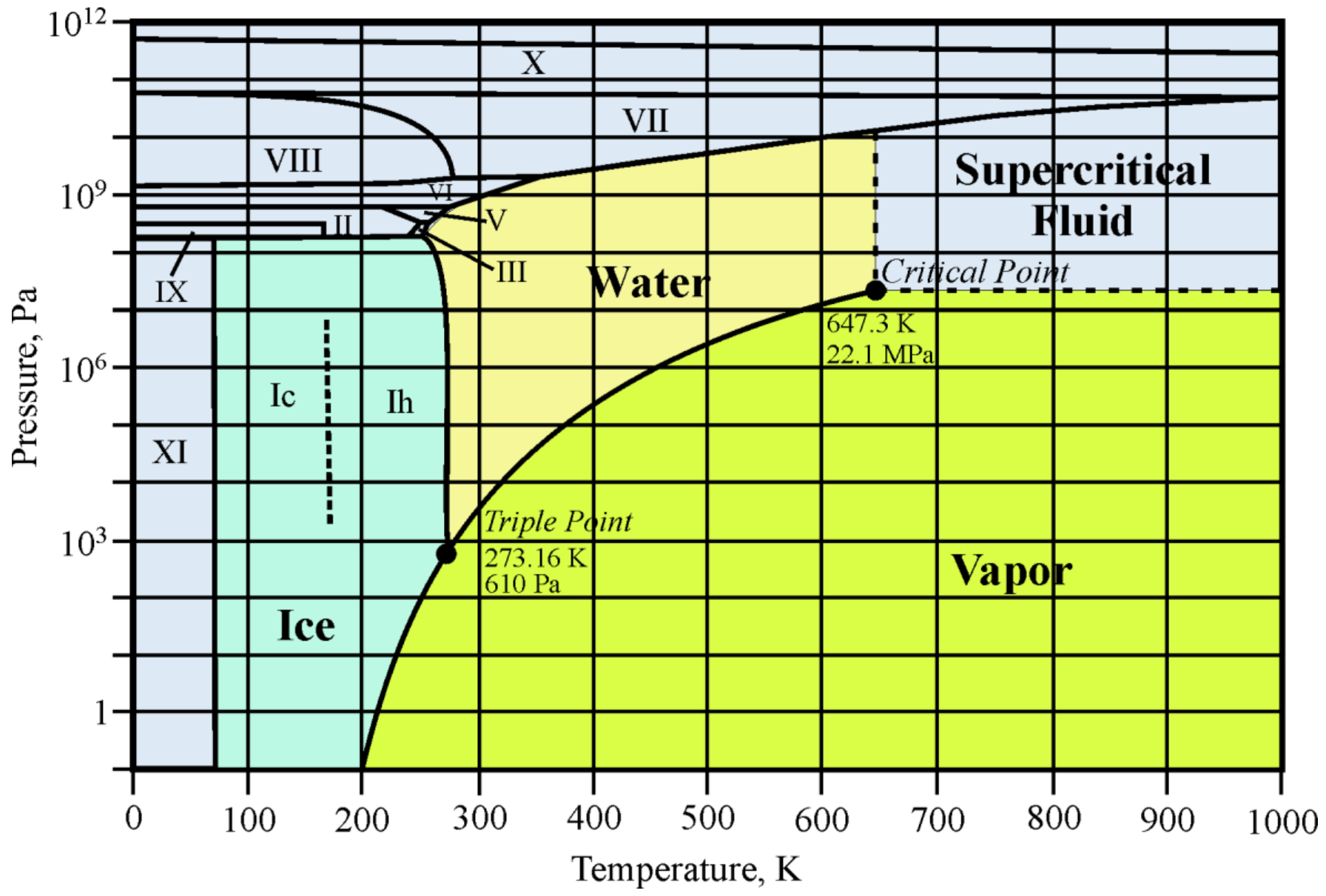
- phase diagram of water is shown below:
- thermal conductivity of ice versus absolute temperature is given by an interpolating formula , its accuracy in the relevant temperature range is better than 5 %;
- the Stephan-Boltzmann constant, .
- maximum of spectral radiance of the Sun (i.e. the ratio of a radiation power in a given small wavelength interval to its length ) corresponds to a wavelength of nm, while the surface temperature of solar photosphere is largely close to K.
Part I: Heat Balance and Ice Sheet
1.1. Determine the heat outflux coming from the depths of planet. Express via the quantities given in the problem statement (derive an equation) and evaluate the numerical value with at least 5% accuracy. Write the answer in . [3 т.]
1.2. Determine a thickness of the ice sheet at a pole. Express via the quantities given in the problem statement (derive an equation) and evaluate the numerical value with at least 10% accuracy. Write the answer in meters. [3 т.]
1.3. Estimate a thickness of ice sheet at the equator on the dayside of planet-ocean in an area of maximum temperature. Express via the quantities given in the problem statement (derive an equation) and evaluate its numerical value. Write the answer in meters. [2 т.]
1.4. Determine a temperature of the star photosphere. Express via the quantities given in the problem statement (derive an equation) and evaluate its numerical value. Write the answer in Kelvins. [3 т.]
1.5. Obtain a relation between maximum daytime temperature on the planet surface and a latitude (derive an equation). [2 т.]
1.6. Determine a wavelength corresponding to the maximum radiance of star X. Write the answer in nm. [1 т.]
Part II: Polynya and Crater
Consider the following situation. Somewhere at the equator in a region of maximum temperature a sufficiently large patch of ice sheet has quickly disappeared «without a trace» leaving a stretch of open water surrounded by ice. Such a «hole» in an ice sheet is called «polynya». The polynya size is of the order of ice sheet thickness and much smaller than the planet radius.
2.1. Estimate a time required for water in polynya to rise to a new equilibrium level (measure the time from the moment of polynya formation). Express via the quantities given in the problem statement and those already found (derive an equation), evaluate the numerical value. Write the answer in seconds. [3 т.]
2.2. Estimate the thickness of ice layer in the polynya immediately after the ice has frozen on its surface. Express via the quantities given in the problem statement (derive an equation) and evaluate its numerical value. Write the answer in meters. [5 т.]
2.3. Estimate the depth of a «crater» which will form on the ice surface at the place of the polynya in a sufficiently long time. Write the answer in meters. [2 т.]
Assume that evaporation and freezing of water occur while its level rises, however, the final freezing of the surface layer proceeds after water has almost stopped approaching its new equilibrium level.
Part III: Tunnel Freezing
Consider the processes occurring after initial crust of ice has formed in the polynya. Let us assume that the temperature of crust surface equates the temperature of the planet surface fairly quickly. Obviously, water will be freezing on the bottom side of ice crust and the crust thickness will continue to grow.
3.1. Estimate a time in which the layer depth increases two-fold compared to the initial thickness . Express via the quantities given in the problem statement and those already found (derive an equation), evaluate the numerical value. Write the answer in Earth days. [5 т.]
3.2. Estimate an age of a polynya in which the ice depth is m. Express via the quantities given in the problem statement (derive an equation) and evaluate its numerical value. Write the answer in Earth years. [4 т.]
3.3. Estimate an age of a polynya in which the bottom of ice crust reached the bottom of the surrounding ice sheet. Express via the quantities given in the problem statement and the quantities already found (derive an equation) and evaluate its numerical value. Write the answer in Earth years. [7 т.]
Решение
Proposed Solution
Part I
First of all, notice that the planet always faces the star with a single side given angular rotation velocities of the planet (around the star and around its axis). Furthermore, the angular velocity is too small for centrifugal force to cause a significant redistribution of the planet mass. Under these conditions, there will be an almost invariable distribution of temperature and phases of matter in the planet. Hence, a depth of ice crust on the planet surface will be practically unchanged.
Suppose that everywhere the crust depth is much less than the planet radius (an indication to this fact is given in the second part of the problem). According to the phase diagram of water, the temperature at the ice-water interface approximately equals that of the triple point of water K (because the melting point of water remains practically constant in a wide pressure range from Pa to Pa). Then a radial temperature gradient inside the crust is much greater than a gradient along the plane surface (temperature difference between the highest value at the equator and a pole, K, is less than one third of K and the distance between the equator and a pole is much greater than an ice depth). Therefore, a heat flux density along the planet surface is negligible compared to the radial one.
Let us write an equation of heat balance for a small patch of ice sheet located on the planet dayside at a latitude . The desired heat flux coming from the planet depths (let us call it «geothermal») added to the heat flux coming from the star (the latter is a function of the incidence angle of star radiation on the surface, i.e. it depends on a «planetocentric» latitude of the patch) must be equal to the heat flux radiated by planet surface:
(here the Stephan-Boltzmann law is used both for the radiant emittance of the star photosphere and the planet surface, and is the ice surface temperature).
From this equation the following conclusions can be drawn.
1.1. The star radiation has no effect on a pole (), hence, the heat radiated by the planet on a pole equals to the desired geothermal flux:
The data accuracy is surely better than 5%, and a surface flux, if accounted for, contributes even less. Hence, the accuracy of the result is better than required.
1.2. The depth of ice crust on a pole can be found as follows. A geothermal flux through a thin layer is the same for all layers, according to Fourier’s law, it equals:
Substituting the given law , in the above equation, where and , one obtains:
Numerical calculation yields .
Using the information on chemical composition of the planet and the numerical value of the free fall acceleration on its surface one can estimate the planet radius which turns out to be about 2-3 thousand kilometers. Thus, the assumed smallness of the ice sheet depth compared to the planet radius is justified and a surface heat flux would contribute less than 0,1%! This correction can be safely ignored and the accuracy of the results obtained in this section is no worse than 10% given the accuracy of interpolation formula for .
1.3. The depth of the ice sheet on the equator in the area of maximum daytime temperature can be found from the formula obtained in 1.2, in which must be replaced by . It is not easy to estimate the accuracy of this result since we do not know how well the black body approximation works in the case at hand (ice reflectivity is not known, although there are indications that it is small). Numerical calculations give . The pressure exerted by such an ice layer is Pa. This confirms the above assumption that the temperature at the crust bottom is close to 273 K.
1.4. The equation of heat balance for a small patch of ice at the equator on the planet dayside can be now written as
Whence, the temperature of the star photosphere is K.
1.5. Therefore, the maximum daytime temperature as a function of latitude is:
1.6. According to Wien’s displacement law, , therefore, 929 nm, i.e. the star X radiates mostly in the infrared range.
Part II
After rapid disappearance of ice layer, water will rush upward being pushed by the pressure of surrounding ice. There will be almost zero pressure at the surface of rising water although the temperature will remain approximately the same and equal to , the temperature at the triple point, as we have already seen in the previous section. According to the phase diagram of water, the state of the surface layer will be in «Vapor» area, so it begins to vaporize rapidly. The vaporization heat will be taken from lower water layers which cool down and freeze as a result. According to the problem statement, both vaporization and freezing proceed at the same pace with the rise of water, which at the end results in formation of the solid ice «crust» on the water surface.
2.1. Pressure above the water surface quickly equates the pressure of saturated vapor but still remains negligible compared to , the pressure exerted by the ice sheet. The latter will be balanced by a pressure of water layer in the polynya then and only then, when the layer depth becomes equal to . Water rushes into the polynya from all directions from below and a velocity of water approaching the polynya is sufficiently less than a speed of the rising water column. Therefore, the speed at the moment when a height of water column equals can be estimated from Bernoulli’s equation: , whence . Therefore, the time it takes water to rise to a height approximately equals s.
2.2. According to the phase diagram, a near-surface layer boils, so water at temperature will freeze only at a depth where the pressure equals Pa, the temperature at the triple point of water. The corresponding depth equals cm. The heat required to vaporize a water layer of thickness will be taken from a lower layer which turns into the layer of ice of a thickness . Then, according to an equation of heat balance, . Hence, .
2.3. Obviously, the crater depth does not change after water in the polynya begins to freeze. Therefore, the crater depth is equal to m.
Part III
If a depth of ice layer in some place is less than in the surrounding area, the heat outflow through the thin «crust» will be much higher, provided the temperature difference is the same, and it will not be balanced by the geothermal inflow. Therefore, the ice layer will grow with time and the solidification heat will go out through the ice together with the geothermal flow. Let a depth of the growing ice layer at time be equal to . Then for a small time interval ,
Let us denote and integrate the above equation:
3.1. At the initial stage of freezing, (so the geothermal flow at this stage is negligible compared to the heat outflow and can be neglected). In this case, in the denominator can be discarded, then
3.2. In the second case, still, so the same formula applies:
3.3. In the third case, the ice layer is already sufficiently thick: , so for an estimate one can assume that . Since the time is mostly spent on a «late» stage of freezing, one can simply set in the integrand numerator, this gives:
Note. Of course, one can derive the general formula without resorting to these approximations, in this case:
One can see that the result changes significantly only in the third case:
i.e. the improved value for is almost two times less.
Marking scheme (Problem 3)
City ____________________ Name ________________________________________
| № | ANSWER | Maximum Score Score |
|---|---|---|
| 1.1. | Density of heat outflow from the planet-ocean depths, ; Allowed range (0,34 ÷ 0,36) . | 3 = (2 for equation) + (1 for num. value) |
| 1.2. | Ice sheet thickness at pole, , here , . Allowed range (2200 ÷ 2300) m. | 3 = (2 for equation) + (1 for num. value) |
| 1.3. | Ice sheet thickness on equator in area of maximum temperature , here , . Allowed range (1550 ÷ 1650) m. | 2 = (1 for equation) + (1 for num. value) |
| 1.4. | Temperature of star photosphere Allowed range (3000 ÷ 3200) K. | 3 = (2 for equation) + (1 for num value) |
| 1.5. | Maximum daytime temperature on the planet surface versus latitude: | 2 |
| 1.6. | nm. Allowed range (928 ÷ 930). | 1 |
| 2.1. | Time of water rising in polynya to the new equilibrium level, , where Allowed range (50 ÷ 60) (40 ÷ 70)* | 3 = (1 for equation) + (2 (1) for num. value) |
| 2.2. | Ice crust thickness in polynya immediately after the freezing of surface layer, , where Pa is the pressure at triple point of water. Allowed range (4,3 ÷ 4,6) (4 ÷ 5)* | 5 = (3 for equation) + (2 (1) for num. value) |
| 2.3. | Crater depth, m. Allowed range (150 ÷ 170) | 2 |
| 3.1. | Ice layer thickness will increase two-fold compared to the initial thickness in . Allowed range (190 ÷ 195) (180 ÷ 200)* | 5 = (3 for equation) + (2 (1) for num. value) |
| 3.2. | Age of polynya in which ice crust is m thick, . Allowed range (85 ÷ 95) (80 ÷ 100)* | 4 = (2 for equation) + (2 (1) for num. value) |
| 3.3. | Crude estimate for the age of polynya in which the bottom of ice crust reached that of the surrounding ice, . Allowed range (100 ÷ 105) (95 ÷ 110) Accurate answer, . Allowed range (60 ÷ 65). | 7 = 4 for equation + 3 for num. value (100 ÷ 105) 5 = (3 for equation) + (2 for num. value 95 ÷ 110), the accurate answer also scores as 7 = 4 + 3 |
| TOTAL | 40 |
*The second range corresponds to the score in parenthesis.
Оригинал в Архива: 3.pdf · официални решения: theory-criteria.pdf