IOM 2019, Експеримент — Задача 5. Exercise 1.5: Deviation from Boyle-Marriotte's law
The 4th International Olympiad of Metropolises — Carbon Dioxide Solubility in Water
Recommendations Regarding the Experiment
There are two long exercises in the proposed experiment. Exercise 1.5 and exercise 2.1 in total may take more than three hours to complete. Consider this fact when allocating time and responsibilities to the participants during the experiment.
Условие
Sparkling water is the water in which carbon dioxide (CO) is dissolved. If a sealed bottle is partially filled with such water then there is a CO gas above the water surface. This gas can be mixed with air and/or with saturated water vapor. In the stationary state, the rate of carbon dioxide release from water will be equal to the rate of carbon dioxide return from the gas phase into the water. In this case, the concentration of carbon dioxide both in water and in the gas phase will not change, and the partial pressure of carbon dioxide in the gas phase also will not change.
The amount of gas dissolved in water in stationary conditions is proportional to the partial pressure of carbon dioxide above water and to the volume of water. The number of moles of gas dissolved in water under stationary conditions can be expressed as
where is the equilibrium partial pressure of carbon dioxide above water, is the volume of water, is the molar gas constant, is the temperature corresponding to zero degrees Celsius. The quantity is the solubility of carbon dioxide in water.
If, for some reason, the amount of gas dissolved in water is larger than the equilibrium value given by formula (2), then the rate of gas release from water will exceed the rate of gas dissolution in water. Therefore, the amount of gas dissolved in water will decrease while the partial pressure of carbon dioxide above water will increase. This process will continue until the carbon dioxide partial pressure above water and the amount of gas dissolved in water are related by equation (2), which means that the equilibrium state has been established.
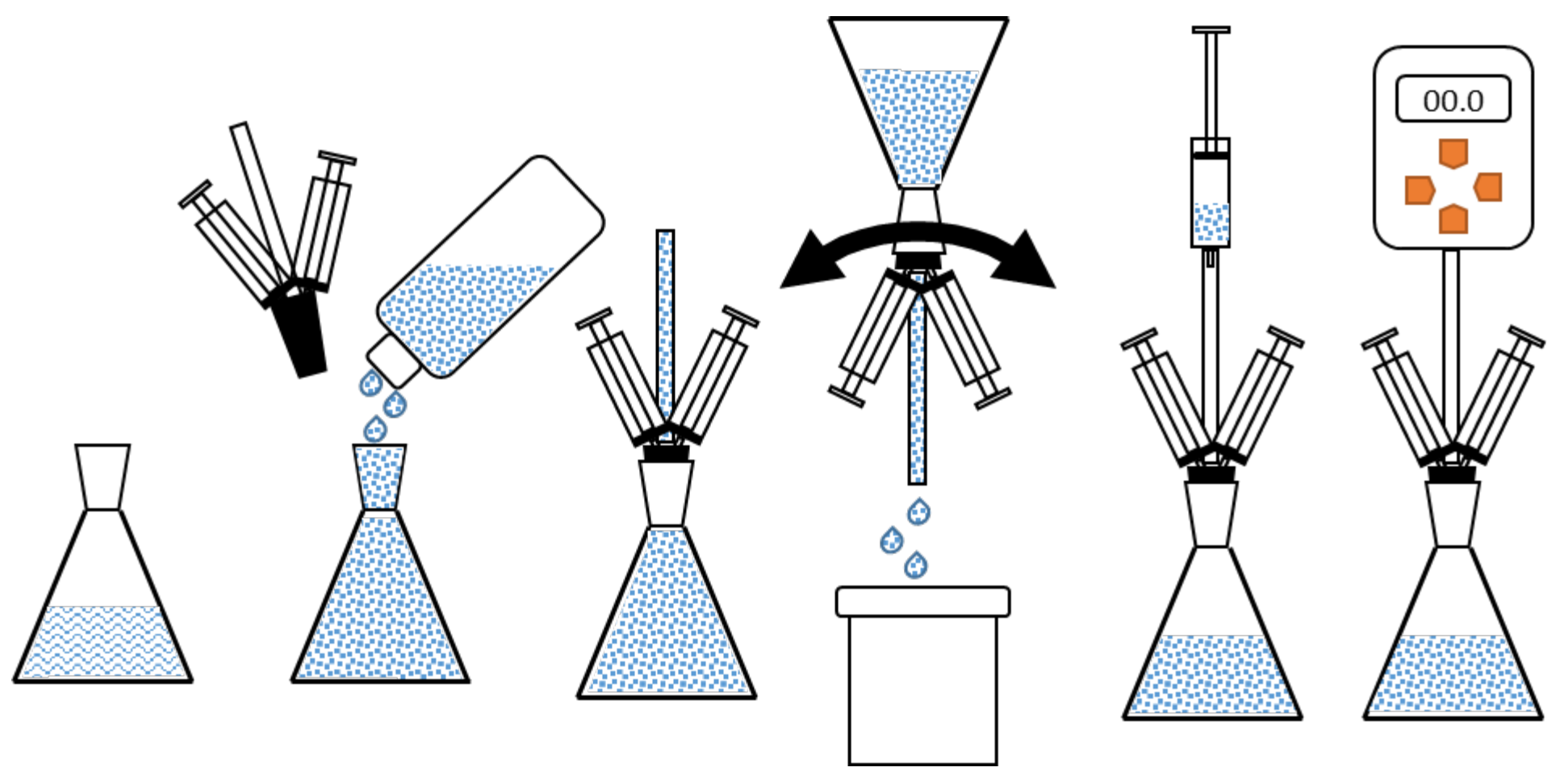
Measure the volume of one of the flasks closed with a plug. Measure the volume of the tube used to connect the flask with the manometer. The internal volume of the manometer inlet is approximately 0.5 ml.
Pour 10 ml of water into this flask (Fig. 2). Add sparkling water from the bottle to the flask so that no air remains in it. Close the flask using the plug with syringes and tube inserted in it to connect it to the manometer. Turn the flask over and shake it while pointing the tube into the water box. The water will begin to flow out through the tube. If water starts flowing into the syringes inserted in the plug, press down on their pistons to return the water back to the flask. In this way, pour so much sparkling water and regular water out of the flask that there is approximately 40-50 ml of liquid left in the flask. Pinch the tube with a plastic clip. Then connect another 20-ml syringe to the tube and open the clip. Pull the piston of the syringe connected to the flask via the tube to the "10-ml" mark, thus sucking out of the tube the remaining water and small amount of carbon dioxide from the flask. Pinch the connecting tube again with the plastic clip, disconnect the syringe and connect the tube to the manometer. Return the clip to the open position. Now you have a flask with carbonated water containing practically no air above the surface.
Pour some hot water from the water bath into the water box so that the water temperature in the box is close to room temperature. Immerse the flask into the water box and fix the flask with a support stand so that it touches the bottom of the box and is almost completely immersed in water. Leave the flask in water for 5 minutes to establish a thermodynamic equilibrium between the contents of the flask and the water box.
In this experiment you will be required to measure the equilibrium pressure of carbon dioxide above water. It may take dozens of hours for the equilibrium state to establish. To speed up the equilibration process, you may slightly shake the water flask. The rate of carbon dioxide escape from water will increase and the partial pressure during the shaking will increase much quicker than it would have been if the flask had been left at rest. However, due to shaking, the carbon dioxide partial pressure may increase too much, exceeding the equilibrium pressure. Therefore, shake the water flask for 15 seconds so that the pressure does not become higher than the equilibrium pressure. After shaking, the water in the flask will keep moving for 2-3 minutes, i.e. it will not be in a stationary state. Therefore, after shaking wait for more than 3 minutes so that after water has stopped moving in the flask you can observe whether the pressure in the flask will rise or fall. It is suggested that the waiting time be 4 minutes and 45 seconds, so that the full cycle of shaking and waiting is 5 minutes. If pressure in the flask increases in the last minutes of waiting, it means that the gas pressure is still lower than the equilibrium pressure. Then the flask must be shaken again. If pressure in the flask does not change during the last minutes of waiting, it means that the pressure is close to equilibrium. If pressure in the flask drops in the last minutes of waiting, it means that the pressure is higher than the equilibrium pressure and we missed the equilibrium pressure.
Disconnect the flask from the support stand. Gently stir water in the flask for 15 seconds with rotating movements, so that most part of the flask remains submerged in water. Place the flask back on the bottom of the box and secure it again in the submerged position with a support stand. Wait 4 minutes 45 seconds, and then repeat all the operations again. Observe the pressure in the last 2 minutes of waiting. If the pressure in the flask increases, stir water in the flask again and wait for 4 minutes 45 seconds again. Continue this cyclic experiment until you see that the pressure has stopped changing in the last 2 minutes of waiting. Then stir water in the flask once more to make sure that the pressure starts dropping during the last two minutes of waiting. Write down the manometer reading corresponding to the equilibrium pressure in the flask (see Fig. 3).
Pull the piston of the first syringe out to the "20-ml" mark and fix it with a lock-pin (see equipment description); repeat the experiment with stirring water in the flask. Write down the new equilibrium pressure. Pull the piston of the second syringe out to the "20-ml" mark and repeat the experiment.
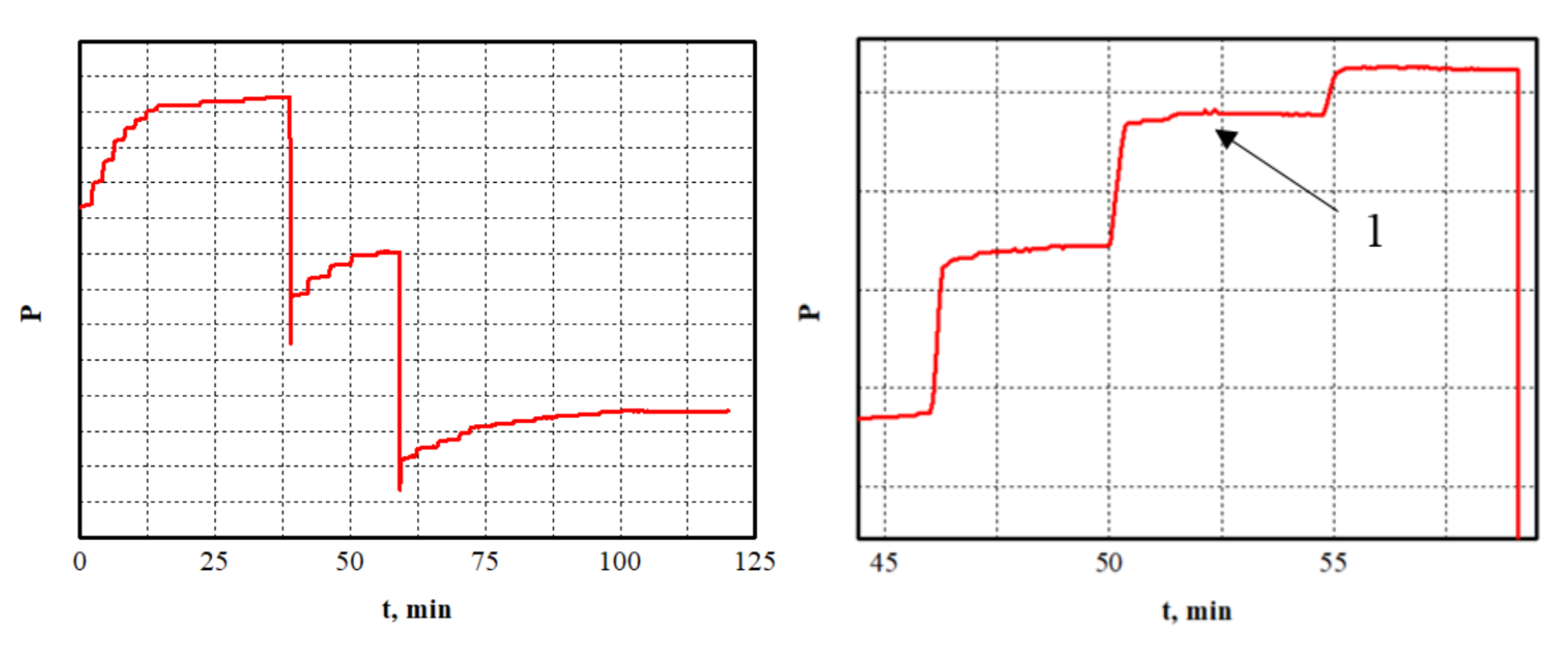
Please note that due to diffusion, the amount of carbon dioxide in the flask is slowly reducing. That is, in the resulting state of equilibrium, the actual gas escape rate from the liquid will balance the sum of two rates: the rate of gas dissolution in liquid and the rate of diffusion flow of molecules from the flask. However, we will assume that the obtained pressure satisfies equation (2).
Решение
Exercise 1.5
Flask volume: 122 ml
Tube volume: 3 ml
| Change in volume, ml | Manometer readings (equilibrium pressure, mmHg.) |
|---|---|
| 0 | 0 |
| 20 | –111.7 |
| 40 | –189 |
Оригинал в Архива: phys-task-prak-iom-2019-en.pdf · официални решения: phys-solution-prak-iom-2019-en.pdf