IOM 2019, Теория — Задача 1. Newton-Laplace Cosmology
The 4th International Olympiad of Metropolises · 25 т.
Условие
After Isaac Newton's discovery of the Law of Universal Gravitation, Pierre-Simón Laplace attempted to describe the behavior of the Universe as a cloud of moving matter. Laplace assumed that, in description of motion of this cloud, out of all interactions only gravity plays significant role at large distances between bodies. However, he lacked experimental data to accomplish construction of a realistic model.
Only in the 20th century, astronomical observations made it possible to establish that in the observed part of the Universe matter is distributed almost uniformly and isotropically (i.e. in the areas containing many galaxies the average density of matter is practically the same). In addition, Edwin Hubble discovered a law according to which distant objects move away from us along the line of sight with velocities proportional to distance : , where is called the Hubble constant; it was found to be independent of distance and approximately equal to years. George Gamow suggested that such velocity distribution is due to the Big Bang, an explosion that occurred in a small area of space, and then the matter flew in different directions at different speeds. Therefore, the particles, which flew faster, have by now gone farther away from the explosion area.
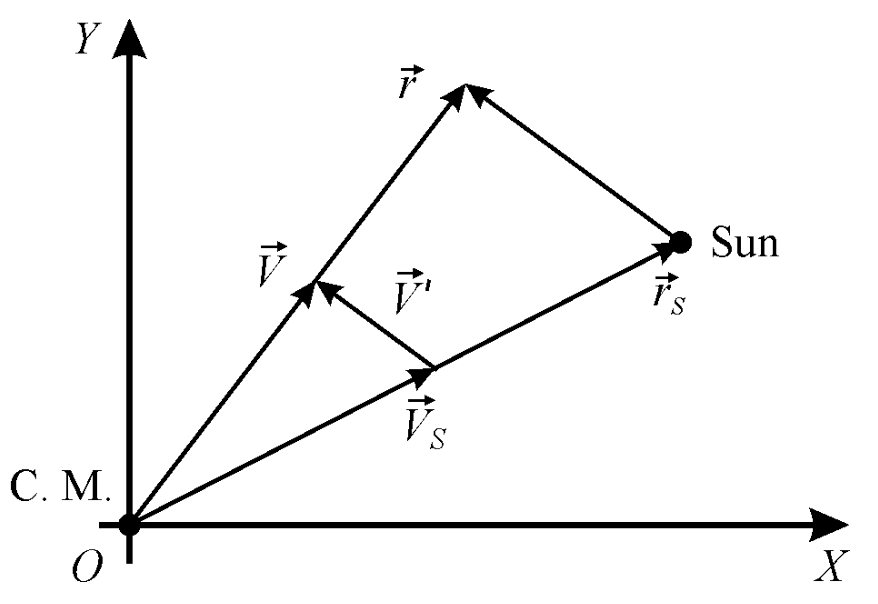
1. Does the Hubble law imply that the solar system is in the area of the Universe where the Big Bang occurred? (Because Hubble made his observations from the Earth). Underline the correct answer and explain it with a drawing and formula. [1 т.]
In theoretical physics, Einstein's general relativity equations are used to describe the expansion of the Universe after the Big Bang. It is interesting, however, to find the conclusions Laplace would have drawn if he used Hubble law and information about the homogeneity of the Universe in his model based on Newton's laws. To find such conclusions, let us consider the expansion of the so-called Newtonian Universe (NU). The NU is a homogeneous ball of total mass kg, in which particles of matter interact due to the Newton’s law of gravity with gravitational constant m/(kg·s), and velocities of matter are distributed according to Hubble law, in which the "constant" is actually a function of time .
2. Calculate gravitational potential energy of the NU at a time when its radius is equal to (give your answer as a formula expressing in terms of and ). [2 т.]
3. Calculate the kinetic energy of the NU at the same time (give your answer as a formula expressing in terms of , and ). [1 т.]
It is clear that in the process of further expansion (over time ) the matter in the NU will be decelerated by gravity. Let's assume that at time , which is counted from the Big Bang, some "residents" of the NU measured the average density of matter in it and the Hubble constant .
4. At what relationship between and the expansion of the NU will stop and be replaced by compression in finite time? Give the answer in the form of inequality. [3 т.]
5. Let the total energy of matter in the NU, i.e. the sum of kinetic energy and potential energy of gravitational interaction, be equal to , where is the speed of light in vacuum. Find the maximum radius of the NU in the process of expansion. Write down the formula and get a numerical answer in parsecs (1 parsec is approximately equal to 3.2 light years, or m). [2 т.]
6. For the conditions described in question 5, find the total lifetime of the NU from the Big Bang to the Big Implosion. Write down the formula and get a numerical answer in years.
Mathematical hint: . [4 т.]
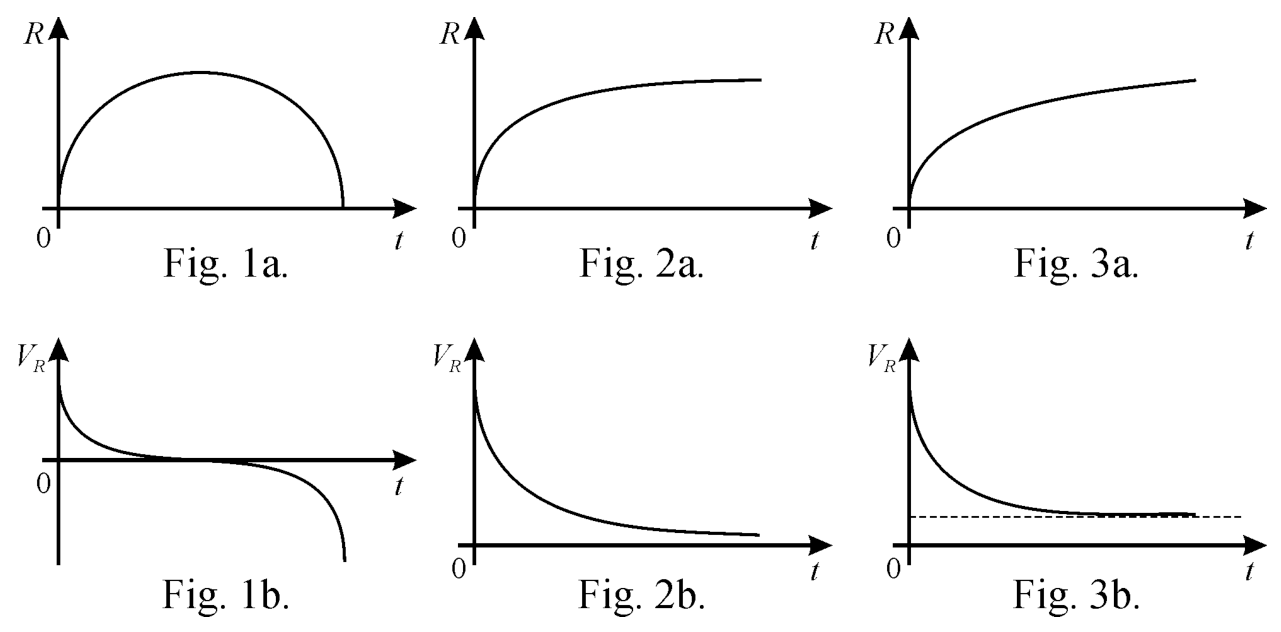
7. What are the options for further movement of matter in the ball at different ratios between the density and the Hubble constant? Describe the qualitative behavior of the NU radius for each of the possible cases. To do this, depict in Figures 1a-1b, 2a-2b and 3a-3b three different pairs of graphs showing the NU radius and the rate of its expansion versus time (keep in mind that at the time of the Big Bang and the radius of the NU is considered to be almost zero). Draw the graphs qualitatively, showing all the important details and features. [3 т.]
Let the results of observations imply that in terms of energy the NU under study has arisen "from nothing", that is, the total energy of matter in it is equal to zero.
8. Find the expansion law of such NU. Give the formula in your answer. [3 т.]
9. How will the density of matter and the Hubble constant change in time? Write down formulas for and . [3 т.]
Suppose the NU with zero energy expands adiabatically and reversibly. Also, let’s assume that its entropy is related to its volume and temperature according to the ideal gas formula, i.e. . At present time, when the Hubble constant in the NU is equal to its modern value of years, its temperature is equal to .
10. Find the NU temperature at time s after the Big Bang. Give a numerical answer. [3 т.]
Отговори
1. No.
Official answer: No. — the Hubble law holds for an observer on any body.
2.
3.
4.
5.
Official solution: m ps; the answer table prints the unit as "p" and the solution text as "ps".
6.
Official solution: s, about years.
7. Three pairs of graphs , for (expansion replaced by compression), (), ( tends to a positive constant); see the official figures.
8.
9.
10.
Решение
Possible Solution
1. In the Big Bang model, all the bodies fly away from the center of mass of the Universe, and at any given moment the speed of an object moving away from the center of the Universe is . Let's consider now the reference frame connected with the Sun. It is clear that the velocity of the Sun relative to the center of masses of the Universe is . Then the velocity of an arbitrary body relative to the Sun is , and in this formula is the radius-vector of the body relative to the Sun. Thus, the Hubble Law will also be applicable to the motion of matter in the Universe relative to the Sun. It is clear that this law will hold for an observer on any of the bodies in the Universe, regardless of its position. Therefore, it does not follow from the Hubble Law that the solar system is near the center of the universe.
2. Using the Gauss theorem (by analogy to electrostatics), one may conclude that inside the ball with constant density the acceleration of free fall at a distance from its center is . Then the gravitational field potential satisfying the equality is equal to . At the external boundary and this potential should coincide with the potential of the ball . That allows one to determine constant , it is equal . Thus, . The energy of the matter layer of radius and thickness in this field is equal to . If we sum up such energies of all layers of matter, we will obtain the energy of interaction of each pair of layers twice - as energy of the second layer in the field of the first layer and as energy of the first layer in the field of the second one. Therefore, the energy of gravitational interaction of layers:
By substituting the mass in this formula one obtains .
Note: the analogy to electrostatics is acceptable, because it is possible to use the formula for the energy of a homogeneously charged ball with necessary corrections (change of sign, replacement and ).
3. The kinetic energy of matter layer of radius and thickness is equal to . Therefore, the kinetic energy of the entire ball is , or .
4. The total mechanical energy of the NU is equal to . Note that for the movement of the outer surface of the ball, . That's why
Expansion of the NU corresponds to a “plus” sign in (1). It is obvious that the expansion rate can only be set to zero if . On the other hand, if we express the energy in terms of density of matter and the Hubble constant then one can note that if . The density of matter is called "critical density". It is interesting that the Laplace model in Newtonian mechanics gives for exactly the same expression as in Friedman's models based on the general relativity equations.
5. As far as the said energy is concerned, equation (1) at the expansion stage is . The maximum radius corresponds to the stopping point , therefore, . Substituting numerical values, we find m. Such distance in astronomy is usually measured in parsecs, 1 ps ≈ 3.2 light years ≈ m. Thus, ps.
6. After expanding to a maximum radius, the NU stops and then begins its compression that is symmetrical to expansion. Therefore, the lifetime of such a NU is equal to twice the expansion time: . Using substitution , we bring this expression to the form . According to the "mathematical hint", . Therefore, s. This corresponds to about years.
7. In accordance with (1) the behavior of the NU is determined by the sign of total energy. As we have seen above, if then the expansion stops and is replaced by compression. If then the rate of expansion is always positive and at that. If then this expansion rate is also always positive, and even after an infinitely long time remains greater than a positive constant . On the other hand, it can be seen from expression that the sign of energy is determined by and . Thus, the relationship between density and Hubble constant really determines the further fate of the NU. With , the expansion of the NU is replaced by compression; if , then the NU expands eternally and the expansion rate decreases, tending to zero at infinite time; while if then the expansion never stops and becomes uniform at a very long period of time. The corresponding graphs are shown below.
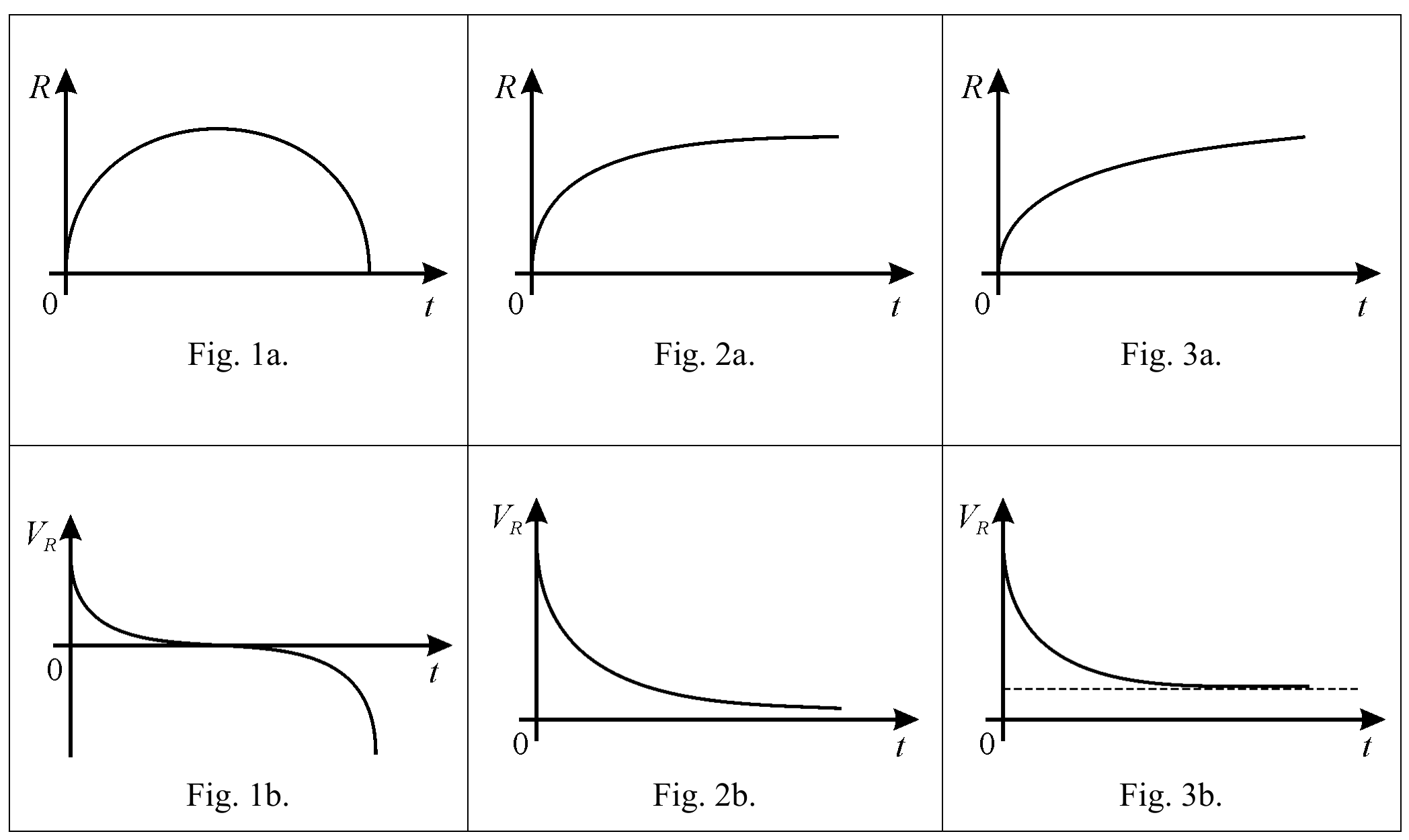
The correctness criteria for the above graphs involve the following facts: start "from 0" (for 1a, 2a, 3a), infinite radius growth (for 2a and 3a), return of radius to zero (1a), monotonous speed change and change of speed sign (for 1b), correct asymptotes (for 1b, 2b, 3b). It is allowed to consider the speed at to be almost infinite.
8. Substituting in (1) we get for the expanding NU . Consequently, . Thus, .
9. It is clear that . At zero energy, , i.e. . Therefore, Hubble's constant is related to the reverse age of the NU!
10. In reversible adiabatic expansion, the entropy of the NU remains constant, and, therefore, . As , then . Note that . Taking into account that , we find the temperature K.
TABLE OF ANSWERS AND CRITERIA
| № | ANSWER | Maximal score |
|---|---|---|
| 1 | No. . | 1 |
| 2 | . | 2 |
| 3 | . | 1 |
| 4 | . | 3 |
| 5 | p. | 2 |
| 6 | years. | 4 |
| 7 | Fig. 1a. Fig. 2a. Fig. 3a. Fig. 1b. Fig. 2b. Fig. 3b. (in any order) | 6 × 0,5 = 3 |
| 8 | . | 3 |
| 9 | ; . | 1,5 + 1,5 = 3 |
| 10 | K. | 3 |
| TOTAL: | 25 |
Оригинал в Архива: phys-theory1-2019-en.pdf · официални решения: phys-theory1-solutions-2019-en.pdf