IOM 2019, Теория — Задача 2. The Stirling Cycle and Regeneration
The 4th International Olympiad of Metropolises — Problem 2: The Stirling Cycle and Regeneration · 33 т.
Условие
Some heat engines use regeneration to improve their efficiency. Regeneration means the return to the working body of a part of heat that is transferred to the cooler. We will call this amount of returned heat "the amount of heat to be recovered" and we will denote it as . Different schemes of regeneration are possible: 1) transmission of through a special heat exchanger (regenerator); 2) transmission of to the working body of the second heat machine connected "in parallel" to the first machine; 3) transmission of through a heat pump (such devices are also called refrigeration units - they work as heat machines with a "reverse" cycle).
Part I: Parallel Heat Machines with Regeneration
Let's consider the second scheme. For a Stirling engine the problem of low efficiency is very significant, so the use of regenerators is critical for such engines. The cyclic process in the working body (WB) of a Stirling engine can be described with good accuracy as a cycle consisting of two isochores and two isotherms.
Let’s have two Stirling engines connected in parallel. They get heat from a common heat reservoir and do useful work on the same object (e.g. piston or shaft), but work in counter phase. When one of these engines performs positive work in the process of isothermal expansion, the second one goes through the isothermal compression stage, and vice versa. Regeneration is done by controlled heat exchange. The first engine working body (WB1) with temperature corresponding to the "hot" isotherm, at the beginning of isochoric cooling, is brought into thermal contact with the working body of the second engine (WB2) having at that moment the temperature of the "cold" isotherm at the beginning of isochoric heating. Heat exchange takes place at a constant volume and during heat exchange WB1 cools down to some temperature and WB2 heats up to some temperature . At the same time heat exchange between WB1 (or WB2) and other bodies can be neglected. Then the thermal contact is broken, and WB1 cools down giving the heat to the environment while WB2 continues heating getting the heat from the heater. In the second half of the cycle the processes are repeated, only the WB1 and WB2 change roles. The WB1 and WB2 consist of the same amounts of gas, the gas may be considered ideal.
Let temperature be higher than by and the efficiency of the Stirling engine without regeneration be . Let's call the ratio the "regeneration factor", where is the total heat obtained in one cycle by the WB of the engine that operates with regeneration.
1.1. At what values of and coefficient will be the maximum possible for such regeneration scheme? Answer the question by expressing the sought temperatures in terms of and . [1 т.]
1.2. What is the maximum possible value of ? Write down the answer as a formula (that uses the quantities specified in the problem statement), and calculate it as a percentage accurate to a tenth. [5 т.]
1.3. Find the efficiency of the engine with maximum regeneration if the useful work equals of the total work performed by WB1 and WB2 (i.e. gives the part of specified work lost on mechanical friction in the engine components, etc.). Write down the answer as a formula that uses the quantities specified in the problem statement, and calculate it in percentage rounding it to the nearest whole (if necessary). [4 т.]
Part II: Unusual Substance
Let some very unusual substance be at our disposal. We have the following information about this substance:
- its heat capacity in isobaric process depends on absolute temperature ; the work performed by this substance and the amount of heat obtained by it in the isobaric process are related as ;
- its heat capacity in isochoric process depends on temperature , and the equation of isochore is , where is a constant exponential factor;
- if then volume and internal energy of this substance tend to zero at any finite pressure, and internal energy grows with temperature.
2.1. Write down the isobaric process equation for this substance in temperature-volume coordinates. [3 т.]
2.2. Write down (to a positive constant factor) the caloric equation of state of this substance, i.e. the equation connecting the internal energy with temperature and volume . [5 т.]
2.3. Write down (using the same positive constant factor) the thermal equation of state of this substance, i.e. the equation connecting pressure with temperature and volume . [7 т.]
Note: as for any thermodynamic system, the thermal and caloric equations of state for this substance satisfy .
2.4. Find the internal energy of this substance in terms of its pressure and volume. Write down the adiabatic equation of this substance in pressure-volume coordinates. [2 т.]
Part III: Regeneration using a Heat Pump
Let's consider another method of regeneration, when part of the work produced by the WB of heat engine is directed to the WB' of a heat pump. Due to this work, the heat pump returns a part of the heat given to the cooler by the WB during its cooling stage back to the WB during its heating stage. The scheme of operation of such a device is shown in the figure.
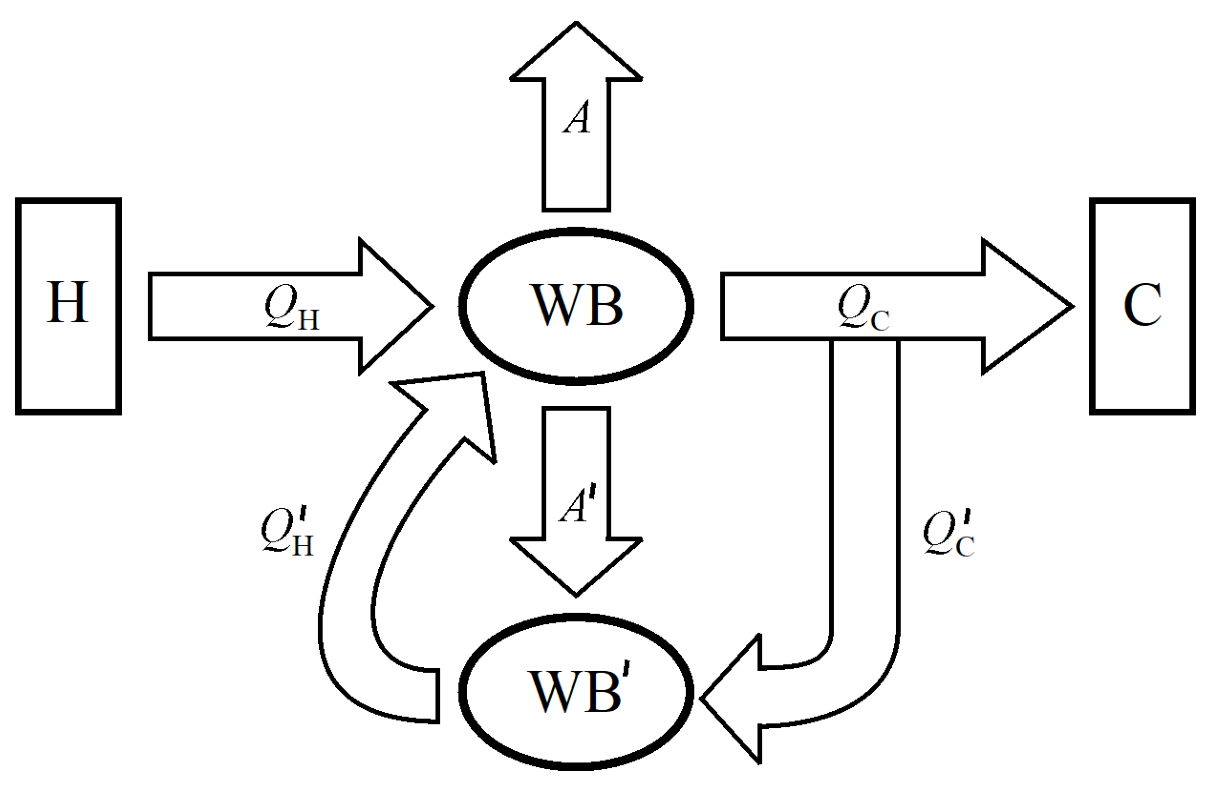
Let it contain a WB, which consists of constant amount of the same ideal gas as in Part I of the problem, performing the Stirling cycle with the same parameters (now we know that the ideal gas used as the WB is three-atomic). At the same time, the WB' is a constant amount of substance considered in Part II of the problem, which also performs the Stirling cycle. In this cycle, the ratio of the maximum absolute temperature to the minimum absolute temperature and the ratio of the maximum volume to the minimum volume are exactly the same as in the WB cycle. The efficiency of a heat pump is characterized by its refrigerating factor , which is the ratio of the heat taken away from the colder body to the work spent on the activation of the heat pump.
3.1. Calculate the Stirling Cycle refrigerating factor with the substance from Part II and the parameters given in Part I. Give your answer in percentage rounded to the nearest whole. [4 т.]
3.2. Find the efficiency of an engine with this method of regeneration if the ratio of the amounts of substance is such that the regeneration factor and the useful work is part of work . Give your answer in percentage rounded to the tenths. [2 т.]
Отговори
1.1.
1.2. ≈ %
1.3. ≈ %
2.1.
2.2.
2.3.
2.4.
3.1. 473 %
Correct range is from 472% to 474% (answer table).
3.2. 21.5 %
Решение
Possible Solution
1.1. Let's consider the cycle of WB1. The amount of heat transferred from WB1 to WB2 during isochoric cooling can be related to temperature change , where is the specific heat of the working body at constant volume. According to the statement of the problem, the same amount of heat is transferred by WB1 to WB2 during the isochoric heating . From these equations we obtain . Therefore, . The total amount of heat received by each working body in one cycle is because in the isothermal process the internal energy of ideal gas does not change, so is equal to work done on the "hot" isotherm. Therefore, the regeneration factor . Note that WB1 transmits heat to WB2 by means of heat exchange while cooling down to temperature , at the same time WB2 is heating to temperature . Therefore, in order to prevent the reverse heat flow, the requirement must be satisfied. Since , this requirement means that . Therefore, the maximum value of corresponds to .
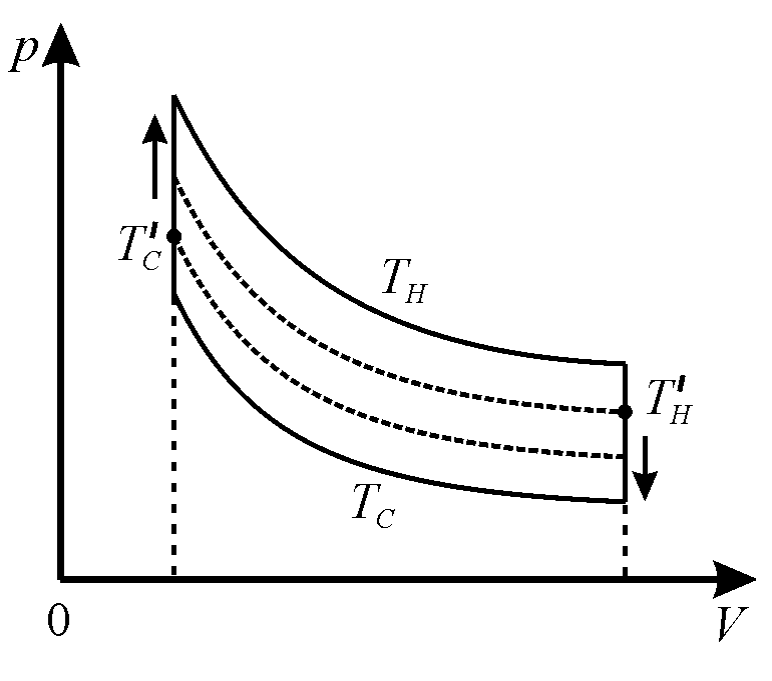
1.2. This quantity is equal to . The absolute value of isothermal work is equal to the area under the process curve in pressure-volume coordinates, which is . According to the Clapeyron-Mendeleev equation, the process equation for a constant amount of ideal gas is . Thus, even without calculating the integral, it is clear that . For an engine without regeneration, gas work in one cycle is equal to . It means that . From this ratio we obtain . Thus, the maximum value of the regeneration factor in the proposed scheme is . One may note that the problem is correct only if , which is natural because is equal to the efficiency of the Carnot cycle with the same temperatures of the heater and the cooler.
1.3. When regeneration is used, the cycle work is the same and the heat generated by the heater during the cycle is reduced by . Consequently, the efficiency of the engine with regeneration , and for the maximum regeneration factor . Taking into account mechanical losses, the engine efficiency is .
2.1. The amount of heat received by the substance during isobaric heating from temperature to temperature can be calculated using heat capacity . According to the problem statement, the substance performs work related to the volume change: . Since , the change of volume in the isobaric process is proportional to the change of the absolute temperature squared. Taking into account that , we find the isobaric equation for this substance in the temperature-volume coordinates: .
2.2. It follows from the result of problem 2.1 that the pressure of the unknown substance is a function of , i.e. the thermal equation of state should have the form . In addition, the change in the internal energy in this process is . Using , we find that , where . On the other hand, the amount of heat obtained in the isochoric process (when the work is not performed) is equal to the change of internal energy . Taking into account that here too , we come to the conclusion that the caloric equation of state looks like . Let's compare the two results obtained: since , there must be a constant , such that , and then . It means that . Now it is clear from the problem statement that .
2.3. The relationship between the caloric and thermal equations of state leads to the equation:
In other words, . It is easy to see that this requirement is satisfied by the function , i.e. the thermal equation of state has the form .
Note: Actually, it is clear that the general solution to the above differential equation is , where is an arbitrary constant. However, the isochore equation has a form given in the statement only if .
It should be noted that the pressure of our substance is always negative! This is very unusual for normal gases, but negative pressure may be observed in a condensed state within some range of the state parameters. Besides, the varieties of matter with similar equations of state are sometimes considered in inflationary cosmology (quintessence, generalized Chaplygin's gas).
2.4. Using the results of 2.3 and 2.2, we find that . The adiabatic equation is obtained from the condition , wherefrom it follows that . So, the adiabatic equation is .
3.1. The Stirling cycle for WB′ in pressure-volume coordinates looks as shown in the figure. The isothermal equation is , and therefore the work done on WB′ in the process 1-2, is equal to , and similarly . Therefore, the total work done on WB′ is . The amount of heat that WB′ received in the cycle is . For isochoric process . For isothermal process
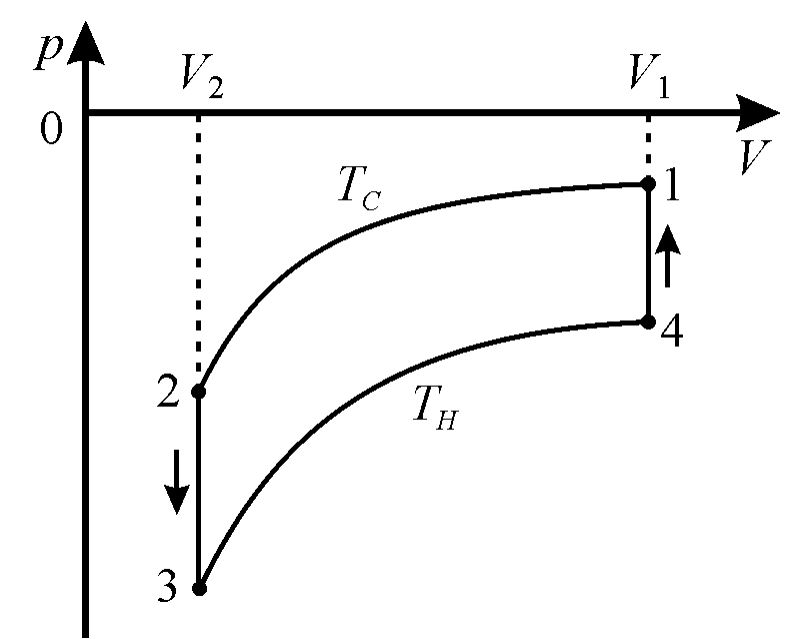
Therefore, . Consequently, . According to the problem statement, and are exactly the same as in the WB-cycle. That means that .
The efficiency of the Stirling cycle for three-atomic ideal gas is calculated simply: the work produced in the cycle , while the heat of the heater . Therefore, the efficiency . Thus, . It's easy to note that .
3.2. When using regeneration, the WB-cycle efficiency remains the same, i.e. . On the other hand, and, therefore, . Finally, we use the known regeneration factor: . From these equations we find .
TABLE OF ANSWERS AND CRITERIA
| № | ANSWER | Maximal score |
|---|---|---|
| 1.1. | . | 1 |
| 1.2. | 4 | |
| 12,5 %. | 1 | |
| 1.3. | . | 3 |
| 21 %. | 1 | |
| 2.1. | , or equivalent expression | 3 |
| 2.2. | , or equivalent expression | 5 |
| 2.3. | An equation is presented that is equivalent to ; | 2 |
| , or equivalent expression | 5 | |
| 2.4. | . | 1 |
| . | 1 | |
| 3.1. | 473 % (Correct range is from 472% to 474%. For the range from 470% to 475% only 1 point is given) | 4 |
| 3.2. | 21,5 %. | 2 |
| TOTAL | 33 |
Оригинал в Архива: phys-theory2-2019-en.pdf · официални решения: phys-theory2-solutions-2019-en.pdf